Stack n' Scroll

Code, Campaigns, and Lessons from the Digital Realm

September 2026
S M T W T F S
 12345
6789101112
13141516171819
20212223242526
27282930  
« Aug    

Meta

  • Register
  • Log in
  • Entries feed
  • Comments feed
  • WordPress.org
Frank Jamison Avatar
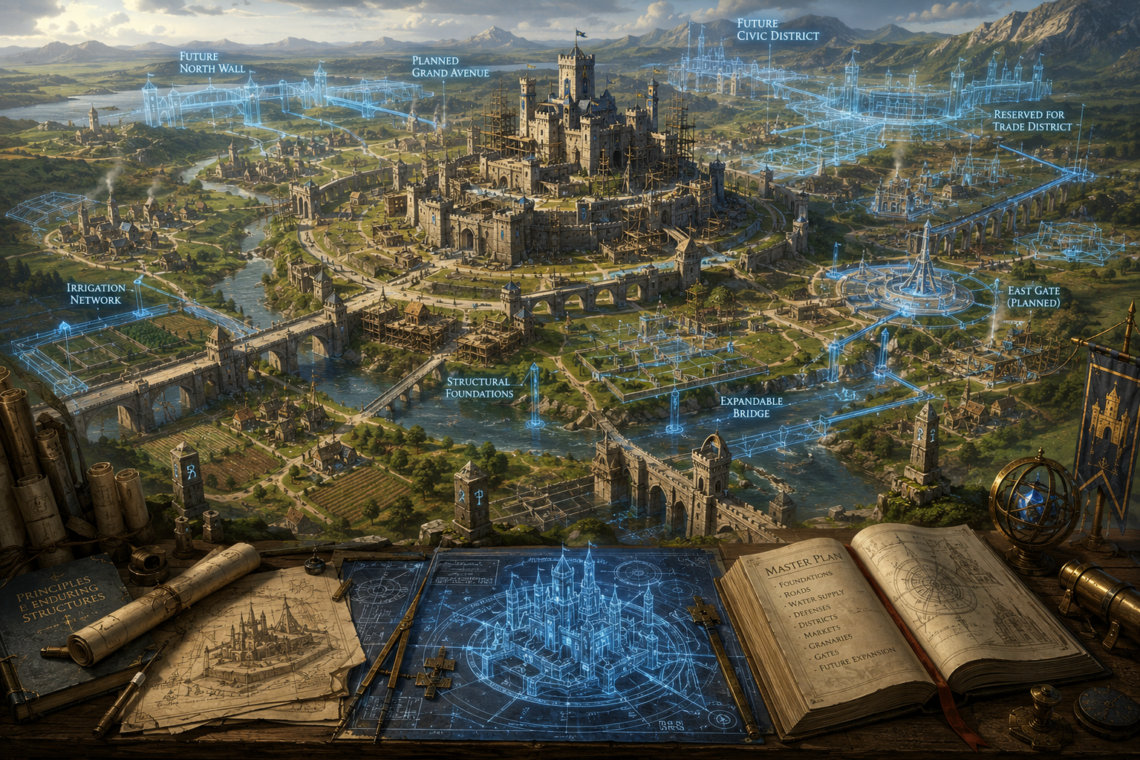
  • A panoramic fantasy kingdom is shown in the early stages of carefully planned expansion, centered on a partially completed stone castle surrounded by villages, bridges, roads, and farmland. Glowing blue architectural overlays, magical surveying grids, and blueprint-style projections illustrate future city walls, districts, bridges, and infrastructure without physically constructing them. In the foreground, an architect's drafting table holds illuminated blueprints, manuscripts, measuring tools, compasses, and engineering instruments, reinforcing the theme of deliberate planning and long-term design. The peaceful medieval landscape emphasizes thoughtful growth, maintainability, and architectural foresight in a classic Dungeons & Dragons-inspired editorial fantasy style.
    The Architect's Grimoire

    Building for Today’s Quest or Tomorrow’s Empire?

    July 1, 2026 /

    Every shortcut is a promise the future must eventually keep. The First Road Beyond the Castle Gates Long before a kingdom becomes an empire, someone chooses where the first road will be built. Travelers may never remember who laid those stones, but generations will depend upon the decision. Software is built much the same way. Long before users celebrate new features, someone quietly decides how the application will grow, how its parts will work together, and whether future engineers will inherit a thriving kingdom or spend their days repairing crumbling foundations. When I first began writing software, I believed every project had a finish line. Complete the feature, fix the…
    Read More
    Frank Jamison

    You May Also Like

    An epic fantasy map-style illustration depicts a thriving kingdom viewed from above, with a grand central castle labeled "The Core" connected by glowing roads and magical pathways to surrounding regions. Each district represents a software architecture concept, including Northern Watch (Security and Access Control), Eastern Ports (Integrations and External APIs), The Royal Treasury (Data Storage and Databases), The Observatory (Monitoring and Metrics), The Training Grounds (Testing and Quality Assurance), Market Square (Messaging and Event Streams), Resource Mines (Infrastructure and Servers), The Archives (Documentation and Knowledge Base), and Southern Gate (Clients and Users). In the foreground, an open book titled The Architect's Grimoire rests on a stone table alongside maps, drafting tools, and architectural plans. A banner reads, "A Well Designed Kingdom Endures. A Well Architected System Thrives." The image uses fantasy kingdom imagery to visualize software architecture as an interconnected, carefully planned realm.

    Building Kingdoms That Endure

    June 28, 2026
    A group of royal architects and cartographers gather around a massive illuminated kingdom map inside an ornate medieval planning hall. Using compasses, rulers, and drafting tools, they carefully define provincial boundaries that follow rivers, mountains, and trade routes. Shelves filled with scrolls, blueprints, and surveying instruments surround the room, while stained-glass windows reveal a thriving kingdom beyond. The detailed fantasy scene symbolizes thoughtful software architecture by illustrating the deliberate planning and organization required to establish meaningful boundaries within a growing system.

    Dividing the Kingdom: Finding the Right Boundaries

    July 8, 2026
    A detailed fantasy castle is shown in cross-section, revealing a maze of interconnected rooms, stairways, hidden passages, and structural layers that symbolize the complexity of a long-lived software system. At the center, tangled corridors and web-like connections represent circular dependencies and hidden coupling, while workshop-like chambers illustrate concepts such as duplicated logic, hard-coded rules, temporary fixes, fragile tests, dead code, and hidden dependencies. In the foreground, an architect studies blueprints and a refactoring plan spread across a drafting table, surrounded by engineering tools, manuscripts, and architectural diagrams. The surrounding kingdom is orderly and well maintained, contrasting with the increasingly convoluted interior of the castle. The painterly, Dungeons & Dragons-inspired editorial illustration uses fantasy architecture to represent technical debt, legacy systems, refactoring, and the challenge of maintaining software that has grown through years of incremental change.

    Hidden Traps in the Dungeon: Escaping Technical Debt

    July 15, 2026
  • The Architect's Grimoire (13)
  • The CSS Codex (13)
  • The Enchanted Workshop (13)
  • The Full-Stack Campaign (8)
  • The Guildmaster’s Handbook (13)
  • The Kingdom in the Clouds (8)

AI-Assisted Development Artificial Intelligence Backend Development Career Development Clean Code Cloud-Native Architecture Code Quality CSS Architecture CSS Best Practices CSS Fundamentals CSS Layout Design Systems Developer Growth Developer Productivity Distributed Systems Dungeons and Dragons Engineering Culture Engineering Judgment Engineering Leadership Fantasy Theme Front-End Development Frontend Development Full Stack Development Human-AI Collaboration Maintainable Code Mentorship Professional Development Professional Growth Refactoring Responsive Design Software Architecture Software Craftsmanship Software Design Software Development Software Engineering StackNScroll System Design Technical Debt Technical Leadership The Architect's Grimoire The CSS Codex The Enchanted Workshop The Full-Stack Campaign The Guildmaster's Handbook Web Development

Stack N' Scroll - 2026 ©