Stack n' Scroll

Code, Campaigns, and Lessons from the Digital Realm

August 2026
S M T W T F S
 1
2345678
9101112131415
16171819202122
23242526272829
3031  
« Jul    

Meta

  • Register
  • Log in
  • Entries feed
  • Comments feed
  • WordPress.org
Frank Jamison Avatar
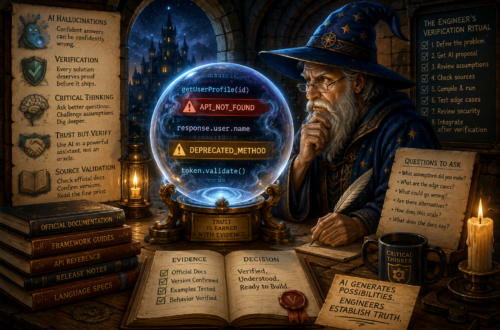
  • An experienced wizard sits thoughtfully at a workbench inside a warm, medieval-inspired workshop, collaborating with a glowing owl familiar that represents artificial intelligence. Ancient spellbooks and engineering references surround them alongside a modern laptop displaying architectural diagrams, while magical holographic interfaces illustrate AI-assisted development workflows. Banners and notes throughout the workshop emphasize engineering judgment, human responsibility, and collaboration over automation. The scene blends fantasy and software engineering to symbolize AI as a trusted apprentice that accelerates development without replacing the wisdom, decision-making, and accountability of the engineer.
    The Enchanted Workshop

    The Wizard’s New Apprentice: Working Alongside AI

    July 27, 2026 /

    The greatest familiar is still only as wise as the wizard who commands it. Every generation of software engineers encounters a tool that promises to change the profession forever. Assembly language gave way to higher-level languages. Manual deployments yielded to continuous integration and continuous delivery. Virtual machines evolved into cloud platforms. Each innovation made building software faster, but none diminished the importance of sound engineering judgment. Artificial intelligence represents the latest transformation in that long history. It is a remarkable addition to the workshop, but it remains exactly that: an addition. The craft itself has not changed nearly as much as the tools we use to practice it. The excitement…

    Read More
    Frank Jamison

    You May Also Like

    A wise wizard in a candlelit medieval workshop mentors a towering stone golem whose glowing blue runes illuminate the room as it carefully writes magical symbols onto a workbench. Behind them, a chalkboard labeled "Engineering Topics" lists AI Testing, Unit Tests, Integration Tests, Edge Cases, and Test Coverage, while a banner reading "Quality Is Magic" hangs above shelves of spellbooks and alchemical supplies. The wizard studies an open book titled Tests Are Trust while pointing toward the golem's work, symbolizing human guidance directing AI-assisted software testing. Nearby, books, scrolls, and a parchment labeled The Master's Instructions emphasize protecting business rules, validating behavior, thinking beyond the happy path, covering what matters, and building confidence. A glowing crystal ball displaying test coverage metrics and engineering-themed books reinforce the article's message that AI is a tireless assistant whose effectiveness depends on the quality of the instructions it receives.

    The Tireless Golem: Building Better Tests with AI

    August 5, 2026
    A fantasy wizard studies a glowing AI spellbook inside a restricted archive, surrounded by magical security shields and references to security, privacy, intellectual property, confidential data, and responsible AI usage. An illuminated diagram connects AI with input, authority, and output, while notes about least privilege and careful information sharing emphasize responsible engineering judgment.

    Forbidden Tomes: AI, Security, and Responsible Engineering

    August 12, 2026
    An elderly wizard in deep blue robes sits at a wooden desk inside a grand medieval library, carefully writing on a parchment with a feather quill. Shelves of ancient books fill the background beneath tall stone arches, creating the atmosphere of a magical archive. Around the wizard, glowing blue holographic panels illustrate an AI-assisted documentation workflow, showing an AI assistant drafting information, an engineer adding judgment and context, and a review process validating accuracy and clarity before documentation is shared. Stacks of books labeled Design Decisions, Lessons Learned, Architecture Notes, Incident Reports, and Operational Runbooks reinforce the importance of preserving engineering knowledge. A scroll on the desk highlights the qualities of effective documentation, including explaining why decisions were made, capturing context, guiding future decisions, preventing mistakes, and outliving the original engineers. Nearby, a documentation quality checklist emphasizes accuracy, current information, clear context, valid examples, and usefulness to future team members. A glowing crystal orb displays the message Better Docs = Better Systems, visually connecting thoughtful documentation, AI-assisted knowledge sharing, and long-term software maintainability.

    The Endless Scribe: Writing Documentation with AI

    August 3, 2026
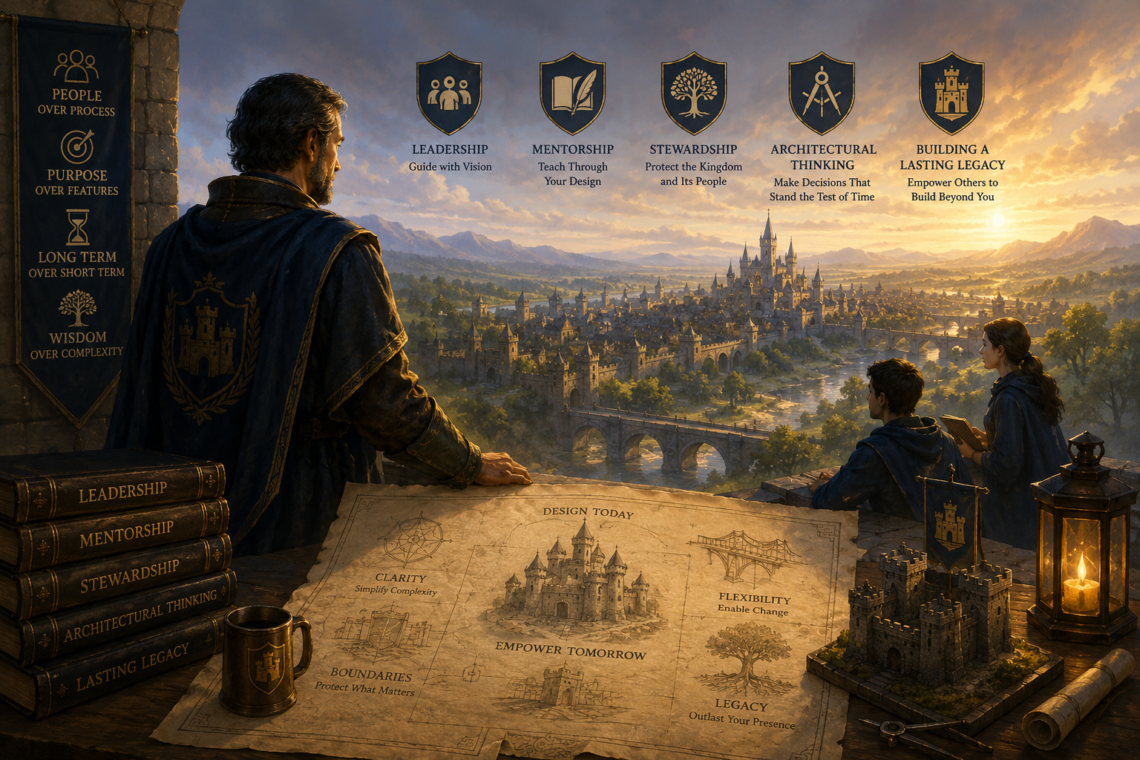
  • A cinematic fantasy illustration of a master architect standing on a castle balcony at sunrise, overlooking a vast medieval kingdom while mentoring two apprentices. An architectural blueprint of the kingdom is spread across a stone table alongside drafting tools, a castle model, and books labeled Leadership, Mentorship, Stewardship, Architectural Thinking, and Lasting Legacy. Banners and heraldic emblems reinforce themes of leadership, architectural vision, and building systems that endure. The warm golden light, expansive cityscape, and symbolic imagery convey the lasting influence of thoughtful software architecture, mentorship, and engineering stewardship across generations.
    The Architect's Grimoire

    Becoming the Royal Architect: Designing Systems That Outlive You

    July 24, 2026 /

    Every kingdom remembers its architects long after its builders have gone home. Every software system eventually becomes someone else’s responsibility. That single reality has shaped nearly every architectural decision I have made throughout my career. Features are eventually rewritten. Technologies become obsolete. Frameworks rise and fall. Entire engineering teams come and go. Yet long after the original developers have moved on, the software remains, waiting for new engineers to understand it, maintain it, and continue building upon it. Whether those future engineers inherit a thriving kingdom or a crumbling ruin depends far less on the quality of individual features than on the quality of the architecture beneath them. Throughout The…

    Read More
    Frank Jamison

    You May Also Like

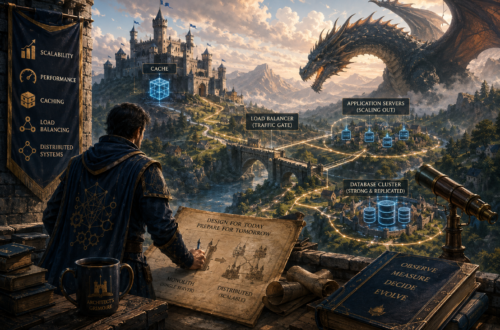
    A sprawling medieval fantasy kingdom stretches across a lush valley, with a fortified castle serving as the central hub of an expansive network of roads, bridges, and satellite settlements that symbolize a scalable software architecture. A massive dragon circles above the kingdom, representing the challenges of system growth, while an architect studies detailed plans from a stone overlook in the foreground. Glowing pathways connect infrastructure throughout the realm, illustrating concepts such as load balancing, distributed systems, caching, and scalable services. The scene emphasizes thoughtful planning, resilient infrastructure, and measured expansion through richly detailed architecture and environmental storytelling, using a classic Dungeons & Dragons-inspired aesthetic to visualize modern software engineering principles.

    The Dragon Named Scale: Building Systems That Grow

    July 13, 2026
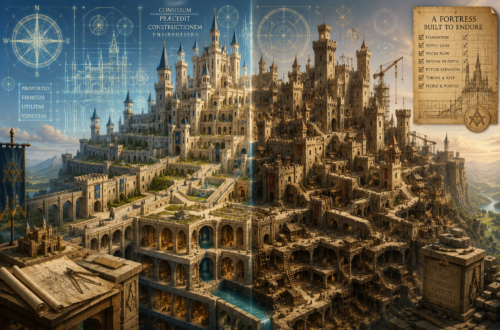
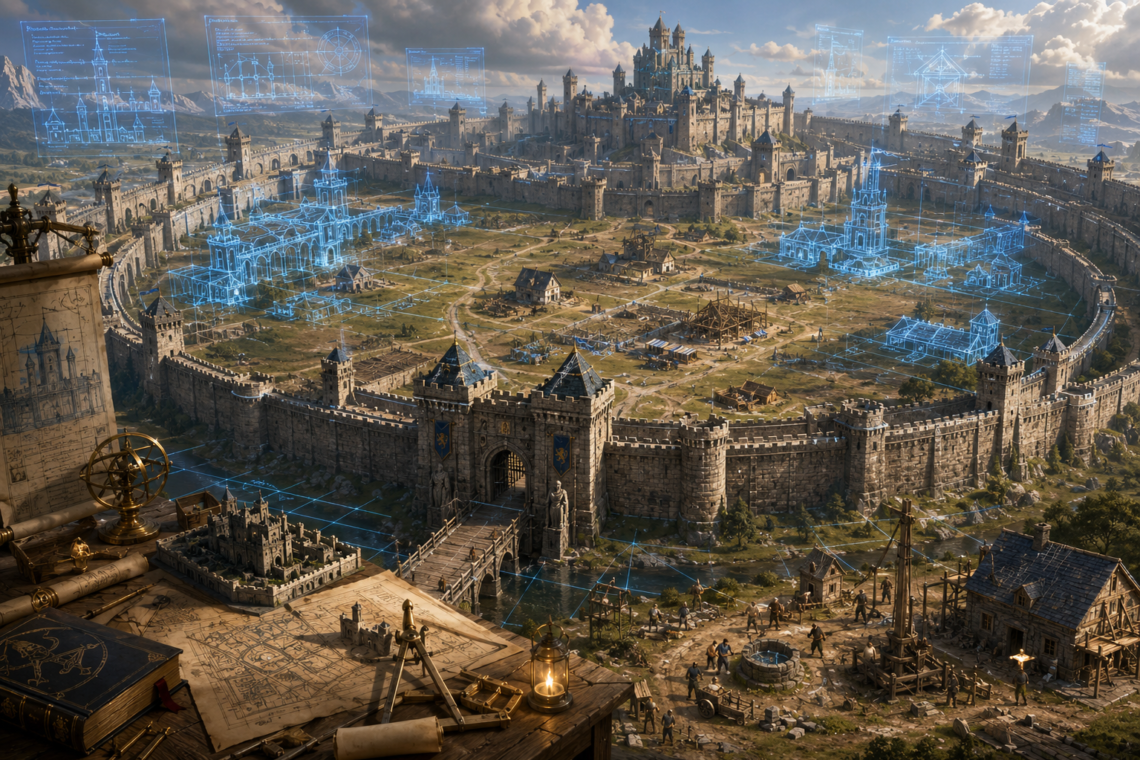
    A vast medieval fantasy kingdom is enclosed within enormous concentric stone walls, towering gatehouses, fortified keeps, and defensive towers that dominate the landscape. Despite the immense fortifications, the protected interior remains largely undeveloped, with only a few cottages, a small farmhouse, scattered construction sites, unfinished roads, and a partially built marketplace spread across open fields. Glowing blue magical architectural projections overlay the empty city, revealing ambitious plans for future districts, guild halls, towers, canals, and public buildings that have yet to be constructed. In the foreground, drafting tables, blueprints, surveying instruments, and engineering tools reinforce the theme of excessive planning, while a small group of builders focuses on practical structures such as a well and simple homes. The painterly Dungeons & Dragons-inspired scene symbolizes the software engineering concept of premature overengineering by contrasting overwhelming defensive infrastructure with a kingdom that has barely begun to grow.

    The Curse of Premature Fortification

    July 3, 2026
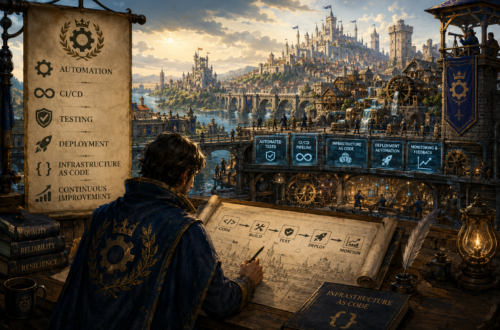
    A wise wizard studies a glowing crystal orb overlooking a vast fantasy kingdom where medieval architecture merges with modern software engineering. Across a towering stone aqueduct, six banners illustrate a continuous delivery pipeline labeled Automation, CI/CD, Testing, Deployment, Infrastructure as Code, and Continuous Improvement, with engineers working at illuminated stations beneath each stage. A detailed map on the wizard's table mirrors the same workflow using symbols and pathways, while holographic diagrams and glowing blue interfaces blend seamlessly into the medieval setting. The composition symbolizes mature software engineering practices transforming disciplined processes into an automated, self-improving kingdom, with warm golden light contrasting against cool blue technological elements. The article title does not appear in the image.

    Seeing Through the Crystal Ball: Observability Beyond Monitoring

    July 20, 2026
  • A wise wizard studies a glowing crystal orb overlooking a vast fantasy kingdom where medieval architecture merges with modern software engineering. Across a towering stone aqueduct, six banners illustrate a continuous delivery pipeline labeled Automation, CI/CD, Testing, Deployment, Infrastructure as Code, and Continuous Improvement, with engineers working at illuminated stations beneath each stage. A detailed map on the wizard's table mirrors the same workflow using symbols and pathways, while holographic diagrams and glowing blue interfaces blend seamlessly into the medieval setting. The composition symbolizes mature software engineering practices transforming disciplined processes into an automated, self-improving kingdom, with warm golden light contrasting against cool blue technological elements. The article title does not appear in the image.
    The Architect's Grimoire

    Seeing Through the Crystal Ball: Observability Beyond Monitoring

    July 20, 2026 /

    A wise ruler never governs a kingdom they cannot see. Software architecture reaches an interesting stage after the obvious problems have been solved. The application survives deployments without drama, customers depend upon it every day, and the engineering team gradually shifts its attention from building features to operating a growing platform. Confidence naturally follows that maturity because the system appears stable, the infrastructure scales predictably, and production incidents become increasingly uncommon. Then, almost without warning, engineers begin encountering problems that refuse to fit neatly into familiar patterns. A handful of users report intermittent failures that nobody can reproduce. Response times drift upward despite healthy infrastructure metrics. A background process occasionally…

    Read More
    Frank Jamison

    You May Also Like

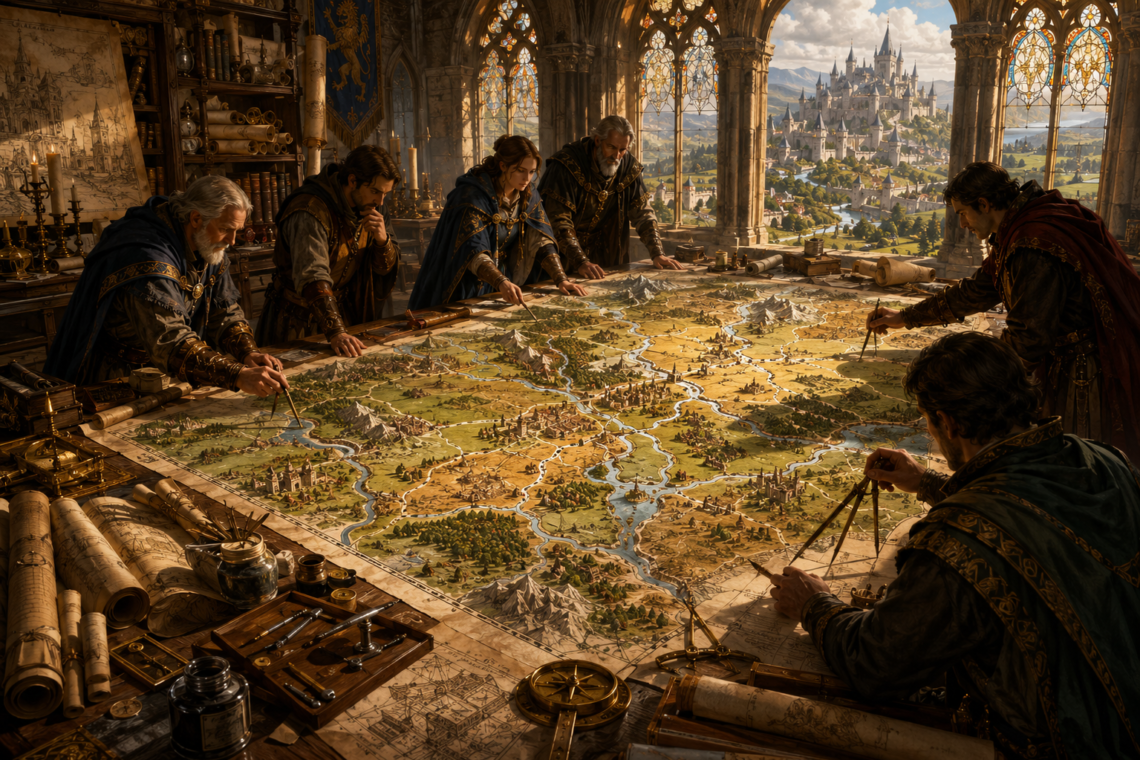
    A group of royal architects and cartographers gather around a massive illuminated kingdom map inside an ornate medieval planning hall. Using compasses, rulers, and drafting tools, they carefully define provincial boundaries that follow rivers, mountains, and trade routes. Shelves filled with scrolls, blueprints, and surveying instruments surround the room, while stained-glass windows reveal a thriving kingdom beyond. The detailed fantasy scene symbolizes thoughtful software architecture by illustrating the deliberate planning and organization required to establish meaningful boundaries within a growing system.

    Dividing the Kingdom: Finding the Right Boundaries

    July 8, 2026
    A fantasy-inspired digital illustration depicts a royal architect standing over maps and plans as a massive stone castle burns under a night sky filled with flaming projectiles. Although sections of the fortress are engulfed in flames, smaller fortified districts below remain connected by glowing blue pathways, symbolizing resilient system architecture and fault isolation. Floating holographic icons represent High Availability, Backups, Disaster Recovery, Fault Tolerance, and Incident Response, visually linking medieval defenses with modern software engineering concepts. Scrolls and architectural plans in the foreground reinforce themes of preparation, recovery, and thoughtful design, while the dramatic contrast between destruction and continuity emphasizes that resilient systems are designed to withstand failure rather than prevent it entirely.

    When the Kingdom Burns: Designing for Failure Before Disaster Strikes

    July 17, 2026
    A hooded royal architect studies a detailed medieval blueprint inside a heavily fortified castle treasury, where secure vaults, locked chests, and guarded passageways symbolize data protection, ownership, persistence, secrets management, and data integrity. Through a large stone archway, a majestic castle overlooks a peaceful river valley, reinforcing the theme that strong software architecture protects an organization's most valuable assets through thoughtful design rather than visible defenses alone.

    The Royal Treasury: Protecting the Kingdom’s Data

    July 10, 2026
  • A group of royal architects and cartographers gather around a massive illuminated kingdom map inside an ornate medieval planning hall. Using compasses, rulers, and drafting tools, they carefully define provincial boundaries that follow rivers, mountains, and trade routes. Shelves filled with scrolls, blueprints, and surveying instruments surround the room, while stained-glass windows reveal a thriving kingdom beyond. The detailed fantasy scene symbolizes thoughtful software architecture by illustrating the deliberate planning and organization required to establish meaningful boundaries within a growing system.
    The Architect's Grimoire

    Dividing the Kingdom: Finding the Right Boundaries

    July 8, 2026 /

    A realm divided too soon may fall before it ever grows. Software architecture has a way of making every difficult decision appear deceptively simple. A whiteboard fills with neatly drawn boxes connected by clean lines, and suddenly an application that once fit comfortably into a single project has become a collection of independent services. Every box promises greater flexibility, cleaner organization, and limitless room for future growth. Years spent designing, maintaining, and repairing production systems eventually teach every architect the same lesson. Every boundary carries a cost that will be paid long after the diagram has been erased. This week, as we continue Designing the Realm, we are moving beyond…

    Read More
    Frank Jamison

    You May Also Like

    A fantasy-inspired illustration depicts a master engineer overlooking a thriving medieval kingdom powered by invisible systems rather than heroic effort. In the foreground, a cloaked architect studies a blueprint illustrating a software delivery pipeline from code to build, test, deployment, and monitoring. Below, workshops, waterwheels, bridges, and aqueducts symbolize automated infrastructure supporting the bustling city above. Watchtowers overlook the realm while illuminated engineering panels represent automated testing, CI/CD pipelines, infrastructure as code, deployment automation, and monitoring. The scene conveys how automation, continuous improvement, and dependable engineering systems quietly enable a prosperous kingdom without drawing attention to themselves.

    The Automated Kingdom: When Excellence Becomes Routine

    July 22, 2026
    A wise wizard studies a glowing crystal orb overlooking a vast fantasy kingdom where medieval architecture merges with modern software engineering. Across a towering stone aqueduct, six banners illustrate a continuous delivery pipeline labeled Automation, CI/CD, Testing, Deployment, Infrastructure as Code, and Continuous Improvement, with engineers working at illuminated stations beneath each stage. A detailed map on the wizard's table mirrors the same workflow using symbols and pathways, while holographic diagrams and glowing blue interfaces blend seamlessly into the medieval setting. The composition symbolizes mature software engineering practices transforming disciplined processes into an automated, self-improving kingdom, with warm golden light contrasting against cool blue technological elements. The article title does not appear in the image.

    Seeing Through the Crystal Ball: Observability Beyond Monitoring

    July 20, 2026
    A fantasy-inspired digital illustration depicts a royal architect standing over maps and plans as a massive stone castle burns under a night sky filled with flaming projectiles. Although sections of the fortress are engulfed in flames, smaller fortified districts below remain connected by glowing blue pathways, symbolizing resilient system architecture and fault isolation. Floating holographic icons represent High Availability, Backups, Disaster Recovery, Fault Tolerance, and Incident Response, visually linking medieval defenses with modern software engineering concepts. Scrolls and architectural plans in the foreground reinforce themes of preparation, recovery, and thoughtful design, while the dramatic contrast between destruction and continuity emphasizes that resilient systems are designed to withstand failure rather than prevent it entirely.

    When the Kingdom Burns: Designing for Failure Before Disaster Strikes

    July 17, 2026
  • A sweeping high-angle fantasy landscape depicts a thriving medieval kingdom interconnected by an extensive network of beautifully engineered stone roads and towering arched bridges. Magnificent walled cities, castles, villages, ports, and mountain fortresses are linked across rivers, cliffs, forests, fertile farmland, and snow-capped peaks, emphasizing the infrastructure that unites the realm. Merchant caravans, mounted couriers, travelers, and supply wagons move peacefully along the highways beneath warm golden morning light, illustrating dependable communication, cooperation, and thoughtful planning. The image symbolizes well-designed software architecture, with the roads representing trusted APIs that seamlessly connect independent systems into a unified, flourishing kingdom.
    The Architect's Grimoire

    The Roads Between Cities: Building APIs Worth Trusting

    July 6, 2026 /

    Kingdoms prosper because their roads are trusted as much as their walls. A castle can stand for centuries and still preside over a dying realm. Towering walls may discourage invaders, magnificent keeps may inspire admiration, and disciplined soldiers may protect the capital, but none of those accomplishments guarantee prosperity. A thriving civilization depends upon something far less glamorous. Merchants must reach distant markets, royal couriers must carry news without delay, craftsmen must exchange ideas across provinces, and neighboring cities must cooperate toward common goals. Long before history remembers the greatness of a realm, it first remembers whether its roads could be depended upon. Software architecture follows the same principle. Well-designed…

    Read More
    Frank Jamison

    You May Also Like

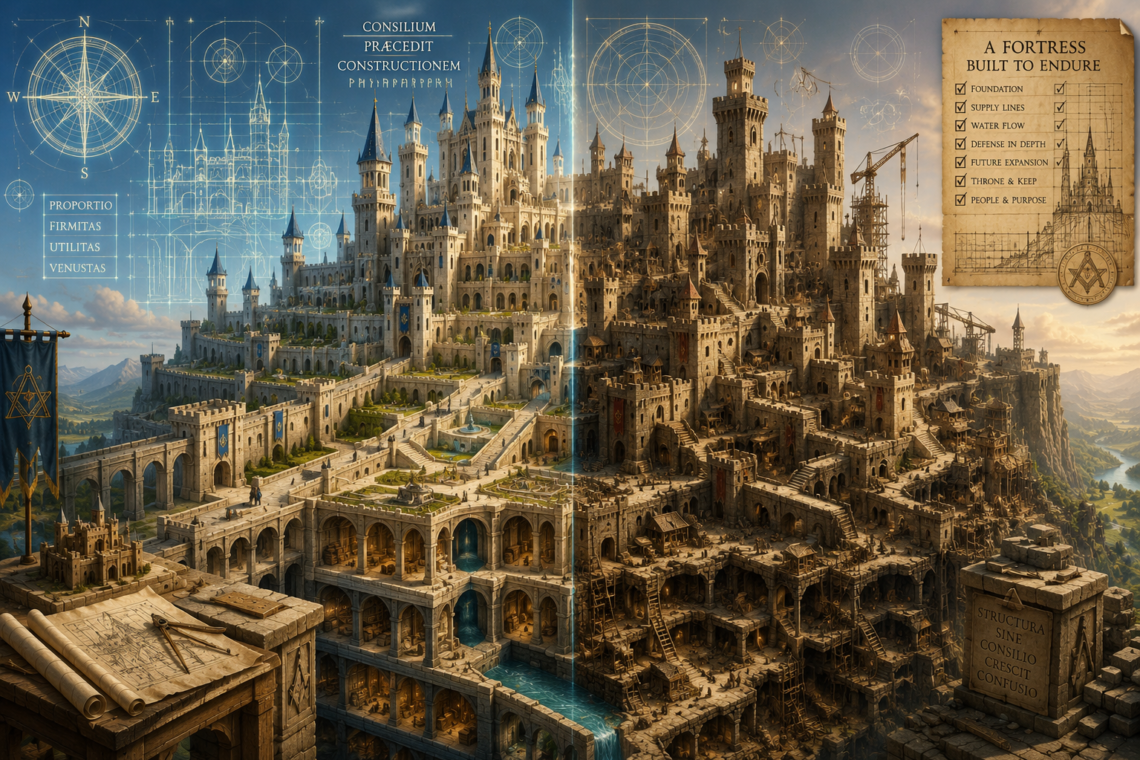
    A vast medieval fantasy castle dominates the landscape, split into two contrasting halves to illustrate the importance of architectural planning. The left side features a beautifully organized fortress with symmetrical towers, interconnected courtyards, bridges, aqueducts, and orderly roads, overlaid with glowing magical blueprints, surveying grids, compass roses, and geometric construction diagrams. The right side remains impressive but is visibly less organized, with awkward tower placement, inefficient stairways, conflicting roads, and haphazard expansions that suggest growth without an overall plan. Artistic cutaway sections reveal deep stone foundations, underground chambers, drainage tunnels, and structural supports extending into bedrock. Tiny builders and stonemasons emphasize the immense scale of the castle, while warm morning light highlights the contrast between intentional design and organic growth, visually representing the role of software architecture in creating maintainable, long-lasting systems.

    Why Castles Need Architects

    June 29, 2026
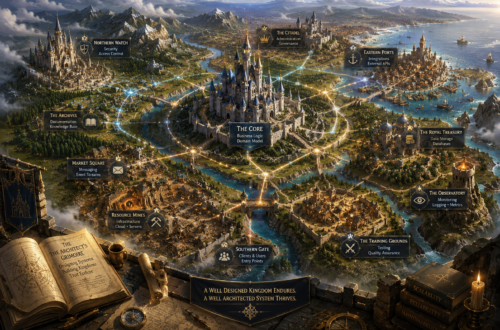
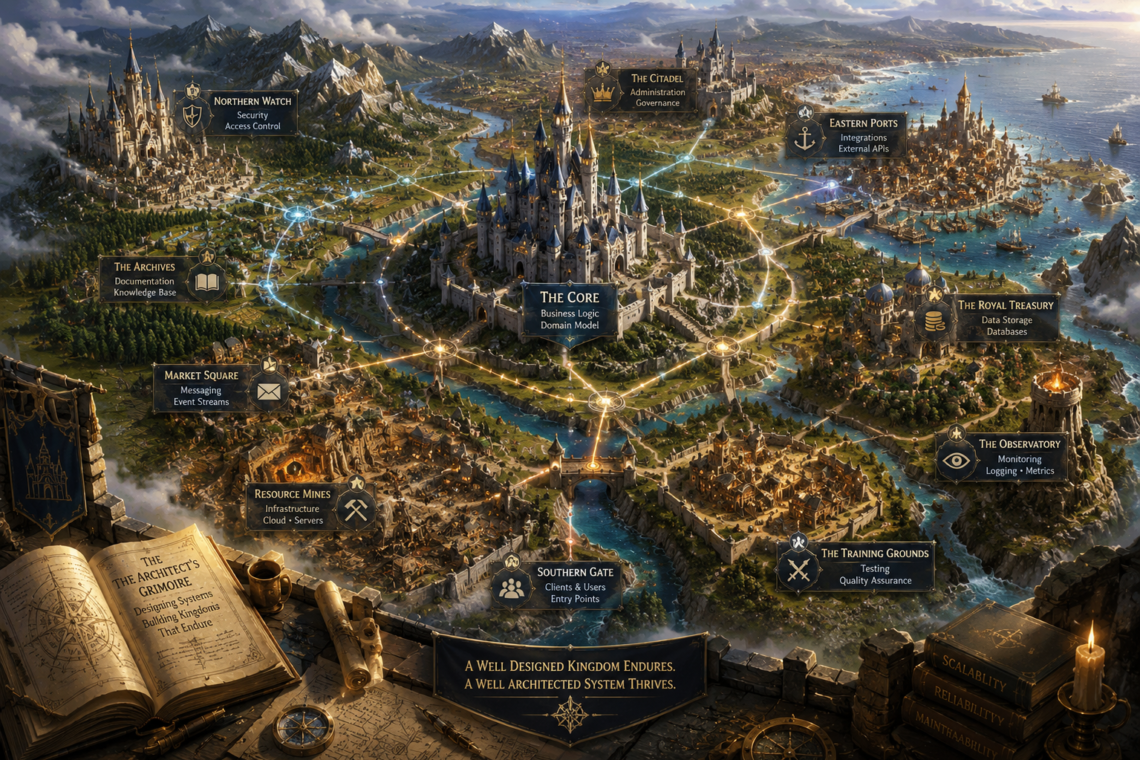
    An epic fantasy map-style illustration depicts a thriving kingdom viewed from above, with a grand central castle labeled "The Core" connected by glowing roads and magical pathways to surrounding regions. Each district represents a software architecture concept, including Northern Watch (Security and Access Control), Eastern Ports (Integrations and External APIs), The Royal Treasury (Data Storage and Databases), The Observatory (Monitoring and Metrics), The Training Grounds (Testing and Quality Assurance), Market Square (Messaging and Event Streams), Resource Mines (Infrastructure and Servers), The Archives (Documentation and Knowledge Base), and Southern Gate (Clients and Users). In the foreground, an open book titled The Architect's Grimoire rests on a stone table alongside maps, drafting tools, and architectural plans. A banner reads, "A Well Designed Kingdom Endures. A Well Architected System Thrives." The image uses fantasy kingdom imagery to visualize software architecture as an interconnected, carefully planned realm.

    Building Kingdoms That Endure

    June 28, 2026
    A fantasy-inspired illustration depicts a master engineer overlooking a thriving medieval kingdom powered by invisible systems rather than heroic effort. In the foreground, a cloaked architect studies a blueprint illustrating a software delivery pipeline from code to build, test, deployment, and monitoring. Below, workshops, waterwheels, bridges, and aqueducts symbolize automated infrastructure supporting the bustling city above. Watchtowers overlook the realm while illuminated engineering panels represent automated testing, CI/CD pipelines, infrastructure as code, deployment automation, and monitoring. The scene conveys how automation, continuous improvement, and dependable engineering systems quietly enable a prosperous kingdom without drawing attention to themselves.

    The Automated Kingdom: When Excellence Becomes Routine

    July 22, 2026
  • A vast medieval fantasy kingdom is enclosed within enormous concentric stone walls, towering gatehouses, fortified keeps, and defensive towers that dominate the landscape. Despite the immense fortifications, the protected interior remains largely undeveloped, with only a few cottages, a small farmhouse, scattered construction sites, unfinished roads, and a partially built marketplace spread across open fields. Glowing blue magical architectural projections overlay the empty city, revealing ambitious plans for future districts, guild halls, towers, canals, and public buildings that have yet to be constructed. In the foreground, drafting tables, blueprints, surveying instruments, and engineering tools reinforce the theme of excessive planning, while a small group of builders focuses on practical structures such as a well and simple homes. The painterly Dungeons & Dragons-inspired scene symbolizes the software engineering concept of premature overengineering by contrasting overwhelming defensive infrastructure with a kingdom that has barely begun to grow.
    The Architect's Grimoire

    The Curse of Premature Fortification

    July 3, 2026 /

    Not every empty field needs a fortress. Software rarely becomes difficult to maintain because developers lacked technical ability. More often, intelligent engineers create long-term maintenance problems by solving challenges that have not yet appeared. A project begins with a handful of straightforward requirements, but its structure quickly expands to accommodate hypothetical integrations, future scalability, interchangeable components, and extension points that may never become necessary. Before long, the codebase grows steadily larger while the problem it exists to solve remains remarkably small. Long before the application reaches maturity, supporting the design requires nearly as much effort as advancing the product itself. Good design prepares software to evolve as knowledge grows. Premature…

    Read More
    Frank Jamison

    You May Also Like

    A fantasy-inspired illustration depicts a master engineer overlooking a thriving medieval kingdom powered by invisible systems rather than heroic effort. In the foreground, a cloaked architect studies a blueprint illustrating a software delivery pipeline from code to build, test, deployment, and monitoring. Below, workshops, waterwheels, bridges, and aqueducts symbolize automated infrastructure supporting the bustling city above. Watchtowers overlook the realm while illuminated engineering panels represent automated testing, CI/CD pipelines, infrastructure as code, deployment automation, and monitoring. The scene conveys how automation, continuous improvement, and dependable engineering systems quietly enable a prosperous kingdom without drawing attention to themselves.

    The Automated Kingdom: When Excellence Becomes Routine

    July 22, 2026
    A fantasy-inspired digital illustration depicts a royal architect standing over maps and plans as a massive stone castle burns under a night sky filled with flaming projectiles. Although sections of the fortress are engulfed in flames, smaller fortified districts below remain connected by glowing blue pathways, symbolizing resilient system architecture and fault isolation. Floating holographic icons represent High Availability, Backups, Disaster Recovery, Fault Tolerance, and Incident Response, visually linking medieval defenses with modern software engineering concepts. Scrolls and architectural plans in the foreground reinforce themes of preparation, recovery, and thoughtful design, while the dramatic contrast between destruction and continuity emphasizes that resilient systems are designed to withstand failure rather than prevent it entirely.

    When the Kingdom Burns: Designing for Failure Before Disaster Strikes

    July 17, 2026
    A group of royal architects and cartographers gather around a massive illuminated kingdom map inside an ornate medieval planning hall. Using compasses, rulers, and drafting tools, they carefully define provincial boundaries that follow rivers, mountains, and trade routes. Shelves filled with scrolls, blueprints, and surveying instruments surround the room, while stained-glass windows reveal a thriving kingdom beyond. The detailed fantasy scene symbolizes thoughtful software architecture by illustrating the deliberate planning and organization required to establish meaningful boundaries within a growing system.

    Dividing the Kingdom: Finding the Right Boundaries

    July 8, 2026
  • A vast medieval fantasy castle dominates the landscape, split into two contrasting halves to illustrate the importance of architectural planning. The left side features a beautifully organized fortress with symmetrical towers, interconnected courtyards, bridges, aqueducts, and orderly roads, overlaid with glowing magical blueprints, surveying grids, compass roses, and geometric construction diagrams. The right side remains impressive but is visibly less organized, with awkward tower placement, inefficient stairways, conflicting roads, and haphazard expansions that suggest growth without an overall plan. Artistic cutaway sections reveal deep stone foundations, underground chambers, drainage tunnels, and structural supports extending into bedrock. Tiny builders and stonemasons emphasize the immense scale of the castle, while warm morning light highlights the contrast between intentional design and organic growth, visually representing the role of software architecture in creating maintainable, long-lasting systems.
    The Architect's Grimoire

    Why Castles Need Architects

    June 29, 2026 /

    Even the finest builders need someone who can see beyond the next wall. Foundations of the Kingdom Maintaining software taught me lessons that writing software never could. Early in my career, I assumed difficult applications were usually the result of poor programming. Whenever a simple change required hours of investigation, I expected to uncover careless decisions, rushed deadlines, or code that had simply been neglected for too long. The more systems I inherited, however, the less convincing that explanation became. Different companies, different teams, and different programming languages produced remarkably similar maintenance problems. As we begin Foundations of the Kingdom, one lesson rises above all the others: every enduring kingdom…

    Read More
    Frank Jamison

    You May Also Like

    A sweeping high-angle fantasy landscape depicts a thriving medieval kingdom interconnected by an extensive network of beautifully engineered stone roads and towering arched bridges. Magnificent walled cities, castles, villages, ports, and mountain fortresses are linked across rivers, cliffs, forests, fertile farmland, and snow-capped peaks, emphasizing the infrastructure that unites the realm. Merchant caravans, mounted couriers, travelers, and supply wagons move peacefully along the highways beneath warm golden morning light, illustrating dependable communication, cooperation, and thoughtful planning. The image symbolizes well-designed software architecture, with the roads representing trusted APIs that seamlessly connect independent systems into a unified, flourishing kingdom.

    The Roads Between Cities: Building APIs Worth Trusting

    July 6, 2026
    A wise wizard studies a glowing crystal orb overlooking a vast fantasy kingdom where medieval architecture merges with modern software engineering. Across a towering stone aqueduct, six banners illustrate a continuous delivery pipeline labeled Automation, CI/CD, Testing, Deployment, Infrastructure as Code, and Continuous Improvement, with engineers working at illuminated stations beneath each stage. A detailed map on the wizard's table mirrors the same workflow using symbols and pathways, while holographic diagrams and glowing blue interfaces blend seamlessly into the medieval setting. The composition symbolizes mature software engineering practices transforming disciplined processes into an automated, self-improving kingdom, with warm golden light contrasting against cool blue technological elements. The article title does not appear in the image.

    Seeing Through the Crystal Ball: Observability Beyond Monitoring

    July 20, 2026
    A vast medieval fantasy kingdom is enclosed within enormous concentric stone walls, towering gatehouses, fortified keeps, and defensive towers that dominate the landscape. Despite the immense fortifications, the protected interior remains largely undeveloped, with only a few cottages, a small farmhouse, scattered construction sites, unfinished roads, and a partially built marketplace spread across open fields. Glowing blue magical architectural projections overlay the empty city, revealing ambitious plans for future districts, guild halls, towers, canals, and public buildings that have yet to be constructed. In the foreground, drafting tables, blueprints, surveying instruments, and engineering tools reinforce the theme of excessive planning, while a small group of builders focuses on practical structures such as a well and simple homes. The painterly Dungeons & Dragons-inspired scene symbolizes the software engineering concept of premature overengineering by contrasting overwhelming defensive infrastructure with a kingdom that has barely begun to grow.

    The Curse of Premature Fortification

    July 3, 2026
  • An epic fantasy map-style illustration depicts a thriving kingdom viewed from above, with a grand central castle labeled "The Core" connected by glowing roads and magical pathways to surrounding regions. Each district represents a software architecture concept, including Northern Watch (Security and Access Control), Eastern Ports (Integrations and External APIs), The Royal Treasury (Data Storage and Databases), The Observatory (Monitoring and Metrics), The Training Grounds (Testing and Quality Assurance), Market Square (Messaging and Event Streams), Resource Mines (Infrastructure and Servers), The Archives (Documentation and Knowledge Base), and Southern Gate (Clients and Users). In the foreground, an open book titled The Architect's Grimoire rests on a stone table alongside maps, drafting tools, and architectural plans. A banner reads, "A Well Designed Kingdom Endures. A Well Architected System Thrives." The image uses fantasy kingdom imagery to visualize software architecture as an interconnected, carefully planned realm.
    The Architect's Grimoire

    Building Kingdoms That Endure

    June 28, 2026 /

    Every enduring kingdom begins with a blueprint. Every developer learns to build. The best developers learn what to build next. No kingdom becomes legendary because its masons laid beautiful stones. No empire survives because its carpenters built magnificent gates or its blacksmiths forged exceptional swords. History remembers kingdoms that endured because someone looked beyond the next building and imagined how an entire realm would one day function. Roads connected cities before merchants ever traveled them. Walls protected districts that had not yet been built. Aqueducts carried water to neighborhoods that existed only on parchment. Long before the first stone was laid, someone had already begun designing the future. Software follows…

    Read More
    Frank Jamison

    You May Also Like

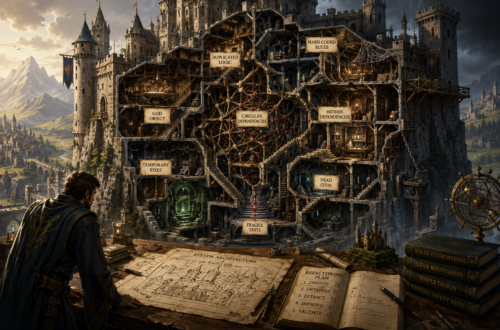
    A detailed fantasy castle is shown in cross-section, revealing a maze of interconnected rooms, stairways, hidden passages, and structural layers that symbolize the complexity of a long-lived software system. At the center, tangled corridors and web-like connections represent circular dependencies and hidden coupling, while workshop-like chambers illustrate concepts such as duplicated logic, hard-coded rules, temporary fixes, fragile tests, dead code, and hidden dependencies. In the foreground, an architect studies blueprints and a refactoring plan spread across a drafting table, surrounded by engineering tools, manuscripts, and architectural diagrams. The surrounding kingdom is orderly and well maintained, contrasting with the increasingly convoluted interior of the castle. The painterly, Dungeons & Dragons-inspired editorial illustration uses fantasy architecture to represent technical debt, legacy systems, refactoring, and the challenge of maintaining software that has grown through years of incremental change.

    Hidden Traps in the Dungeon: Escaping Technical Debt

    July 15, 2026
    A fantasy-inspired illustration depicts a master engineer overlooking a thriving medieval kingdom powered by invisible systems rather than heroic effort. In the foreground, a cloaked architect studies a blueprint illustrating a software delivery pipeline from code to build, test, deployment, and monitoring. Below, workshops, waterwheels, bridges, and aqueducts symbolize automated infrastructure supporting the bustling city above. Watchtowers overlook the realm while illuminated engineering panels represent automated testing, CI/CD pipelines, infrastructure as code, deployment automation, and monitoring. The scene conveys how automation, continuous improvement, and dependable engineering systems quietly enable a prosperous kingdom without drawing attention to themselves.

    The Automated Kingdom: When Excellence Becomes Routine

    July 22, 2026
    A sweeping high-angle fantasy landscape depicts a thriving medieval kingdom interconnected by an extensive network of beautifully engineered stone roads and towering arched bridges. Magnificent walled cities, castles, villages, ports, and mountain fortresses are linked across rivers, cliffs, forests, fertile farmland, and snow-capped peaks, emphasizing the infrastructure that unites the realm. Merchant caravans, mounted couriers, travelers, and supply wagons move peacefully along the highways beneath warm golden morning light, illustrating dependable communication, cooperation, and thoughtful planning. The image symbolizes well-designed software architecture, with the roads representing trusted APIs that seamlessly connect independent systems into a unified, flourishing kingdom.

    The Roads Between Cities: Building APIs Worth Trusting

    July 6, 2026
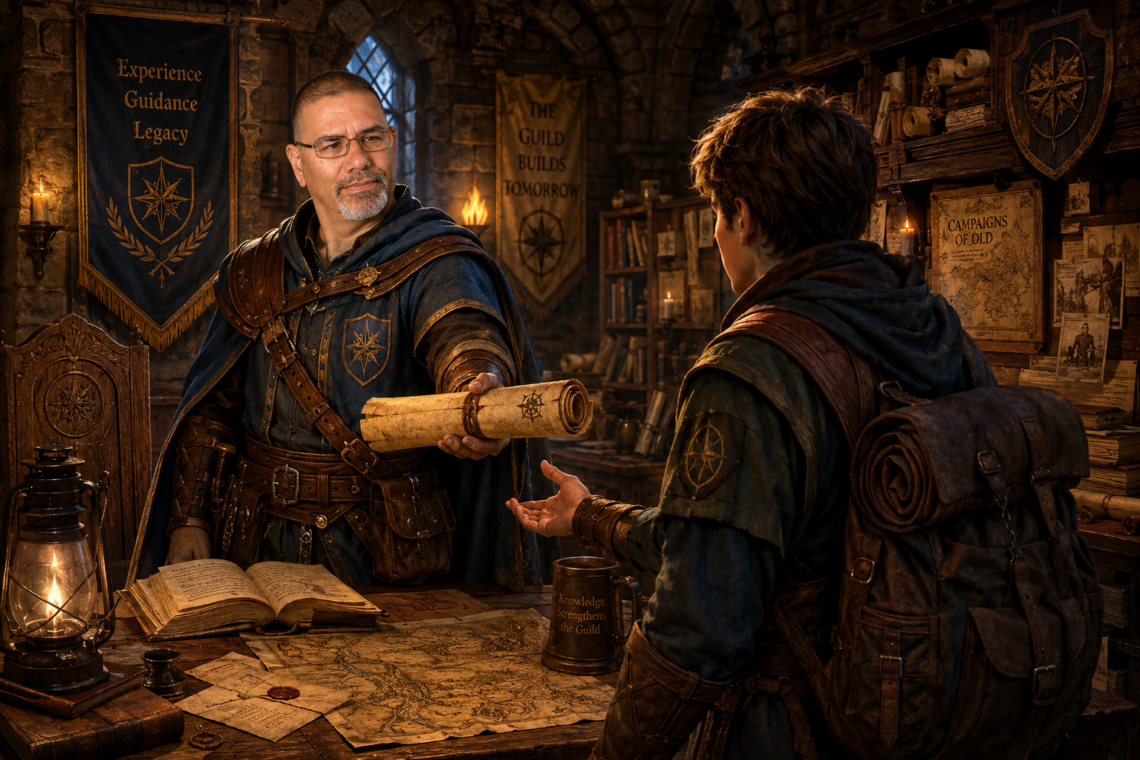
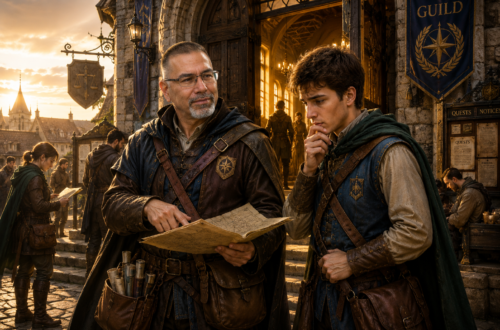
  • Frank Jamison, depicted as an experienced fantasy guildmaster, stands inside a warmly lit medieval guild hall and hands a rolled parchment map to a young adventurer preparing for a journey. Wearing practical adventuring gear and guildmaster robes, he appears confident, patient, and encouraging. The hall is filled with maps, books, scrolls, and records of past adventures, with banners emphasizing experience, guidance, and legacy. The scene symbolizes mentorship, knowledge sharing, and helping the next generation of adventurers find their path.
    The Guildmaster’s Handbook

    Becoming the Developer You Once Needed

    June 26, 2026 /

    The greatest guides are often those who remember what it felt like to walk alone. The Veteran at the Tavern Table One of the most surprising lessons I have learned throughout my career is that software development is not ultimately about software. The code matters. The systems matter. The architecture matters. Yet when I look back on the people who changed my career, I do not remember them primarily because of the software they built. I remember them because of the guidance they provided when I needed it most. Over time, I came to realize that the final stage of becoming a developer is not mastering technology. It is becoming…

    Read More
    Frank Jamison

    You May Also Like

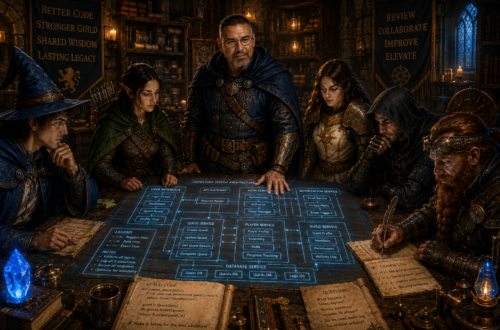
    Frank Jamison, portrayed as a seasoned guildmaster adventurer, stands at the center of a grand medieval guild hall strategy table covered with maps, contracts, architectural blueprints, engineering schematics, and glowing magical diagrams. Surrounded by representatives of merchants, nobility, scholars, quartermasters, and city officials, he calmly mediates a discussion while gesturing toward an illuminated map displaying interconnected pathways across the kingdom. Warm torchlight and cool magical light fill the bustling stone hall, emphasizing leadership, collaboration, communication, and problem-solving in a richly detailed fantasy setting inspired by Dungeons & Dragons.

    Working With Stakeholders Without Losing Sanity

    June 12, 2026
    Frank Jamison portrayed as a veteran guildmaster mentoring a nervous young adventurer outside a grand fantasy guild hall at dawn, reviewing a map while adventurers prepare for quests in the background.

    Interviews Without Panic Damage

    June 24, 2026
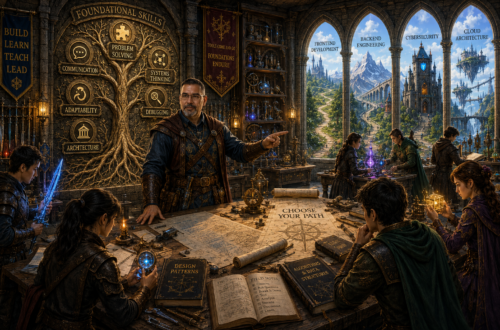
    Frank Jamison, portrayed as a seasoned guildmaster and veteran engineer, stands in a grand fantasy training hall guiding young adventurers toward foundational skills rather than magical treasures. A towering stone skill tree labeled Communication, Problem Solving, Systems Thinking, Adaptability, Debugging, and Architecture dominates the wall behind him. Apprentices study maps, engineering blueprints, notebooks, drafting tools, and glowing artifacts around a massive wooden training table marked Choose Your Path. Through large arched windows, fantasy landscapes represent different technology career paths including Frontend Development, Backend Engineering, Cybersecurity, and Cloud Architecture. Warm torchlight and subtle blue magical illumination create a wise, instructional atmosphere emphasizing mentorship, learning, and long-term skill development.

    Building Skills That Actually Matter

    June 5, 2026
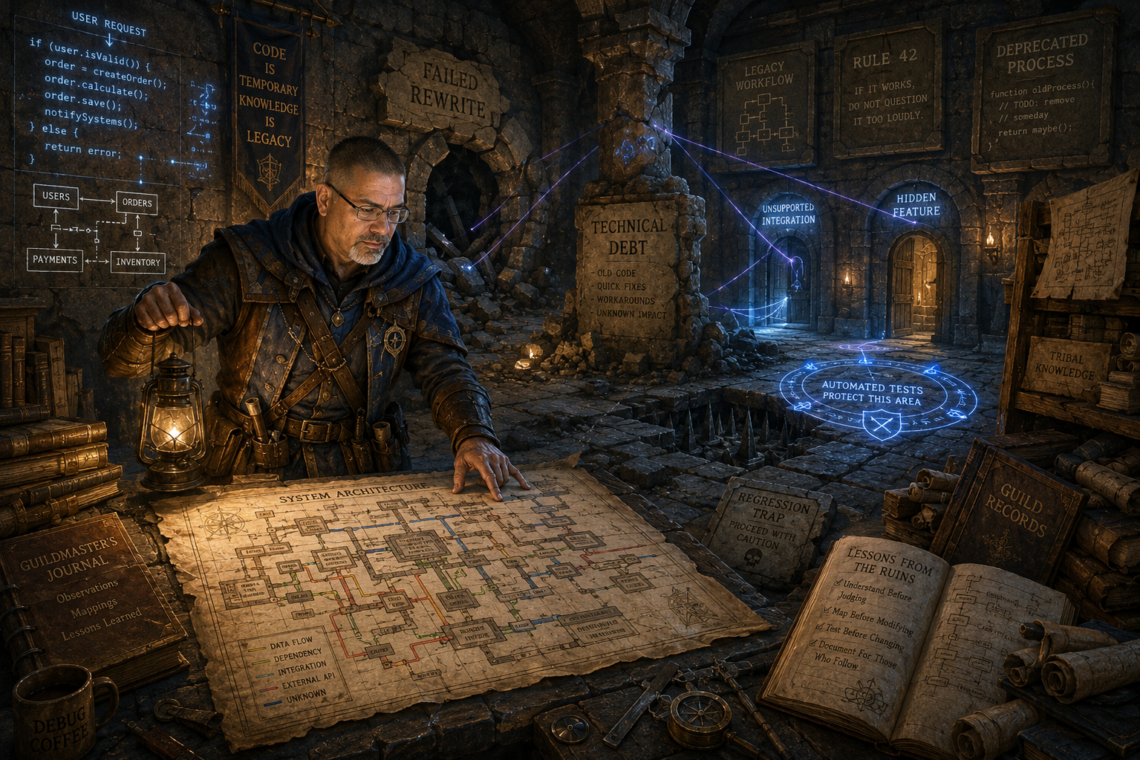
  • Frank Jamison, depicted as a seasoned Guildmaster and software engineer, studies a detailed architectural map inside a vast underground fantasy ruin representing a legacy software system. Wearing practical adventurer-scholar gear and holding a lantern, he stands at a stone table surrounded by guild journals, engineering records, maps, and ancient scrolls. Glowing blue runes resembling source code, database diagrams, and system architecture cover the dungeon walls. Nearby, a collapsed passage marked Failed Rewrite, a monument labeled Technical Debt, hidden doors representing undocumented features, and magical wards protecting explored areas symbolize the challenges of maintaining legacy code. The cinematic scene conveys exploration, problem-solving, knowledge preservation, and the careful navigation of complex software systems.
    The Guildmaster’s Handbook

    Legacy Code and Ancient Curses

    June 15, 2026 /

    Every developer eventually enters forgotten ruins and wonders what kind of sorcery built them. Entering the Forgotten Ruins Among all the challenges software engineers face throughout their careers, few are as universal as inheriting legacy code. Most developers begin their journey imagining they will spend their days creating new applications, experimenting with modern technologies, and designing elegant architectures from a blank canvas. While those opportunities certainly exist, they represent only a portion of professional software development. Much of our work involves maintaining, extending, repairing, and modernizing systems that already exist. Some of these applications are only a few years old. Others have survived multiple generations of developers and business leaders.…


    Read More
    Frank Jamison

    You May Also Like

    Frank Jamison, portrayed as a seasoned guildmaster adventurer, stands at the center of a grand medieval guild hall strategy table covered with maps, contracts, architectural blueprints, engineering schematics, and glowing magical diagrams. Surrounded by representatives of merchants, nobility, scholars, quartermasters, and city officials, he calmly mediates a discussion while gesturing toward an illuminated map displaying interconnected pathways across the kingdom. Warm torchlight and cool magical light fill the bustling stone hall, emphasizing leadership, collaboration, communication, and problem-solving in a richly detailed fantasy setting inspired by Dungeons & Dragons.

    Working With Stakeholders Without Losing Sanity

    June 12, 2026
    Frank Jamison, depicted as a seasoned adventurer-engineer, studies a large map at a guild hall worktable covered with architectural diagrams, engineering blueprints, books, scrolls, and magical instruments. Behind him looms a towering shadowy creature formed from smoke and mist, symbolizing impostor syndrome. Warm torchlight illuminates the stone chamber, highlighting symbols of past achievements, knowledge, and experience. The scene blends medieval fantasy and software engineering themes to represent overcoming self-doubt through wisdom, perseverance, and hard-earned expertise.

    When Impostor Syndrome Rolls a Critical Hit

    June 19, 2026
    Frank Jamison, portrayed as a seasoned guildmaster and veteran engineer, stands at the center of a grand medieval guild hall, guiding a group of young adventurers around a glowing magical map table. Multiple illuminated pathways branch from a central crossroads toward fantasy realms representing technology career paths, including backend development, frontend development, cybersecurity, cloud engineering and DevOps, and AI and data science. Floating books, architectural diagrams, magical runes, code fragments, and enchanted cityscapes surround the table, while warm lantern light and blue magical energy create an atmosphere of mentorship, discovery, and professional growth. The scene blends Dungeons & Dragons-inspired fantasy with modern software engineering concepts, symbolizing the process of choosing a path in technology.

    Picking Your Class in Tech

    June 1, 2026
123
  • The Architect's Grimoire (13)
  • The CSS Codex (13)
  • The Enchanted Workshop (9)
  • The Full-Stack Campaign (7)
  • The Guildmaster’s Handbook (13)

AI-Assisted Development Artificial Intelligence Backend Development Career Development Clean Code Code Quality CSS CSS Architecture CSS Best Practices CSS Fundamentals CSS Layout Design Systems Developer Education Developer Growth Developer Productivity Dungeons and Dragons Engineering Culture Engineering Judgment Engineering Leadership Fantasy Theme Front-End Development Frontend Development Full Stack Development Maintainable Code Maintainable CSS Mentorship Professional Development Professional Growth Refactoring Responsive Design Software Architecture Software Craftsmanship Software Design Software Development Software Engineering StackNScroll System Design Technical Debt Technical Leadership The Architect's Grimoire The CSS Codex The Enchanted Workshop The Full-Stack Campaign The Guildmaster's Handbook Web Development

Stack N' Scroll - 2026 ©