The Crystal Ball Lies Sometimes: Verifying AI Before You Trust It
Even enchanted mirrors occasionally reflect impossible futures.
Artificial intelligence has rapidly become one of the most productive tools ever placed into the hands of software engineers. It can explain unfamiliar concepts, generate working prototypes, refactor decades-old code, write unit tests, summarize documentation, and even identify subtle defects that would otherwise escape notice. After spending only a few weeks working alongside modern AI systems, it becomes difficult to imagine returning to a workflow that depends entirely on search engines, reference manuals, and trial-and-error.
Yet every experienced engineer eventually encounters a moment that changes the relationship.
Perhaps the generated code compiles perfectly while quietly introducing a race condition. Perhaps an API appears genuine until the compiler reminds you that it has never existed. Sometimes AI confidently cites documentation that leads nowhere because the documentation itself was invented. The response looks polished, the explanation feels convincing, and the reasoning appears internally consistent. Only careful verification reveals that the crystal ball has shown a future that never existed.
I experienced this firsthand while experimenting with a newly released framework feature. AI produced an elegant implementation, explained every design choice, and even described why the approach aligned with current best practices. Everything looked exactly as I would have expected from an experienced engineer. There was only one problem. The central API that held the entire solution together simply did not exist. Five minutes spent checking the official documentation revealed what an hour of coding would eventually have discovered through frustration.
The danger is not that artificial intelligence occasionally makes mistakes. Every engineer, every textbook, and every technical blog eventually does the same. The real danger lies in how confidently AI presents incorrect information. Confidence is a poor substitute for correctness, yet human beings naturally associate polished explanations with expertise. The better these systems become at communicating, the easier it becomes to mistake fluency for truth.
That realization marks an important transition in the journey of every engineer learning to work with AI. In our first chapter of The Enchanted Workshop, we explored how AI should become a trusted familiar rather than an independent wizard. In our previous chapter, we learned that effective prompt engineering resembles the careful crafting of magical spells, where precision determines the quality of the result. The next lesson is perhaps the most important of all. Powerful magic deserves equally powerful skepticism.
Within every fantasy kingdom sits an enchanted observatory containing a magnificent crystal ball. Advisors consult it before military campaigns, architects use it to visualize new cities, and scholars seek glimpses of forgotten history. It often provides remarkable insight by revealing patterns invisible to ordinary observers and connections that might otherwise remain hidden. Wise rulers value its guidance because it helps them ask better questions, but they never mistake it for reality.
The greatest kingdoms survive because every prophecy undergoes verification before armies march or castles rise. Scouts confirm what the crystal ball revealed. Surveyors measure the land themselves. Librarians compare new discoveries against trusted archives. Decisions emerge not from faith in magic alone but from disciplined confirmation. Modern software engineering demands exactly the same mindset.
The First Vision of the Crystal Ball
One of the most useful ways to think about AI is not as an expert answering questions but as an assistant producing first drafts. Whether the output consists of source code, architectural recommendations, SQL queries, or deployment strategies, every response should begin life as a proposal awaiting review rather than as an accepted solution.
This shift in perspective changes everything.
Instead of asking whether AI is trustworthy, experienced engineers begin asking a different question. What evidence supports this answer? The conversation immediately becomes more productive because verification replaces assumption. AI ceases to be an oracle dispensing unquestionable wisdom and becomes an experienced colleague whose work deserves thoughtful review.
That distinction exists throughout professional engineering. Code reviews assume talented developers make mistakes. Automated tests assume successful compilation proves very little. Monitoring systems assume deployments occasionally fail despite careful planning. Defensive engineering exists because confidence alone has never guaranteed correctness, and artificial intelligence belongs within the same category.
Treating every response as a draft also removes unnecessary emotional attachment. Engineers sometimes become surprisingly invested in generated solutions because they appear elegant or required only a single prompt. When later evidence proves the answer incorrect, frustration follows. By assuming the response is provisional from the beginning, correction becomes an expected part of the workflow rather than a disappointing surprise. Good engineers revise drafts because great engineers expect to.
When the Enchanted Mirror Invents the Future
The term hallucination often creates unnecessary confusion because it sounds mysterious or unpredictable. In reality, most hallucinations result from a surprisingly ordinary characteristic of language models. Their primary objective is to generate text that is statistically likely to follow the conversation, not to independently verify factual accuracy.
That distinction explains many surprising failures.
Suppose you ask AI for an example using a library that changed dramatically six months ago. If the training data primarily reflects older versions, the generated code may reference deprecated classes or methods. The answer still resembles valid software because it follows familiar programming patterns, yet the implementation quietly belongs to another version of reality.
The same problem appears when requesting obscure APIs, uncommon configuration settings, or specialized framework features. Rather than admitting uncertainty, the model sometimes fills the missing information with something that appears plausible. The generated answer contains realistic naming conventions, sensible parameter lists, and convincing explanations. Everything feels correct until someone attempts to compile the code.
Engineers sometimes assume hallucinations occur only during complex requests, but production experience suggests otherwise. Even simple questions can produce subtle inaccuracies if the requested information exists near the edge of the model’s knowledge or involves rapidly evolving technology. The danger often lies not in spectacularly incorrect answers but in almost-correct answers that require careful scrutiny to uncover.
Imagine standing before an enchanted mirror that has spent centuries observing kingdoms throughout history. It has seen thousands of castles, libraries, workshops, and towers. When asked to describe a newly constructed fortress beyond its experience, it assembles familiar architectural elements into something entirely believable. Towers connect naturally to walls. Gates appear where gates usually belong. Defensive positions overlook the surrounding countryside.
Unfortunately, the bridge leads nowhere because the fortress itself never existed.
The mirror did not intend to deceive anyone. It simply constructed the most probable image from everything it had previously observed.
AI often works in much the same way.
Understanding this behavior transforms hallucinations from mysterious failures into predictable engineering risks. Predictable risks can be managed. Once engineers recognize that plausible answers are not necessarily verified answers, they begin building habits that consistently separate useful assistance from costly mistakes.
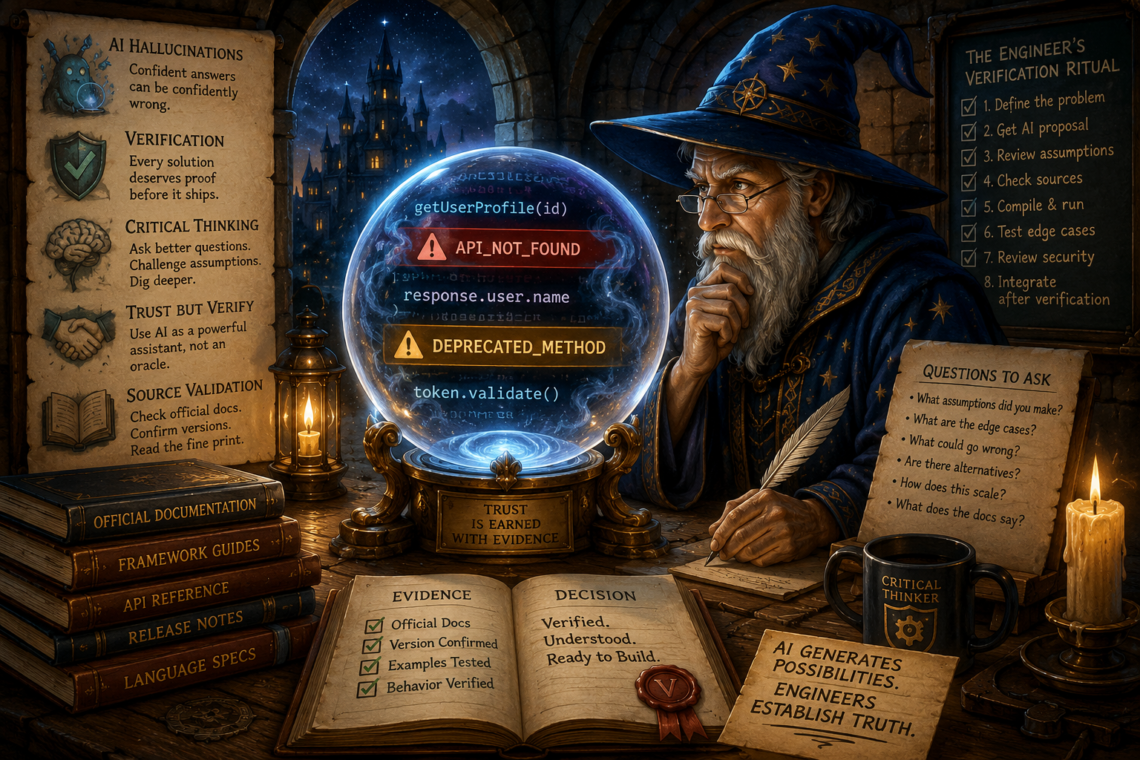
AI generates possibilities. Engineers establish truth.
The Royal Inspectors
Every mature engineering discipline includes some form of verification. Civil engineers calculate load limits before concrete is poured. Electrical engineers test circuits before they reach production. Database administrators rehearse backups before trusting disaster recovery plans. Software engineering should approach AI-generated output with exactly the same discipline. Verification is not an admission of distrust. It is recognition that every complex system deserves independent confirmation before becoming part of a production environment.
The encouraging news is that verifying AI rarely requires extraordinary effort. Most of the techniques engineers already use to validate human-written code apply equally well to AI-generated work. Compile the code. Execute the tests. Compare the implementation against the documentation. Review architectural decisions. Ask whether the solution fits the surrounding codebase instead of evaluating it in isolation. These habits existed long before AI entered the workshop, and they remain just as valuable today.
Experienced developers often discover that AI is remarkably effective at accelerating the first eighty percent of a solution. The remaining 20% still depends on professional judgment. That final portion includes understanding business requirements, recognizing architectural constraints, identifying security implications, and ensuring long-term maintainability. AI can accelerate progress, but only engineers can determine whether the destination is actually correct. The goal is not to eliminate trust. The goal is to earn it through evidence.
Consulting the Great Library
One of the simplest ways to reduce AI mistakes is to ask where the information came from before accepting the answer itself. Modern AI systems frequently summarize concepts that originated in framework documentation, technical standards, RFCs, or language specifications. Whenever possible, those original sources should become part of the conversation rather than remaining hidden behind the generated response.
Suppose AI recommends a new framework feature introduced in a recent release. Rather than implementing it immediately, verify that the feature actually appears in the official documentation. Confirm the version number. Read the examples provided by the framework maintainers. Look for migration notes that explain limitations or compatibility concerns. In many cases, the documentation reveals important details that AI either simplified or omitted entirely.
This practice becomes especially valuable when working with rapidly evolving technologies. AI training data inevitably reflects a snapshot of the past, while official documentation reflects the present. The larger the gap between those two moments, the more valuable direct verification becomes. Engineers who consistently consult authoritative sources gradually develop confidence based upon evidence rather than convenience.
Within our enchanted kingdom, even the finest crystal ball cannot replace the royal archives. When ancient laws determine the fate of the realm, wise scholars retrieve the original manuscripts rather than relying upon remembered summaries. Software engineering deserves the same respect for primary sources because authoritative documentation remains the closest thing our profession has to recorded history.
Questioning the Court Wizard
Verification does not always require leaving the conversation. One of AI’s greatest strengths is its ability to critique its own work when asked thoughtful questions. The first answer should rarely be the last.
Instead of accepting an implementation immediately, continue the discussion.
Ask why a particular design was chosen over another. Request alternative approaches. Ask what assumptions the solution makes. Invite the model to identify edge cases or potential failure scenarios. Challenge it to explain situations where the proposed implementation would be inappropriate. These follow-up questions often expose weaknesses that remained hidden during the initial response.
For example, an engineer might begin with a straightforward request.
Write a function that caches user profiles in memory.The generated solution may appear perfectly reasonable, much like an apprentice wizard proudly presenting a newly completed spell. Rather than celebrating too early, continue the conversation.
What concurrency problems could this implementation create?

How would this behave under heavy load?

Would this approach work in a distributed environment?

What assumptions did you make that I did not specify?
Notice that none of these questions ask AI to produce more code. They ask it to examine its own reasoning. Engineers frequently discover missing requirements, overlooked edge cases, or architectural limitations simply by continuing the conversation beyond the initial implementation. The discussion evolves from code generation into architectural review, which is often where AI becomes most valuable.
The Apprentice’s Verification Ritual
The most reliable engineers eventually stop treating verification as a separate activity. Instead, they incorporate it directly into their daily workflow. Every AI interaction follows a familiar sequence that becomes almost automatic over time. Just as every responsible wizard develops rituals before attempting dangerous magic, experienced engineers establish habits that reduce unnecessary risk before code reaches production.
A practical verification ritual might resemble this:
1. Define the problem clearly.
2. Ask AI for a proposed solution.
3. Review the assumptions.
4. Compare against official documentation.
5. Compile and execute the code.
6. Test normal cases and edge cases.
7. Review for maintainability and security.
8. Integrate only after verification.
None of these steps are revolutionary. Together, however, they create an effective safety net that catches many of the subtle mistakes AI occasionally introduces while reinforcing one of the central lessons of this chapter.
AI generates possibilities. Engineers establish truth.
Ironically, this discipline becomes even more valuable as AI systems improve. An obviously broken implementation attracts immediate attention. A subtly incorrect implementation may survive code review, automated testing, and even production deployment before revealing itself under unusual circumstances. The more convincing the crystal ball becomes, the more important it is to confirm that the road it reveals truly exists.
The Cost of False Prophecies
One misconception surrounding AI-assisted development is that verification slows developers down. In practice, the opposite often proves true. Engineers who blindly accept generated code frequently spend hours debugging problems that careful verification would have prevented. A few minutes spent validating assumptions usually costs far less than tracing defects through a production system.
Consider an engineer implementing authentication against an unfamiliar identity provider. AI quickly produces configuration code, middleware registration, and token validation logic. The application compiles, authentication appears functional, and progress seems impressive. Weeks later, a penetration test reveals that several recommended validation checks were omitted because the generated example simplified the implementation. Nothing failed during development because the missing safeguards protected against situations that had not yet occurred.
False confidence is often more expensive than visible failure.
Verification changes the timeline. Instead of discovering architectural weaknesses after deployment, engineers uncover them while the implementation remains inexpensive to modify. Professional software engineering has always favored confidence earned through evidence over confidence granted by appearances. AI simply reminds us why that principle has endured throughout the history of our profession.
The Greatest Spell Is Judgment
Artificial intelligence has changed many aspects of software development, but it has not changed the qualities that define an exceptional engineer. Organizations still value developers who ask thoughtful questions, challenge assumptions, recognize hidden risks, and make sound architectural decisions under uncertainty. AI can contribute ideas to each of those activities, but it cannot assume responsibility for them. That responsibility continues to belong to the engineer who ultimately approves the design, commits the code, and supports the application after it reaches production.
Perhaps that is why experienced developers often appear less impressed by AI than newcomers. They recognize both its extraordinary strengths and its equally important limitations. They appreciate the acceleration without confusing it for expertise. Years spent maintaining production systems teach an important lesson that no language model can replace. Software rarely fails because someone could not write code. It usually fails because someone trusted an assumption that should have been verified.
That lesson becomes more valuable as AI continues to improve. Better tools amplify both good and bad engineering habits. Engineers who already value careful verification become dramatically more productive because AI reduces the time spent on routine implementation. Engineers who skip validation simply make bigger mistakes more quickly. The tool magnifies the habits that already exist.
Within our enchanted kingdom, apprentice wizards spend years studying the royal observatory before they are ever allowed to advise the king. Learning to interpret the crystal ball is only part of their education. They also study history, geography, mathematics, diplomacy, and engineering. Every vision is compared against evidence gathered from scouts, librarians, surveyors, and scholars. Only after those independent sources agree does the kingdom act upon what the crystal ball has revealed. The greatest wizards are remembered not because they trusted the crystal ball, but because they knew when not to.
The Guild That Questions Everything
Verification should never fall to a single developer. Healthy engineering organizations create cultures where questioning assumptions is encouraged rather than discouraged. Code reviews become conversations instead of inspections. Documentation explains why decisions were made rather than merely describing what was implemented. Testing validates expected behavior, while monitoring confirms that production continues to behave as intended.
AI naturally fits within this culture because its work deserves the same collaborative scrutiny as every other engineering contribution. Generated code should receive the same review as handwritten code. AI-assisted architectural recommendations deserve the same design discussions as proposals originating from senior developers. Documentation drafted by AI should still pass through human editors who understand the audience and the surrounding system.
This perspective also removes unnecessary stigma from AI-assisted development. Using AI responsibly is no different from consulting a colleague, reading technical documentation, or studying an open-source project. Professional engineers have always gathered ideas from many sources before arriving at a final solution. AI simply becomes another valuable contributor within that process.
Contributors provide input. Engineers make decisions.
The Laws of the Workshop
As AI becomes increasingly integrated into daily development, a handful of habits consistently separate productive engineers from careless ones. None of these practices are particularly complicated, yet together they form a reliable foundation for trustworthy AI-assisted development.
Begin by assuming every generated response is a proposal rather than a conclusion. Verify unfamiliar APIs against official documentation before incorporating them into production code. Compile and execute every example, regardless of how polished it appears. Challenge AI to explain its assumptions and identify potential weaknesses. Test edge cases instead of relying upon successful demonstrations. Finally, remember that maintainability often matters more than cleverness. Finally, remember that maintainability often matters more than cleverness. The solution that stands the test of time is rarely the most elaborate one.
Verification is the difference between software engineering and wishful thinking.
That principle applies equally to generated code, architectural advice, internet tutorials, conference presentations, vendor documentation, and even our own previous work. Every engineer eventually discovers mistakes hidden within code they personally wrote years earlier. Verification exists because memory fades, requirements evolve, and certainty occasionally proves misplaced. Wisdom begins where verification begins, and the crystal ball simply reminds us that polished answers are not the same as proven ones.
Leaving the Observatory
Artificial intelligence will continue improving. Models will become more capable, more specialized, and more accurate than the systems we use today. Many of today’s hallucinations will disappear as training improves, retrieval techniques mature, and domain-specific reasoning becomes increasingly sophisticated. Even so, verification will remain an essential engineering discipline because software development has never been solely about generating answers.
It has always been about making responsible decisions.
The engineer who verifies an AI-generated solution today will verify another engineer’s proposal tomorrow. The architect who compares recommendations against business requirements will continue doing so regardless of whether those recommendations originate from a colleague, a consultant, or a future AI agent. The habit outlives the technology because it reflects professional judgment rather than technical implementation.
Every powerful tool throughout history has rewarded disciplined craftsmanship while exposing careless habits. Modern AI follows exactly the same pattern. It extends the reach of thoughtful engineers while amplifying the consequences of poor judgment. The crystal ball has become clearer, but our accountability for verifying what it reveals remains exactly the same.
The Lesson of the Crystal Ball
Throughout this chapter of The Enchanted Workshop, we have explored one of the most important lessons in AI-assisted software engineering. Artificial intelligence excels at generating ideas, identifying patterns, accelerating implementation, and helping engineers navigate unfamiliar technologies. Those capabilities make it an extraordinarily valuable companion within the workshop. They do not eliminate the need for verification, evidence, or professional judgment.
The most successful engineers will not be those who trust AI completely or reject it entirely. They will be the ones who understand where its strengths end and where their own responsibility begins. They will recognize that confidence is persuasive, evidence is convincing, and verification is indispensable. The tools will continue to evolve, but the responsibility for every production deployment will remain exactly where it has always been: with the engineer.
Every apprentice eventually learns that the greatest danger is not magic that fails. It is magic that appears to work.
As Crafting Better Magic begins next week, we will leave the royal observatory behind and step into the kingdom’s great archive for The Endless Scribe: Writing Documentation with AI. There, we will explore how artificial intelligence can help engineers produce documentation that remains accurate, maintainable, and genuinely useful long after the original authors have moved on. After all, even the fastest magical quill is valuable only when the knowledge it records can still be trusted years after the wizard who wrote it has left the workshop.


You May Also Like

The Enchanted Workshop Begins: An Engineer’s Guide to the Age of AI

The Wizard Who Forgot Magic: Keeping Your Engineering Skills Sharp