The Tireless Golem: Building Better Tests with AI
A servant who never sleeps must still be taught what success looks like.
Software engineers have always searched for ways to reduce repetitive work without sacrificing quality. Compilers eliminated many manual mistakes. Continuous integration ensured that code could be validated automatically after every change. Static analysis exposed entire categories of defects before applications ever reached production. Each advancement freed engineers to spend more time solving meaningful problems instead of repeating mechanical tasks.
Artificial intelligence represents another step along that path, but it introduces a subtle temptation. Because AI can generate code remarkably quickly, it is easy to assume it can generate equally effective tests with little oversight. Many developers discover otherwise after accepting dozens of AI-generated test cases that execute successfully yet verify almost nothing important. A green test suite is comforting, but comfort and confidence are not the same thing.
This distinction becomes increasingly important as development teams adopt AI-assisted workflows. Code generation has become commonplace, documentation can often be produced in seconds, and design discussions frequently begin with AI-generated suggestions. Testing naturally follows, yet testing demands a different kind of thinking. The objective is not simply producing code that compiles. The objective is to create evidence that the software behaves correctly under both expected and unexpected conditions.
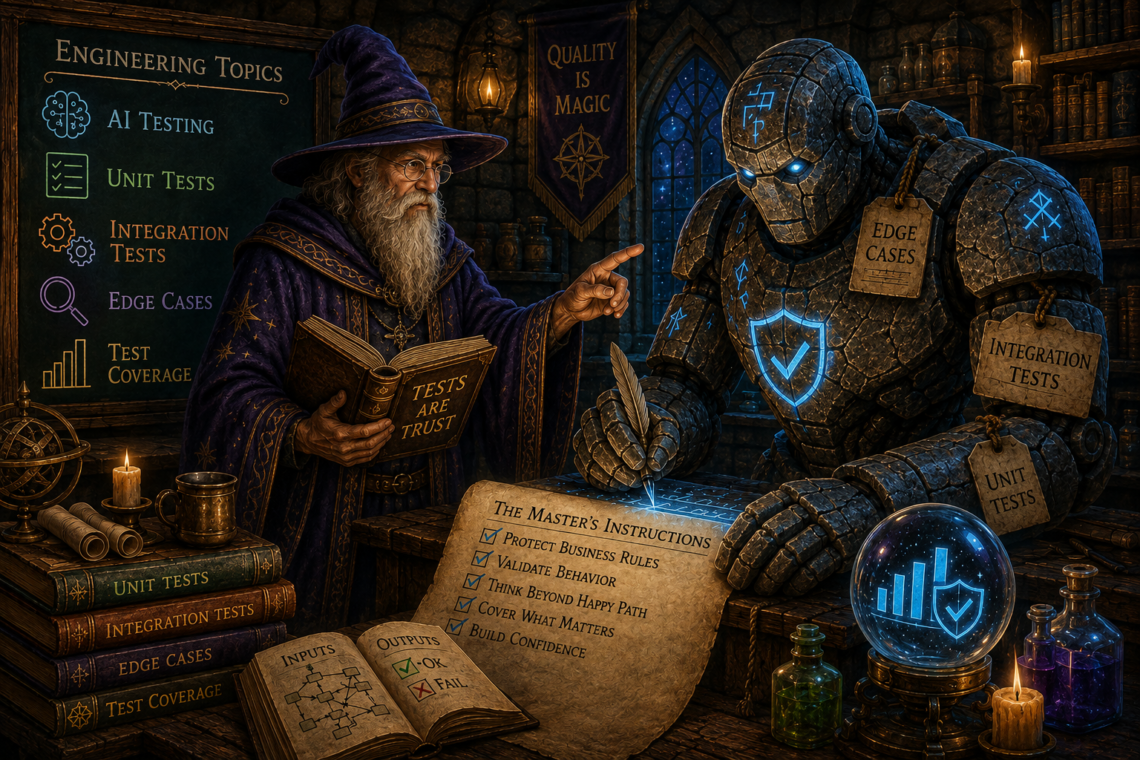
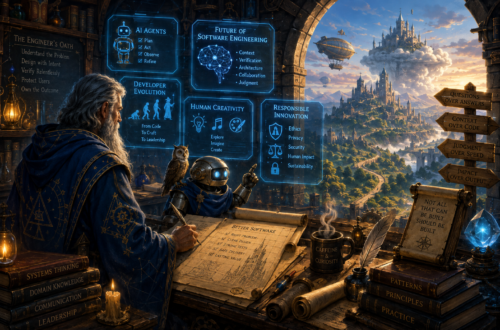
Within The Enchanted Workshop, it is helpful to imagine AI as an enchanted golem built by a skilled wizard. The golem possesses limitless endurance, unquestioning obedience, and incredible speed. It will inspect every stone in the workshop, polish every tool, and repeat the same task thousands of times without complaint. Yet the golem possesses no wisdom of its own. It cannot distinguish between meaningful work and busy work unless its master defines success with exceptional precision.
That metaphor captures the challenge of AI-generated testing remarkably well. AI excels at repetition, expansion, and exploration. Like the enchanted golem tirelessly patrolling every corridor of the workshop, it can produce hundreds of test cases faster than any engineer could reasonably write them. What it cannot do is determine whether those tests actually protect the behaviors that matter most to your users or your business. That judgment remains firmly within the responsibility of experienced engineers.
Carving the Golem’s Command Runes
Testing is sometimes misunderstood as a final verification step performed after development concludes. Experienced engineers recognize something quite different. Well-designed tests become an executable description of system behavior. They document assumptions, preserve architectural intent, and give future developers confidence that critical functionality continues to operate as expected. A strong test suite is as much a communication tool as it is a defect detector.
This perspective changes how AI should participate in testing. If tests merely exist to increase coverage percentages, AI can produce impressive-looking numbers with astonishing speed. If tests exist to preserve engineering intent, then every command rune carved into the golem must reflect deliberate thinking about the system’s responsibilities. AI becomes an assistant performing the craftsmanship rather than the architect making the design decisions.
Many organizations initially evaluate testing quality through metrics such as code coverage. Coverage certainly has value. Untested code frequently hides unexpected defects, and measuring coverage helps identify neglected areas of an application. However, experienced teams learn that coverage is only a measurement of where tests execute code. It says very little about whether those tests validate meaningful behavior.
Consider a function that calculates shipping costs across multiple countries, currencies, and customer memberships. An AI assistant can easily generate tests that execute every branch within the method. Those tests may confirm that the code runs without exceptions, yet never verify whether premium customers actually receive their discounts or international taxes are calculated correctly. Coverage appears excellent while confidence remains surprisingly low.
The difference lies in understanding intent. Engineers naturally think about business rules, customer expectations, regulatory requirements, and operational risks. AI generally reasons from patterns found within the surrounding code and its training data. Without careful guidance, it tends to verify implementation details rather than validate outcomes users actually experience.
A test is not evidence that software works. It is evidence that someone cared enough to define what working means.
Writing the Master’s Instructions
One of the most valuable habits experienced engineers develop is defining success before searching for failure. It sounds obvious, yet many testing discussions begin by asking what might break rather than what correct behavior truly looks like. The order matters because meaningful failures can only be identified after expected behavior has been established.
Imagine completing the final enchantments on the workshop’s newest golem. If instructed simply to guard the library, it might refuse entry to everyone, including the librarians responsible for maintaining the collection. Technically, the books remain protected. Practically, the workshop can no longer function. The instructions achieved one objective while violating several others that were never explicitly stated.
AI-generated tests frequently encounter the same problem. When prompted only to create unit tests for a method, the model often validates whatever behavior currently exists. It rarely questions whether that behavior aligns with the underlying business requirements unless those expectations are clearly described. Existing bugs can therefore become permanently documented as expected behavior.
Effective prompts shift the conversation away from implementation and toward observable outcomes. Rather than requesting tests for a specific function, engineers describe the responsibilities that function fulfills, the constraints it must honor, and the situations that must never occur. Those instructions become the runes that guide the golem’s work, providing the AI with the context necessary to generate tests that examine behavior rather than merely exercise code paths.
Consider an order validation service that approves purchases before payment processing. A weak request might ask AI to generate unit tests for the validation method. A stronger request states that orders exceeding inventory must always be rejected, inactive customer accounts cannot make purchases, promotional discounts expire on specific dates, and duplicate submissions should never create multiple transactions. Suddenly, the generated tests begin reflecting business intent rather than implementation mechanics.
The most effective AI-assisted testing workflows resemble conversations between experienced engineers instead of command execution. Each prompt refines assumptions, introduces additional scenarios, clarifies edge cases, and gradually teaches the model what success truly means. Like the tireless golem working faithfully beneath the vaulted ceilings of the workshop, AI follows its instructions with remarkable consistency. The quality of its work ultimately depends upon the quality of the guidance it receives.
Designing the Workshop’s Trial Chambers
One of AI’s greatest strengths is its ability to imagine variations that engineers may overlook during an initial implementation. Given enough context, it can rapidly generate boundary conditions, invalid inputs, unexpected sequences of events, and combinations of data that would require considerable manual effort to enumerate. Used well, AI becomes an excellent brainstorming partner for discovering additional scenarios rather than replacing the engineer’s understanding of the system.
That partnership becomes especially valuable when exploring edge cases. Production failures rarely occur because users follow the happy path exactly as developers envisioned. Systems fail because a customer submits an empty form after a session expires, an external service responds slowly, a timestamp crosses midnight in another time zone, or an inventory update arrives milliseconds after another transaction. These situations are tedious to enumerate manually, yet they are exactly the kinds of variations AI can help generate when provided with sufficient business context.
Every workshop worthy of a master wizard contains trial chambers where enchanted creations are tested before they are trusted. The chambers are deliberately constructed to expose weaknesses rather than celebrate successes. Software testing serves the same purpose. Instead of asking whether code works under perfect conditions, effective tests deliberately challenge the assumptions most likely to fail once real users begin interacting with the system.
The key is remembering that AI proposes possibilities rather than certainties. Every suggested test should answer a simple question before it is added to the test suite. Does this scenario represent behavior that matters to users, the business, or the application’s long-term stability? If the answer is no, the test may simply become another maintenance burden waiting for future developers.
Consider a payment service responsible for processing customer orders. A simple prompt might produce several tests verifying that valid payments succeed and invalid payments fail. A stronger engineering conversation asks AI to identify conditions involving duplicate payment requests, network interruptions, expired authorization tokens, partial refunds, currency mismatches, and retry behavior after temporary failures. The resulting test suite becomes significantly more resilient because it reflects operational reality instead of ideal circumstances.
Consulting the Workshop’s Spellbook
The quality of AI-generated tests often depends less on technical terminology than on the questions engineers ask. Prompting AI to write unit tests usually produces reasonable coverage of existing logic. Prompting AI to identify assumptions, failure modes, and business invariants produces an entirely different class of tests. The model begins reasoning about the system rather than merely translating the implementation into assertions.
For example, suppose an inventory reservation service determines whether an order can proceed.
A minimal request might simply be:
Generate unit tests for this inventory reservation method.The generated tests will likely verify expected return values for common inputs. While useful, they rarely challenge the underlying assumptions.
A stronger prompt encourages deeper reasoning:
This service reserves inventory before checkout.

Generate unit tests that verify:

- inventory never becomes negative
- duplicate reservation requests remain idempotent
- concurrent requests cannot oversell stock
- canceled reservations return inventory correctly
- failed transactions leave inventory unchanged

Suggest additional edge cases that protect these business rules.
Notice how the second prompt never focuses on the implementation itself. Instead, it describes the responsibilities the software must uphold regardless of how the code evolves. If the implementation changes during a future refactoring, those expectations should remain true. That distinction yields tests that survive architectural evolution rather than being tightly coupled to today’s implementation details.
Imagine replacing inventory with a vault of enchanted reagents inside the workshop. The golem does not need to understand how every shelf is organized, or every cabinet is constructed. It only needs to ensure that no rare ingredient disappears unexpectedly, no apprentice withdraws materials twice, and no failed experiment permanently depletes the workshop’s supply. The implementation may change over time, but the rules governing the workshop remain constant. Well-designed tests protect those rules in exactly the same way.
This approach also encourages AI to become a reviewer rather than merely a code generator. Instead of asking what code should be written, engineers begin to ask which assumptions deserve protection. Those conversations frequently uncover overlooked scenarios long before production users ever encounter them.
AI does not create confidence. It simply scales whatever definition of confidence you provide.
From Brittle Clay to Enchanted Stone
Many development teams eventually discover that writing tests is easier than maintaining them. A test suite that constantly fails after harmless refactoring soon loses credibility. Developers begin questioning whether failures indicate genuine regressions or simply outdated assertions. Eventually, the temptation grows to update failing tests without fully understanding why they broke.
AI can unintentionally contribute to this problem by making assertions about implementation details rather than observable behavior. Tests that verify internal helper methods, private data structures, or exact execution sequences become tightly coupled to the current design. Minor improvements to readability or performance suddenly require dozens of unrelated tests to change alongside the production code.
Master builders never construct workshop walls from brittle clay when enchanted stone is available. One survives until the first hard winter. The other withstands decades of weather because it was designed around enduring principles instead of temporary convenience. Test suites follow the same pattern. Assertions tied to implementation crumble whenever the code changes, while tests built around observable behavior continue protecting the system through years of refactoring.
Experienced engineers therefore encourage AI to validate outcomes that users, APIs, or dependent systems actually observe. If a report is generated correctly, customers rarely care how many helper methods executed internally. If an order is processed successfully, they do not measure the sequence of private function calls. Resilient tests focus on externally visible behavior because behavior defines the software’s contract.
Coverage measures where your code went. Good tests explain why it mattered.
That philosophy transforms AI into a remarkably productive collaborator. The model can generate large numbers of behavioral tests while engineers concentrate on defining meaningful contracts. Each side contributes its greatest strength. AI supplies speed and breadth. Engineers provide judgment, priorities, and architectural intent. Together they create a testing strategy that is stronger than either could achieve alone.
The Wizard Still Holds the Chisel
Perhaps the greatest misconception surrounding AI-assisted testing is that the goal is to automate the engineer out of the process. In reality, the opposite is true. As AI becomes more capable of producing code, documentation, and tests, the value of engineering judgment only increases. Someone must still decide which behaviors deserve protection, which risks are acceptable, and which assumptions could one day become expensive failures.
This is why experienced developers rarely measure the success of a test suite by the number of tests it contains. They measure it by the confidence those tests provide when change inevitably arrives. Every production system evolves. Features are added, architectures are refined, dependencies change, and performance improvements alter implementations. A valuable test suite enables those changes with confidence by verifying the behaviors that matter, rather than the implementation that exists today.
AI accelerates this process tremendously. It can generate variations, suggest edge cases, identify missing scenarios, and even recommend additional assertions that strengthen existing tests. Yet every suggestion still requires an engineer to answer the most important question in software development. Does this test protect something valuable, or does it merely exercise another line of code?
That question rarely has a purely technical answer. Sometimes protecting a business rule matters far more than increasing branch coverage. Sometimes an integration test provides greater confidence than twenty isolated unit tests. Sometimes deleting outdated tests improves maintainability more than adding new ones. These are architectural decisions born from experience, and they cannot be delegated to any tool, regardless of how sophisticated it becomes.
Within the Enchanted Workshop, every master wizard eventually learns that carving the first rune is the easy part. Knowing which runes should never be carved requires wisdom earned through years of building, repairing, and maintaining magical creations. AI may hold the chisel, but the wizard still chooses what is written into stone.
When the Golem Returns to the Workshop
After months of faithful service, the tireless golem eventually returns to the workshop for inspection. It has walked every corridor, guarded every vault, and performed every task exactly as instructed. The master craftsmen do not praise it simply because it worked tirelessly. They examine whether its work still serves the workshop’s purpose. They refine its instructions, replace worn runes, and improve its behavior before sending it back into service.
Software testing deserves the same continuous attention. Test suites are living assets rather than completed artifacts. As systems evolve, new business rules emerge, customer expectations shift, and architectural boundaries change. Tests that once provided tremendous confidence can gradually become outdated, redundant, or focused on behavior that no longer matters. Maintaining a healthy test suite requires the same deliberate care that keeps the workshop’s greatest creations operating reliably year after year.
AI occupies the same role within modern software engineering. It is an extraordinary assistant precisely because it excels at the work humans find repetitive, time-consuming, and mechanically tedious. Like the enchanted golem, it can tirelessly expand a thoughtful testing strategy into hundreds of carefully structured cases without losing patience or consistency. What it cannot do is determine whether the underlying strategy deserves to exist in the first place.
The most effective engineering teams therefore treat AI neither as an oracle nor as a replacement for thoughtful design. They treat it as a trusted apprentice that never grows tired. Every prompt teaches it a little more about the workshop. Every review refines its understanding. Every conversation improves the quality of its future work. The relationship succeeds not because the apprentice becomes wiser than the master, but because the master continually provides better guidance.
That perspective changes the role of testing entirely. Writing tests is no longer about proving that code works today. It is about preserving confidence for every engineer who will inherit the system tomorrow. AI simply makes it possible to build that confidence faster, provided we continue supplying the judgment that machines cannot.
Automation magnifies whatever process already exists. AI simply magnifies it faster.
A tireless servant is only as valuable as the instructions carved into its stone, and the same has always been true of every testing tool we have ever built.
As this week’s theme, Crafting Better Magic, continues throughout The Enchanted Workshop, we have explored two practices that quietly shape the long-term quality of software. Documentation preserves knowledge. Tests preserve confidence. Neither attracts the attention of a flashy demonstration, yet both determine whether future engineers can safely understand, maintain, and extend the systems entrusted to them. Like every enduring enchantment within the workshop, their value grows with time rather than diminishing.
On Friday, we will open one of the oldest chambers in the workshop in Restoring Ancient Spellbooks: Modernizing Legacy Code. Every experienced engineer eventually inherits software that has accumulated years of assumptions, forgotten decisions, and well-intentioned compromises. AI offers remarkable new tools for understanding and refactoring these aging systems, but only when guided by the same engineering judgment that has shaped every lesson in this series. Together, we will explore how to breathe new life into legacy code without erasing the hard-earned knowledge hidden beneath its layers, continuing our journey through The Enchanted Workshop one carefully crafted spell at a time.


You May Also Like
Forbidden Tomes: AI, Security, and Responsible Engineering
The Workshop of Tomorrow: The Future of AI-Assisted Software Engineering