Stack n' Scroll

Code, Campaigns, and Lessons from the Digital Realm

September 2026
S M T W T F S
 12345
6789101112
13141516171819
20212223242526
27282930  
« Aug    

Meta

  • Register
  • Log in
  • Entries feed
  • Comments feed
  • WordPress.org
Frank Jamison Avatar
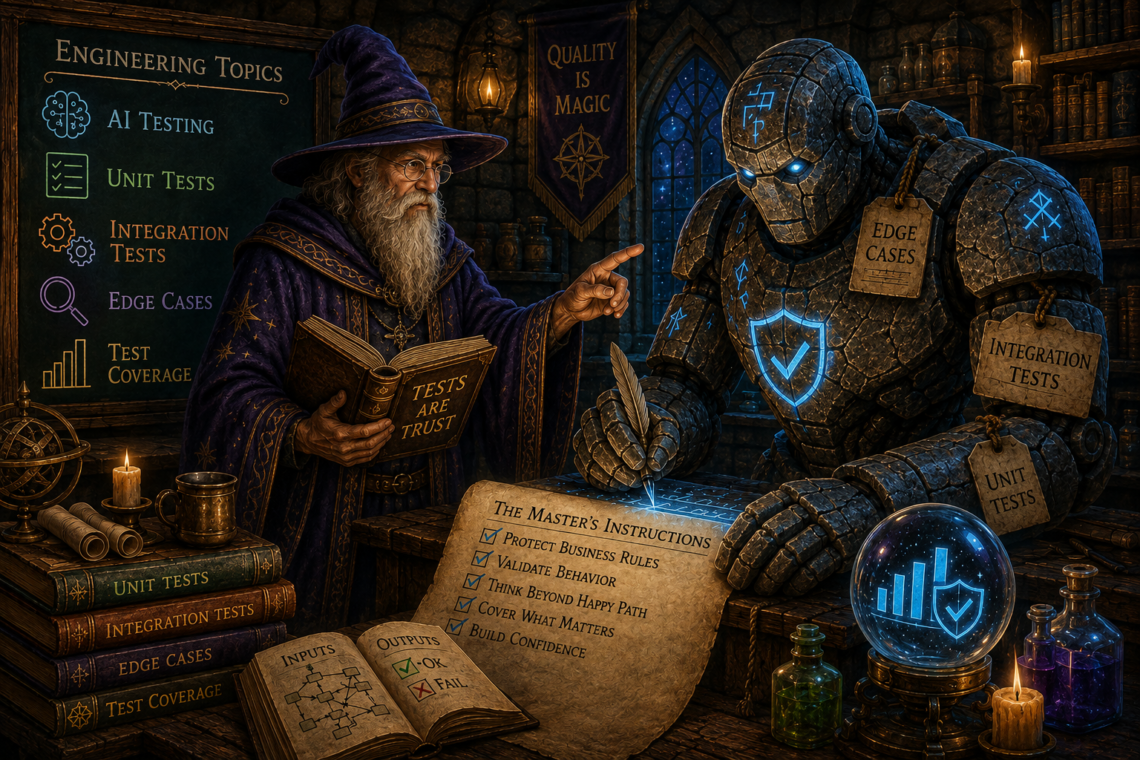
  • A wise wizard in a candlelit medieval workshop mentors a towering stone golem whose glowing blue runes illuminate the room as it carefully writes magical symbols onto a workbench. Behind them, a chalkboard labeled "Engineering Topics" lists AI Testing, Unit Tests, Integration Tests, Edge Cases, and Test Coverage, while a banner reading "Quality Is Magic" hangs above shelves of spellbooks and alchemical supplies. The wizard studies an open book titled Tests Are Trust while pointing toward the golem's work, symbolizing human guidance directing AI-assisted software testing. Nearby, books, scrolls, and a parchment labeled The Master's Instructions emphasize protecting business rules, validating behavior, thinking beyond the happy path, covering what matters, and building confidence. A glowing crystal ball displaying test coverage metrics and engineering-themed books reinforce the article's message that AI is a tireless assistant whose effectiveness depends on the quality of the instructions it receives.
    The Enchanted Workshop

    The Tireless Golem: Building Better Tests with AI

    August 5, 2026 /

    A servant who never sleeps must still be taught what success looks like. Software engineers have always searched for ways to reduce repetitive work without sacrificing quality. Compilers eliminated many manual mistakes. Continuous integration ensured that code could be validated automatically after every change. Static analysis exposed entire categories of defects before applications ever reached production. Each advancement freed engineers to spend more time solving meaningful problems instead of repeating mechanical tasks. Artificial intelligence represents another step along that path, but it introduces a subtle temptation. Because AI can generate code remarkably quickly, it is easy to assume it can generate equally effective tests with little oversight. Many developers discover…

    Read More
    Frank Jamison

    You May Also Like

    An elderly wizard restores a massive ancient spellbook in a candlelit fantasy library, studying aged pages filled with code, diagrams, and architectural notes while a small AI automaton assists nearby. Glowing blue system diagrams, old technical volumes, scrolls, and a castle beyond the window symbolize legacy code, refactoring, code modernization, technical debt, and AI-assisted cleanup.

    Restoring Ancient Spellbooks: Modernizing Legacy Code

    August 7, 2026
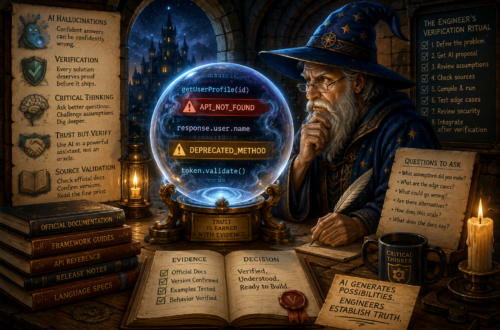
    A thoughtful wizard studies a glowing crystal ball inside a medieval observatory transformed into a software engineering workspace. The crystal ball displays realistic-looking code alongside prominent warning messages indicating nonexistent APIs and deprecated methods, symbolizing AI hallucinations. Surrounding the wizard are official documentation books, verification checklists, engineering notes, and a ritual board outlining a disciplined software validation process. Additional notes encourage asking critical questions, verifying assumptions, and consulting authoritative sources before trusting AI-generated solutions. The scene combines fantasy and technology to illustrate the importance of critical thinking, source validation, and professional judgment in AI-assisted software development.

    The Crystal Ball Lies Sometimes: Verifying AI Before You Trust It

    July 31, 2026
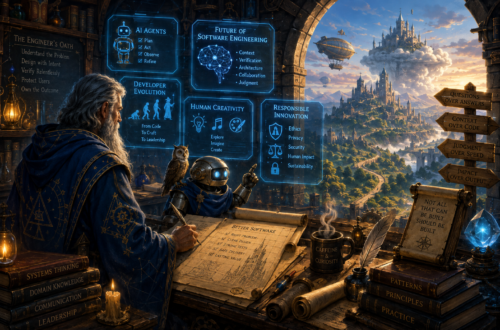
    A fantasy software engineer works beside a small AI automaton in an enchanted workshop overlooking a vast cloud-bound kingdom. Glowing panels represent AI agents, the future of software engineering, developer evolution, human creativity, and responsible innovation, while books, blueprints, and signs emphasize systems thinking, engineering judgment, context, security, and responsible development.

    The Workshop of Tomorrow: The Future of AI-Assisted Software Engineering

    August 21, 2026
  • A wise wizard studies a glowing crystal orb overlooking a vast fantasy kingdom where medieval architecture merges with modern software engineering. Across a towering stone aqueduct, six banners illustrate a continuous delivery pipeline labeled Automation, CI/CD, Testing, Deployment, Infrastructure as Code, and Continuous Improvement, with engineers working at illuminated stations beneath each stage. A detailed map on the wizard's table mirrors the same workflow using symbols and pathways, while holographic diagrams and glowing blue interfaces blend seamlessly into the medieval setting. The composition symbolizes mature software engineering practices transforming disciplined processes into an automated, self-improving kingdom, with warm golden light contrasting against cool blue technological elements. The article title does not appear in the image.
    The Architect's Grimoire

    Seeing Through the Crystal Ball: Observability Beyond Monitoring

    July 20, 2026 /

    A wise ruler never governs a kingdom they cannot see. Software architecture reaches an interesting stage after the obvious problems have been solved. The application survives deployments without drama, customers depend upon it every day, and the engineering team gradually shifts its attention from building features to operating a growing platform. Confidence naturally follows that maturity because the system appears stable, the infrastructure scales predictably, and production incidents become increasingly uncommon. Then, almost without warning, engineers begin encountering problems that refuse to fit neatly into familiar patterns. A handful of users report intermittent failures that nobody can reproduce. Response times drift upward despite healthy infrastructure metrics. A background process occasionally…
    Read More
    Frank Jamison

    You May Also Like

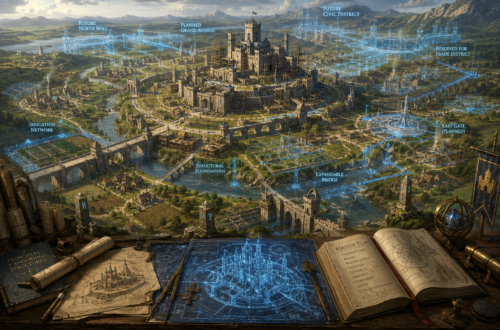
    A panoramic fantasy kingdom is shown in the early stages of carefully planned expansion, centered on a partially completed stone castle surrounded by villages, bridges, roads, and farmland. Glowing blue architectural overlays, magical surveying grids, and blueprint-style projections illustrate future city walls, districts, bridges, and infrastructure without physically constructing them. In the foreground, an architect's drafting table holds illuminated blueprints, manuscripts, measuring tools, compasses, and engineering instruments, reinforcing the theme of deliberate planning and long-term design. The peaceful medieval landscape emphasizes thoughtful growth, maintainability, and architectural foresight in a classic Dungeons & Dragons-inspired editorial fantasy style.

    Building for Today’s Quest or Tomorrow’s Empire?

    July 1, 2026
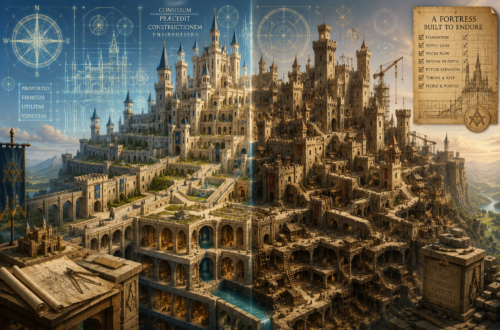
    A vast medieval fantasy castle dominates the landscape, split into two contrasting halves to illustrate the importance of architectural planning. The left side features a beautifully organized fortress with symmetrical towers, interconnected courtyards, bridges, aqueducts, and orderly roads, overlaid with glowing magical blueprints, surveying grids, compass roses, and geometric construction diagrams. The right side remains impressive but is visibly less organized, with awkward tower placement, inefficient stairways, conflicting roads, and haphazard expansions that suggest growth without an overall plan. Artistic cutaway sections reveal deep stone foundations, underground chambers, drainage tunnels, and structural supports extending into bedrock. Tiny builders and stonemasons emphasize the immense scale of the castle, while warm morning light highlights the contrast between intentional design and organic growth, visually representing the role of software architecture in creating maintainable, long-lasting systems.

    Why Castles Need Architects

    June 29, 2026
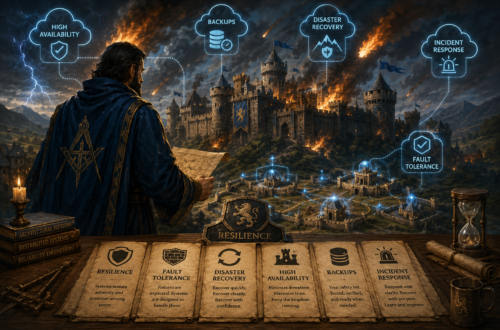
    A fantasy-inspired digital illustration depicts a royal architect standing over maps and plans as a massive stone castle burns under a night sky filled with flaming projectiles. Although sections of the fortress are engulfed in flames, smaller fortified districts below remain connected by glowing blue pathways, symbolizing resilient system architecture and fault isolation. Floating holographic icons represent High Availability, Backups, Disaster Recovery, Fault Tolerance, and Incident Response, visually linking medieval defenses with modern software engineering concepts. Scrolls and architectural plans in the foreground reinforce themes of preparation, recovery, and thoughtful design, while the dramatic contrast between destruction and continuity emphasizes that resilient systems are designed to withstand failure rather than prevent it entirely.

    When the Kingdom Burns: Designing for Failure Before Disaster Strikes

    July 17, 2026
  • The Architect's Grimoire (13)
  • The CSS Codex (13)
  • The Enchanted Workshop (13)
  • The Full-Stack Campaign (8)
  • The Guildmaster’s Handbook (13)
  • The Kingdom in the Clouds (9)

AI-Assisted Development Artificial Intelligence Backend Development Career Development Clean Code Cloud-Native Architecture Code Quality CSS Architecture CSS Best Practices Design Systems Developer Growth Developer Productivity Distributed Systems Dungeons and Dragons Engineering Culture Engineering Judgment Engineering Leadership Fantasy Theme Front-End Development Frontend Development Full Stack Development Human-AI Collaboration Maintainable Code Maintainable CSS Mentorship Professional Development Professional Growth Refactoring Responsive Design Software Architecture Software Craftsmanship Software Design Software Development Software Engineering StackNScroll System Design Technical Debt Technical Leadership The Architect's Grimoire The CSS Codex The Enchanted Workshop The Full-Stack Campaign The Guildmaster's Handbook The Kingdom in the Clouds Web Development

Stack N' Scroll - 2026 ©