-
The Automated Kingdom: When Excellence Becomes Routine
The greatest kingdoms flourish because excellence becomes routine. The most reliable software systems are often the least impressive. Their deployments happen without ceremony. Their monitoring catches problems before customers notice them. Their infrastructure quietly provisions itself, and their operational routines become so dependable that engineers gradually stop thinking about them. The greatest compliment those systems receive is that nobody considers them remarkable anymore. Like the finest kingdoms, their success has become ordinary because excellence has become routine. Travelers rarely praise the aqueducts that deliver clean water every day or the roads that quietly connect every village to the capital. They admire the thriving markets, magnificent libraries, and prosperous cities made…
-
Hidden Traps in the Dungeon: Escaping Technical Debt
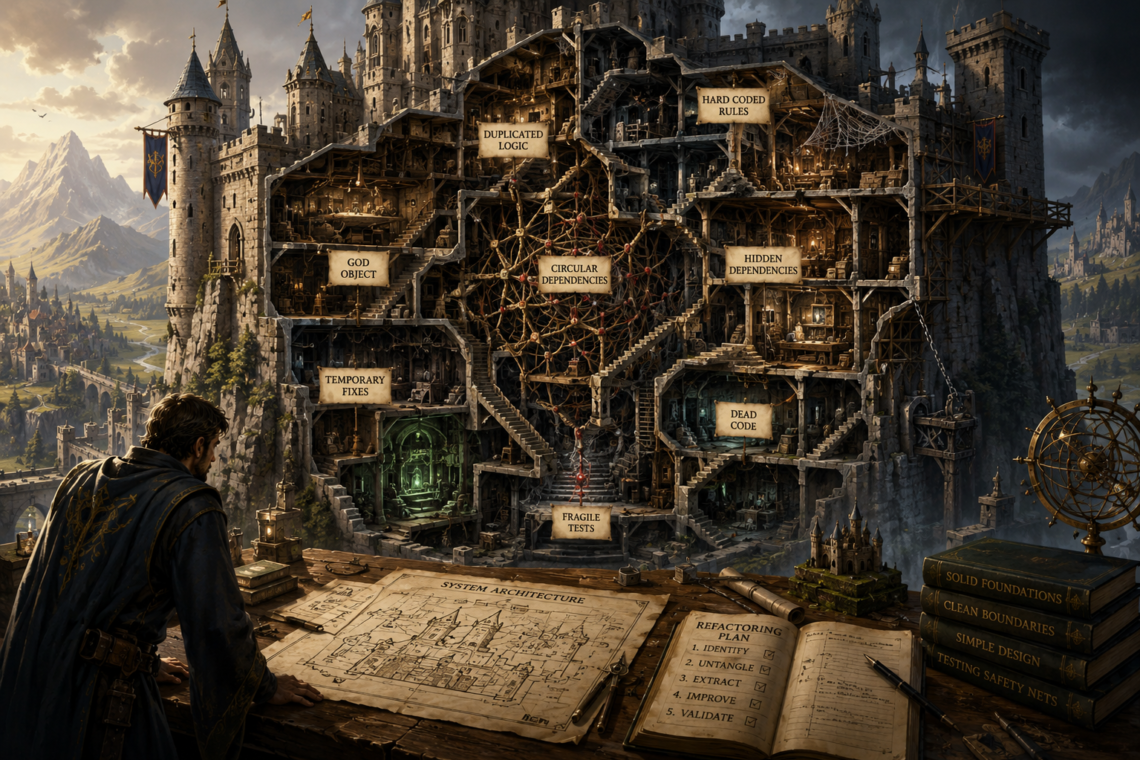
The deadliest dangers are often the ones built into the castle itself. No architect intentionally designs a maze. Every castle begins with a sensible plan. Corridors connect naturally, storerooms serve nearby kitchens, towers overlook vulnerable approaches, and every staircase leads somewhere meaningful. Yet castles that survive for generations rarely retain that original simplicity. New rulers expand old wings. Temporary passageways become permanent corridors. Storage rooms become workshops. Secret tunnels built during one crisis remain long after the danger has passed. Over time, the castle becomes increasingly difficult to navigate, not because its builders lacked skill, but because each generation solved the problems immediately before them. Long-lived software follows the same…
-
Becoming the Developer You Once Needed
The greatest guides are often those who remember what it felt like to walk alone. The Veteran at the Tavern Table One of the most surprising lessons I have learned throughout my career is that software development is not ultimately about software. The code matters. The systems matter. The architecture matters. Yet when I look back on the people who changed my career, I do not remember them primarily because of the software they built. I remember them because of the guidance they provided when I needed it most. Over time, I came to realize that the final stage of becoming a developer is not mastering technology. It is becoming…
-
When Impostor Syndrome Rolls a Critical Hit
Even seasoned adventurers sometimes mistake uncertainty for failure. The Trial Hidden Behind the Character Sheet During this week’s theme, The Trials of the Realm, it would be easy to focus exclusively on technical challenges. We could discuss production outages, difficult debugging sessions, complex architectures, or impossible deadlines. Those are certainly trials every engineer encounters. Yet one of the most persistent challenges I have faced throughout my career never appeared in a ticketing system, generated an error message, or triggered an alert. It appeared quietly in my own thinking and attempted to convince me that I did not belong where I had already earned the right to stand. Impostor syndrome is…
-
Legacy Code and Ancient Curses
Every developer eventually enters forgotten ruins and wonders what kind of sorcery built them. Entering the Forgotten Ruins Among all the challenges software engineers face throughout their careers, few are as universal as inheriting legacy code. Most developers begin their journey imagining they will spend their days creating new applications, experimenting with modern technologies, and designing elegant architectures from a blank canvas. While those opportunities certainly exist, they represent only a portion of professional software development. Much of our work involves maintaining, extending, repairing, and modernizing systems that already exist. Some of these applications are only a few years old. Others have survived multiple generations of developers and business leaders.…
-
Code Reviews Without Emotional Damage
Criticism is not the enemy. Pride without growth is far more dangerous. The Review Table in the Guild Hall One of the most important lessons I have learned during my years in software development has very little to do with writing code. It is not about mastering a framework, learning a language, designing architecture, or deploying applications to the cloud. Instead, it concerns learning how to participate in code reviews without allowing pride, insecurity, frustration, or ego to interfere with growth. Many developers spend years improving their technical skills while investing far less effort in the collaborative skills that make engineering teams successful. Yet some of the strongest engineers I…
-
Learning Without Burning Out
No warrior survives every battle at full speed. Pace yourself, or exhaustion becomes the enemy. In our last gathering at the guild hall, I spoke about choosing a path. Every developer eventually faces a decision about where to invest time, energy, and attention. Some are drawn toward frontend development. Others find themselves fascinated by backend systems, cybersecurity, cloud infrastructure, data science, or countless other specialties. Choosing a path provides direction, but direction alone is not enough. An adventurer who charges down the correct road at an unsustainable pace may still fail to reach the destination. One of the most important lessons I have learned throughout my career is that success…