Stack n' Scroll

Code, Campaigns, and Lessons from the Digital Realm

September 2026
S M T W T F S
 12345
6789101112
13141516171819
20212223242526
27282930  
« Aug    

Meta

  • Register
  • Log in
  • Entries feed
  • Comments feed
  • WordPress.org
Frank Jamison Avatar
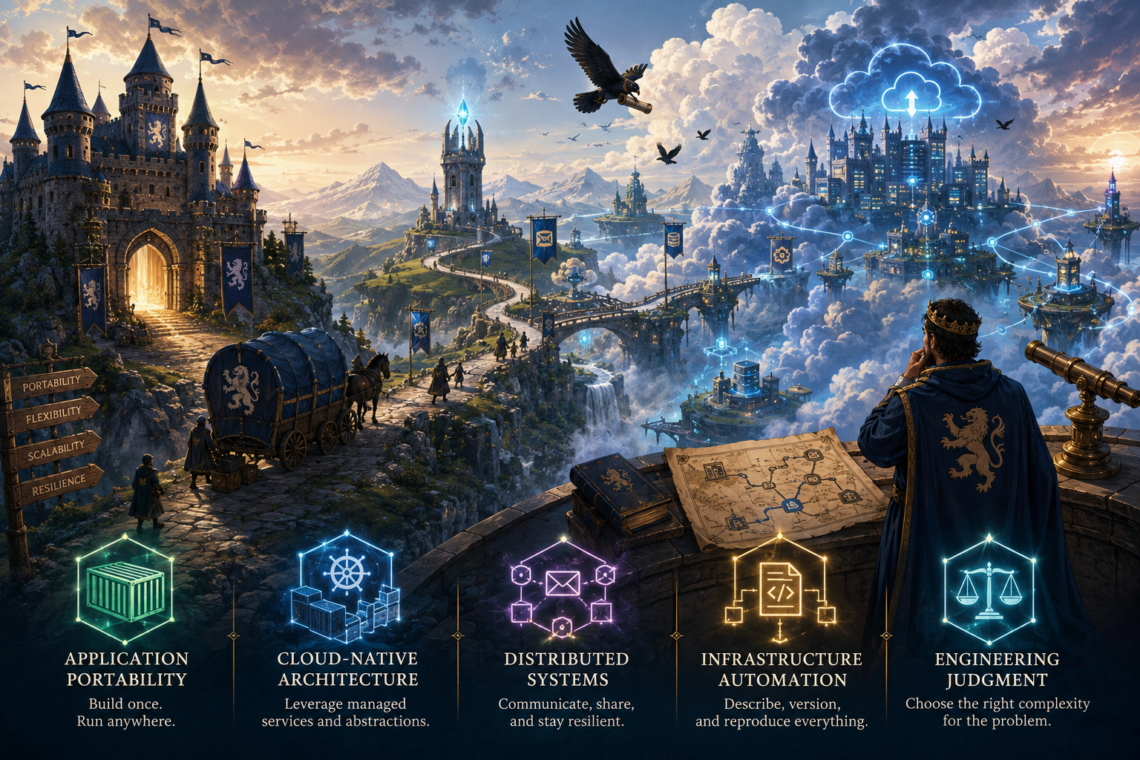
  • A fantasy castle opens onto a winding road leading toward a futuristic kingdom floating among the clouds, connected by glowing networks and infrastructure. A crowned architect studies the realm from a stone overlook while visual symbols represent application portability, cloud-native architecture, distributed systems, infrastructure automation, and engineering judgment.
    The Kingdom in the Clouds

    The Kingdom in the Clouds: When Software Leaves the Castle

    August 23, 2026 /

    The strongest kingdoms are not bound to a single castle, but built to endure wherever their people must go. For much of software history, we built applications as though we were building castles. The walls gave us boundaries. We knew where the application lived, where its data lived, and which machines carried the work. Even complicated systems offered a comforting sense of geography because their important pieces occupied places engineers could identify and understand. When something failed, there was usually a server, process, database, or network connection somewhere that could be examined. Modern software has been steadily dismantling that certainty. Applications move between environments, workloads appear and disappear, and infrastructure…

    Read More
    Frank Jamison

    You May Also Like

    A vast cloud kingdom of floating cities and towers connected by glowing aerial roads, gateways, and branching energy paths, symbolizing service communication, APIs, service discovery, load balancing, and reliable cloud-native networking.

    Roads Through the Sky: Connecting Cloud-Native Services

    September 4, 2026
    Cutaway view of a vast wizard’s tower rising above the clouds, revealing layered workshops, storage chambers, managed systems, and small engineer-scholars operating within a provider-maintained infrastructure.

    Renting the Wizard’s Tower: Understanding Cloud Infrastructure

    August 31, 2026
    A grand fantasy war room contains a glowing tabletop map of a vast kingdom, with many castles connected by luminous roads and blue magical markers as robed strategists study the scene beneath towering banners, stone arches, and candlelight.

    The Keeper of a Thousand Castles: Understanding Kubernetes

    August 28, 2026
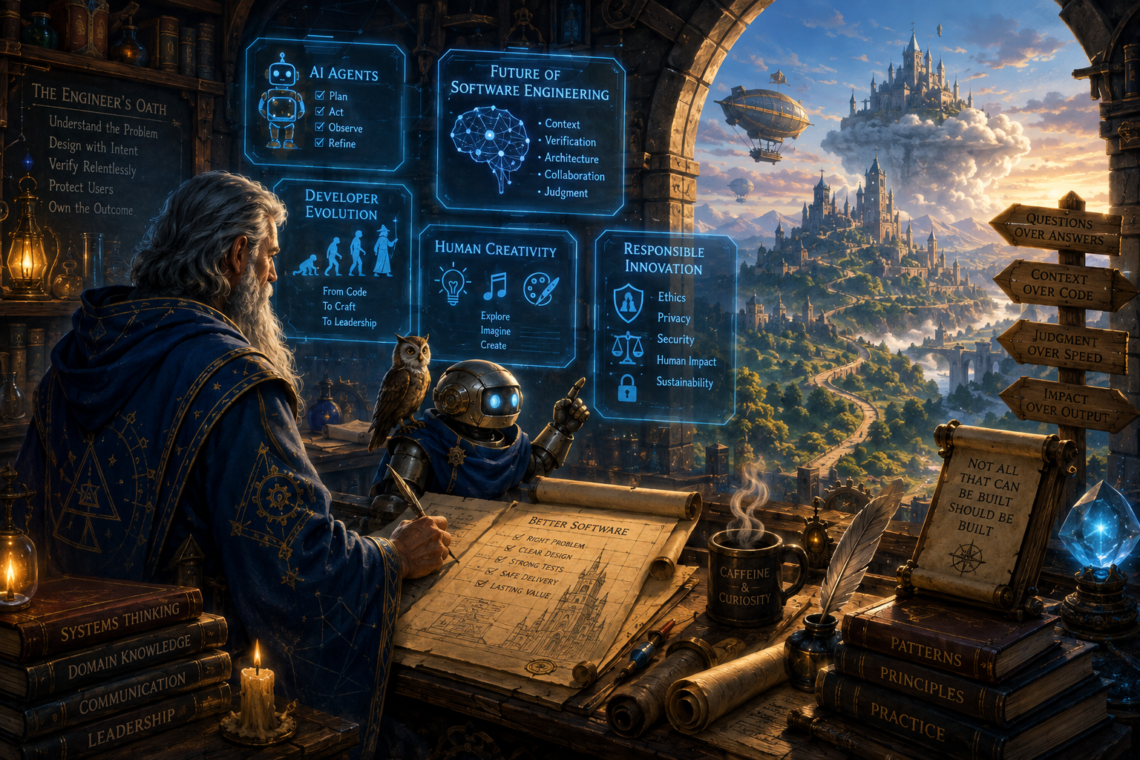
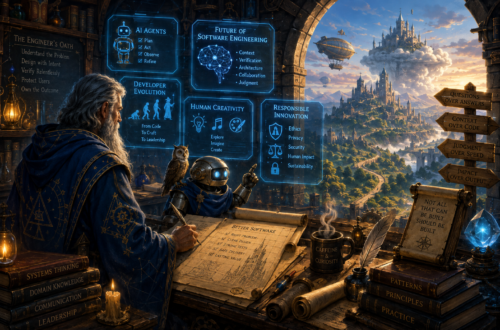
  • A fantasy software engineer works beside a small AI automaton in an enchanted workshop overlooking a vast cloud-bound kingdom. Glowing panels represent AI agents, the future of software engineering, developer evolution, human creativity, and responsible innovation, while books, blueprints, and signs emphasize systems thinking, engineering judgment, context, security, and responsible development.
    The Enchanted Workshop

    The Workshop of Tomorrow: The Future of AI-Assisted Software Engineering

    August 21, 2026 /

    Every generation of wizards inherits greater magic and greater responsibility. There was a time when the most valuable object in a wizard’s workshop was the spellbook. It contained knowledge that had taken generations to discover and preserve, and a young wizard might spend years learning its incantations before being trusted to use them. Then imagine placing an enchanted tome on the workbench that could produce a new spell on demand, explain unfamiliar enchantments, repair damaged runes, and occasionally invent an incantation that sounded perfectly legitimate but summoned absolutely nothing. The workshop would become more productive almost overnight, but it would not become simpler. Software engineering has entered that workshop. AI-assisted…

    Read More
    Frank Jamison

    You May Also Like

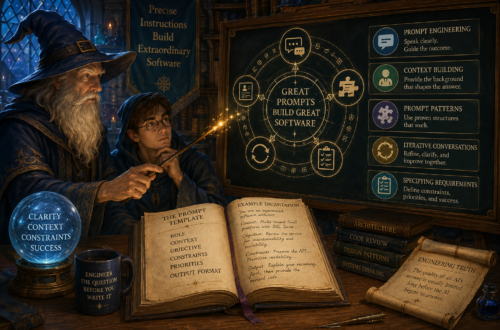
    An experienced wizard mentors a young apprentice in a candlelit magical workshop where fantasy and software engineering converge. A glowing instructional board illustrates prompt engineering concepts including context building, prompt patterns, iterative conversations, and specifying requirements, while an open spellbook displays a structured AI prompt template. A crystal ball labeled with clarity, context, constraints, and success symbolizes effective prompt design, surrounded by engineering books, architectural references, and magical artifacts that reinforce the theme of AI as an apprentice guided by thoughtful engineering judgment.

    Speaking the Language of Spells: Prompt Engineering That Works

    July 29, 2026
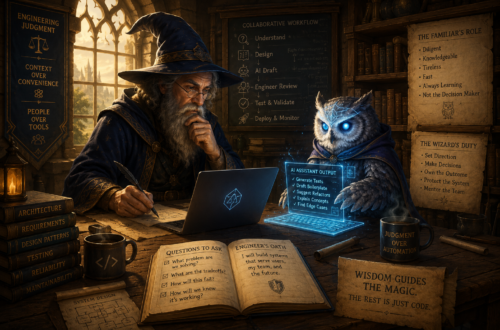
    An experienced wizard sits thoughtfully at a workbench inside a warm, medieval-inspired workshop, collaborating with a glowing owl familiar that represents artificial intelligence. Ancient spellbooks and engineering references surround them alongside a modern laptop displaying architectural diagrams, while magical holographic interfaces illustrate AI-assisted development workflows. Banners and notes throughout the workshop emphasize engineering judgment, human responsibility, and collaboration over automation. The scene blends fantasy and software engineering to symbolize AI as a trusted apprentice that accelerates development without replacing the wisdom, decision-making, and accountability of the engineer.

    The Wizard’s New Apprentice: Working Alongside AI

    July 27, 2026
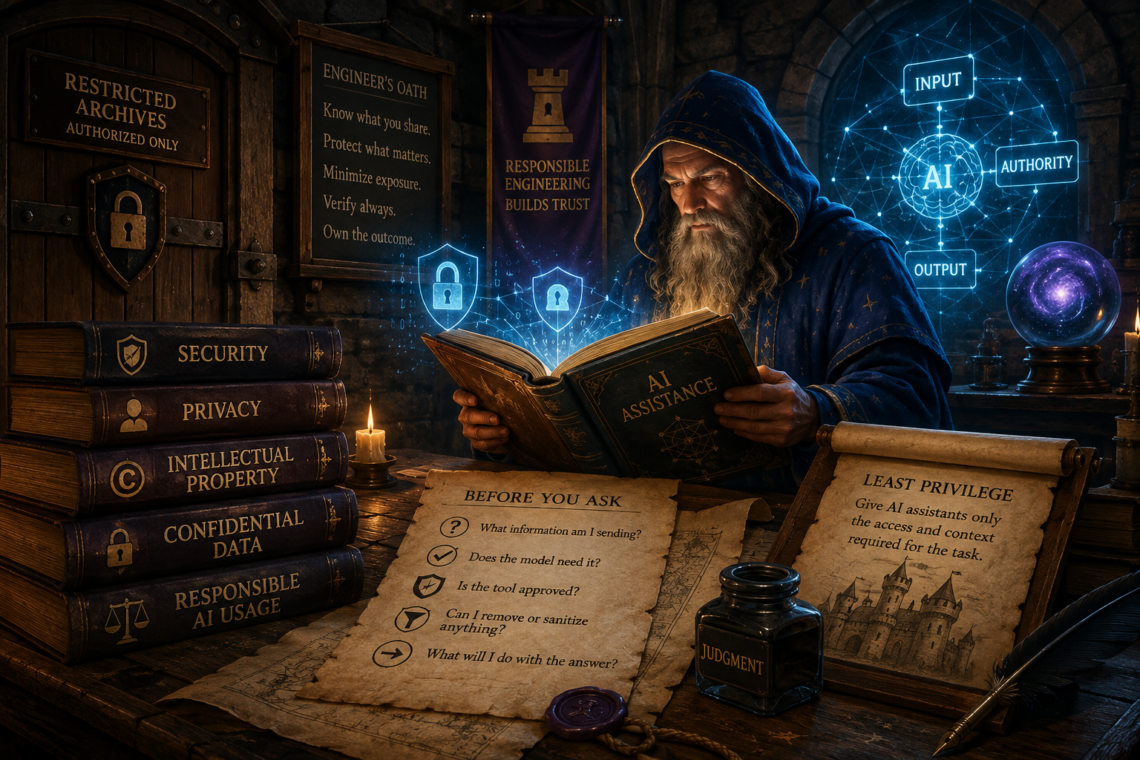
    A fantasy wizard studies a glowing AI spellbook inside a restricted archive, surrounded by magical security shields and references to security, privacy, intellectual property, confidential data, and responsible AI usage. An illuminated diagram connects AI with input, authority, and output, while notes about least privilege and careful information sharing emphasize responsible engineering judgment.

    Forbidden Tomes: AI, Security, and Responsible Engineering

    August 12, 2026
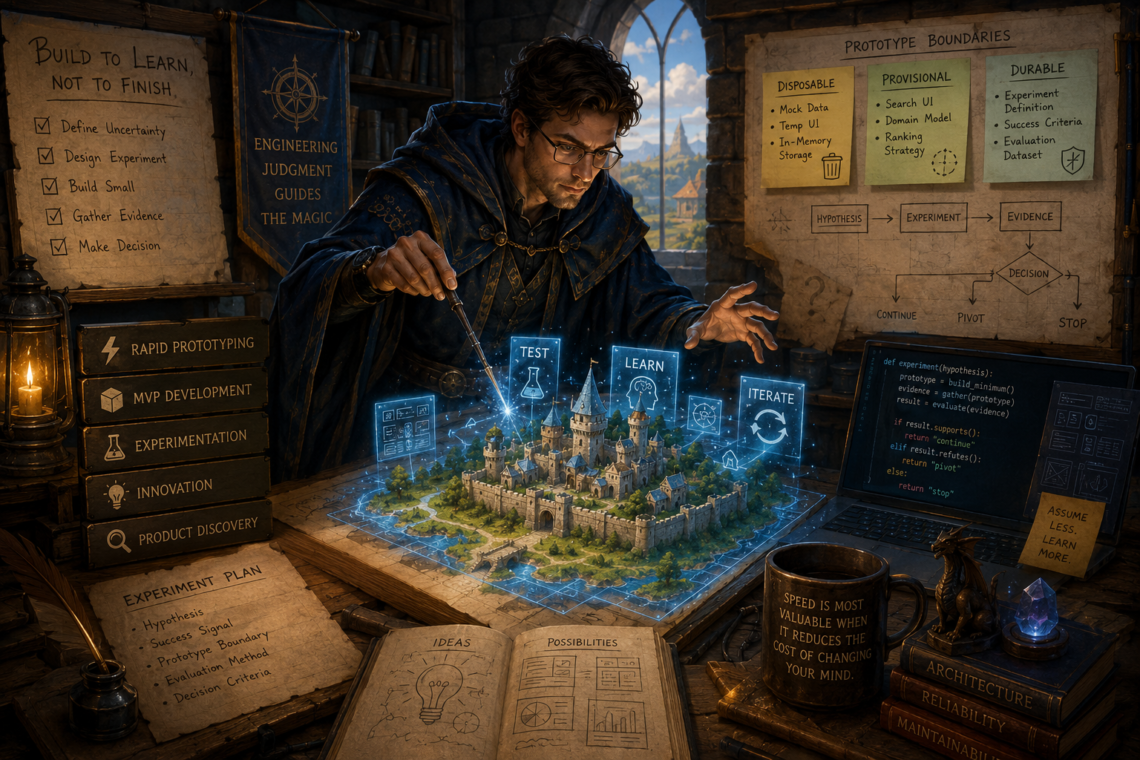
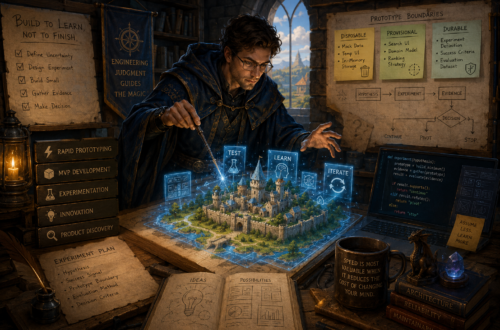
  • A fantasy-inspired software engineer in a medieval workshop uses glowing blue magic to build a miniature castle prototype, surrounded by diagrams for prototype boundaries, experimentation, and decision-making, with references to rapid prototyping, MVP development, innovation, and product discovery.
    The Enchanted Workshop

    Building New Kingdoms Overnight: Rapid Prototyping with AI

    August 19, 2026 /

    True magic does not eliminate the work. It allows impossible journeys to begin before sunrise. There is a particular kind of engineering work that becomes expensive long before anyone has written much code. A team spends weeks debating architecture, defining abstractions, estimating implementation effort, and defending assumptions about users who have not yet touched the product. By the time the first working version appears, the original question has often been buried beneath the machinery built to answer it. Rapid prototyping exists to reverse that sequence, not by eliminating engineering discipline, but by moving learning earlier in the process. Instead of investing heavily before discovering whether an assumption is true, engineers…

    Read More
    Frank Jamison

    You May Also Like

    A fantasy software engineer works beside a small AI automaton in an enchanted workshop overlooking a vast cloud-bound kingdom. Glowing panels represent AI agents, the future of software engineering, developer evolution, human creativity, and responsible innovation, while books, blueprints, and signs emphasize systems thinking, engineering judgment, context, security, and responsible development.

    The Workshop of Tomorrow: The Future of AI-Assisted Software Engineering

    August 21, 2026
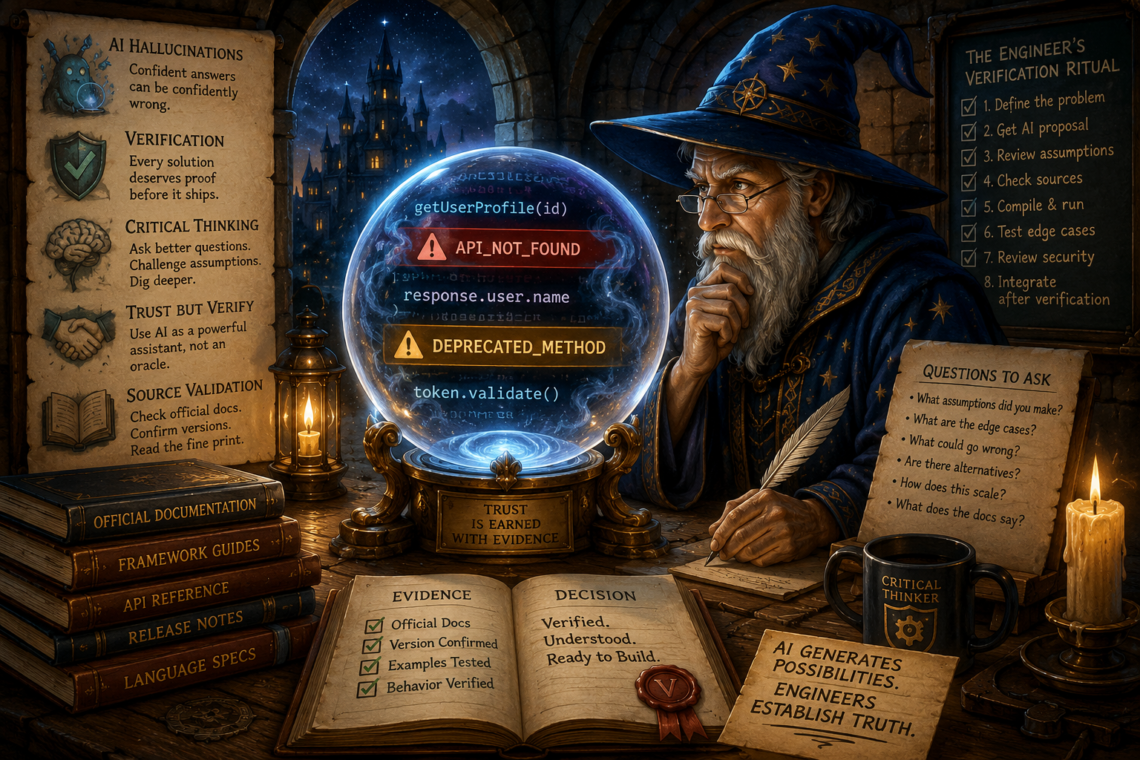
    A thoughtful wizard studies a glowing crystal ball inside a medieval observatory transformed into a software engineering workspace. The crystal ball displays realistic-looking code alongside prominent warning messages indicating nonexistent APIs and deprecated methods, symbolizing AI hallucinations. Surrounding the wizard are official documentation books, verification checklists, engineering notes, and a ritual board outlining a disciplined software validation process. Additional notes encourage asking critical questions, verifying assumptions, and consulting authoritative sources before trusting AI-generated solutions. The scene combines fantasy and technology to illustrate the importance of critical thinking, source validation, and professional judgment in AI-assisted software development.

    The Crystal Ball Lies Sometimes: Verifying AI Before You Trust It

    July 31, 2026
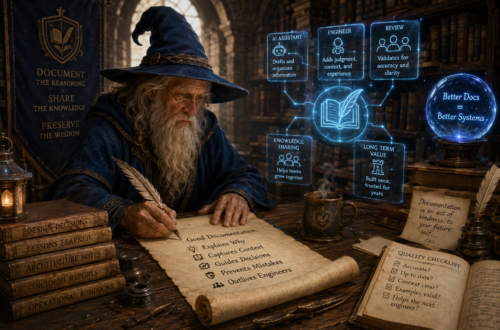
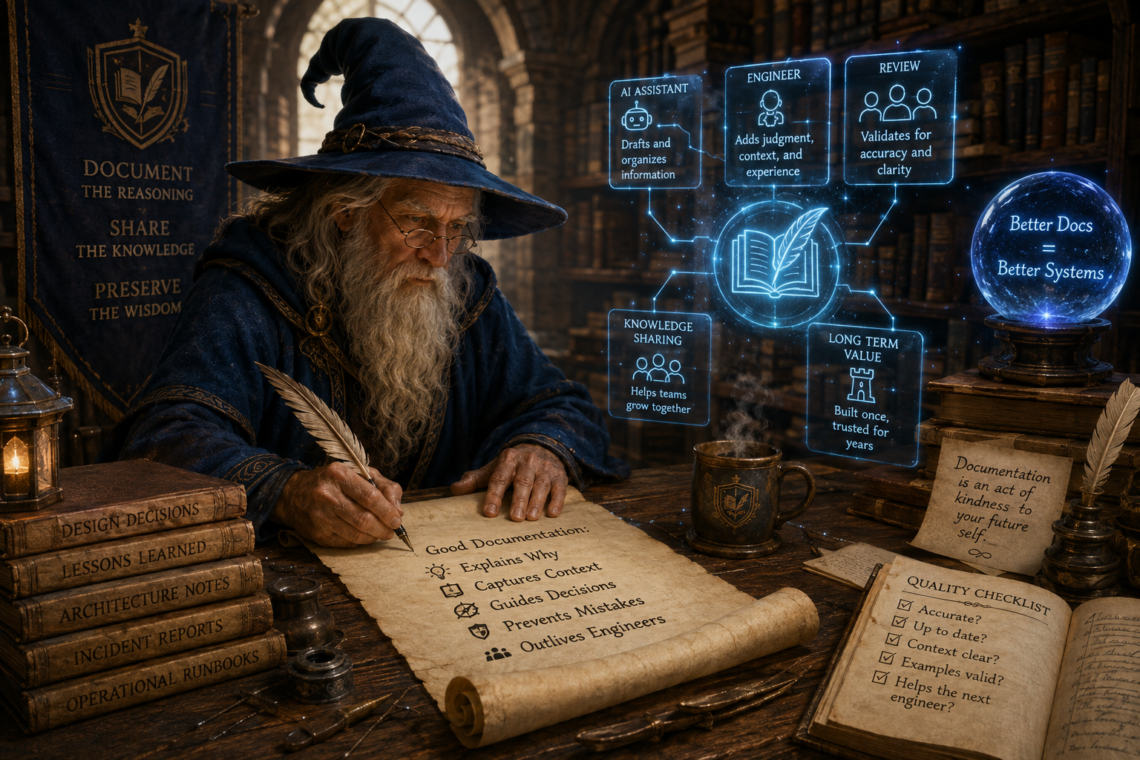
    An elderly wizard in deep blue robes sits at a wooden desk inside a grand medieval library, carefully writing on a parchment with a feather quill. Shelves of ancient books fill the background beneath tall stone arches, creating the atmosphere of a magical archive. Around the wizard, glowing blue holographic panels illustrate an AI-assisted documentation workflow, showing an AI assistant drafting information, an engineer adding judgment and context, and a review process validating accuracy and clarity before documentation is shared. Stacks of books labeled Design Decisions, Lessons Learned, Architecture Notes, Incident Reports, and Operational Runbooks reinforce the importance of preserving engineering knowledge. A scroll on the desk highlights the qualities of effective documentation, including explaining why decisions were made, capturing context, guiding future decisions, preventing mistakes, and outliving the original engineers. Nearby, a documentation quality checklist emphasizes accuracy, current information, clear context, valid examples, and usefulness to future team members. A glowing crystal orb displays the message Better Docs = Better Systems, visually connecting thoughtful documentation, AI-assisted knowledge sharing, and long-term software maintainability.

    The Endless Scribe: Writing Documentation with AI

    August 3, 2026
  • The Enchanted Workshop

    The Guild of Many Minds: Collaborative Engineering in the Age of AI

    August 17, 2026 /

    The strongest enchantments emerge only after every wizard has challenged the spell. There is a peculiar temptation that arrives with powerful tools. When an engineer can describe a problem to an AI system and receive working code seconds later, software development begins to feel increasingly individual. A developer can explore an unfamiliar library, draft an implementation, generate tests, inspect an error, and revise the solution without asking another person to leave whatever they are doing. The enchanted workshop suddenly contains a tireless apprentice who is always available and remarkably quick with a quill. Yet the more capable that apprentice becomes, the easier it is to forget one of the oldest…

    Read More
    Frank Jamison

    You May Also Like

    A wide, painterly fantasy workshop serves as an editorial metaphor for modern software engineering. An experienced wizard mentor and a thoughtful apprentice study a glowing architectural blueprint projected above a large drafting table covered with medieval engineering plans, measuring tools, and manuscripts. A luminous blue magical familiar sits beside them, symbolizing human and AI collaboration. Towering bookshelves are filled with volumes on algorithms, design patterns, testing, security, ethics, and software architecture, while the surrounding workshop features drafting instruments, enchanted artifacts, blueprints, and engineering ledgers that emphasize craftsmanship, long-term planning, and responsible engineering. Warm golden light contrasts with cool blue magical illumination, creating an atmosphere of thoughtful mentorship where engineering judgment, software craftsmanship, and responsible AI take precedence over magical spectacle. The image introduces The Enchanted Workshop by portraying software engineering as a disciplined craft supported by powerful tools rather than defined by them, consistent with the StackNScroll editorial illustration philosophy.

    The Enchanted Workshop Begins: An Engineer’s Guide to the Age of AI

    July 25, 2026
    A fantasy wizard studies a glowing AI spellbook inside a restricted archive, surrounded by magical security shields and references to security, privacy, intellectual property, confidential data, and responsible AI usage. An illuminated diagram connects AI with input, authority, and output, while notes about least privilege and careful information sharing emphasize responsible engineering judgment.

    Forbidden Tomes: AI, Security, and Responsible Engineering

    August 12, 2026
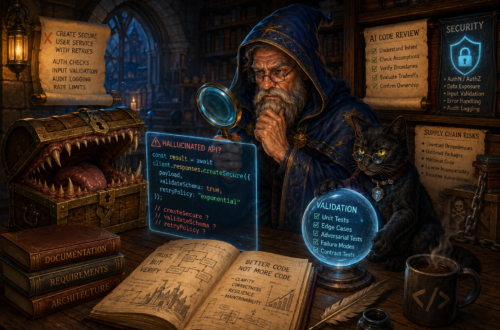
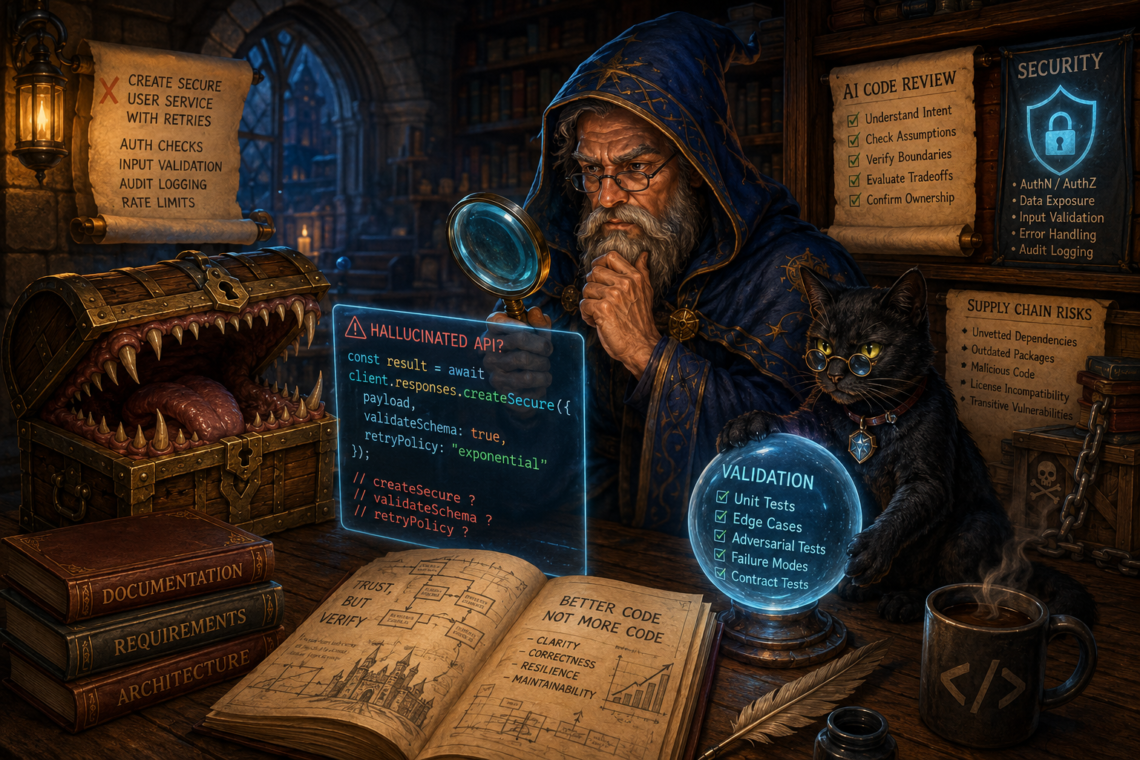
    A fantasy wizard-developer examines glowing AI-generated code with a magnifying glass in a candlelit library while a black cat familiar guards a validation orb. A toothy mimic chest lurks nearby, surrounded by scrolls and books representing AI code review, security, hallucinated APIs, supply chain risks, testing, requirements, and architecture.

    The Mimic in the Library: Trusting AI Without Being Fooled

    August 10, 2026
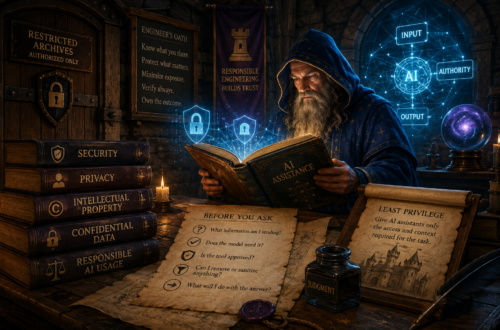
  • A fantasy wizard studies a glowing AI spellbook inside a restricted archive, surrounded by magical security shields and references to security, privacy, intellectual property, confidential data, and responsible AI usage. An illuminated diagram connects AI with input, authority, and output, while notes about least privilege and careful information sharing emphasize responsible engineering judgment.
    The Enchanted Workshop

    Forbidden Tomes: AI, Security, and Responsible Engineering

    August 12, 2026 /

    Some spells are dangerous not because they fail, but because they succeed too easily. Every workshop eventually acquires a locked cabinet. The books inside are not necessarily evil, and the spells written across their pages may be extraordinarily useful. They are locked away because their power changes the consequences of carelessness. Artificial intelligence has reached a similar place in software engineering. The same tools that can explain unfamiliar code, generate tests, draft documentation, analyze failures, and accelerate development can also expose confidential information, introduce vulnerabilities, recommend questionable dependencies, or quietly move protected intellectual property beyond boundaries an engineer never intended to cross. Responsible AI engineering is therefore more complicated than…

    Read More
    Frank Jamison

    You May Also Like

    A thoughtful wizard studies a glowing crystal ball inside a medieval observatory transformed into a software engineering workspace. The crystal ball displays realistic-looking code alongside prominent warning messages indicating nonexistent APIs and deprecated methods, symbolizing AI hallucinations. Surrounding the wizard are official documentation books, verification checklists, engineering notes, and a ritual board outlining a disciplined software validation process. Additional notes encourage asking critical questions, verifying assumptions, and consulting authoritative sources before trusting AI-generated solutions. The scene combines fantasy and technology to illustrate the importance of critical thinking, source validation, and professional judgment in AI-assisted software development.

    The Crystal Ball Lies Sometimes: Verifying AI Before You Trust It

    July 31, 2026
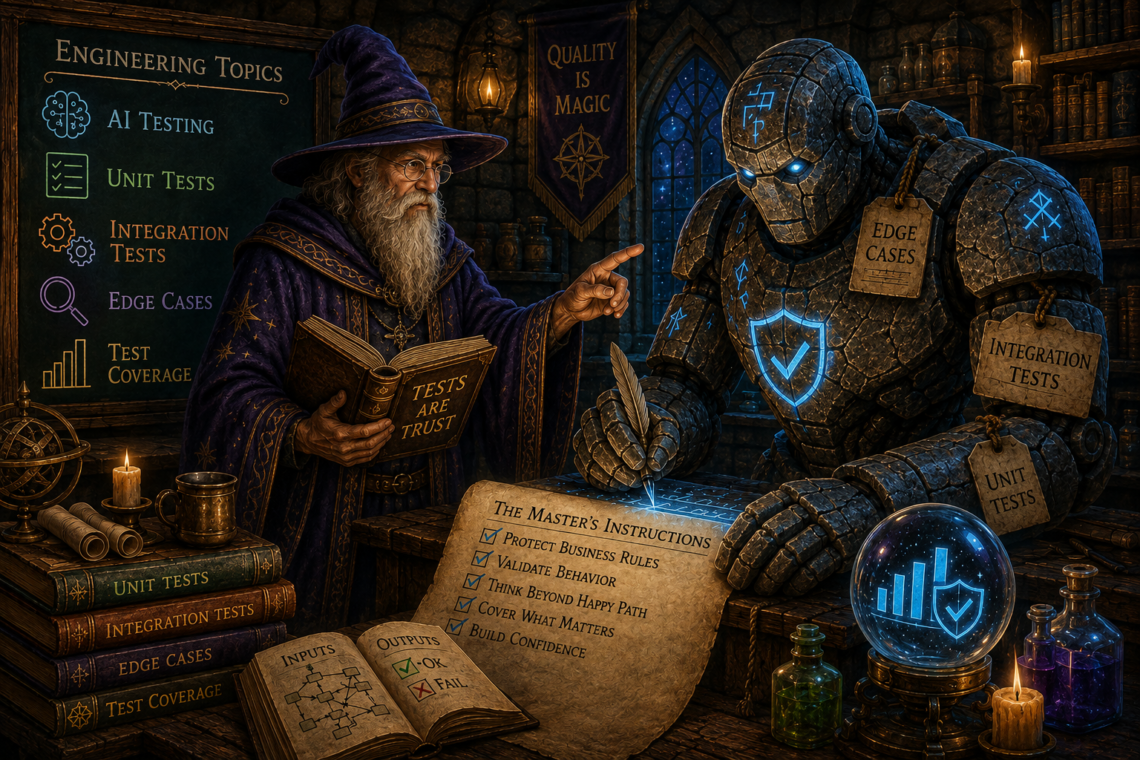
    A wise wizard in a candlelit medieval workshop mentors a towering stone golem whose glowing blue runes illuminate the room as it carefully writes magical symbols onto a workbench. Behind them, a chalkboard labeled "Engineering Topics" lists AI Testing, Unit Tests, Integration Tests, Edge Cases, and Test Coverage, while a banner reading "Quality Is Magic" hangs above shelves of spellbooks and alchemical supplies. The wizard studies an open book titled Tests Are Trust while pointing toward the golem's work, symbolizing human guidance directing AI-assisted software testing. Nearby, books, scrolls, and a parchment labeled The Master's Instructions emphasize protecting business rules, validating behavior, thinking beyond the happy path, covering what matters, and building confidence. A glowing crystal ball displaying test coverage metrics and engineering-themed books reinforce the article's message that AI is a tireless assistant whose effectiveness depends on the quality of the instructions it receives.

    The Tireless Golem: Building Better Tests with AI

    August 5, 2026
    A wide, painterly fantasy workshop serves as an editorial metaphor for modern software engineering. An experienced wizard mentor and a thoughtful apprentice study a glowing architectural blueprint projected above a large drafting table covered with medieval engineering plans, measuring tools, and manuscripts. A luminous blue magical familiar sits beside them, symbolizing human and AI collaboration. Towering bookshelves are filled with volumes on algorithms, design patterns, testing, security, ethics, and software architecture, while the surrounding workshop features drafting instruments, enchanted artifacts, blueprints, and engineering ledgers that emphasize craftsmanship, long-term planning, and responsible engineering. Warm golden light contrasts with cool blue magical illumination, creating an atmosphere of thoughtful mentorship where engineering judgment, software craftsmanship, and responsible AI take precedence over magical spectacle. The image introduces The Enchanted Workshop by portraying software engineering as a disciplined craft supported by powerful tools rather than defined by them, consistent with the StackNScroll editorial illustration philosophy.

    The Enchanted Workshop Begins: An Engineer’s Guide to the Age of AI

    July 25, 2026
  • A fantasy wizard-developer examines glowing AI-generated code with a magnifying glass in a candlelit library while a black cat familiar guards a validation orb. A toothy mimic chest lurks nearby, surrounded by scrolls and books representing AI code review, security, hallucinated APIs, supply chain risks, testing, requirements, and architecture.
    The Enchanted Workshop

    The Mimic in the Library: Trusting AI Without Being Fooled

    August 10, 2026 /

    Not every answer wearing the robes of wisdom deserves your trust. There is a particular danger experienced adventurers learn to fear more than an obvious monster. A dragon announces itself with fire, claws, and a considerable disregard for local building codes. A mimic survives by looking useful. AI-generated production code can present the same problem. The function is clean, the naming is sensible, and the explanation sounds authoritative. Nothing immediately signals that somewhere inside it sits an incorrect assumption, a nonexistent API, a security weakness, or an architectural decision that does not belong in production. Modern AI tools are remarkably good at producing plausible code. Given a clear request, they…

    Read More
    Frank Jamison

    You May Also Like

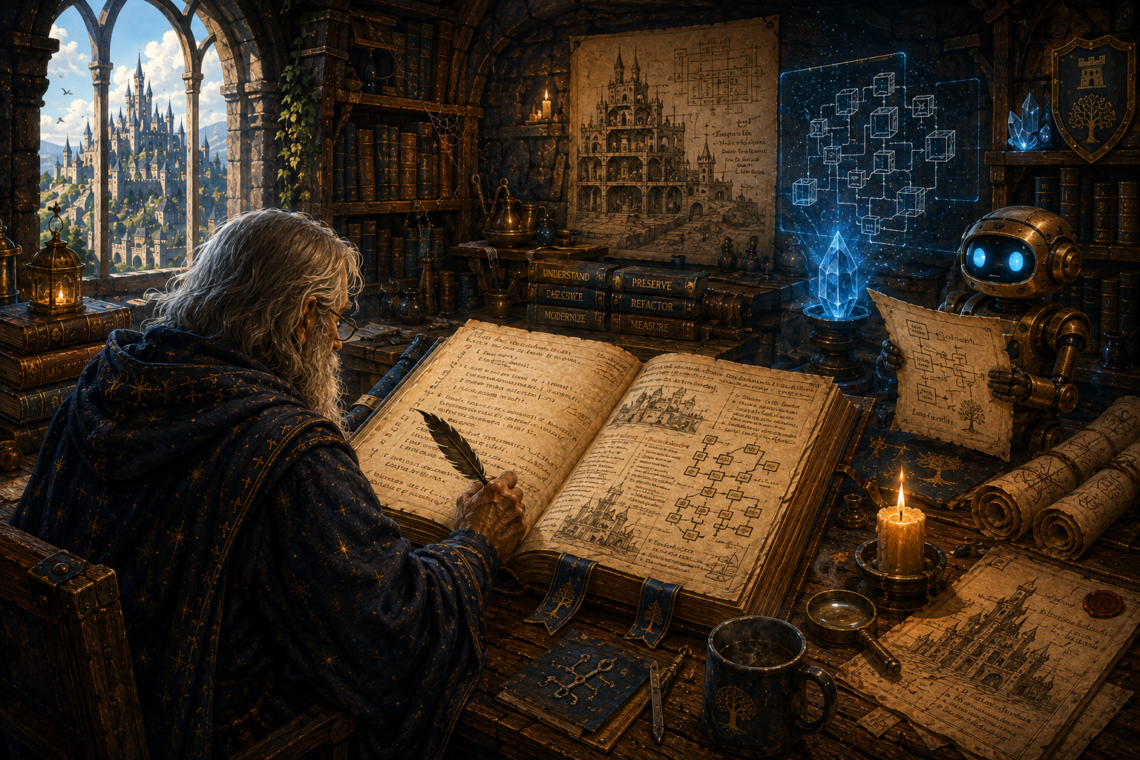
    An elderly wizard restores a massive ancient spellbook in a candlelit fantasy library, studying aged pages filled with code, diagrams, and architectural notes while a small AI automaton assists nearby. Glowing blue system diagrams, old technical volumes, scrolls, and a castle beyond the window symbolize legacy code, refactoring, code modernization, technical debt, and AI-assisted cleanup.

    Restoring Ancient Spellbooks: Modernizing Legacy Code

    August 7, 2026
    An experienced wizard mentors a young apprentice in a candlelit magical workshop where fantasy and software engineering converge. A glowing instructional board illustrates prompt engineering concepts including context building, prompt patterns, iterative conversations, and specifying requirements, while an open spellbook displays a structured AI prompt template. A crystal ball labeled with clarity, context, constraints, and success symbolizes effective prompt design, surrounded by engineering books, architectural references, and magical artifacts that reinforce the theme of AI as an apprentice guided by thoughtful engineering judgment.

    Speaking the Language of Spells: Prompt Engineering That Works

    July 29, 2026
    An elderly wizard in deep blue robes sits at a wooden desk inside a grand medieval library, carefully writing on a parchment with a feather quill. Shelves of ancient books fill the background beneath tall stone arches, creating the atmosphere of a magical archive. Around the wizard, glowing blue holographic panels illustrate an AI-assisted documentation workflow, showing an AI assistant drafting information, an engineer adding judgment and context, and a review process validating accuracy and clarity before documentation is shared. Stacks of books labeled Design Decisions, Lessons Learned, Architecture Notes, Incident Reports, and Operational Runbooks reinforce the importance of preserving engineering knowledge. A scroll on the desk highlights the qualities of effective documentation, including explaining why decisions were made, capturing context, guiding future decisions, preventing mistakes, and outliving the original engineers. Nearby, a documentation quality checklist emphasizes accuracy, current information, clear context, valid examples, and usefulness to future team members. A glowing crystal orb displays the message Better Docs = Better Systems, visually connecting thoughtful documentation, AI-assisted knowledge sharing, and long-term software maintainability.

    The Endless Scribe: Writing Documentation with AI

    August 3, 2026
  • An elderly wizard restores a massive ancient spellbook in a candlelit fantasy library, studying aged pages filled with code, diagrams, and architectural notes while a small AI automaton assists nearby. Glowing blue system diagrams, old technical volumes, scrolls, and a castle beyond the window symbolize legacy code, refactoring, code modernization, technical debt, and AI-assisted cleanup.
    The Enchanted Workshop

    Restoring Ancient Spellbooks: Modernizing Legacy Code

    August 7, 2026 /

    Some of the greatest magic lies hidden beneath centuries of dust. There is a particular kind of software that almost every experienced engineer eventually encounters. It has been running for years, perhaps decades, quietly processing orders, generating reports, moving money, coordinating inventory, or supporting some other function the business cannot simply abandon. Its architecture reflects decisions made by developers who may have left long ago. Its dependencies have aged, its conventions belong to another era, and certain portions of the codebase are approached with the same caution a wizard might use when opening an ancient spellbook whose margins contain several generations of increasingly nervous annotations. The temptation is to look…

    Read More
    Frank Jamison

    You May Also Like

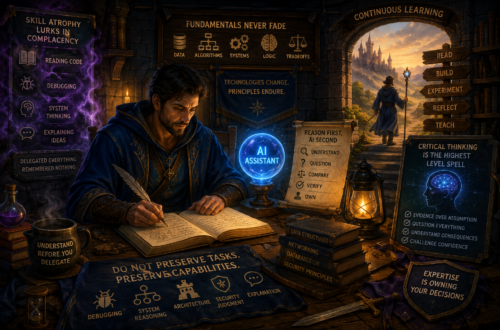
    A fantasy-inspired software engineer in blue wizard robes studies an open spellbook at a glowing workshop desk beside an AI assistant orb. Surrounding signs and books emphasize engineering fundamentals, continuous learning, debugging, system reasoning, security, critical thinking, and maintaining expertise, reinforcing the message that AI should support an engineer’s capabilities without replacing independent thought and judgment.

    The Wizard Who Forgot Magic: Keeping Your Engineering Skills Sharp

    August 14, 2026
    An experienced wizard mentors a young apprentice in a candlelit magical workshop where fantasy and software engineering converge. A glowing instructional board illustrates prompt engineering concepts including context building, prompt patterns, iterative conversations, and specifying requirements, while an open spellbook displays a structured AI prompt template. A crystal ball labeled with clarity, context, constraints, and success symbolizes effective prompt design, surrounded by engineering books, architectural references, and magical artifacts that reinforce the theme of AI as an apprentice guided by thoughtful engineering judgment.

    Speaking the Language of Spells: Prompt Engineering That Works

    July 29, 2026
    A thoughtful wizard studies a glowing crystal ball inside a medieval observatory transformed into a software engineering workspace. The crystal ball displays realistic-looking code alongside prominent warning messages indicating nonexistent APIs and deprecated methods, symbolizing AI hallucinations. Surrounding the wizard are official documentation books, verification checklists, engineering notes, and a ritual board outlining a disciplined software validation process. Additional notes encourage asking critical questions, verifying assumptions, and consulting authoritative sources before trusting AI-generated solutions. The scene combines fantasy and technology to illustrate the importance of critical thinking, source validation, and professional judgment in AI-assisted software development.

    The Crystal Ball Lies Sometimes: Verifying AI Before You Trust It

    July 31, 2026
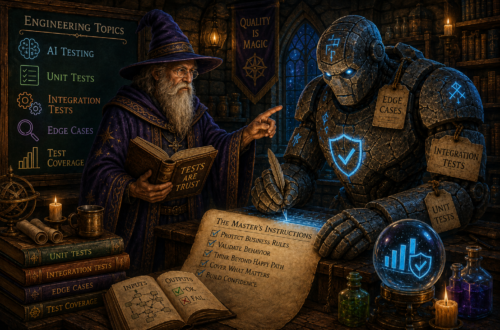
  • A wise wizard in a candlelit medieval workshop mentors a towering stone golem whose glowing blue runes illuminate the room as it carefully writes magical symbols onto a workbench. Behind them, a chalkboard labeled "Engineering Topics" lists AI Testing, Unit Tests, Integration Tests, Edge Cases, and Test Coverage, while a banner reading "Quality Is Magic" hangs above shelves of spellbooks and alchemical supplies. The wizard studies an open book titled Tests Are Trust while pointing toward the golem's work, symbolizing human guidance directing AI-assisted software testing. Nearby, books, scrolls, and a parchment labeled The Master's Instructions emphasize protecting business rules, validating behavior, thinking beyond the happy path, covering what matters, and building confidence. A glowing crystal ball displaying test coverage metrics and engineering-themed books reinforce the article's message that AI is a tireless assistant whose effectiveness depends on the quality of the instructions it receives.
    The Enchanted Workshop

    The Tireless Golem: Building Better Tests with AI

    August 5, 2026 /

    A servant who never sleeps must still be taught what success looks like. Software engineers have always searched for ways to reduce repetitive work without sacrificing quality. Compilers eliminated many manual mistakes. Continuous integration ensured that code could be validated automatically after every change. Static analysis exposed entire categories of defects before applications ever reached production. Each advancement freed engineers to spend more time solving meaningful problems instead of repeating mechanical tasks. Artificial intelligence represents another step along that path, but it introduces a subtle temptation. Because AI can generate code remarkably quickly, it is easy to assume it can generate equally effective tests with little oversight. Many developers discover…

    Read More
    Frank Jamison

    You May Also Like

    A wide, painterly fantasy workshop serves as an editorial metaphor for modern software engineering. An experienced wizard mentor and a thoughtful apprentice study a glowing architectural blueprint projected above a large drafting table covered with medieval engineering plans, measuring tools, and manuscripts. A luminous blue magical familiar sits beside them, symbolizing human and AI collaboration. Towering bookshelves are filled with volumes on algorithms, design patterns, testing, security, ethics, and software architecture, while the surrounding workshop features drafting instruments, enchanted artifacts, blueprints, and engineering ledgers that emphasize craftsmanship, long-term planning, and responsible engineering. Warm golden light contrasts with cool blue magical illumination, creating an atmosphere of thoughtful mentorship where engineering judgment, software craftsmanship, and responsible AI take precedence over magical spectacle. The image introduces The Enchanted Workshop by portraying software engineering as a disciplined craft supported by powerful tools rather than defined by them, consistent with the StackNScroll editorial illustration philosophy.

    The Enchanted Workshop Begins: An Engineer’s Guide to the Age of AI

    July 25, 2026
    An elderly wizard restores a massive ancient spellbook in a candlelit fantasy library, studying aged pages filled with code, diagrams, and architectural notes while a small AI automaton assists nearby. Glowing blue system diagrams, old technical volumes, scrolls, and a castle beyond the window symbolize legacy code, refactoring, code modernization, technical debt, and AI-assisted cleanup.

    Restoring Ancient Spellbooks: Modernizing Legacy Code

    August 7, 2026
    An experienced wizard sits thoughtfully at a workbench inside a warm, medieval-inspired workshop, collaborating with a glowing owl familiar that represents artificial intelligence. Ancient spellbooks and engineering references surround them alongside a modern laptop displaying architectural diagrams, while magical holographic interfaces illustrate AI-assisted development workflows. Banners and notes throughout the workshop emphasize engineering judgment, human responsibility, and collaboration over automation. The scene blends fantasy and software engineering to symbolize AI as a trusted apprentice that accelerates development without replacing the wisdom, decision-making, and accountability of the engineer.

    The Wizard’s New Apprentice: Working Alongside AI

    July 27, 2026
  • An elderly wizard in deep blue robes sits at a wooden desk inside a grand medieval library, carefully writing on a parchment with a feather quill. Shelves of ancient books fill the background beneath tall stone arches, creating the atmosphere of a magical archive. Around the wizard, glowing blue holographic panels illustrate an AI-assisted documentation workflow, showing an AI assistant drafting information, an engineer adding judgment and context, and a review process validating accuracy and clarity before documentation is shared. Stacks of books labeled Design Decisions, Lessons Learned, Architecture Notes, Incident Reports, and Operational Runbooks reinforce the importance of preserving engineering knowledge. A scroll on the desk highlights the qualities of effective documentation, including explaining why decisions were made, capturing context, guiding future decisions, preventing mistakes, and outliving the original engineers. Nearby, a documentation quality checklist emphasizes accuracy, current information, clear context, valid examples, and usefulness to future team members. A glowing crystal orb displays the message Better Docs = Better Systems, visually connecting thoughtful documentation, AI-assisted knowledge sharing, and long-term software maintainability.
    The Enchanted Workshop

    The Endless Scribe: Writing Documentation with AI

    August 3, 2026 /

    The fastest quill is worthless if no one can read what it writes. Software has a remarkable ability to outlive the people who create it. A feature completed during a single sprint may continue serving customers for a decade. Entire engineering organizations evolve around systems whose original architects have long since moved on. New developers inherit the code, extend it, modernize it, and occasionally struggle against it without ever hearing the conversations that shaped its design. By the time software reaches maturity, its greatest challenge is rarely understanding what it does. The real challenge is understanding why thoughtful engineers decided it should behave that way. The software itself may remain…

    Read More
    Frank Jamison

    You May Also Like

    A fantasy wizard studies a glowing AI spellbook inside a restricted archive, surrounded by magical security shields and references to security, privacy, intellectual property, confidential data, and responsible AI usage. An illuminated diagram connects AI with input, authority, and output, while notes about least privilege and careful information sharing emphasize responsible engineering judgment.

    Forbidden Tomes: AI, Security, and Responsible Engineering

    August 12, 2026
    A thoughtful wizard studies a glowing crystal ball inside a medieval observatory transformed into a software engineering workspace. The crystal ball displays realistic-looking code alongside prominent warning messages indicating nonexistent APIs and deprecated methods, symbolizing AI hallucinations. Surrounding the wizard are official documentation books, verification checklists, engineering notes, and a ritual board outlining a disciplined software validation process. Additional notes encourage asking critical questions, verifying assumptions, and consulting authoritative sources before trusting AI-generated solutions. The scene combines fantasy and technology to illustrate the importance of critical thinking, source validation, and professional judgment in AI-assisted software development.

    The Crystal Ball Lies Sometimes: Verifying AI Before You Trust It

    July 31, 2026
    An elderly wizard restores a massive ancient spellbook in a candlelit fantasy library, studying aged pages filled with code, diagrams, and architectural notes while a small AI automaton assists nearby. Glowing blue system diagrams, old technical volumes, scrolls, and a castle beyond the window symbolize legacy code, refactoring, code modernization, technical debt, and AI-assisted cleanup.

    Restoring Ancient Spellbooks: Modernizing Legacy Code

    August 7, 2026
  • A thoughtful wizard studies a glowing crystal ball inside a medieval observatory transformed into a software engineering workspace. The crystal ball displays realistic-looking code alongside prominent warning messages indicating nonexistent APIs and deprecated methods, symbolizing AI hallucinations. Surrounding the wizard are official documentation books, verification checklists, engineering notes, and a ritual board outlining a disciplined software validation process. Additional notes encourage asking critical questions, verifying assumptions, and consulting authoritative sources before trusting AI-generated solutions. The scene combines fantasy and technology to illustrate the importance of critical thinking, source validation, and professional judgment in AI-assisted software development.
    The Enchanted Workshop

    The Crystal Ball Lies Sometimes: Verifying AI Before You Trust It

    July 31, 2026 /

    Even enchanted mirrors occasionally reflect impossible futures. Artificial intelligence has rapidly become one of the most productive tools ever placed into the hands of software engineers. It can explain unfamiliar concepts, generate working prototypes, refactor decades-old code, write unit tests, summarize documentation, and even identify subtle defects that would otherwise escape notice. After spending only a few weeks working alongside modern AI systems, it becomes difficult to imagine returning to a workflow that depends entirely on search engines, reference manuals, and trial-and-error. Yet every experienced engineer eventually encounters a moment that changes the relationship. Perhaps the generated code compiles perfectly while quietly introducing a race condition. Perhaps an API appears…
    Read More
    Frank Jamison

    You May Also Like

    A fantasy-inspired software engineer in blue wizard robes studies an open spellbook at a glowing workshop desk beside an AI assistant orb. Surrounding signs and books emphasize engineering fundamentals, continuous learning, debugging, system reasoning, security, critical thinking, and maintaining expertise, reinforcing the message that AI should support an engineer’s capabilities without replacing independent thought and judgment.

    The Wizard Who Forgot Magic: Keeping Your Engineering Skills Sharp

    August 14, 2026
    A fantasy wizard studies a glowing AI spellbook inside a restricted archive, surrounded by magical security shields and references to security, privacy, intellectual property, confidential data, and responsible AI usage. An illuminated diagram connects AI with input, authority, and output, while notes about least privilege and careful information sharing emphasize responsible engineering judgment.

    Forbidden Tomes: AI, Security, and Responsible Engineering

    August 12, 2026
    A fantasy-inspired software engineer in a medieval workshop uses glowing blue magic to build a miniature castle prototype, surrounded by diagrams for prototype boundaries, experimentation, and decision-making, with references to rapid prototyping, MVP development, innovation, and product discovery.

    Building New Kingdoms Overnight: Rapid Prototyping with AI

    August 19, 2026
12
  • The Architect's Grimoire (13)
  • The CSS Codex (13)
  • The Enchanted Workshop (13)
  • The Full-Stack Campaign (8)
  • The Guildmaster’s Handbook (13)
  • The Kingdom in the Clouds (8)

AI-Assisted Development Artificial Intelligence Backend Development Career Development Clean Code Cloud-Native Architecture Code Quality CSS Architecture CSS Best Practices CSS Fundamentals CSS Layout Design Systems Developer Growth Developer Productivity Distributed Systems Dungeons and Dragons Engineering Culture Engineering Judgment Engineering Leadership Fantasy Theme Front-End Development Frontend Development Full Stack Development Human-AI Collaboration Maintainable Code Mentorship Professional Development Professional Growth Refactoring Responsive Design Software Architecture Software Craftsmanship Software Design Software Development Software Engineering StackNScroll System Design Technical Debt Technical Leadership The Architect's Grimoire The CSS Codex The Enchanted Workshop The Full-Stack Campaign The Guildmaster's Handbook Web Development

Stack N' Scroll - 2026 ©