
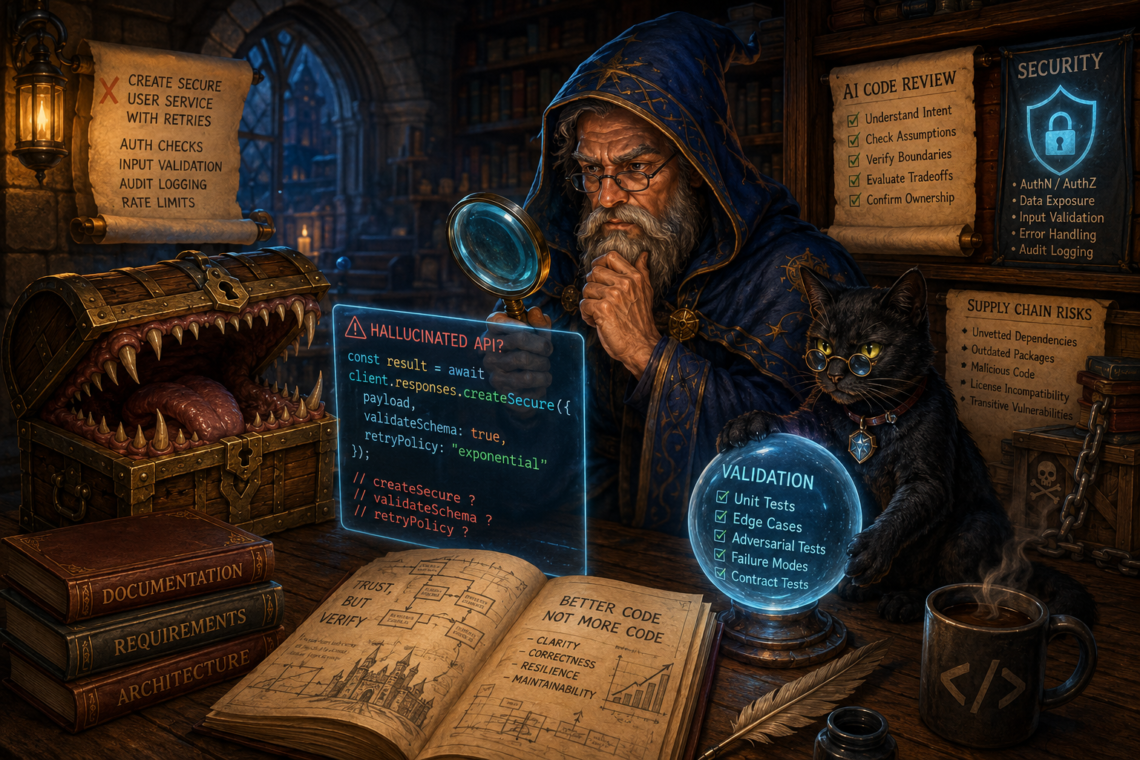
The Mimic in the Library: Trusting AI Without Being Fooled
Not every answer wearing the robes of wisdom deserves your trust.
There is a particular danger experienced adventurers learn to fear more than an obvious monster. A dragon announces itself with fire, claws, and a considerable disregard for local building codes. A mimic survives by looking useful. AI-generated production code can present the same problem. The function is clean, the naming is sensible, and the explanation sounds authoritative. Nothing immediately signals that somewhere inside it sits an incorrect assumption, a nonexistent API, a security weakness, or an architectural decision that does not belong in production.
Modern AI tools are remarkably good at producing plausible code. Given a clear request, they can generate controllers, database queries, tests, configuration files, integrations, and entire features in seconds. Much of that code can be genuinely useful. The problem is that AI has made producing code dramatically cheaper without making verification equally cheap. Generation may take seconds, but confidence still has to be earned through requirements, context, testing, documentation, and engineering judgment.
That changes where some of our work happens. Instead of spending most of our time building an obvious first implementation, we can spend more time evaluating what we have generated. Does the code solve the correct problem? What assumptions does it make? How does it fail? Does it fit the surrounding architecture? Those questions distinguish software generation from software engineering, and they matter most when the generated answer looks convincing enough that we are tempted not to ask them.
The Chest That Looks Perfectly Ordinary
A mimic succeeds because recognition is one of the shortcuts our minds use to navigate complexity. Developers do something similar when reading code. Familiar patterns build confidence because they resemble implementations we have seen before, and AI systems are exceptionally capable of reproducing them. That resemblance makes generated code easier to understand, but it tells us remarkably little about whether the implementation belongs in our particular application.
Consider an AI-generated service method:
</> TypeScript

async function getUserProfile(userId: string) {
    const user = await db.users.findUnique({
        where: { id: userId },
        include: {
            profile: true,
            preferences: true
        }
    });

    if (!user) {
        throw new Error("User not found");
    }

    return user;
}
Nothing immediately looks suspicious. The function is small, readable, and easy to understand. It retrieves a user and related information using a familiar data-access pattern. In isolation, an engineer could reasonably describe it as clean code. If our review ends with readability, however, we have evaluated the chest’s craftsmanship without checking whether it has teeth. Plausibility is not evidence of correctness.
Production systems are rarely evaluated in isolation. Does the caller have permission to retrieve this user? Should every field be returned? Can preferences contain private information? What happens when the database request fails? Does the surrounding architecture expect repository access rather than direct database access? The generated function cannot answer those questions because syntax cannot tell us whether an implementation belongs in the system.
This is the first discipline of reviewing AI-generated production code: compare the implementation with the application, not merely with itself. Clean formatting, descriptive names, and familiar patterns can make generated code easier to trust without making it more trustworthy. Requirements, architectural boundaries, security expectations, and existing conventions provide the missing evidence. The question is not merely whether the code looks correct. It is whether the code solves the correct problem in the correct place.
Correct Code Can Still Be Wrong
Developers often use “working” as shorthand for “correct,” but production engineering requires a stronger definition. Code can compile and still violate a requirement. It can pass tests and still mishandle an edge case. It can return the expected result while bypassing an architectural boundary created for security, auditing, or maintainability. Successful execution proves only that one path through the program produced an acceptable result under particular conditions.
Imagine asking an AI assistant to create a function that retrieves an invoice by identifier. It might produce perfectly valid database code that finds the invoice and returns it. Yet the production requirement may state that customers can retrieve only invoices for their own accounts. If ownership was absent from the supplied context, the generated implementation may faithfully solve the wrong problem while appearing completely reasonable.
The lesson is not that AI cannot produce production-quality code. It is that requirements omitted from the conversation do not become requirements merely because they exist elsewhere in the application. Generated code must be evaluated against the actual system rather than only against the prompt that produced it. Better prompting can reduce context omissions, but no prompt eliminates the responsibility to examine what ultimately enters production.
When the Spellbook Invents a Spell
Generative AI can also produce APIs, methods, configuration options, and library features that look believable but do not exist. The danger increases when the invented interface resembles conventions used by the real library. A developer scanning the code may see exactly what they expect. The fictional API can be surrounded by enough legitimate code that the mistake resembles an unfamiliar feature rather than an obvious fabrication.
Suppose generated code recommends an integration like this:
</> TypeScript

const result = await client.responses.createSecure({
    payload,
    validateSchema: true,
    retryPolicy: "exponential"
});
Everything about those options sounds reasonable. That is precisely why they require verification. Does createSecure actually exist in the installed version? What does validateSchema validate? What happens when validation fails? Is the retry behavior safe for the operation being performed? A reassuring method name does not establish a security guarantee, and professional-looking configuration does not establish that the configuration is real.
Official documentation, release notes, type definitions, installed versions, and existing application code therefore become part of the evidence chain. Verification is not punishment for using AI. It is ordinary engineering discipline applied to a tool capable of producing unfamiliar code at extraordinary speed. Names are promises, not proof. When generated production code depends on unfamiliar behavior, we should follow that behavior far enough to understand where the guarantee actually comes from.
The Supply Caravan at the City Gate
Hallucinated APIs become more dangerous when generated code introduces dependencies. Ask an AI assistant for validation, authentication, HTTP retries, document conversion, or another common capability, and it may recommend a library that appears to solve the problem immediately. Sometimes that recommendation is excellent. Sometimes the dependency is unnecessary, outdated, misnamed, or ill-suited to the existing application. The convenience of a generated solution should not prevent us from examining what enters the system along with it.
Engineers should verify that a recommended package is real, maintained, appropriately licensed, compatible with the project, and necessary for the problem being solved. Even legitimate packages increase the application’s supply-chain surface through code, maintainers, transitive dependencies, releases, and potential vulnerabilities outside the team’s direct control. An incorrectly named package can also send a developer toward something that was never intended. Adding a dependency is therefore an engineering decision, not merely an installation command.
AI makes dependency discipline especially important because recommendations arrive with far less friction than discovery once did. Developers traditionally had to search for a library, compare alternatives, read the documentation, and figure out how it worked. Generated solutions can jump directly to polished integration code, making adoption feel like a minor implementation detail. Treat every new dependency like a caravan requesting entrance to a fortified city: useful travelers are welcome, but the guards still inspect the wagon.
Testing the Mimic Instead of Admiring It
Tests provide one of the strongest ways to convert generated confidence into evidence, but AI-assisted testing requires the same skepticism as AI-assisted implementation. If the same model generates both a function and all of its tests from the same assumptions, those tests may simply confirm the model’s original interpretation. Ten passing tests do not help much if all ten protect the wrong requirement. A beautifully tested misunderstanding remains a misunderstanding, regardless of how reassuring the green check marks look.
For production code, tests should challenge assumptions rather than merely demonstrate the happy path. A generated parser deserves malformed input. Authorization logic deserves users who should be denied access. External integrations deserve timeouts, invalid responses, and partial failures. State-changing behavior deserves repeated requests and unexpected state. Those cases tell us more about durability than another demonstration that expected input produces expected output.
The engineer should therefore actively work against the generated implementation. Ask what assumptions would cause it to fail, request adversarial cases and boundary conditions, and compare those suggestions with the actual requirements. Add tests derived from your independent understanding of the system, rather than letting AI define everything worth testing. Human judgment should break the closed loop in which the same reasoning creates an implementation, decides how to test it, and then declares it successful.
Testing also provides a practical path toward the outcome we actually want: better code. A failed boundary test may reveal missing validation. An authorization test can reveal a requirement that was absent from the original prompt. A timeout test may reveal unsafe retry behavior. The objective is not to catch AI doing something wrong. It is to discover weaknesses while they remain inexpensive to correct.
Code Review Has Changed Jobs
Traditional code review often assumes that another human created an implementation through a deliberate sequence of decisions. Reviewers inspect those decisions, question tradeoffs, identify defects, and share knowledge. AI-generated code changes that dynamic because an implementation can appear before anyone has reasoned through every line. The developer submitting it may understand the requirement while still inheriting implementation choices that were generated rather than deliberately selected.
Review may therefore require reconstructing decisions that were never consciously made. Why was this abstraction chosen? Why does this function bypass an existing service? Why was this dependency introduced? Why is this error swallowed rather than propagated? Those questions turn generated output into deliberate engineering and prevent accidental choices from quietly becoming architectural precedent.
The developer accepting generated code effectively becomes its author. Version control does not care whether a function originated in a developer’s memory, documentation, a forum, an AI assistant, or an unusually ambitious enchanted quill. Once merged, the organization owns its behavior, vulnerabilities, dependencies, tests, and architectural consequences. The conversation that generated the code may disappear within hours, while the implementation may remain in production for years.
Developers therefore should not approve generated code they cannot explain at the level necessary to maintain it. This does not require understanding every internal detail of every framework, but it does require understanding why important decisions are appropriate for the system. If a reviewer asks why input is trusted at a boundary or why a dependency was introduced, the fact that AI generated it is not an engineering rationale. AI can propose the decision, but ownership begins when the engineer decides that proposal deserves to remain.
Trust Is Something Code Earns
The strongest protection against misleading AI output is a repeatable verification habit. Start with the requirement and compare the implementation against it before becoming absorbed in individual lines of code. Identify what the function assumes about its input, caller, dependencies, state, and external services. Determine which assumptions are guaranteed by the system and which merely happen to be true in the generated example.
Then gather evidence appropriate to the risk. Check unfamiliar interfaces against authoritative documentation and the versions actually used by the project. Use static analysis, type checking, linters, security tooling, and existing tests where appropriate. Concentrate additional tests around failure conditions and trust boundaries. Finally, review the resulting diff as if it came from an unfamiliar contributor whose work may be excellent but whose understanding of the system has not yet been established.
Not every generated function deserves identical scrutiny. A formatting helper and an authorization boundary carry different consequences if they fail. Authentication, payments, sensitive data, destructive operations, infrastructure, dependency changes, and externally exposed interfaces deserve stronger evidence. Lower-risk boilerplate can move through a lighter process. Risk-based verification preserves AI’s productivity advantage without quietly lowering the quality threshold.
The goal is calibrated trust rather than blanket skepticism. AI can generate implementations, suggest alternatives, identify edge cases, and help improve code remarkably quickly. Engineers decide which possibilities belong in production by gathering enough evidence to justify that decision. When answers become abundant, judgment becomes the scarce engineering resource. That is where AI-assisted development stops being code generation and becomes engineering.
The Wizard Still Guards the Library
Software engineering has always depended on trust. We trust compilers, operating systems, frameworks, libraries, cloud platforms, databases, colleagues, and thousands of abstractions we did not personally create. Effective engineering would be impossible if every developer had to reconstruct the entire computing stack from first principles. The challenge has never been eliminating trust. The challenge has been deciding where trust is justified and what safeguards should be in place when that trust turns out to be misplaced.
AI-generated code belongs inside that same model of professional trust. It does not deserve automatic suspicion because a machine produced it, but polished output does not deserve automatic confidence either. AI can propose implementations, identify edge cases, suggest tests, and offer alternatives. It also lacks a comprehensive understanding of the context surrounding a particular application and has no accountability for what happens after its suggestions are merged. That accountability remains with the engineer and the team responsible for the system.
The best AI-assisted engineers will therefore not be the developers who accept the most generated code. They will be the developers who turn generated possibilities into deliberate engineering decisions. They will know when a low-risk helper needs a quick review, when authentication or payment logic demands deeper scrutiny, and when the treasure chest sitting conveniently in the middle of the dungeon deserves a cautious poke with a ten-foot pole. The speed of generation changes how quickly choices appear. It does not change who owns their consequences.
Better Code Is Still the Goal
It is easy to measure the value of AI-assisted development by how quickly code appears on the screen. A function that once required documentation searches and implementation work may appear in seconds. Generation speed is visible and impressive, but speed alone is a poor measure of engineering value. Faster production of mediocre code merely increases the rate at which maintenance work accumulates.
The better opportunity is to reinvest the time AI saves. Instead of spending the entire development cycle producing an obvious first draft, we can spend more of it evaluating tradeoffs, testing assumptions, simplifying designs, removing duplication, and examining failure modes. Generated code that bypasses an existing abstraction or introduces an unnecessary dependency can be revised before it becomes another permanent feature of the architecture. AI makes iteration cheaper, but engineering judgment determines whether each iteration actually improves the system.
This is why improving code quality matters more than maximizing generated output. Every accepted implementation becomes part of the codebase future engineers must understand. Small compromises accumulate into conventions, dependencies become architecture, and shortcuts become assumptions that other code begins to rely upon. AI enables us to make those decisions faster. Used well, that speed should buy us more opportunities to improve the code rather than merely more code.
Dangerous Magic
This week’s theme in The Enchanted Workshop is Dangerous Magic, and the danger is not the existence of powerful tools. Software engineering has repeatedly advanced by trusting increasingly powerful abstractions. Compilers automate work we once performed ourselves, frameworks hide enormous amounts of implementation detail, and open-source libraries let teams build on code they did not create. Professional engineering already depends on carefully managed trust.
AI introduces a different variation because generative systems can produce new answers with varying levels of reliability. The interface may function perfectly while the answer itself is wrong. A compiler generally does not invent a language feature and confidently explain why it exists. An AI assistant can produce an imaginary API, a plausible dependency, an incomplete test suite, or a subtly incorrect implementation that looks convincing enough to survive a hurried review.
That difference requires adaptation rather than retreat. We should use faster implementation, broader exploration, automated explanation, and test generation while preserving the practices that distinguish software generation from software engineering. Requirements, documentation, validation, testing, security, and code review still matter. AI changes how quickly the spell can be written, not who is responsible when the spell is cast.
Beyond the Library Doors
Throughout The Enchanted Workshop, we have gradually increased what our new familiar can do. We learned to work alongside AI, improved the instructions we give it, examined why its crystal ball sometimes lies, used it to help with documentation and testing, and brought it to bear on the difficult work of modernizing legacy code. Each new capability has made the workshop more productive. Each has also made engineering judgment more important.
The Mimic in the Library is ultimately not a warning against trusting AI. It is a lesson about what engineering trust has always meant. Trust is not certainty, nor is it familiarity. It is confidence supported by evidence, bounded by risk, and accompanied by mechanisms that help us discover when our assumptions are wrong. That principle will remain useful long after today’s models and development tools have been replaced.
On Wednesday, our journey through Dangerous Magic continues with Forbidden Tomes: AI, Security, and Responsible Engineering. We will move beyond evaluating generated code and examine the boundaries around what engineers give AI in the first place, including security, privacy, intellectual property, and confidential information. Some mistakes create bugs. Others expose things that should never have left the workshop.
The library contains extraordinary knowledge, and the new familiar can reach its shelves faster than any wizard who came before us. The goal is not to fear what waits among those shelves or assume that every book contains wisdom. Experienced engineers inspect what they find, understand what they use, and accept responsibility for what they carry back into the workshop. The wisdom is knowing what deserves to leave the library with us.


You May Also Like

The Enchanted Workshop Begins: An Engineer’s Guide to the Age of AI

Building New Kingdoms Overnight: Rapid Prototyping with AI