Restoring Ancient Spellbooks: Modernizing Legacy Code
Some of the greatest magic lies hidden beneath centuries of dust.
There is a particular kind of software that almost every experienced engineer eventually encounters. It has been running for years, perhaps decades, quietly processing orders, generating reports, moving money, coordinating inventory, or supporting some other function the business cannot simply abandon. Its architecture reflects decisions made by developers who may have left long ago. Its dependencies have aged, its conventions belong to another era, and certain portions of the codebase are approached with the same caution a wizard might use when opening an ancient spellbook whose margins contain several generations of increasingly nervous annotations.
The temptation is to look at such a system and see only what is wrong with it. The naming is inconsistent. Functions are too large. Responsibilities overlap. Tests are sparse or nonexistent. Framework conventions have changed, libraries have fallen out of support, and some sections seem to survive through a combination of institutional memory and ritual. Modern tools, especially AI coding assistants, can make the contrast even sharper by producing cleaner-looking alternatives almost instantly. Yet the first lesson of legacy modernization is one experienced engineers learn repeatedly: ugly code that has survived production for fifteen years may understand the business better than beautiful code written this afternoon.
That distinction matters because modernization is not fundamentally an exercise in making old code resemble new code. It is an exercise in reducing the cost and risk of changing a system while preserving the behavior that made the system valuable in the first place. An old production application may contain technical debt, but it also contains thousands of decisions about customers, workflows, exceptions, integrations, regulations, and operational realities. Some were deliberate. Others emerged through years of bug fixes and changing requirements. Either way, those decisions have become part of the application.
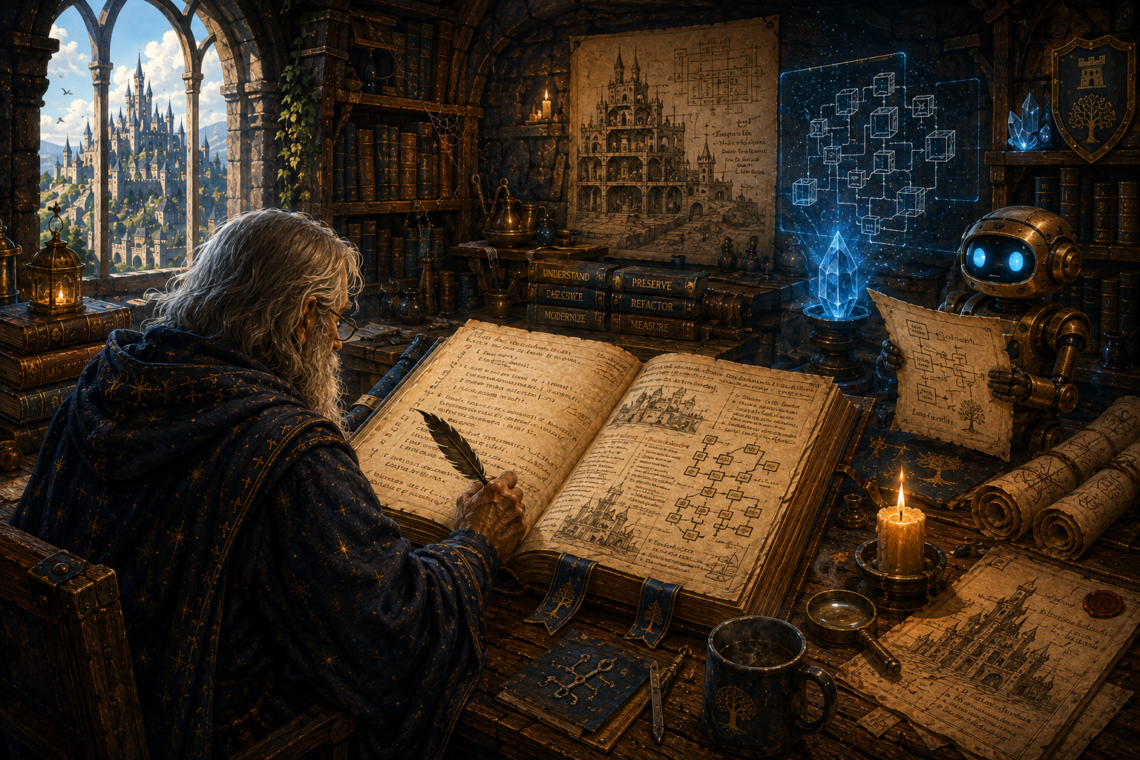
This makes legacy code less like a ruined spellbook and more like a working grimoire whose language has become difficult to read. The objective is not to burn it and write a prettier one. The objective is to understand which spells still protect the kingdom, which incantations can be simplified, and which strange-looking symbols are holding something together that nobody remembered was fragile.
The Spellbook Is Not the Problem
The phrase legacy code often carries an accusation. Developers use it to describe software that feels outdated, unpleasant, or inconsistent with current engineering practices. Age certainly contributes to the problem, but age alone does not make software dangerous. A ten-year-old module that rarely changes, has clear boundaries, performs reliably, and causes little operational trouble may deserve far less attention than a two-year-old service that developers fear modifying.
A more useful definition focuses on the cost of change. Legacy code becomes an engineering problem when understanding it takes too long, modifications produce unpredictable consequences, defects recur because responsibilities are unclear, or routine maintenance requires disproportionate effort. Those characteristics create drag on every future decision. A feature that should take an afternoon ends up taking three days because engineers must reconstruct forgotten assumptions before touching anything. A dependency update becomes a miniature migration project. A small business rule change requires editing in five places because the rule has been duplicated over the years of maintenance.
This is also where technical debt becomes more useful as an economic metaphor than as a synonym for bad code. Debt matters because of the interest being paid on it. When a tangled component repeatedly slows feature delivery, produces regressions, complicates upgrades, or consumes hours of engineering investigation, the organization is paying maintenance interest every time that component changes. Modernization should therefore prioritize debt with expensive recurring interest rather than attempting to repay every imperfect implementation in the codebase.
That is why reducing the maintenance burden is a better modernization objective than modernizing the application. Modern is temporary. Every framework, language feature, architectural fashion, and toolchain eventually becomes old. Maintainability is the more durable goal because it measures whether tomorrow’s engineer can understand today’s decisions and safely change them when the business requires it.
The best modernization work does not make old software look young. It makes future change less expensive.
Once that becomes the objective, modernization decisions become considerably more disciplined. You stop asking whether every class could be rewritten and start asking which areas consume the most engineering effort. You stop measuring progress by lines replaced and begin measuring whether developers can diagnose defects faster, add features more safely, and understand the system with less archaeological excavation. That shift turns modernization from aesthetic renovation into engineering.
Mapping the Ancient Library
Before changing an old production application, learn where its real danger lies. Mature systems rarely have technical debt distributed evenly throughout the codebase. Some components may be ugly but stable. Others may look relatively clean while sitting at the intersection of dozens of workflows and integrations. Treating every file as equally deserving of modernization wastes time and increases unnecessary risk.
Start by examining change frequency, defect history, operational incidents, dependency age, test coverage, and the amount of developer effort required to modify different parts of the application. Version-control history can reveal modules that change constantly. Issue trackers can identify components associated with recurring bugs. Production logs can expose fragile integration points. Conversations with the engineers and users who know the system can uncover areas where seemingly harmless changes routinely produce surprising consequences.
This produces something more valuable than a list of ugly code: a modernization map. Imagine entering an ancient library with thousands of spellbooks. Some are dusty because nobody needs them anymore. Some are consulted every day. A few are chained to the shelves because removing them would apparently summon something unpleasant from beneath the floor. You do not begin restoration by alphabetizing every shelf. You identify the books the kingdom depends upon and the ones librarians are afraid to touch.
The same principle applies to production software. A 2,000-line class that has not changed in six years may be poor code by contemporary standards, but rewriting it may provide little practical benefit. A 300-line pricing module that changes twice a month and is responsible for recurring defects may be an excellent modernization target. Engineering judgment means distinguishing technical ugliness from technical cost.
First Learn What the Spell Does
The most dangerous moment in legacy modernization occurs when developers believe they understand the code before they understand its behavior. Old applications frequently contain logic that appears redundant, inefficient, or simply bizarre. Removing it can seem obvious until production reveals the obscure customer, data condition, integration, or historical requirement that depended upon it.
Consider a simplified order-processing function:
</> JavaScript

function calculateDiscount(customer, order) {
    let discount = 0;

    if (customer.type === "preferred") {
        discount = order.total * 0.10;
    }

    if (customer.accountAge > 10 && order.total > 500) {
        discount += 25;
    }

    if (customer.region === "legacy-west") {
        discount = Math.min(discount, 50);
    }

    return discount;
}
A developer encountering legacy-west might reasonably wonder why one region receives special treatment. An AI assistant asked to simplify the function might identify the condition as an inconsistent business rule and propose consolidating the discount calculation. The resulting implementation could be cleaner, shorter, and wrong. That strange condition may encode a contractual limitation, a regulatory requirement, or a migration rule established twelve years earlier.
The engineering problem therefore comes before the refactoring problem. Before simplifying the implementation, establish what behavior must remain unchanged. Existing tests help, but legacy applications often have inadequate coverage precisely where modernization is needed most. Production examples, database records, logs, documentation, support tickets, and conversations with domain experts can all become sources of behavioral evidence. The goal is to build confidence around what the system actually does before deciding what it should look like.
Build a Circle of Protection
One of the safest first investments in legacy modernization is characterization testing. Traditional unit tests often begin with intended behavior: given these inputs, the code should produce these outputs. Characterization tests begin with observed behavior: given these inputs, this is what the existing system currently produces. That difference is crucial when the original requirements have disappeared.
Suppose the discount function is poorly documented but widely used. Before restructuring it, we can capture representative behavior:
</> JavaScript

describe("calculateDiscount", () => {
    test("preserves preferred customer discount", () => {
        const customer = {
            type: "preferred",
            accountAge: 3,
            region: "east"
        };

        const order = { total: 1000 };

        expect(calculateDiscount(customer, order)).toBe(100);
    });

    test("preserves legacy-west discount cap", () => {
        const customer = {
            type: "preferred",
            accountAge: 15,
            region: "legacy-west"
        };

        const order = { total: 1000 };

        expect(calculateDiscount(customer, order)).toBe(50);
    });
});
These tests do not prove that the business rules are correct. They establish a boundary around the existing behavior so that engineers can change the implementation without accidentally altering the observable result. Additional cases should come from actual production behavior, particularly boundary conditions and historical defects. Over time, that protective circle becomes one of the most valuable artifacts produced during modernization because it converts undocumented assumptions into executable knowledge.
This is also where AI can become genuinely useful. An assistant can inspect complex functions, propose test cases, identify branches that lack coverage, suggest boundary conditions, and help explain unfamiliar control flow. It can accelerate the tedious work of exploring the spellbook. What it cannot do is determine whether the strange behavior it discovers is intentional.
That judgment still belongs to the engineer.
Refactor Toward Understanding
Once important behavior has protection, modernization can proceed incrementally. Large rewrites are seductive because they promise a clean boundary between the old world and the new one. Production systems rarely cooperate with that fantasy. The longer a rewrite continues separately from the existing application, the more the original system evolves while the replacement attempts to catch up.
Smaller refactorings reduce that risk. Extract a business rule into a clearly named function. Separate database access from decision logic. Replace duplicated calculations with one tested implementation. Introduce an adapter around an obsolete external dependency. Move configuration out of procedural code. Each change should make the next change easier without requiring the entire application to be transformed first.
This approach can feel frustratingly modest because replacing thousands of lines of old code with a new architecture yields more visible progress than extracting a single tangled responsibility from a service. Yet the value of incremental modernization compounds. Once responsibilities become clearer, tests become easier to write. Once tests improve, dependencies become safer to update. Once boundaries become explicit, components become easier to replace.
The objective is not to finish modernization. In a living production application, that finish line may never exist. The objective is to create a system that becomes easier to maintain with each deliberate improvement rather than harder with every new feature.
AI as the Apprentice Restorer
AI-assisted development adds a powerful tool to this work, as legacy modernization involves many tasks that benefit from rapid analysis. An AI assistant can explain unfamiliar code, trace data transformations, identify duplication, propose tests, translate outdated syntax, suggest smaller functions, document dependencies, and generate candidate refactorings. Used carefully, it can dramatically reduce the time engineers spend deciphering mechanical complexity.
The danger appears when speed is mistaken for understanding. AI sees the code placed in its context window. The production system exists in a much larger world of databases, undocumented integrations, customer expectations, deployment processes, historical incidents, and institutional knowledge. A generated refactoring may be syntactically excellent while quietly violating assumptions that were never visible in the source supplied to the model.
This means AI should often be used as an investigator before it is used as a renovator. Ask it to identify responsibilities. Ask which branches deserve characterization tests. Ask it to list assumptions a function appears to make. Ask it to compare duplicated implementations and highlight behavioral differences. These tasks help engineers form better questions before changing code.
Only then should generated modernization proposals enter the workflow. Treat them as candidate patches that require the same review, testing, domain validation, and production discipline as code written by another engineer. The assistant may read the ancient language remarkably quickly, but it was not present when the spellbook was written.
Replace Boundaries Before Kingdoms
Some legacy components eventually do need to be replaced. Unsupported frameworks create security problems. Obsolete libraries may prevent platform upgrades. Architectural constraints can make important features prohibitively expensive. The mistake is assuming that replacement must happen at application scale.
A safer strategy is often to modernize around boundaries. Identify where the legacy application communicates with databases, external services, user interfaces, authentication systems, messaging infrastructure, or other components. Introduce explicit interfaces where implicit coupling currently exists. Once a boundary becomes stable, the implementation behind it can change with less impact on the rest of the application.
This is similar to restoring a great library while scholars continue using it. Closing the entire building for five years and rebuilding from the foundation might yield a magnificent result, assuming the kingdom can survive without the library during that time. More often, restoration happens wing by wing. Supports are reinforced, dangerous rooms are repaired, collections are relocated temporarily, and access continues throughout the work.
Production software usually deserves the same respect. The business cannot stop while engineers pursue architectural purity. Modernization must coexist with feature development, defect repair, security updates, and operational responsibilities. Good modernization strategies acknowledge those constraints rather than pretend they are inconveniences.
Measure the Burden You Remove
If the purpose of modernization is to reduce the maintenance burden, then success should be visible in maintenance work. A codebase is not meaningfully improved merely because it uses newer syntax or has fewer lines. The real question is whether engineers can work within it more effectively.
Look for changes in lead time for routine modifications. Track recurring defects in targeted components. Notice whether onboarding engineers can understand important workflows without relying entirely on tribal knowledge. Examine whether dependency upgrades become smaller and more predictable. Watch whether incidents take less time to diagnose because responsibilities and boundaries are clearer.
Some useful improvements will remain qualitative. Developers stop saying nobody touches that file. Code reviews become discussions about behavior rather than attempts to reconstruct what a function does. Engineers can make local changes without first reading half the application. Those signals matter because fear is itself a maintenance cost.
Technical debt should be evaluated through this same lens. A system does not need every debt repaid any more than a kingdom needs every old road replaced. The debts worth addressing are those whose interest is repeatedly collected through slower delivery, fragile releases, recurring defects, operational risk, or excessive engineering effort. When that interest begins to wane, modernization produces something more valuable than cleaner code: it returns engineering capacity to the organization.
Know Which Dust to Leave Alone
Perhaps the most mature modernization decision is choosing not to modernize something. Engineers are trained to improve systems, so deliberately leaving old code untouched can feel negligent. Sometimes it is the most responsible choice available.
A component that is stable, isolated, well understood operationally, and unlikely to change may not justify the risk of rewriting it. The code may offend contemporary style preferences, but production engineering is not a beauty contest. Every modification creates an opportunity for regression, consumes testing effort, and competes with work that may provide greater value elsewhere.
This is especially important when AI makes rewriting inexpensive. Lowering the cost of producing replacement code does not eliminate the cost of proving that replacement correct. Verification, integration testing, deployment, observation, documentation, and future ownership still belong to the engineering organization. Generating code was never the entire price of modernization.
Experienced engineers therefore learn to distinguish code that is old from code that is expensive. They preserve stable portions of the spellbook while concentrating restoration where decay interferes with the work of the kingdom. That restraint is not resistance to progress. It is part of engineering judgment.
Leaving the Spellbook Better Than You Found It
Modernizing legacy code is ultimately an exercise in stewardship. The engineers who created an old production application worked with the requirements, tools, deadlines, and knowledge available to them. Some decisions aged well. Others did not. Our responsibility is not to judge the past by the standards of the present, but to make the system safer for whoever must maintain it next.
That means preserving behavior before improving structure, identifying costly areas before launching broad rewrites, and modernizing through boundaries that limit risk. It means using AI to accelerate understanding without surrendering judgment. It means measuring success through reduced maintenance burden rather than architectural fashion. Most importantly, it means recognizing that the strange code we inherit often contains knowledge that has survived precisely because the business depended upon it.
The ancient spellbook does not need to become a brand-new volume overnight. Restore the damaged pages. Translate the passages nobody can understand. Add annotations where knowledge has been lost. Strengthen the binding where constant use has worn it thin. Then return it to the shelf in a condition that makes the next engineer slightly less afraid to open it.
That closes our work in Crafting Better Magic, where we have explored how AI can help engineers document software, build stronger tests, and now modernize the systems they inherit. Next week, The Enchanted Workshop enters Dangerous Magic, where the challenge changes. The question is no longer simply whether AI can produce useful code, explanations, tests, and recommendations. It is whether an engineer can recognize when something that looks authoritative, polished, and entirely plausible should not be trusted.
On Monday, we will open The Mimic in the Library: Trusting AI Without Being Fooled. In any well-stocked fantasy library, the dangerous book is easy enough to avoid when it has teeth. The harder problem begins when the mimic looks exactly like the knowledge you were hoping to find.


You May Also Like

The Enchanted Workshop Begins: An Engineer’s Guide to the Age of AI
The Workshop of Tomorrow: The Future of AI-Assisted Software Engineering