Stack n' Scroll

Code, Campaigns, and Lessons from the Digital Realm

August 2026
S M T W T F S
 1
2345678
9101112131415
16171819202122
23242526272829
3031  
« Jul    

Meta

  • Register
  • Log in
  • Entries feed
  • Comments feed
  • WordPress.org
Frank Jamison Avatar
  • An elderly wizard restores a massive ancient spellbook in a candlelit fantasy library, studying aged pages filled with code, diagrams, and architectural notes while a small AI automaton assists nearby. Glowing blue system diagrams, old technical volumes, scrolls, and a castle beyond the window symbolize legacy code, refactoring, code modernization, technical debt, and AI-assisted cleanup.
    The Enchanted Workshop

    Restoring Ancient Spellbooks: Modernizing Legacy Code

    August 7, 2026 /

    Some of the greatest magic lies hidden beneath centuries of dust. There is a particular kind of software that almost every experienced engineer eventually encounters. It has been running for years, perhaps decades, quietly processing orders, generating reports, moving money, coordinating inventory, or supporting some other function the business cannot simply abandon. Its architecture reflects decisions made by developers who may have left long ago. Its dependencies have aged, its conventions belong to another era, and certain portions of the codebase are approached with the same caution a wizard might use when opening an ancient spellbook whose margins contain several generations of increasingly nervous annotations. The temptation is to look…

    Read More
    Frank Jamison

    You May Also Like

    An experienced wizard mentors a young apprentice in a candlelit magical workshop where fantasy and software engineering converge. A glowing instructional board illustrates prompt engineering concepts including context building, prompt patterns, iterative conversations, and specifying requirements, while an open spellbook displays a structured AI prompt template. A crystal ball labeled with clarity, context, constraints, and success symbolizes effective prompt design, surrounded by engineering books, architectural references, and magical artifacts that reinforce the theme of AI as an apprentice guided by thoughtful engineering judgment.

    Speaking the Language of Spells: Prompt Engineering That Works

    July 29, 2026
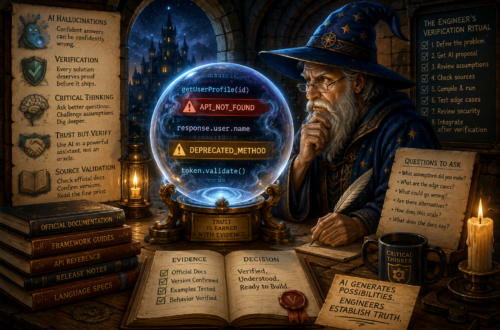
    A thoughtful wizard studies a glowing crystal ball inside a medieval observatory transformed into a software engineering workspace. The crystal ball displays realistic-looking code alongside prominent warning messages indicating nonexistent APIs and deprecated methods, symbolizing AI hallucinations. Surrounding the wizard are official documentation books, verification checklists, engineering notes, and a ritual board outlining a disciplined software validation process. Additional notes encourage asking critical questions, verifying assumptions, and consulting authoritative sources before trusting AI-generated solutions. The scene combines fantasy and technology to illustrate the importance of critical thinking, source validation, and professional judgment in AI-assisted software development.

    The Crystal Ball Lies Sometimes: Verifying AI Before You Trust It

    July 31, 2026
    An experienced wizard sits thoughtfully at a workbench inside a warm, medieval-inspired workshop, collaborating with a glowing owl familiar that represents artificial intelligence. Ancient spellbooks and engineering references surround them alongside a modern laptop displaying architectural diagrams, while magical holographic interfaces illustrate AI-assisted development workflows. Banners and notes throughout the workshop emphasize engineering judgment, human responsibility, and collaboration over automation. The scene blends fantasy and software engineering to symbolize AI as a trusted apprentice that accelerates development without replacing the wisdom, decision-making, and accountability of the engineer.

    The Wizard’s New Apprentice: Working Alongside AI

    July 27, 2026
  • An elderly wizard in deep blue robes sits at a wooden desk inside a grand medieval library, carefully writing on a parchment with a feather quill. Shelves of ancient books fill the background beneath tall stone arches, creating the atmosphere of a magical archive. Around the wizard, glowing blue holographic panels illustrate an AI-assisted documentation workflow, showing an AI assistant drafting information, an engineer adding judgment and context, and a review process validating accuracy and clarity before documentation is shared. Stacks of books labeled Design Decisions, Lessons Learned, Architecture Notes, Incident Reports, and Operational Runbooks reinforce the importance of preserving engineering knowledge. A scroll on the desk highlights the qualities of effective documentation, including explaining why decisions were made, capturing context, guiding future decisions, preventing mistakes, and outliving the original engineers. Nearby, a documentation quality checklist emphasizes accuracy, current information, clear context, valid examples, and usefulness to future team members. A glowing crystal orb displays the message Better Docs = Better Systems, visually connecting thoughtful documentation, AI-assisted knowledge sharing, and long-term software maintainability.
    The Enchanted Workshop

    The Endless Scribe: Writing Documentation with AI

    August 3, 2026 /

    The fastest quill is worthless if no one can read what it writes. Software has a remarkable ability to outlive the people who create it. A feature completed during a single sprint may continue serving customers for a decade. Entire engineering organizations evolve around systems whose original architects have long since moved on. New developers inherit the code, extend it, modernize it, and occasionally struggle against it without ever hearing the conversations that shaped its design. By the time software reaches maturity, its greatest challenge is rarely understanding what it does. The real challenge is understanding why thoughtful engineers decided it should behave that way. The software itself may remain…

    Read More
    Frank Jamison

    You May Also Like

    A fantasy wizard-developer examines glowing AI-generated code with a magnifying glass in a candlelit library while a black cat familiar guards a validation orb. A toothy mimic chest lurks nearby, surrounded by scrolls and books representing AI code review, security, hallucinated APIs, supply chain risks, testing, requirements, and architecture.

    The Mimic in the Library: Trusting AI Without Being Fooled

    August 10, 2026
    An experienced wizard sits thoughtfully at a workbench inside a warm, medieval-inspired workshop, collaborating with a glowing owl familiar that represents artificial intelligence. Ancient spellbooks and engineering references surround them alongside a modern laptop displaying architectural diagrams, while magical holographic interfaces illustrate AI-assisted development workflows. Banners and notes throughout the workshop emphasize engineering judgment, human responsibility, and collaboration over automation. The scene blends fantasy and software engineering to symbolize AI as a trusted apprentice that accelerates development without replacing the wisdom, decision-making, and accountability of the engineer.

    The Wizard’s New Apprentice: Working Alongside AI

    July 27, 2026
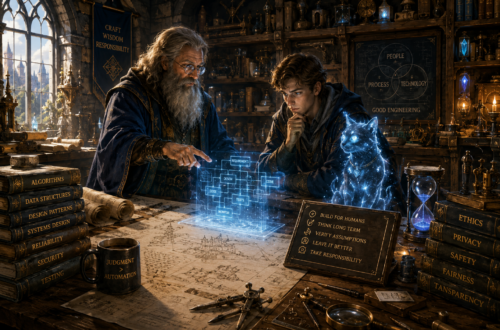
    A wide, painterly fantasy workshop serves as an editorial metaphor for modern software engineering. An experienced wizard mentor and a thoughtful apprentice study a glowing architectural blueprint projected above a large drafting table covered with medieval engineering plans, measuring tools, and manuscripts. A luminous blue magical familiar sits beside them, symbolizing human and AI collaboration. Towering bookshelves are filled with volumes on algorithms, design patterns, testing, security, ethics, and software architecture, while the surrounding workshop features drafting instruments, enchanted artifacts, blueprints, and engineering ledgers that emphasize craftsmanship, long-term planning, and responsible engineering. Warm golden light contrasts with cool blue magical illumination, creating an atmosphere of thoughtful mentorship where engineering judgment, software craftsmanship, and responsible AI take precedence over magical spectacle. The image introduces The Enchanted Workshop by portraying software engineering as a disciplined craft supported by powerful tools rather than defined by them, consistent with the StackNScroll editorial illustration philosophy.

    The Enchanted Workshop Begins: An Engineer’s Guide to the Age of AI

    July 25, 2026
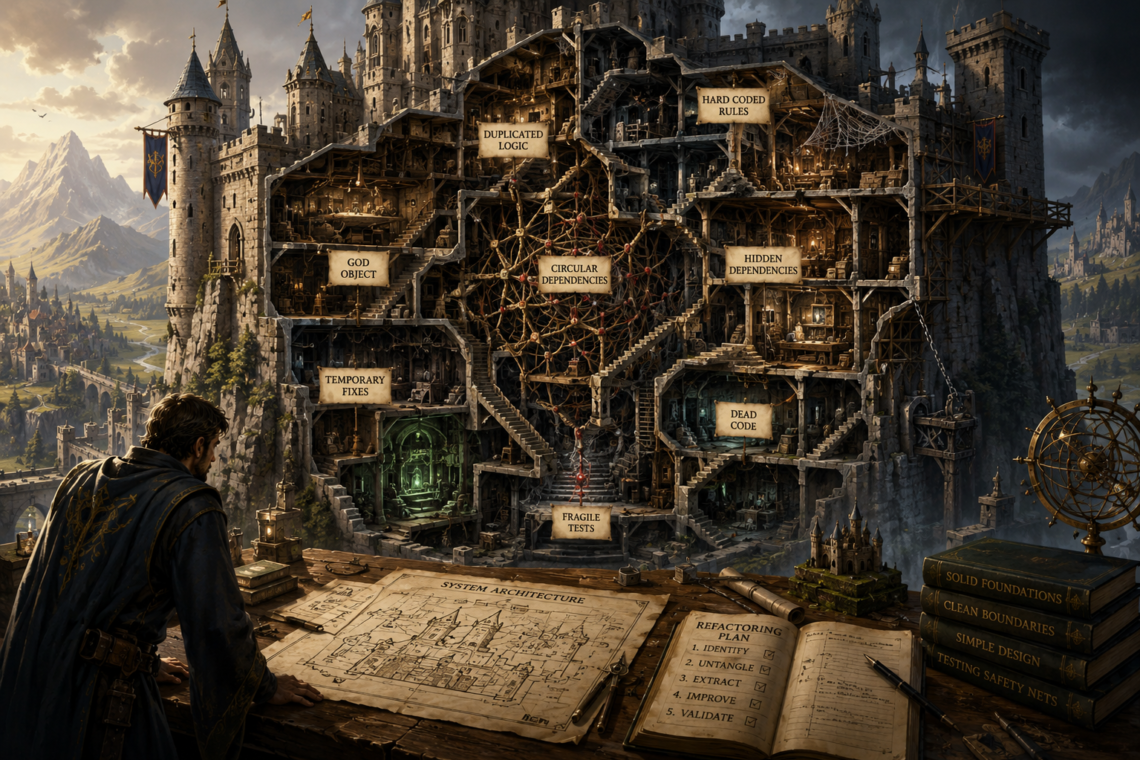
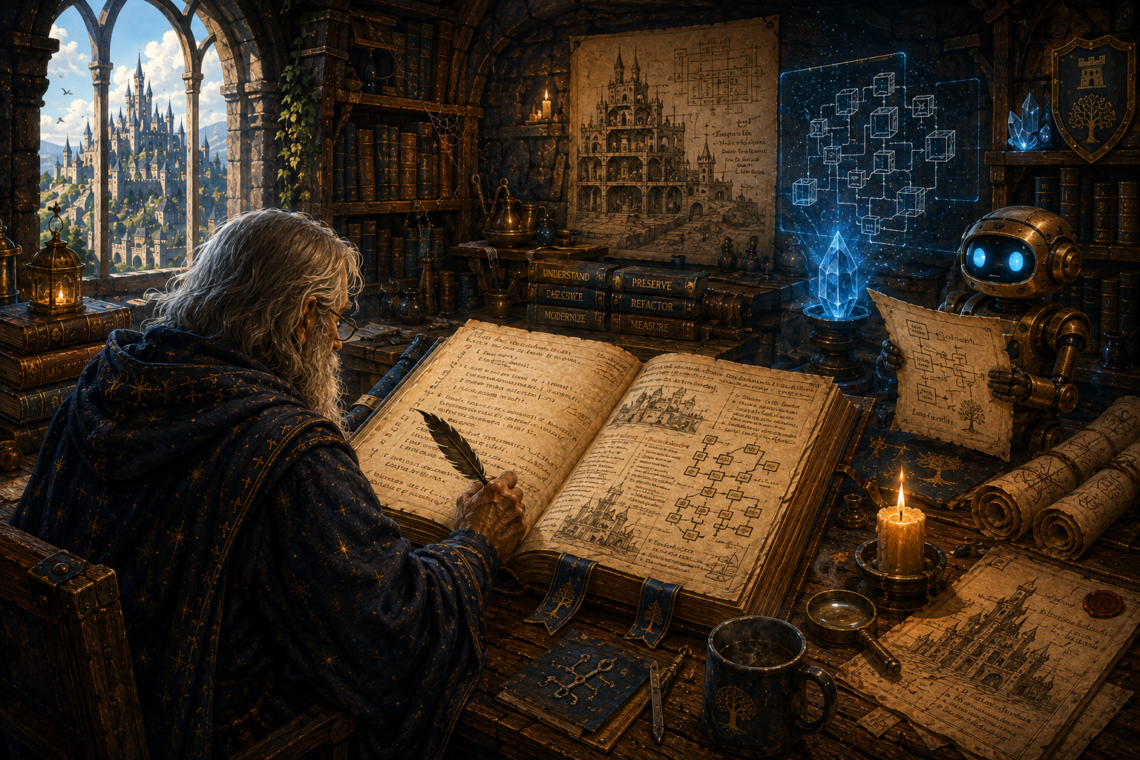
  • A detailed fantasy castle is shown in cross-section, revealing a maze of interconnected rooms, stairways, hidden passages, and structural layers that symbolize the complexity of a long-lived software system. At the center, tangled corridors and web-like connections represent circular dependencies and hidden coupling, while workshop-like chambers illustrate concepts such as duplicated logic, hard-coded rules, temporary fixes, fragile tests, dead code, and hidden dependencies. In the foreground, an architect studies blueprints and a refactoring plan spread across a drafting table, surrounded by engineering tools, manuscripts, and architectural diagrams. The surrounding kingdom is orderly and well maintained, contrasting with the increasingly convoluted interior of the castle. The painterly, Dungeons & Dragons-inspired editorial illustration uses fantasy architecture to represent technical debt, legacy systems, refactoring, and the challenge of maintaining software that has grown through years of incremental change.
    The Architect's Grimoire

    Hidden Traps in the Dungeon: Escaping Technical Debt

    July 15, 2026 /

    The deadliest dangers are often the ones built into the castle itself. No architect intentionally designs a maze. Every castle begins with a sensible plan. Corridors connect naturally, storerooms serve nearby kitchens, towers overlook vulnerable approaches, and every staircase leads somewhere meaningful. Yet castles that survive for generations rarely retain that original simplicity. New rulers expand old wings. Temporary passageways become permanent corridors. Storage rooms become workshops. Secret tunnels built during one crisis remain long after the danger has passed. Over time, the castle becomes increasingly difficult to navigate, not because its builders lacked skill, but because each generation solved the problems immediately before them. Long-lived software follows the same…

    Read More
    Frank Jamison

    You May Also Like

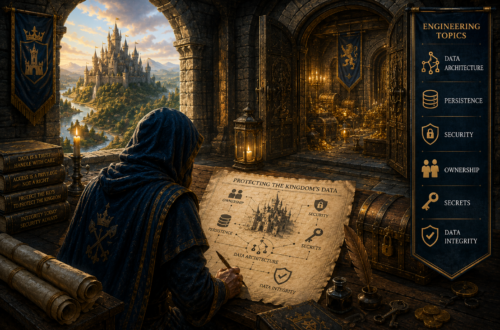
    A hooded royal architect studies a detailed medieval blueprint inside a heavily fortified castle treasury, where secure vaults, locked chests, and guarded passageways symbolize data protection, ownership, persistence, secrets management, and data integrity. Through a large stone archway, a majestic castle overlooks a peaceful river valley, reinforcing the theme that strong software architecture protects an organization's most valuable assets through thoughtful design rather than visible defenses alone.

    The Royal Treasury: Protecting the Kingdom’s Data

    July 10, 2026
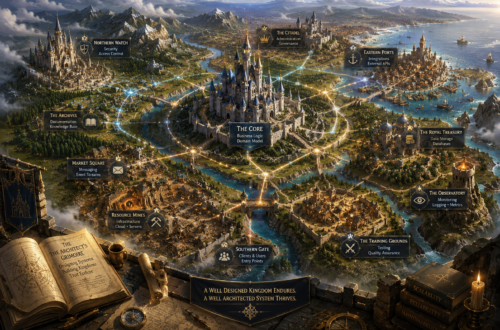
    A sprawling medieval fantasy kingdom stretches across a lush valley, with a fortified castle serving as the central hub of an expansive network of roads, bridges, and satellite settlements that symbolize a scalable software architecture. A massive dragon circles above the kingdom, representing the challenges of system growth, while an architect studies detailed plans from a stone overlook in the foreground. Glowing pathways connect infrastructure throughout the realm, illustrating concepts such as load balancing, distributed systems, caching, and scalable services. The scene emphasizes thoughtful planning, resilient infrastructure, and measured expansion through richly detailed architecture and environmental storytelling, using a classic Dungeons & Dragons-inspired aesthetic to visualize modern software engineering principles.

    The Dragon Named Scale: Building Systems That Grow

    July 13, 2026
    A fantasy-inspired illustration depicts a master engineer overlooking a thriving medieval kingdom powered by invisible systems rather than heroic effort. In the foreground, a cloaked architect studies a blueprint illustrating a software delivery pipeline from code to build, test, deployment, and monitoring. Below, workshops, waterwheels, bridges, and aqueducts symbolize automated infrastructure supporting the bustling city above. Watchtowers overlook the realm while illuminated engineering panels represent automated testing, CI/CD pipelines, infrastructure as code, deployment automation, and monitoring. The scene conveys how automation, continuous improvement, and dependable engineering systems quietly enable a prosperous kingdom without drawing attention to themselves.

    The Automated Kingdom: When Excellence Becomes Routine

    July 22, 2026
  • The Architect's Grimoire (13)
  • The CSS Codex (13)
  • The Enchanted Workshop (9)
  • The Full-Stack Campaign (7)
  • The Guildmaster’s Handbook (13)

AI-Assisted Development Artificial Intelligence Backend Development Career Development Clean Code Code Quality CSS CSS Architecture CSS Best Practices CSS Fundamentals CSS Layout Design Systems Developer Education Developer Growth Developer Productivity Dungeons and Dragons Engineering Culture Engineering Judgment Engineering Leadership Fantasy Theme Front-End Development Frontend Development Full Stack Development Maintainable Code Maintainable CSS Mentorship Professional Development Professional Growth Refactoring Responsive Design Software Architecture Software Craftsmanship Software Design Software Development Software Engineering StackNScroll System Design Technical Debt Technical Leadership The Architect's Grimoire The CSS Codex The Enchanted Workshop The Full-Stack Campaign The Guildmaster's Handbook Web Development

Stack N' Scroll - 2026 ©