
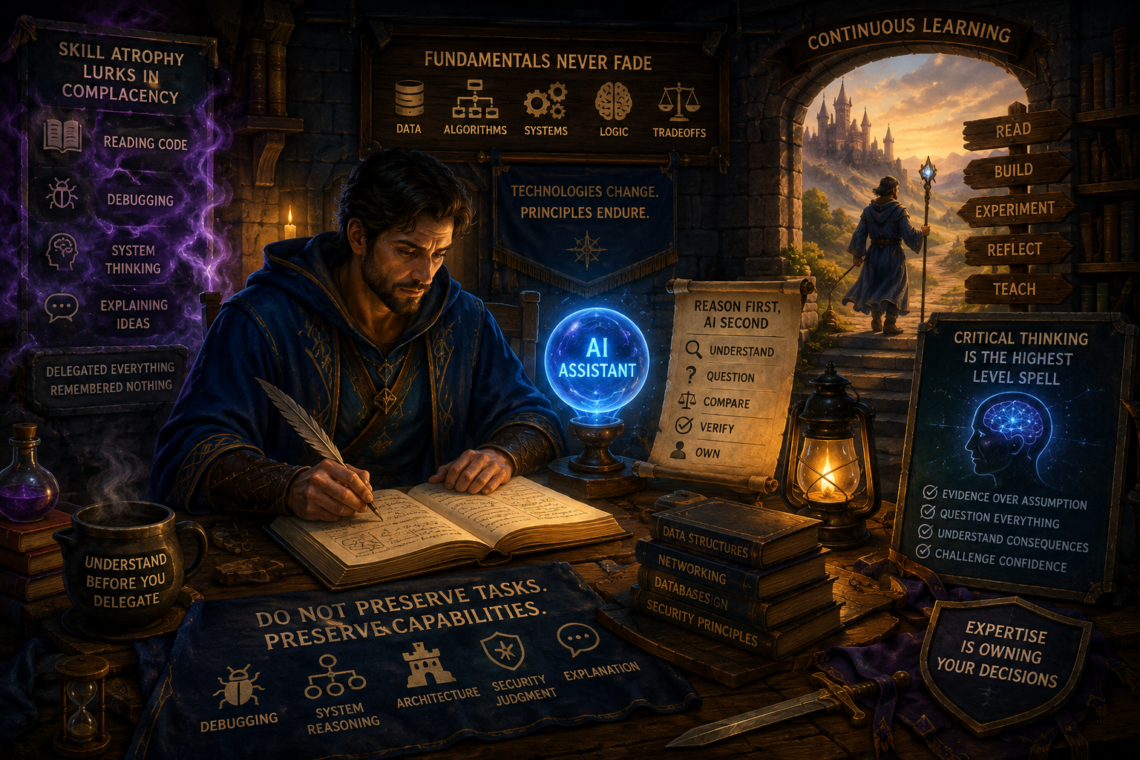
The Wizard Who Forgot Magic: Keeping Your Engineering Skills Sharp
A wand should extend the wizard’s reach, never replace the wizard’s mind.
There is an uncomfortable possibility hiding inside every tool that makes us faster: eventually, we may become less capable without it. Software engineers have lived with versions of this problem for decades. Integrated development environments remember syntax, frameworks abstract away infrastructure, libraries package difficult algorithms, and search engines place decades of accumulated knowledge within seconds of our keyboards. Artificial intelligence simply pushes that progression much further. It can now write functions, explain unfamiliar code, generate tests, propose architectures, diagnose errors, and transform a vague requirement into something that looks remarkably close to finished software.
That capability is enormously useful, but usefulness and mastery are not the same thing. A wizard who carries an enchanted wand capable of casting every spell may accomplish more than the wizard who memorizes each incantation. The danger begins when the wand becomes the only thing standing between the wizard and helplessness. Engineering works the same way. AI should increase the range of our abilities, but if we gradually surrender the reasoning beneath those abilities, we have exchanged expertise for dependency.
The question facing engineers is therefore not whether AI belongs in the workshop. It already does. The more important question is which parts of engineering we must continue to practice ourselves, even when a machine can perform them faster. That question matters because the abilities most worth preserving are rarely the mechanical ones. They are the habits of reasoning that tell us whether the generated answer is appropriate, incomplete, dangerous, or simply solving the wrong problem.
The Spellbook You Carry in Your Head
Experienced engineers rarely spend their days proving that they remember every method signature or command-line option. Memorization has never been the highest form of technical competence. What matters is the mental model underneath the syntax: understanding how data moves through a system, how state changes, where failures can occur, what abstractions hide, and which tradeoffs become expensive later. Those models allow an engineer to encounter an unfamiliar technology and still reason about it.
That distinction matters because AI is particularly good at producing the visible artifacts of engineering. It can generate a controller, a database query, a test suite, a configuration file, or a deployment script almost instantly. The artifact may even be correct. Yet the artifact is only the final inscription in the spellbook. Engineering expertise lives in the reasoning that determines whether that inscription belongs there at all.
Consider a developer who asks an AI assistant to build a caching layer. The generated implementation may use sensible keys, expiration times, and invalidation logic. None of those choices answer the architectural questions surrounding the cache. What happens when cached data becomes stale? Which source remains authoritative? Can users tolerate inconsistency? What happens during cache failure? Is caching actually solving the performance bottleneck that motivated the change?
Those questions require a model of the system rather than knowledge of a particular API. They are also the kinds of questions that become harder to ask when engineers grow accustomed to accepting completed solutions before thinking through the problem. The skill most threatened by automation is not typing code. It is recognizing which questions must be answered before the code deserves to exist.
When Convenience Becomes Skill Atrophy
Skill atrophy rarely announces itself dramatically. Nobody opens an editor one morning and suddenly discovers that years of engineering knowledge have disappeared. The change happens quietly through hundreds of tiny decisions. Instead of tracing an exception, we paste it into an assistant. Instead of reading unfamiliar code, we request a summary. Instead of designing a function, we describe the desired behavior and accept the implementation.
Each individual choice is reasonable. In many cases, it is exactly the efficient choice. The problem appears when delegation becomes automatic rather than intentional. A capability that is never exercised eventually becomes harder to summon when the enchanted tool is unavailable, wrong, or operating outside familiar territory. The danger is not that engineers use assistance too often according to some arbitrary quota. The danger is that they stop noticing which parts of the work they no longer practice.
We have seen this pattern with earlier generations of tools. Developers who rely solely on graphical Git clients sometimes struggle when repository history becomes complex. Engineers who know an ORM but not relational databases can become confused when generated queries perform poorly. Developers who work entirely through framework abstractions may have difficulty diagnosing what happens beneath them. The tools are not responsible for those weaknesses. The weakness comes from allowing an abstraction to replace the underlying model rather than building on it.
AI deserves the same treatment. There is nothing virtuous about manually performing work that a reliable tool can automate. Experienced engineers do not earn additional points for suffering through boilerplate that a machine can produce safely. But efficiency becomes dangerous when we stop distinguishing between work that can be delegated and reasoning that maintains our ability to judge the delegated result.
Keep the Fundamentals Under the Robes
Engineering fundamentals are durable precisely because technologies are temporary. Languages change. Frameworks rise and disappear. Cloud platforms introduce new services. AI development environments will evolve faster than most of the tools that preceded them. The engineer who understands only the current interface is always one product update away from becoming an apprentice again.
Fundamentals provide continuity. Data structures still shape performance. Networking still involves latency and failure. Databases still make tradeoffs around consistency, durability, indexing, and concurrency. Security still depends on boundaries, trust, validation, and least privilege. Software design still involves coupling, cohesion, ownership, change, and complexity. Those principles remain useful even when AI produces much of the implementation.
This is why keeping skills sharp does not mean memorizing everything AI can retrieve. I do not need to prove that I can remember the exact syntax for every operation I use. I do need enough understanding to recognize whether the proposed operation makes sense. There is a profound difference between looking up syntax and outsourcing judgment.
The strongest engineers increasingly will be those who know where that boundary lies. They will happily let AI remember ceremony while protecting their own ability to reason about systems. Their expertise will move upward rather than disappear. That is not a retreat from AI-assisted engineering. It is the foundation that makes AI assistance genuinely useful.
Cast a Few Spells Yourself
One practical way to preserve that expertise is to deliberately perform certain engineering tasks without assistance. Not every task deserves preservation simply because engineers once performed it manually. Reproducing boilerplate, memorizing obscure syntax, or repeatedly performing mechanical transformations does little to strengthen the judgment that matters in production. Do not preserve tasks. Preserve capabilities.
The capabilities worth exercising are those that allow us to operate when the obvious answer fails: reading unfamiliar code, debugging with incomplete evidence, reasoning about system boundaries, modeling data, evaluating security implications, comparing architectural trade-offs, and explaining why a technical decision makes sense. Those abilities survive changes in language, framework, and tooling because they operate beneath them. AI can assist with every one of those activities, but engineers should remain capable of participating in the reasoning rather than merely approving its output.
Suppose I need a function that groups application events by user and returns the most recent event for each user. An AI assistant could produce this almost instantly. Occasionally, however, I may choose to sketch the solution myself first:
</> JavaScript

function latestEventByUser(events) {
    const latest = new Map();

    for (const event of events) {
        const current = latest.get(event.userId);

        if (!current || event.timestamp > current.timestamp) {
            latest.set(event.userId, event);
        }
    }

    return latest;
}
The code is not particularly sophisticated, and that is exactly the point. Writing it forces me to think about the data structure, iteration, comparison rule, and expected complexity before an assistant frames the problem for me. I might then ask AI to review the implementation, identify edge cases, or propose alternatives. The tool becomes another mind at the workbench rather than the engineer holding the pencil.
That ordering changes the learning experience. When I reason first and compare second, disagreement becomes informative. If the assistant proposes sorting the entire collection before grouping it, I can evaluate the tradeoff instead of merely observing different code. If it notices malformed timestamps or missing identifiers that I overlooked, I learn something about my own reasoning. The AI has extended my thinking without replacing the thinking that made comparison possible.
Read Before You Ask for the Map
Code comprehension deserves similar protection. Reading unfamiliar code is one of the most important skills an engineer develops, particularly when maintaining production systems. Real applications rarely arrive as neat tutorials with every dependency clearly labeled. They contain history, abandoned approaches, compatibility layers, imperfect abstractions, and decisions whose original context disappeared years ago. Learning to navigate that uncertainty is part of becoming an engineer rather than merely becoming proficient with a particular development tool.
AI summaries are extremely useful when navigating those systems, but immediately requesting an explanation can remove the productive struggle that develops comprehension. Before asking the assistant what a module does, spend a few minutes tracing it yourself. Identify inputs, outputs, dependencies, side effects, state changes, and failure paths. Follow important calls far enough to understand where responsibility moves from one component to another. Most importantly, form a hypothesis about what the code is doing before someone, human or artificial, supplies the answer.
Then ask the AI.
The comparison between your model and the generated explanation becomes far more valuable than the explanation alone. Perhaps the assistant notices a hidden dependency you missed. Perhaps it recognizes a design pattern that clarifies why the code was structured a particular way. Perhaps you discover that its confident summary ignores an important branch or misunderstands a business rule. Any of those outcomes strengthens your engineering ability because you entered the conversation with a model that can be tested, rather than an empty page waiting to be filled.
This habit also protects against one of the subtler risks of AI-assisted development. A plausible explanation can feel like understanding before understanding has actually occurred. Reading creates friction, and some friction is useful because it forces us to construct the mental map ourselves. The dungeon map becomes more meaningful after we have learned how to recognize corridors, doors, dead ends, and traps without having every passage illuminated for us.
Debugging Is Where Wizards Earn Their Robes
Debugging may be the most important skill to preserve because production failures rarely resemble carefully written prompts. They arrive as incomplete evidence. A request intermittently times out. Memory consumption grows slowly over several days. A database query becomes expensive only under particular traffic patterns. A race condition occurs in production but cannot be reproduced locally. The engineer does not receive a neatly packaged problem statement because discovering the actual problem is part of the work.
AI can help enormously with these situations. It can interpret logs, suggest hypotheses, explain stack traces, identify common failure patterns, and remind us of possibilities that experience or fatigue may have caused us to overlook. What it cannot safely replace is disciplined investigation. Debugging is not primarily about knowing the answer. It is the ability to reduce uncertainty methodically until the evidence makes the answer difficult to deny.
Good debugging begins by separating observation from assumption. What do we actually know? What changed? Which components are involved? Can we reproduce the behavior? What evidence would eliminate one hypothesis? Which measurement should we collect next? These questions create a narrowing search rather than a procession of guesses, and learning to conduct that search is one of the most transferable skills in software engineering.
If engineers become accustomed to presenting every error directly to AI and trying the first suggested fix, debugging slowly becomes an incantation. Change this setting. Add this check. Restart that service. Perhaps the problem disappears, but disappearance is not understanding. The system remains mysterious, and mysterious systems eventually demand payment when the same underlying failure returns wearing different robes.
Use AI to generate hypotheses, but retain ownership of the investigation. Ask it what evidence would distinguish one theory from another. Challenge its assumptions. Verify proposed causes against logs, metrics, traces, documentation, source code, and observed behavior. A good assistant can put more possibilities on the table for the investigation, but the engineer should remain the one deciding what the evidence means.
Practice Explaining the Magic
Another powerful defense against skill atrophy is explanation. If I cannot explain why a piece of code works, what tradeoff an architecture makes, or why a particular design is appropriate, then I probably understand it less thoroughly than I believe. Familiarity can masquerade as knowledge surprisingly well, especially when we have spent weeks working inside the same system. Trying to explain that system to another engineer can reveal where our understanding becomes fuzzy.
AI makes explanation deceptively easy because it can produce polished technical prose about almost anything. That makes it tempting to let the assistant explain our own systems for us. Yet explaining something ourselves is one of the mechanisms through which knowledge becomes durable. Turning a mental model into language forces us to confront missing connections that can remain comfortably hidden while we are simply reading code.
Try describing a design before asking AI to improve the explanation. Explain why a service owns particular data. Describe why an asynchronous queue exists between two components. Walk through what happens when a request fails halfway through a transaction. Explain what would happen if a dependency became unavailable for ten minutes. If the explanation becomes vague at a particular point, that vagueness has revealed a gap worth investigating.
This practice matters beyond personal learning. Senior engineers spend much of their time transferring mental models. Code reviews, architecture discussions, mentoring sessions, incident reviews, onboarding, and technical documentation all depend upon the ability to make reasoning visible to other people. AI can polish the language, organize the material, or identify missing details, but the engineer must still possess the reasoning worth communicating.
Build With AI, Then Remove the Wand
There is a useful test for any AI-assisted task: after the work is complete, ask whether you could explain and maintain the result without the conversation that produced it. If the answer is no, the task is not finished. The software may run, the tests may pass, and the pull request may look respectable, but ownership requires more than possessing the generated files.
That does not mean recreating everything from memory. It means understanding the important boundaries. You should know why the major components exist, what assumptions they make, what data they manipulate, where failures can occur, and what tradeoffs shaped the design. You should be able to inspect a future change and reason about its consequences without asking the original assistant to remind you what your own software does.
This becomes especially important as AI generates larger portions of applications. A developer may soon produce thousands of lines of functioning code in an afternoon, something that would once have required days or weeks of implementation. That sounds like extraordinary productivity until the first significant change arrives. Code that nobody understands is not free productivity. It is borrowed productivity with maintenance interest attached.
Imagine that AI generates an authentication middleware layer like this:
</> JavaScript

async function authorizeRequest(req, res, next) {
    const token = req.headers.authorization?.replace("Bearer ", "");

    if (!token) {
        return res.status(401).json({ error: "Unauthorized" });
    }

    try {
        const user = await verifyToken(token);
        req.user = user;
        next();
    } catch (error) {
        return res.status(401).json({ error: "Unauthorized" });
    }
}
Accepting the code is only the beginning of the engineering work. I still need to understand what verifyToken actually verifies, where signing keys originate, whether expiration and revocation are handled, what information is placed in req.user, how authorization differs from authentication elsewhere in the application, and whether every failure should truly produce the same response. The generated function may be perfectly reasonable while the surrounding security model remains incomplete. Knowing JavaScript syntax will not expose that problem. Understanding the system might.
The measurement that matters therefore cannot simply be how quickly code was generated. We also need to ask whether the team acquired enough understanding to own what was created. Production software eventually belongs to humans who must operate, modify, secure, debug, and explain it. AI can accelerate construction, but responsibility does not transfer merely because the first draft came from somewhere else.
Choose What the Familiar Should Carry
The healthiest AI workflow is not one in which humans stubbornly retain every task. It is one in which delegation is intentional. Let the familiar carry weight that does not need to remain in your muscles. Boilerplate, repetitive transformations, documentation drafts, test scaffolding, API exploration, unfamiliar syntax, and mechanical configuration are often excellent candidates because manually performing them provides little additional engineering insight.
The distinction is not between easy work and difficult work. It is between tasks whose automation preserves our ability to reason and tasks whose automation can quietly weaken it. Remembering an obscure API signature is rarely essential expertise. Understanding why an operation can fail, what data it changes, and how that failure affects the rest of the system often is.
That gives us a better standard for deciding what to delegate. We can allow tools to carry more implementation work while deliberately exercising debugging, system reasoning, architecture, data modeling, security judgment, code comprehension, tradeoff analysis, and technical explanation. Those capabilities form the durable layer beneath whatever development environment surrounds us.
Occasionally reverse the relationship. Trace the request manually. Diagnose the exception before asking for help. Sketch the architecture before requesting alternatives. Read the documentation before requesting a summary. Explain the design aloud before asking the assistant to clarify it. These small acts maintain the mental machinery required to judge everything the AI gives us.
The objective is not independence from tools. No serious engineer is independent from tools, and pretending otherwise confuses inconvenience with expertise. The objective is resilience. A resilient engineer can use powerful abstractions without becoming trapped inside them, accept assistance without surrendering judgment, and put down the enchanted wand without discovering that the magic disappeared with it.
Keep a Training Ground Inside the Workshop
Maintaining engineering skill becomes easier when practice is deliberate rather than accidental. Production work is not always a good training environment because deadlines reward completion, not exploration. When a service is failing at two in the morning, nobody earns extra wisdom for refusing the fastest reliable diagnostic tool. Engineers therefore need smaller places where efficiency is not the only measure of success.
Personal projects, coding exercises, prototypes, debugging experiments, and unfamiliar technologies can provide that training ground. Occasionally build a small service without having AI generate the architecture. Read through an unfamiliar repository and diagram the important relationships yourself. Investigate a failure before requesting a diagnosis. None of these exercises need to become elaborate rituals. Their purpose is simply to keep durable engineering capabilities active in situations where there is room to make mistakes.
The same principle applies inside professional teams. A design discussion becomes less valuable if everyone arrives with an AI-generated architecture and nobody can explain why its boundaries exist. A code review weakens when reviewers ask an assistant whether the code is good rather than examining the assumptions themselves. AI can participate in both activities, but it should add another perspective rather than becoming the perspective that everyone else accepts.
There is an important difference between practicing old techniques out of nostalgia and maintaining foundational abilities that remain useful. Engineers do not need to recreate an earlier era of development or manually perform work whose value has been automated away. We need enough practice beneath modern abstractions to understand when those abstractions fail us. The purpose of the training ground is not to prepare for a world without AI. It is to prepare engineers to remain capable in a world filled with it.
Learn New Magic Without Forgetting the Old
Skill maintenance also requires continued learning, although AI changes what learning should look like. When information is instantly available, memorizing every detail becomes less valuable. Understanding relationships becomes more valuable. The engineer who can connect a new database technology to familiar concepts such as indexing, consistency, partitioning, and transactions can learn much faster than someone approaching each technology as an isolated collection of commands.
This gives experienced engineers an advantage only if they continue strengthening those connections. When learning something new with AI, resist the temptation to request a complete tutorial and passively follow it from beginning to end. Ask why the technology exists. Identify the problem it was designed to solve. Compare its tradeoffs with systems you already understand. Explore what happens when its assumptions break.
The same approach helps developing engineers avoid a particularly dangerous illusion: the appearance of rapid expertise. AI can help someone produce surprisingly sophisticated software before they understand the underlying concepts. That is useful because it lowers barriers to experimentation, but successful output should not be confused with acquired knowledge. A wizard who successfully reads a spell from a scroll has demonstrated that the scroll works, not necessarily that the wizard understands the spell.
Real learning appears when circumstances change. Can you modify the design when requirements shift? Can you explain why one approach is safer than another? Can you diagnose failure when the happy path disappears? Can you recognize when the assistant confidently recommends something inappropriate? Those moments reveal whether knowledge has become part of the engineer or remains somewhere inside the tool.
Critical Thinking Is the Highest-Level Spell
As AI improves, many individual technical tasks will become easier. Generating CRUD operations, writing transformations, scaffolding tests, translating between languages, creating deployment configurations, and producing documentation will require progressively less manual effort. That does not make engineering less intellectually demanding. It moves more of the difficulty toward deciding what should be built, evaluating what was produced, and understanding consequences.
Critical thinking therefore becomes more valuable, not less. Engineers must evaluate assumptions, identify missing information, distinguish evidence from plausible explanation, and recognize when requirements conflict. They must understand that a technically correct implementation can still be the wrong engineering decision. AI can contribute to that reasoning, but the responsibility for the decision remains with the people who own the system.
This is where expertise becomes difficult to automate because expertise is partly the accumulation of context. An experienced engineer has watched harmless shortcuts become maintenance problems. They have seen elegant architectures collapse under operational complexity and boring solutions survive for years. They have learned that requirements often contain hidden assumptions and that every abstraction eventually charges rent. Those lessons shape judgment long before anyone begins typing code.
AI can expose developing engineers to more examples and perspectives than previous generations could access easily. That is an extraordinary opportunity. Yet exposure only becomes judgment when engineers examine those examples, make decisions, observe consequences, and reflect on what happened. Information can arrive instantly. Wisdom still has to be built.
Measure Yourself by the Decisions You Can Defend
One way to evaluate whether AI is strengthening or weakening your engineering ability is to stop measuring productivity only by output. Lines of code have always been a poor measurement, and AI makes them almost meaningless. The more useful question is whether the decisions surrounding that code have improved.
Can you explain why a boundary exists? Can you defend the choice of a particular data model? Can you describe the failure modes introduced by an integration? Can you explain why one implementation was selected over another? Can you identify the assumptions that would prompt a reconsideration of the design? Those questions reveal engineering understanding much more clearly than how quickly an implementation appeared.
This also changes how we should think about reviewing AI-generated work. The first question should not simply be whether the code runs. Working software is necessary, but production engineering demands more. We need to understand whether the implementation fits the architecture, whether its complexity is justified, whether its security assumptions are acceptable, whether the team can maintain it, and whether it solves the actual problem.
A useful habit is to treat every significant AI recommendation as something you may eventually need to defend in a room full of experienced engineers. Not because every decision requires a formal architecture review, but because the imagined conversation forces reasoning into the open. If the strongest explanation available is that the assistant recommended it, then the decision does not yet belong to you.
The engineer who cannot explain a decision has not delegated the work. They have delegated ownership.
The Wizard Must Still Know Magic
The fear surrounding AI and engineering skills is sometimes framed too simply. Either AI will make developers dramatically more capable, or it will make them intellectually dependent. The same tool can produce either outcome depending on whether engineers use it to avoid reasoning or to deepen it. The difference is not the power of the wand. The difference is whether the wizard continues learning magic.
Maintaining expertise therefore should not become a defensive campaign against automation. Software engineering has always advanced by allowing tools and abstractions to remove lower-level work. Compilers freed programmers from much machine-level detail, frameworks removed repetitive infrastructure work, and libraries packaged solutions engineers no longer needed to recreate every morning. AI belongs to that progression, even though the range of work it can absorb is considerably broader.
The challenge is to climb as the abstraction rises. If implementation becomes easier, become better at architecture. If syntax becomes cheaper, become better at reasoning. If generating alternatives becomes effortless, become better at evaluating tradeoffs. If information becomes abundant, become better at determining what deserves trust. The skills we protect should be the ones that help us understand, challenge, and own increasingly powerful systems.
That is the distinction at the heart of keeping engineering skills sharp. We do not preserve a task merely because engineers once performed it manually. We preserve the capabilities that allow engineers to recognize when the automated task produced the wrong answer, solved the wrong problem, or introduced a cost that nobody noticed. Tools should inherit our repetition. They should not inherit our judgment.
From Dangerous Magic to Becoming the Archmage
Throughout The Enchanted Workshop, AI has played many roles. It has been an apprentice that required careful instruction, a crystal ball whose answers demanded verification, a tireless scribe and testing golem, a tool for restoring aging spellbooks, and a source of dangerous magic that required security and responsibility. Each lesson has pointed toward the same larger principle: greater capability does not reduce the need for engineering judgment. It increases it.
Keeping our skills sharp completes that argument. The mature engineer does not reject the enchanted workshop and return to carving every component by hand. Nor does the mature engineer surrender the workshop to automation and hope its machinery understands what should be built. Mastery lies between those extremes. We use the strongest tools available while deliberately preserving the knowledge required to direct, inspect, challenge, debug, maintain, and ultimately own their work.
A wand should extend the wizard’s reach, never replace the wizard’s mind. That principle matters far beyond AI-assisted coding. Every abstraction we adopt should allow us to accomplish more without making us incapable of reasoning about what happens beneath it. We do not need to remember every incantation, but we must understand enough magic to recognize when the spell is wrong.
Next week, The Enchanted Workshop begins its final theme: Becoming the Archmage. The focus now shifts from learning how an individual engineer works effectively with AI to the larger question of what mastery looks like as these tools become ordinary parts of professional software engineering. Individual expertise remains essential, but production software has never been the work of solitary wizards for very long.
On Monday, we enter The Guild of Many Minds: Collaborative Engineering in the Age of AI. We will move from the skills of the individual wizard to the collective intelligence of the engineering guild, where code reviews, pair programming, design discussions, knowledge transfer, and AI all meet around the same workbench. The next challenge is not simply learning how a wizard can remain capable while wielding more powerful magic. It is learning how an entire guild can become stronger without allowing its most powerful tools to silence the minds around the table.

You May Also Like
The Workshop of Tomorrow: The Future of AI-Assisted Software Engineering

The Enchanted Workshop Begins: An Engineer’s Guide to the Age of AI