
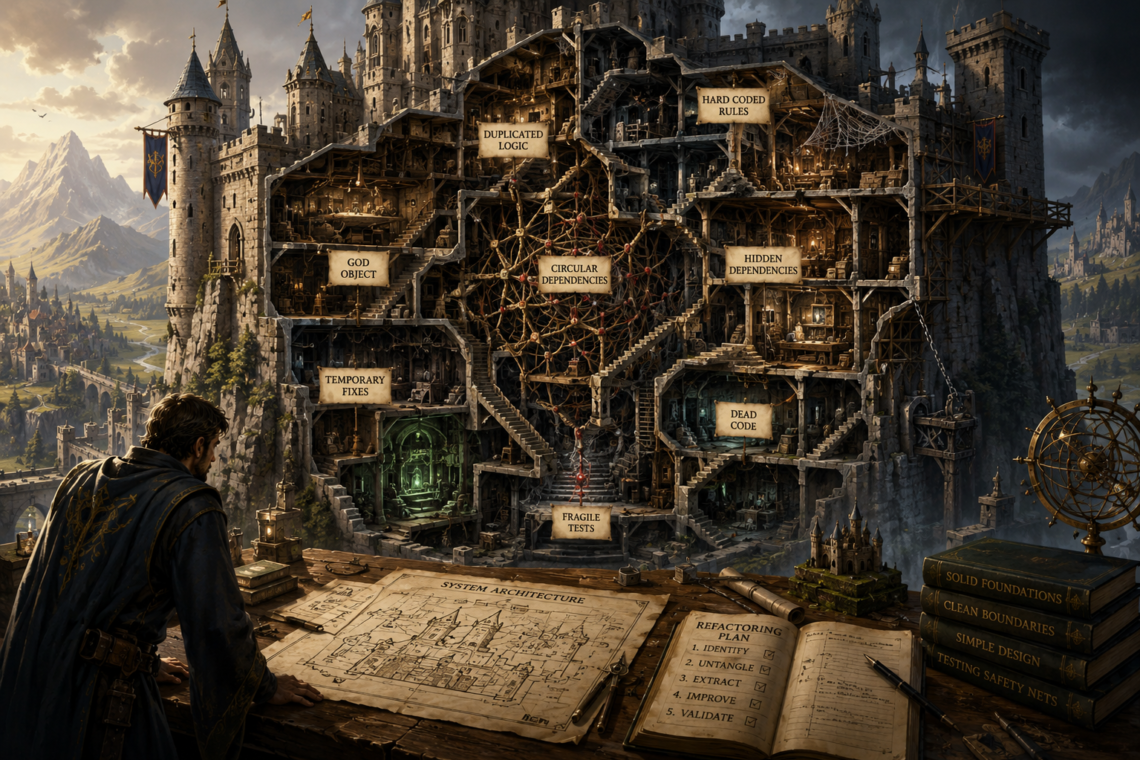
Hidden Traps in the Dungeon: Escaping Technical Debt
The deadliest dangers are often the ones built into the castle itself.
No architect intentionally designs a maze.
Every castle begins with a sensible plan. Corridors connect naturally, storerooms serve nearby kitchens, towers overlook vulnerable approaches, and every staircase leads somewhere meaningful. Yet castles that survive for generations rarely retain that original simplicity. New rulers expand old wings. Temporary passageways become permanent corridors. Storage rooms become workshops. Secret tunnels built during one crisis remain long after the danger has passed. Over time, the castle becomes increasingly difficult to navigate, not because its builders lacked skill, but because each generation solved the problems immediately before them.
Long-lived software follows the same path.
Technical debt rarely announces its arrival. It does not appear in a compiler warning or fail a unit test. More often, it hides inside successful releases, celebrated milestones, and perfectly reasonable engineering decisions. A deadline approaches. A customer needs an urgent feature. A dependency will supposedly be replaced next quarter. A prototype unexpectedly becomes production software. Every compromise appears justified in the moment, yet those decisions slowly accumulate until maintaining the system becomes noticeably more difficult than extending it.
One of the greatest misconceptions about technical debt is that it begins with poor engineering. Most of the time, it does not. It begins with good engineers making sensible decisions under imperfect circumstances. The difficulty is that software rarely remains frozen in the environment for which those decisions were made. Requirements evolve. Teams grow. Businesses change direction. Systems that were once elegantly simple become increasingly resistant to change because the assumptions that shaped their design quietly disappear.
I have watched engineering teams spend weeks implementing features that should have required only days because they were forced to navigate decisions made years earlier. The original developers were not careless. Most were thoughtful professionals balancing competing priorities with the information available at the time. They built exactly the software the business needed. Unfortunately, software has exceptional memory. Long after deadlines are forgotten and product roadmaps have changed, every architectural decision continues influencing the engineers who inherit the system.
Technical debt is often described as a quality problem. In reality, it is a problem of changeability. Poor naming, duplicated logic, sprawling methods, and hidden dependencies certainly contribute to it, but those are symptoms rather than the disease itself. The deeper issue is that software gradually becomes less willing to evolve. Once every modification requires tracing uncertain dependencies, anticipating unpredictable side effects, or carefully avoiding fragile assumptions, the codebase transforms from a valuable asset into an obstacle that demands payment before allowing progress.
Perhaps the most expensive interest payment is not measured in processor time or cloud infrastructure costs. It is measured in people. A duplicated method adds a few minutes to every code review. Hidden coupling forces another engineer to spend an afternoon tracing unexpected behavior. Fragile tests reduce confidence during deployments. New developers require weeks instead of days to become productive because understanding one feature requires understanding five others. Individually, none of those costs appear particularly significant. Collectively, they reshape how an engineering organization operates. Technical debt does not simply slow software. It quietly slows every person responsible for building it.
Within our growing kingdom, imagine a magnificent castle that has expanded steadily over several decades. Every ruler added another tower, another courtyard, another hidden passage, and another defensive wall. Each addition solved an immediate problem, and every construction crew left believing they had improved the castle. No one intended to create confusion. Yet after generations of renovations, the servants can no longer remember which corridors connect to which storerooms, hidden staircases emerge behind bookcases, and support beams disappear into walls whose original purpose has long been forgotten. The castle still stands proudly, but every renovation now requires painstaking investigation before a single stone can be moved.
Successful software often reaches the same destination.
Ironically, technical debt appears most often in systems that have succeeded. Failed software rarely survives long enough to accumulate years of architectural compromises. Successful products continue to grow because customers continue to find value in them. Businesses pivot. Regulations evolve. Frameworks mature. Infrastructure expands. Every new requirement introduces another opportunity to favor immediate delivery over long-term simplicity. Success keeps the project alive. Longevity gives technical debt time to mature.
Throughout The Architect’s Grimoire, we have gradually transformed an empty landscape into a thriving kingdom. We began by laying strong architectural foundations before deciding when to build for tomorrow instead of today. We resisted unnecessary fortification, designed trustworthy roads between cities, established meaningful boundaries, protected the kingdom’s greatest treasure, and learned that every growing kingdom eventually attracts larger challenges. This week’s theme, Defending the Walls, naturally turns our attention inward. Before a kingdom can withstand attacks from outside its walls, it must ensure that its own builders have not quietly weakened the structure from within.
The Hidden Cost of Every Shortcut
One of the most important lessons production software eventually teaches is that technical debt is fundamentally about future decision-making rather than present implementation. Every shortcut changes the choices available to the engineers who inherit the system tomorrow. Some compromises remain inexpensive because the surrounding architecture absorbs them gracefully. Others quietly narrow future options until even simple enhancements become surprisingly expensive.
Consider two development teams delivering nearly identical features under identical deadlines. One team introduces a temporary abstraction with clear documentation explaining why it exists and under what conditions it should be revisited. The second team copies existing logic into several unrelated components because it appears faster than creating a reusable solution. Both teams finish on schedule. Both celebrate a successful release. Six months later, however, only one team remembers exactly where changes need to be made when requirements inevitably evolve.
The deadline was never the deciding factor.
Judgment was.
After enough years maintaining production systems, engineers gradually stop asking whether they can implement a solution and begin asking a far more important question: What kind of system am I creating? Every shortcut solves today’s problem. Good architecture ensures it does not become tomorrow’s. Nearly every design decision works today. The more meaningful question is whether tomorrow’s developers will still understand why it works.
Not every compromise is a mistake.
Every production system carries technical debt because every business operates under constraints. Eliminating every compromise would require unlimited budgets, unlimited schedules, and customers willing to postpone value indefinitely. Professional engineering has never been about perfection. It has always been about making intelligent tradeoffs while remaining honest about their long-term consequences.
That distinction explains why the phrase technical debt can sometimes become dangerously misleading. Debt implies something temporary that will eventually be repaid. Many organizations speak about paying down technical debt while continually postponing the work because visible features always receive higher priority. Eventually, those temporary decisions become permanent architecture. At that point, the problem no longer resembles debt. It resembles structural decay.
Imagine a castle whose builders decide to postpone replacing several weakened wooden support beams because they remain strong enough for another season. That decision might be entirely reasonable if repairs are scheduled for the coming spring. If every spring brings new construction projects that appear more urgent, however, those weakened beams quietly become part of the permanent structure. Years later, no one remembers they were ever considered temporary. The castle simply feels increasingly difficult to maintain, and every renovation carries unexpected risk because no one knows which walls still depend upon aging supports.
Software evolves in remarkably similar ways.
Mapping the Dungeon Before Entering
One mistake I frequently see developing engineers make is assuming that technical debt can be identified simply by reading individual files. Occasionally, that is true. Massive methods, duplicated logic, or inconsistent naming often signal deeper problems. More often, however, the real debt exists between components rather than within them. Hidden coupling, unclear ownership, tangled dependencies, and assumptions scattered throughout the system create maintenance challenges that no static analysis tool fully understands.
This is why experienced architects spend considerable time studying relationships instead of individual implementations. They ask questions that seem unrelated to writing code. Which services depend upon each other? Which modules change together? Which business rules appear in multiple places? Which components require synchronized deployments? Those questions reveal architectural traps long before they manifest as production failures.
When I review an unfamiliar system, I rarely begin by searching for clever algorithms. Instead, I try to understand how easily I can predict the consequences of a change. If modifying one component requires tracing a web of uncertain dependencies throughout the application, I have usually discovered the entrance to the dungeon. The code itself may appear perfectly reasonable. The architecture surrounding it quietly tells a different story.
Clean formatting, descriptive variable names, and consistent style remain important because they improve readability. They do not guarantee maintainability. A beautifully organized maze remains a maze. The true measure of architecture is whether future engineers can confidently extend the system without fearing every change.
Recognizing those hidden relationships is the first step toward escaping technical debt. Once the map becomes clear, the traps that once seemed random begin revealing consistent patterns. Those patterns are rarely dramatic, yet they quietly shape every long-lived software system. Learning to recognize them is one of the defining characteristics that separates writing code from practicing software architecture.
Recognizing the Traps Before They Become Permanent
Technical debt rarely arises from a single catastrophic decision. More often, it enters quietly through patterns that seem entirely reasonable at the time. Most developers have created technical debt without recognizing it because the immediate outcome appeared successful. The feature worked, the deadline was met, and customers remained satisfied. Months or years later, those isolated decisions begin interacting with one another in ways no one originally anticipated. Understanding these patterns early is one of the most valuable architectural skills an engineer can develop because preventing debt is almost always less expensive than removing it.
One common pattern begins with duplicated logic. Copying a working solution often feels safer than extracting a shared abstraction. The code already exists, the behavior is understood, and duplicating it appears faster than redesigning the surrounding architecture. Six months later, a business rule changes, and engineers discover the same calculation exists in six different locations, each having evolved slightly differently. What originally seemed to save an afternoon now consumes an entire sprint simply because no one knows whether every copy behaves exactly the same way.
Another trap emerges through hidden dependencies. One component quietly relies upon behavior provided by another without documenting that relationship. Everything functions correctly until someone modifies the original component, unaware that another part of the application depended on undocumented side effects rather than its published contract. Suddenly, unrelated features begin failing in production, and the investigation feels like chasing ghosts because the real dependency was never visible in the architecture.
Configuration can become another surprisingly common source of debt. Hard-coded values begin as harmless conveniences during development. Environment-specific assumptions slowly spread throughout the application because changing them appears unnecessary. Eventually, deployments require lengthy checklists, emergency patches, or carefully coordinated releases because the software quietly assumes conditions that no longer exist. The code itself has not necessarily become worse. The surrounding operational complexity has simply grown beyond what the original design anticipated.
These patterns rarely appear dangerous when viewed individually.
The danger emerges when they begin reinforcing one another.
Duplicated logic encourages inconsistent behavior. Hidden dependencies make refactoring riskier. Fragile deployments reduce confidence during releases. Slower releases create pressure to take additional shortcuts, which introduce even more debt into the system. Compound interest works because each payment increases the next payment. Technical debt behaves the same way. Every compromise makes the next compromise slightly easier to justify.
The Temptation of Tomorrow
Few phrases have created more technical debt than this one.
We will clean it up later.
The statement is rarely dishonest. At the moment it is spoken, every member of the team genuinely intends to revisit the solution. The difficulty is that software development rarely becomes less busy. New customer requests arrive before old compromises can be addressed. Production incidents consume sprint capacity. Strategic initiatives shift priorities. Before long, the temporary implementation has survived multiple releases and quietly become an accepted part of the system.
This reality explains why experienced engineers become cautious whenever they hear the word temporary. Temporary code deserves the same engineering discipline as permanent code because software has an extraordinary ability to outlive its original purpose. Entire businesses continue operating on systems that began as prototypes, migration utilities, or proof-of-concept applications. Those projects were never intended to survive for decades. Many eventually do.
Rather than asking whether code is temporary, I prefer asking a different question.
What happens if this implementation survives for the next five years?
That single question changes the discussion remarkably often. It encourages developers to think beyond today’s sprint and evaluate whether the compromise remains understandable, maintainable, and recoverable if circumstances prevent immediate cleanup. Sometimes the answer justifies accepting the shortcut. Other times, investing another hour today prevents dozens of hours of unnecessary work tomorrow.
A second question has gradually become part of nearly every architectural review I participate in.
If this decision succeeds beyond our expectations, will we still be happy we made it?
Success changes software far more dramatically than failure. Successful products gain customers, features, integrations, regulations, engineering teams, and operational complexity. Every architectural decision should assume that possibility, because successful software almost always outlives its original predictions.
Debt Worth Carrying
Not all technical debt is harmful.
This idea sometimes surprises newer developers because technical debt is frequently discussed as though every compromise represents an engineering failure. Production software does not operate in an ideal world. Businesses compete. Deadlines matter. Budgets remain finite. Customers expect continuous improvement. Refusing every compromise in pursuit of architectural perfection can become just as damaging as accepting every shortcut without question.
The important distinction is whether the debt was intentional.
Intentional debt resembles borrowing money to build a bridge that creates lasting value for the kingdom. The cost is understood, documented, and incorporated into future planning. Engineers know why the decision was made, what limitations it introduces, and what conditions should trigger repayment. They have not ignored the cost. They have simply chosen to incur it for a compelling reason.
Unintentional debt behaves very differently. It accumulates because no one recognized the consequences, ownership remains unclear, or the system evolved beyond its original assumptions without anyone reevaluating the architecture. That kind of debt compounds quietly because it remains invisible until developers begin struggling against it every day. By the time everyone agrees there is a problem, the original context has usually disappeared.
The difference is awareness.
Responsible architects sometimes deliberately choose debt because delivering value today outweighs the future maintenance costs. They simply refuse to pretend that the cost does not exist. Decisions documented honestly are far easier to revisit than compromises everyone has forgotten.
Leaving Better Maps for Future Architects
One characteristic separates mature engineering teams from inexperienced ones more consistently than almost anything else.
They document decisions rather than merely implementations.
Code explains what the system does. Architectural decisions explain why it was designed that way. Without that context, future developers often remove safeguards they mistake for unnecessary complexity or preserve unnecessary complexity because they assume every unusual implementation serves an important purpose.
Suppose a service retries failed requests exactly three times before giving up. A future engineer may decide that those retries appear excessive and reduce them to one. The change seems perfectly reasonable until intermittent network latency begins causing customer-facing failures. The original decision was not arbitrary. It reflected production experience that disappeared because only the implementation remained.
Architectural Decision Records, design documents, and meaningful pull request discussions preserve knowledge that source code cannot express on its own. They become maps left by previous builders who successfully navigated the dungeon and wanted future architects to avoid the same hazards. Even a brief explanation recorded when a decision is made can prevent hours of unnecessary investigation years later.
The best documentation is rarely the longest.
It is the documentation that answers the question the code never can.
Why?
Clearing the Passage Instead of Building Around It
Eventually, every engineering team reaches a crossroads. A new feature collides with an existing architectural weakness. Developers must choose whether to work around the problem or improve the underlying design before moving forward.
Working around the issue often appears faster.
Sometimes it genuinely is.
The danger arises when workaround after workaround gradually becomes the architecture itself. Every workaround introduces another exception, another conditional branch, another hidden assumption that future engineers must understand before making even modest changes.
Imagine discovering a collapsed corridor beneath the castle. Rather than removing the rubble, each generation constructs another staircase around the obstruction. The first staircase seems reasonable. The fifth staircase leaves visitors wondering why navigating two adjacent rooms requires climbing three flights of stairs. Eventually, no one remembers where the original corridor even existed because everyone has grown accustomed to the detour.
Software accumulates complexity in exactly this fashion.
Refactoring is not simply cleaning code because engineers enjoy elegance. Refactoring restores clarity. It removes unnecessary obstacles before they become permanent landmarks that every future feature must navigate. The best refactoring sessions often produce remarkably little new functionality, yet they dramatically increase the speed and confidence with which future functionality can be delivered.
A Practical Example
Consider an order processing service that calculates customer discounts. The first version supports only one promotional campaign, so embedding the calculation directly into the checkout workflow appears perfectly reasonable.
</> Java

public BigDecimal calculateDiscount(Order order) {
    if (order.getCustomer().isPremium()) {
        return order.getTotal().multiply(new BigDecimal("0.10"));
    }

    return BigDecimal.ZERO;
}
The implementation is straightforward, readable, and entirely appropriate for the original requirements.
Then marketing introduces seasonal promotions.
Regional discounts follow.
Loyalty rewards arrive next.
Soon, partner promotions, coupons, and limited-time campaigns join the list. Rather than reevaluating the design, each new rule extends the original method.
</> Java

public BigDecimal calculateDiscount(Order order) {

    if (isHolidayPromotion(order)) {
        ...
    }

    if (isRegionalPromotion(order)) {
        ...
    }

    if (isPartnerPromotion(order)) {
        ...
    }

    if (isLoyaltyPromotion(order)) {
        ...
    }

    if (isCouponPromotion(order)) {
        ...
    }
Nothing appears catastrophically wrong after each individual change. Every developer adds one more condition, updates the tests, and delivers the requested feature. Years later, however, introducing another promotion requires understanding dozens of intertwined rules whose interactions nobody fully remembers.
At this point, the architecture is communicating something important. The business problem has evolved beyond a simple conditional statement. Continuing to extend the implementation treats the symptom while ignoring the design pressure that created it.
A more maintainable approach separates each pricing rule into an independent strategy that can evolve without modifying any existing conditions.
</> Java

public interface DiscountStrategy {
    BigDecimal apply(Order order);
}
The Strategy pattern is not the lesson.
The lesson is recognizing when the shape of the problem has changed enough that the architecture should evolve with it. Design patterns solve recurring engineering problems. They are valuable because they reduce future complexity, not because experienced developers enjoy collecting patterns like trophies.
That realization marks an important milestone in every engineer’s career. You stop measuring success by how quickly you can add the next feature and begin measuring it by how confidently the next engineer can extend the system after you are gone.
Engineering Wisdom Is Measured Over Years
One of the greatest misconceptions surrounding technical debt is the belief that eliminating it should always be the objective. In reality, mature engineering organizations do not strive for debt-free software. They strive for software whose debt remains visible, intentional, and manageable. That distinction may seem subtle, yet it fundamentally changes how architectural decisions are made. Rather than chasing perfection, successful teams cultivate systems that continue to support change without requiring every future enhancement to be a rescue mission.
The conversation shifts from asking whether technical debt exists to asking whether the current level of debt remains acceptable given the business goals. A young startup validating a new product will naturally tolerate different compromises than a financial institution processing millions of transactions each day. Neither approach is inherently right or wrong because good architecture always reflects context. Sound engineering judgment recognizes that every decision carries both technical and business consequences, and successful architects understand that those two perspectives are inseparable.
This perspective also encourages healthier conversations between engineering and leadership. Technical debt is often presented as an abstract engineering concern that competes with customer-facing features. Framing the discussion in terms of delivery speed, operational risk, maintenance cost, customer satisfaction, and long-term adaptability transforms it into a business conversation. Executives rarely need convincing that systems should remain adaptable. They simply need architects capable of explaining why today’s shortcut may reduce tomorrow’s opportunity.
Every line of code eventually becomes someone else’s problem.
Sometimes that future engineer is another team member. Sometimes it is someone hired years later. Occasionally, it is your future self returning to code you barely remember writing. Regardless of who inherits the work, every architectural decision either makes their job easier or more difficult. That realization has fundamentally changed the way I evaluate nearly every compromise. It reminds me that software architecture is not measured by how impressive today’s implementation appears, but by how approachable tomorrow’s maintenance becomes.
Building a Culture That Prevents Debt
Architectural quality rarely depends upon a single brilliant engineer. More often, it emerges from hundreds of thoughtful decisions made consistently across an entire team. Organizations that manage technical debt well create habits that encourage good judgment long before problems become expensive. Those habits become part of the engineering culture rather than isolated cleanup efforts performed once a year.
One of those habits is to make refactoring part of ordinary development rather than treating it as a separate initiative. Engineers naturally improve nearby code while implementing new features rather than leaving every questionable design for an imaginary future sprint. These improvements may appear insignificant individually, yet over months and years they steadily improve the health of the entire codebase. As with maintaining a castle, small repairs performed consistently prevent the need for massive reconstruction projects later.
Code reviews provide another opportunity to prevent unnecessary debt. The strongest reviews rarely focus exclusively on syntax or formatting. They encourage discussion about coupling, maintainability, ownership, naming, testing strategy, and architectural direction. Thoughtful reviewers ask questions that help authors think beyond today’s implementation. Could another component eventually require this behavior? Does this abstraction simplify future change or merely hide complexity? Are we solving today’s requirement or quietly creating tomorrow’s maintenance burden?
Healthy engineering cultures also celebrate developers who simplify systems, not only those who build new features. Removing unnecessary complexity deserves recognition because maintainability represents a feature every future developer depends upon. The most valuable pull request is not always the one that introduces thousands of lines of new functionality. Sometimes it is the one that removes hundreds of unnecessary lines, making the system easier to understand than before.
Perhaps most importantly, successful teams become comfortable discussing technical debt honestly. They stop treating cleanup as an admission of failure and instead recognize it as evidence of responsible stewardship. Every long-lived system requires maintenance because it continues to evolve. Refactoring is not an apology for previous work. It is the natural consequence of software remaining valuable long enough to grow.
Knowing When the Dungeon Has Become Too Dangerous
Eventually, every mature system reaches a point where incremental improvement alone no longer addresses the underlying problem. Hidden passages have multiplied. Forgotten dependencies stretch across the kingdom. Every deployment requires careful coordination because no one fully understands how each subsystem interacts with the others. At that stage, architects face one of the most difficult decisions in software engineering.
Should we continue repairing the existing structure, or should we redesign part of the castle entirely?
There is no universal answer because every system carries a different history.
Complete rewrites have earned a deserved reputation for failure because they often underestimate the extent of knowledge embedded in production software. Mature systems embody years of bug fixes, customer feedback, operational lessons, regulatory requirements, and business rules that documentation rarely captures completely. Throwing everything away frequently means rediscovering old mistakes through painful experience.
At the same time, refusing to modernize indefinitely can leave an organization trapped beneath the weight of its own history. Systems eventually reach a point where every new feature requires navigating so much accumulated complexity that progress slows to a crawl. Recognizing that moment requires both technical experience and organizational awareness. The answer is rarely rebuilding everything. More often, it involves identifying the portions of the architecture whose maintenance costs have begun exceeding the value they continue to provide.
This is why experienced architects generally favor gradual evolution over revolutionary change. They replace unstable foundations one section at a time while keeping the surrounding kingdom operational. Individual services are modernized. Legacy interfaces are retired. Clear boundaries replace tangled dependencies. Progress becomes continuous rather than disruptive, allowing the system to improve without abandoning the hard-earned knowledge embedded within it.
Patience rarely produces dramatic success stories.
It almost always produces resilient software.
Every Stone Teaches the Next Builder
Perhaps the greatest lesson technical debt teaches is humility.
No architect designs a perfect castle.
No engineer builds a flawless system.
Every experienced developer can point to decisions they would approach differently today. New technologies emerge. Business priorities evolve. Teams grow. Production environments reveal assumptions that appeared perfectly reasonable during development. Architecture changes because understanding changes, and healthy systems are designed to accommodate that reality.
Recognizing this encourages us to build software that forgives imperfect decisions instead of demanding perfect foresight. Loose coupling, modular design, meaningful interfaces, comprehensive testing, and thoughtful documentation do far more than improve today’s implementation. They create opportunities for tomorrow’s engineers to correct yesterday’s mistakes without rebuilding the kingdom from its foundations.
The greatest legacy an architect leaves behind is rarely brilliant code.
It is software that remains understandable.
It is software that remains adaptable.
It is software that enables future generations to continue improving the system rather than merely surviving it.
Within our fantasy kingdom, the wisest rulers never expect every wall to last forever. They build castles whose stones can be replaced without collapsing the surrounding fortress. Secret passages are carefully mapped. Load-bearing walls are clearly understood. Future architects inherit structures designed to evolve rather than monuments frozen in time. The kingdom remains strong because every generation leaves it more maintainable than they found it.
The Journey Continues
Throughout The Architect’s Grimoire, we have gradually transformed an empty landscape into a thriving kingdom. We began by laying strong architectural foundations before deciding when to build for tomorrow instead of today. We resisted unnecessary fortification, designed trustworthy roads between cities, established meaningful boundaries, protected the kingdom’s greatest treasure, and learned that every growing kingdom eventually attracts larger challenges. This week’s theme, Defending the Walls, reminds us that external threats are only half the battle. Castles can also weaken from within if each generation quietly buries another compromise beneath fresh stone.
Technical debt is not evidence of failure.
It is evidence that software has remained valuable long enough to evolve.
Our responsibility as engineers is not to eliminate every compromise. It is making those compromises intentionally, documenting them honestly, and revisiting them before they become hidden traps for those who follow. The best software architects think beyond the next sprint because they understand that maintainability is ultimately an investment in every future feature, every future teammate, and every future customer.
On Friday, our journey continues with When the Kingdom Burns: Designing for Failure Before Disaster Strikes. We have spent this week strengthening the kingdom from within. Next, we will explore what happens when even the strongest walls are breached. Resilient systems are not defined by avoiding failure. They are defined by recovering from it with grace, confidence, and preparation.
Every castle eventually hides forgotten passages.
Every long-lived codebase eventually hides forgotten decisions.
The difference between enduring software and abandoned software is whether each generation leaves better maps than the ones they inherited.


You May Also Like

Building for Today’s Quest or Tomorrow’s Empire?

The Automated Kingdom: When Excellence Becomes Routine