Stack n' Scroll

Code, Campaigns, and Lessons from the Digital Realm

August 2026
S M T W T F S
 1
2345678
9101112131415
16171819202122
23242526272829
3031  
« Jul    

Meta

  • Register
  • Log in
  • Entries feed
  • Comments feed
  • WordPress.org
Frank Jamison Avatar
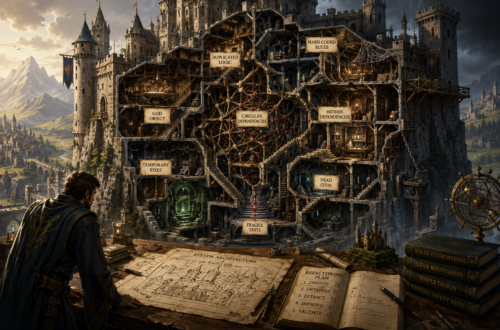
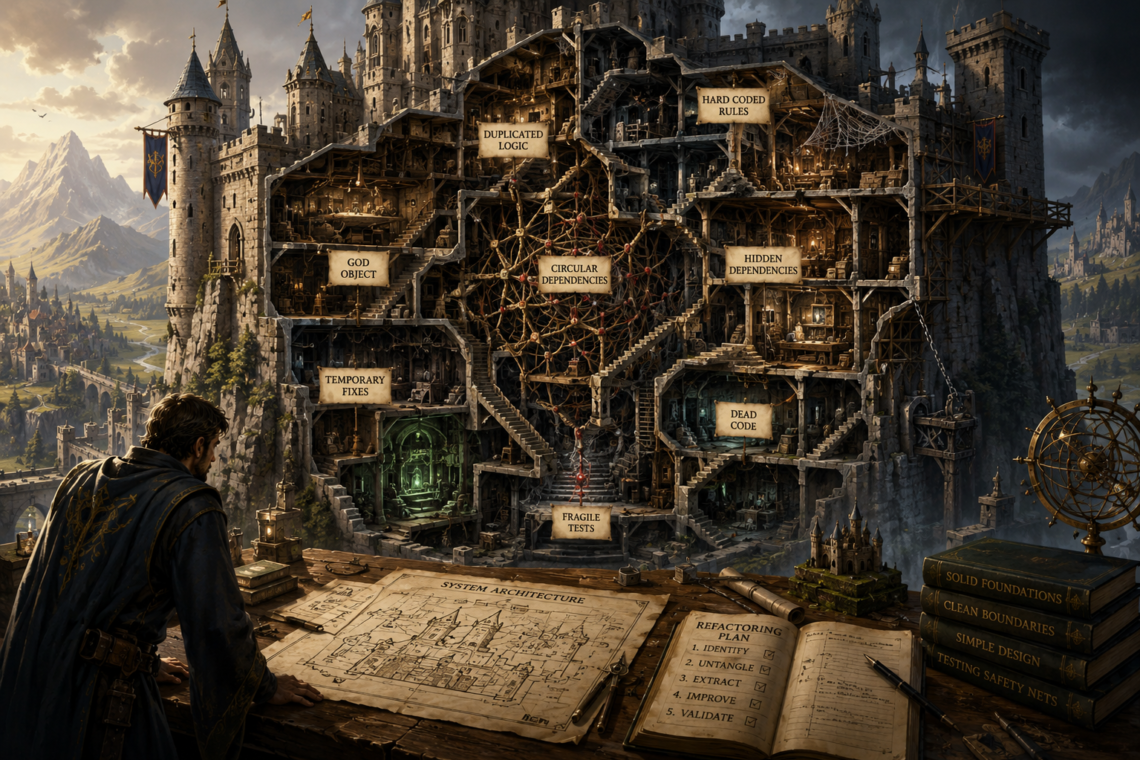
  • A detailed fantasy castle is shown in cross-section, revealing a maze of interconnected rooms, stairways, hidden passages, and structural layers that symbolize the complexity of a long-lived software system. At the center, tangled corridors and web-like connections represent circular dependencies and hidden coupling, while workshop-like chambers illustrate concepts such as duplicated logic, hard-coded rules, temporary fixes, fragile tests, dead code, and hidden dependencies. In the foreground, an architect studies blueprints and a refactoring plan spread across a drafting table, surrounded by engineering tools, manuscripts, and architectural diagrams. The surrounding kingdom is orderly and well maintained, contrasting with the increasingly convoluted interior of the castle. The painterly, Dungeons & Dragons-inspired editorial illustration uses fantasy architecture to represent technical debt, legacy systems, refactoring, and the challenge of maintaining software that has grown through years of incremental change.
    The Architect's Grimoire

    Hidden Traps in the Dungeon: Escaping Technical Debt

    July 15, 2026 /

    The deadliest dangers are often the ones built into the castle itself. No architect intentionally designs a maze. Every castle begins with a sensible plan. Corridors connect naturally, storerooms serve nearby kitchens, towers overlook vulnerable approaches, and every staircase leads somewhere meaningful. Yet castles that survive for generations rarely retain that original simplicity. New rulers expand old wings. Temporary passageways become permanent corridors. Storage rooms become workshops. Secret tunnels built during one crisis remain long after the danger has passed. Over time, the castle becomes increasingly difficult to navigate, not because its builders lacked skill, but because each generation solved the problems immediately before them. Long-lived software follows the same…

    Read More
    Frank Jamison

    You May Also Like

    A cinematic fantasy illustration of a master architect standing on a castle balcony at sunrise, overlooking a vast medieval kingdom while mentoring two apprentices. An architectural blueprint of the kingdom is spread across a stone table alongside drafting tools, a castle model, and books labeled Leadership, Mentorship, Stewardship, Architectural Thinking, and Lasting Legacy. Banners and heraldic emblems reinforce themes of leadership, architectural vision, and building systems that endure. The warm golden light, expansive cityscape, and symbolic imagery convey the lasting influence of thoughtful software architecture, mentorship, and engineering stewardship across generations.

    Becoming the Royal Architect: Designing Systems That Outlive You

    July 24, 2026
    A vast medieval fantasy castle dominates the landscape, split into two contrasting halves to illustrate the importance of architectural planning. The left side features a beautifully organized fortress with symmetrical towers, interconnected courtyards, bridges, aqueducts, and orderly roads, overlaid with glowing magical blueprints, surveying grids, compass roses, and geometric construction diagrams. The right side remains impressive but is visibly less organized, with awkward tower placement, inefficient stairways, conflicting roads, and haphazard expansions that suggest growth without an overall plan. Artistic cutaway sections reveal deep stone foundations, underground chambers, drainage tunnels, and structural supports extending into bedrock. Tiny builders and stonemasons emphasize the immense scale of the castle, while warm morning light highlights the contrast between intentional design and organic growth, visually representing the role of software architecture in creating maintainable, long-lasting systems.

    Why Castles Need Architects

    June 29, 2026
    A fantasy-inspired illustration depicts a master engineer overlooking a thriving medieval kingdom powered by invisible systems rather than heroic effort. In the foreground, a cloaked architect studies a blueprint illustrating a software delivery pipeline from code to build, test, deployment, and monitoring. Below, workshops, waterwheels, bridges, and aqueducts symbolize automated infrastructure supporting the bustling city above. Watchtowers overlook the realm while illuminated engineering panels represent automated testing, CI/CD pipelines, infrastructure as code, deployment automation, and monitoring. The scene conveys how automation, continuous improvement, and dependable engineering systems quietly enable a prosperous kingdom without drawing attention to themselves.

    The Automated Kingdom: When Excellence Becomes Routine

    July 22, 2026
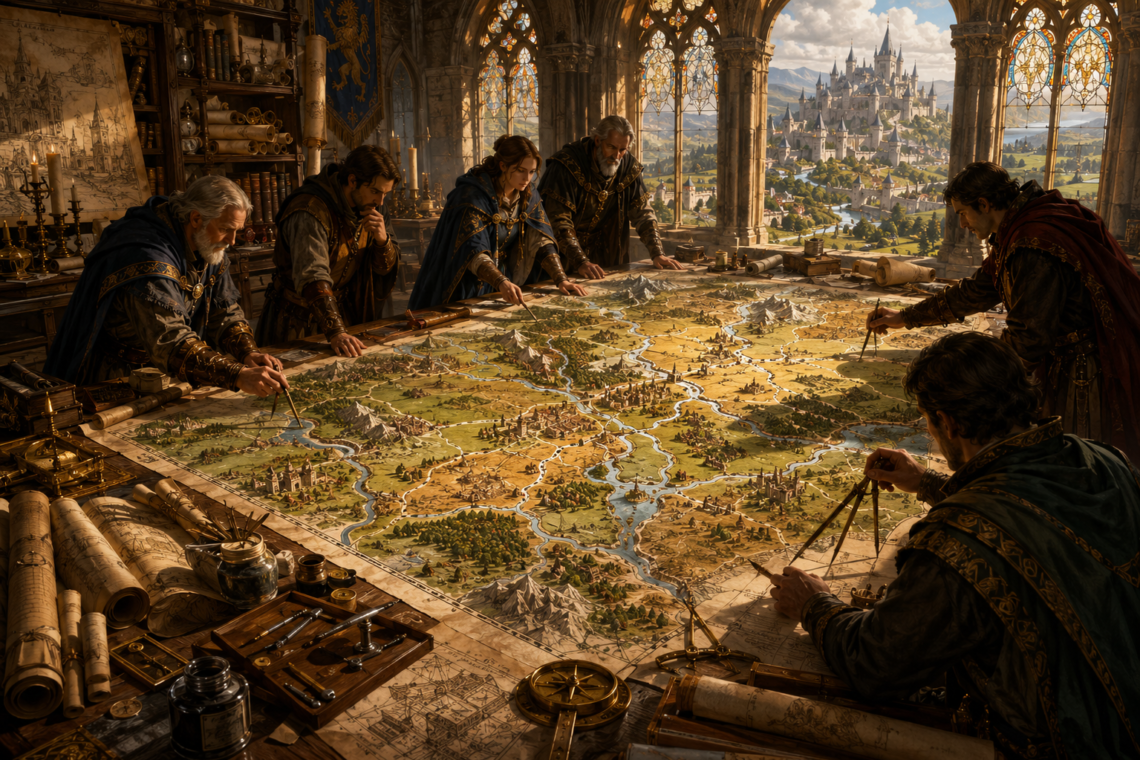
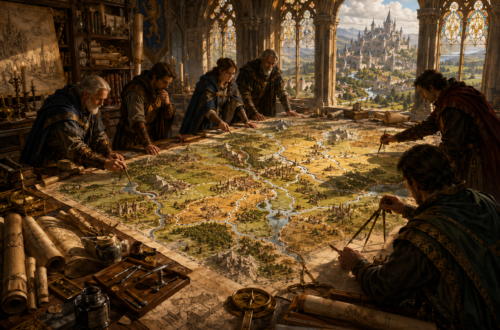
  • A group of royal architects and cartographers gather around a massive illuminated kingdom map inside an ornate medieval planning hall. Using compasses, rulers, and drafting tools, they carefully define provincial boundaries that follow rivers, mountains, and trade routes. Shelves filled with scrolls, blueprints, and surveying instruments surround the room, while stained-glass windows reveal a thriving kingdom beyond. The detailed fantasy scene symbolizes thoughtful software architecture by illustrating the deliberate planning and organization required to establish meaningful boundaries within a growing system.
    The Architect's Grimoire

    Dividing the Kingdom: Finding the Right Boundaries

    July 8, 2026 /

    A realm divided too soon may fall before it ever grows. Software architecture has a way of making every difficult decision appear deceptively simple. A whiteboard fills with neatly drawn boxes connected by clean lines, and suddenly an application that once fit comfortably into a single project has become a collection of independent services. Every box promises greater flexibility, cleaner organization, and limitless room for future growth. Years spent designing, maintaining, and repairing production systems eventually teach every architect the same lesson. Every boundary carries a cost that will be paid long after the diagram has been erased. This week, as we continue Designing the Realm, we are moving beyond…

    Read More
    Frank Jamison

    You May Also Like

    A hooded royal architect studies a detailed medieval blueprint inside a heavily fortified castle treasury, where secure vaults, locked chests, and guarded passageways symbolize data protection, ownership, persistence, secrets management, and data integrity. Through a large stone archway, a majestic castle overlooks a peaceful river valley, reinforcing the theme that strong software architecture protects an organization's most valuable assets through thoughtful design rather than visible defenses alone.

    The Royal Treasury: Protecting the Kingdom’s Data

    July 10, 2026
    A fantasy-inspired illustration depicts a master engineer overlooking a thriving medieval kingdom powered by invisible systems rather than heroic effort. In the foreground, a cloaked architect studies a blueprint illustrating a software delivery pipeline from code to build, test, deployment, and monitoring. Below, workshops, waterwheels, bridges, and aqueducts symbolize automated infrastructure supporting the bustling city above. Watchtowers overlook the realm while illuminated engineering panels represent automated testing, CI/CD pipelines, infrastructure as code, deployment automation, and monitoring. The scene conveys how automation, continuous improvement, and dependable engineering systems quietly enable a prosperous kingdom without drawing attention to themselves.

    The Automated Kingdom: When Excellence Becomes Routine

    July 22, 2026
    A detailed fantasy castle is shown in cross-section, revealing a maze of interconnected rooms, stairways, hidden passages, and structural layers that symbolize the complexity of a long-lived software system. At the center, tangled corridors and web-like connections represent circular dependencies and hidden coupling, while workshop-like chambers illustrate concepts such as duplicated logic, hard-coded rules, temporary fixes, fragile tests, dead code, and hidden dependencies. In the foreground, an architect studies blueprints and a refactoring plan spread across a drafting table, surrounded by engineering tools, manuscripts, and architectural diagrams. The surrounding kingdom is orderly and well maintained, contrasting with the increasingly convoluted interior of the castle. The painterly, Dungeons & Dragons-inspired editorial illustration uses fantasy architecture to represent technical debt, legacy systems, refactoring, and the challenge of maintaining software that has grown through years of incremental change.

    Hidden Traps in the Dungeon: Escaping Technical Debt

    July 15, 2026
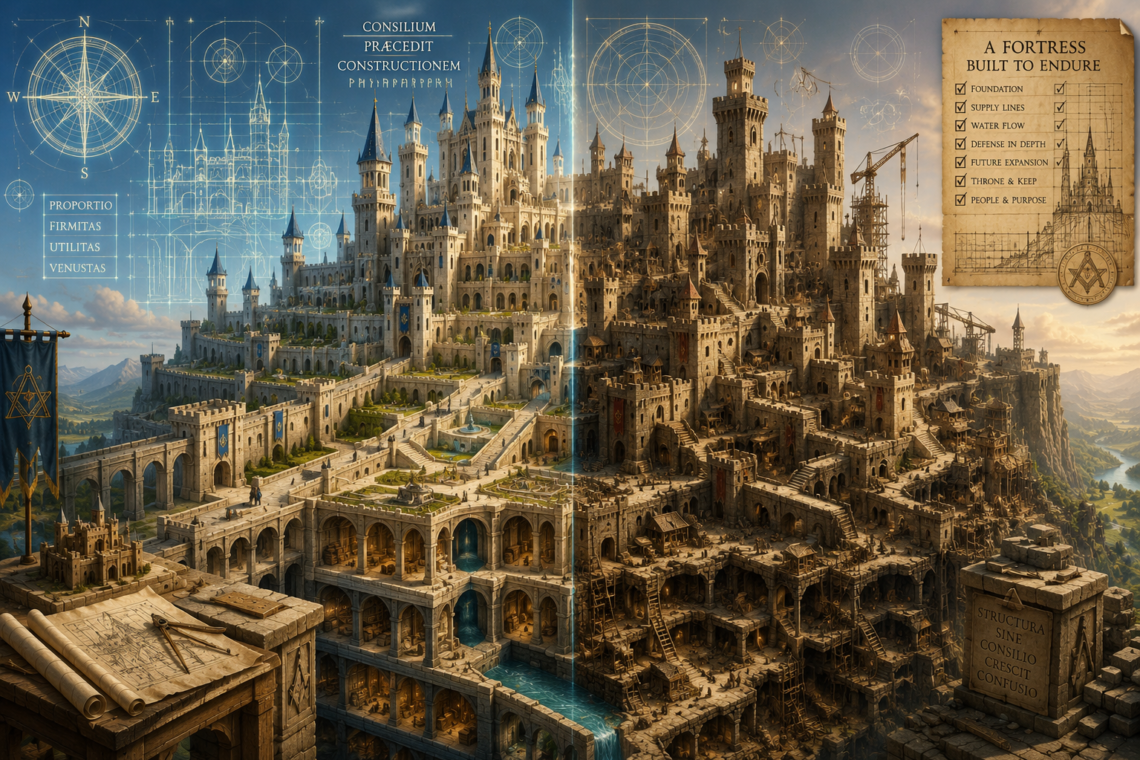
  • A vast medieval fantasy castle dominates the landscape, split into two contrasting halves to illustrate the importance of architectural planning. The left side features a beautifully organized fortress with symmetrical towers, interconnected courtyards, bridges, aqueducts, and orderly roads, overlaid with glowing magical blueprints, surveying grids, compass roses, and geometric construction diagrams. The right side remains impressive but is visibly less organized, with awkward tower placement, inefficient stairways, conflicting roads, and haphazard expansions that suggest growth without an overall plan. Artistic cutaway sections reveal deep stone foundations, underground chambers, drainage tunnels, and structural supports extending into bedrock. Tiny builders and stonemasons emphasize the immense scale of the castle, while warm morning light highlights the contrast between intentional design and organic growth, visually representing the role of software architecture in creating maintainable, long-lasting systems.
    The Architect's Grimoire

    Why Castles Need Architects

    June 29, 2026 /

    Even the finest builders need someone who can see beyond the next wall. Foundations of the Kingdom Maintaining software taught me lessons that writing software never could. Early in my career, I assumed difficult applications were usually the result of poor programming. Whenever a simple change required hours of investigation, I expected to uncover careless decisions, rushed deadlines, or code that had simply been neglected for too long. The more systems I inherited, however, the less convincing that explanation became. Different companies, different teams, and different programming languages produced remarkably similar maintenance problems. As we begin Foundations of the Kingdom, one lesson rises above all the others: every enduring kingdom…

    Read More
    Frank Jamison

    You May Also Like

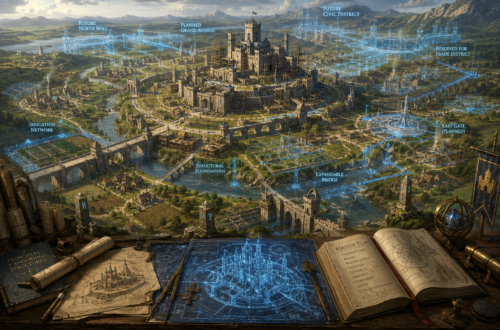
    A panoramic fantasy kingdom is shown in the early stages of carefully planned expansion, centered on a partially completed stone castle surrounded by villages, bridges, roads, and farmland. Glowing blue architectural overlays, magical surveying grids, and blueprint-style projections illustrate future city walls, districts, bridges, and infrastructure without physically constructing them. In the foreground, an architect's drafting table holds illuminated blueprints, manuscripts, measuring tools, compasses, and engineering instruments, reinforcing the theme of deliberate planning and long-term design. The peaceful medieval landscape emphasizes thoughtful growth, maintainability, and architectural foresight in a classic Dungeons & Dragons-inspired editorial fantasy style.

    Building for Today’s Quest or Tomorrow’s Empire?

    July 1, 2026
    A vast medieval fantasy kingdom is enclosed within enormous concentric stone walls, towering gatehouses, fortified keeps, and defensive towers that dominate the landscape. Despite the immense fortifications, the protected interior remains largely undeveloped, with only a few cottages, a small farmhouse, scattered construction sites, unfinished roads, and a partially built marketplace spread across open fields. Glowing blue magical architectural projections overlay the empty city, revealing ambitious plans for future districts, guild halls, towers, canals, and public buildings that have yet to be constructed. In the foreground, drafting tables, blueprints, surveying instruments, and engineering tools reinforce the theme of excessive planning, while a small group of builders focuses on practical structures such as a well and simple homes. The painterly Dungeons & Dragons-inspired scene symbolizes the software engineering concept of premature overengineering by contrasting overwhelming defensive infrastructure with a kingdom that has barely begun to grow.

    The Curse of Premature Fortification

    July 3, 2026
    A fantasy-inspired digital illustration depicts a royal architect standing over maps and plans as a massive stone castle burns under a night sky filled with flaming projectiles. Although sections of the fortress are engulfed in flames, smaller fortified districts below remain connected by glowing blue pathways, symbolizing resilient system architecture and fault isolation. Floating holographic icons represent High Availability, Backups, Disaster Recovery, Fault Tolerance, and Incident Response, visually linking medieval defenses with modern software engineering concepts. Scrolls and architectural plans in the foreground reinforce themes of preparation, recovery, and thoughtful design, while the dramatic contrast between destruction and continuity emphasizes that resilient systems are designed to withstand failure rather than prevent it entirely.

    When the Kingdom Burns: Designing for Failure Before Disaster Strikes

    July 17, 2026
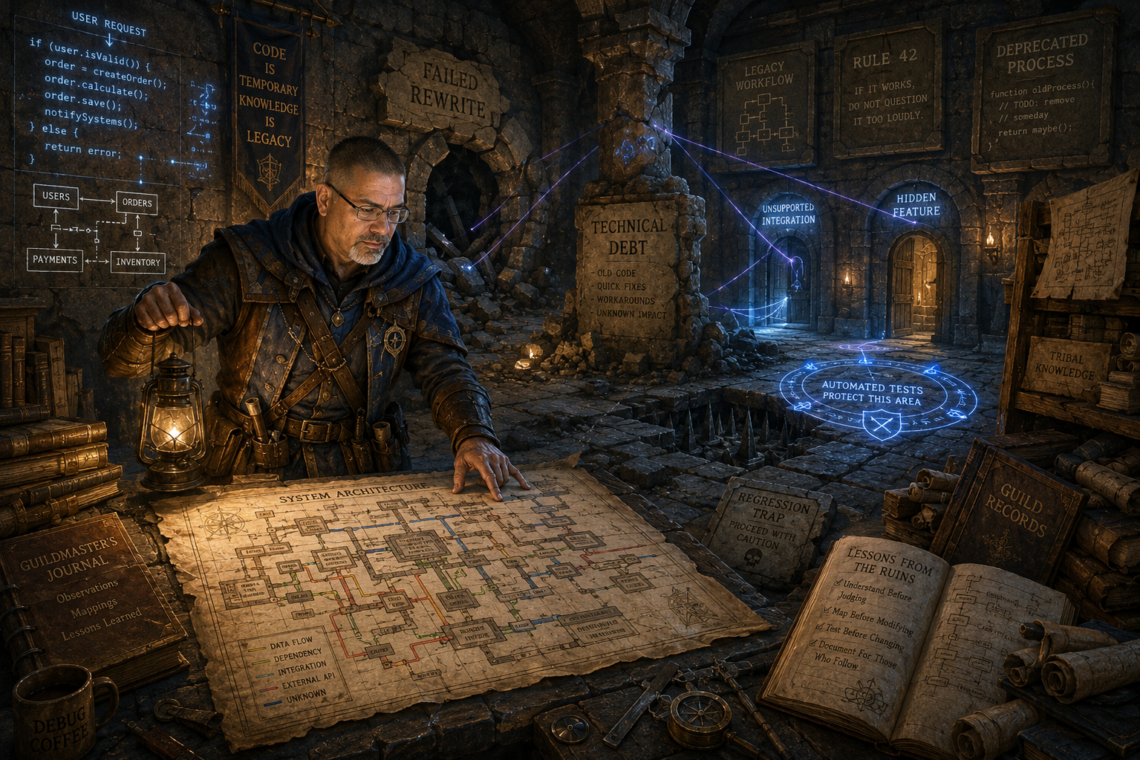
  • Frank Jamison, depicted as a seasoned Guildmaster and software engineer, studies a detailed architectural map inside a vast underground fantasy ruin representing a legacy software system. Wearing practical adventurer-scholar gear and holding a lantern, he stands at a stone table surrounded by guild journals, engineering records, maps, and ancient scrolls. Glowing blue runes resembling source code, database diagrams, and system architecture cover the dungeon walls. Nearby, a collapsed passage marked Failed Rewrite, a monument labeled Technical Debt, hidden doors representing undocumented features, and magical wards protecting explored areas symbolize the challenges of maintaining legacy code. The cinematic scene conveys exploration, problem-solving, knowledge preservation, and the careful navigation of complex software systems.
    The Guildmaster’s Handbook

    Legacy Code and Ancient Curses

    June 15, 2026 /

    Every developer eventually enters forgotten ruins and wonders what kind of sorcery built them. Entering the Forgotten Ruins Among all the challenges software engineers face throughout their careers, few are as universal as inheriting legacy code. Most developers begin their journey imagining they will spend their days creating new applications, experimenting with modern technologies, and designing elegant architectures from a blank canvas. While those opportunities certainly exist, they represent only a portion of professional software development. Much of our work involves maintaining, extending, repairing, and modernizing systems that already exist. Some of these applications are only a few years old. Others have survived multiple generations of developers and business leaders.…

    Read More
    Frank Jamison

    You May Also Like

    A cinematic Dungeons and Dragons inspired scene featuring Frank Jamison portrayed as a wise guildmaster mentor seated at a wooden strategy table inside a candlelit guild hall. Wearing dark blue robes, Frank studies a fantasy campaign map symbolizing a software developer career journey, with miniature adventurers marking paths through Choosing Your Path, Surviving the Guild Hall, The Trials of the Realm, and Becoming the Mentor. Glowing code appears on a magical screen nearby alongside dice, books, candles, and developer themed artifacts. A large banner displays The Guildmaster’s Handbook: Becoming the Developer Everyone Wants on the Quest with the tagline Code wins battles. Wisdom wins campaigns. The atmosphere feels warm, wise, and adventurous, blending software development with D&D mentorship.

    The Guildmaster’s Handbook

    May 14, 2026
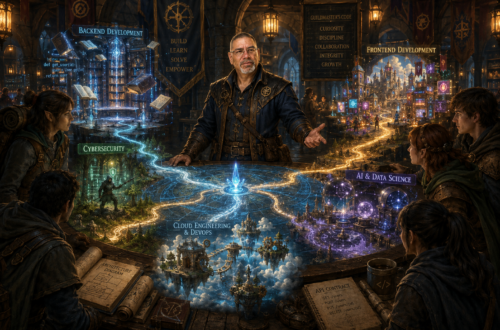
    Frank Jamison, portrayed as a seasoned guildmaster and veteran engineer, stands at the center of a grand medieval guild hall, guiding a group of young adventurers around a glowing magical map table. Multiple illuminated pathways branch from a central crossroads toward fantasy realms representing technology career paths, including backend development, frontend development, cybersecurity, cloud engineering and DevOps, and AI and data science. Floating books, architectural diagrams, magical runes, code fragments, and enchanted cityscapes surround the table, while warm lantern light and blue magical energy create an atmosphere of mentorship, discovery, and professional growth. The scene blends Dungeons & Dragons-inspired fantasy with modern software engineering concepts, symbolizing the process of choosing a path in technology.

    Picking Your Class in Tech

    June 1, 2026
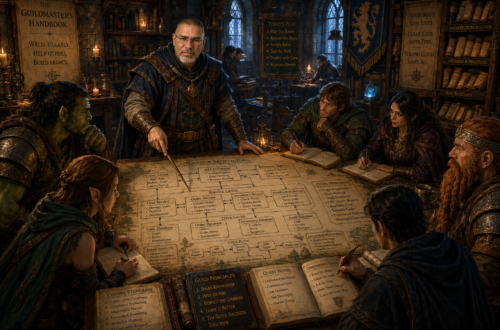
    Frank Jamison, portrayed as a seasoned guildmaster and veteran adventurer, stands at the center of a bustling fantasy guild hall, guiding a diverse group of adventurers around a massive strategy table. The table is covered with detailed architectural diagrams, software-inspired maps, flowcharts, and handwritten guild principles rendered as medieval cartography. Shelves of scrolls, books, and guild records line the walls, while lanterns and warm candlelight illuminate the collaborative scene. Adventurers of multiple races and classes study notes, discuss plans, and learn from Frank's guidance. The image symbolizes code readability, mentorship, onboarding, documentation, and teamwork through visual metaphors of maps, pathways, and shared knowledge within a thriving adventurer's guild.

    Writing Code Others Can Read

    June 8, 2026
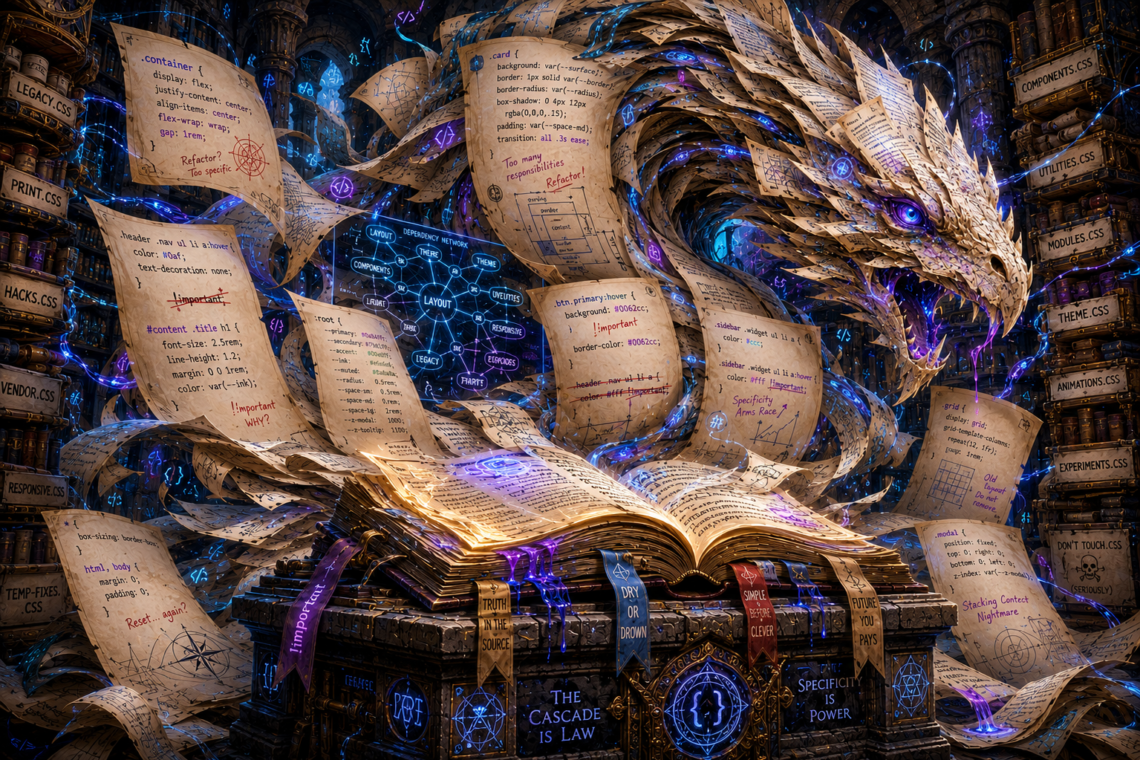
  • An enormous ancient spellbook rests on a carved stone pedestal in a vast arcane archive as hundreds of stylesheet-like parchment pages erupt from its open pages and merge into a colossal serpentine creature made entirely of CSS rules, annotations, diagrams, revisions, and glowing magical symbols. The parchment monster coils through towering shelves filled with labeled codices while streams of luminous blue and violet magical energy connect scattered documents into a sprawling network of dependencies. Individual pages display selectors, properties, comments, crossed-out declarations, and specificity notes, emphasizing accumulated technical debt and architectural complexity. The scene is illuminated by glowing runes, magical ink, and dramatic volumetric light, creating the impression of a once-useful body of knowledge that has grown beyond its original purpose and become an intelligent living manifestation of an unmaintainable stylesheet.
    The CSS Codex

    When the Stylesheet Becomes the Monster

    April 3, 2026 /

    Ignore a growing beast long enough and eventually it guards the dungeon. Editor’s Note: This article originally appeared on RandomThoughtsInTraffic.com and has been revised and expanded for StackNScroll as the closing chapter of The CSS Codex. The original edition explored how CSS codebases gradually become more difficult to maintain as shortcuts, overrides, and exceptions accumulate over time. This updated version expands that discussion with deeper examination of architectural drift, technical debt, component design, specificity management, long-term maintenance practices, and the warning signs that experienced engineers learn to recognize before problems become crises. It also serves as a capstone for the broader lessons explored throughout The CSS Codex, bringing together concepts…
    Read More
    Frank Jamison

    You May Also Like

    Aerial fantasy battlefield viewed from a cartographer's perspective showing three distinct military routes converging on a fortified city. A winding road follows rivers and forests through rugged terrain on the left, a disciplined army advances in straight formations across open ground in the center, and a highly organized network of grid-like roads and districts stretches across the right side of the landscape. Mountains, rivers, valleys, forests, and strategic fortifications create a vast tactical environment that emphasizes planning, movement, and strategy rather than combat.

    Three Layout Tactics for One Battlefield

    March 18, 2026
    A party of four fantasy adventurers escapes from the dark entrance of a massive stone dungeon into a sunlit valley beyond. Viewed from behind, the group runs through an open fortress gate toward a bright landscape of mountains, rivers, and golden fields. Tattered banners and warning signs referencing specificity, complexity, and CSS-related pitfalls hang beside the entrance, while skulls, chains, and dungeon debris emphasize the dangers left behind. Leading the group is a cloaked adventurer resembling a seasoned guildmaster, with companions including a mage, warrior, and dwarf. Warm sunrise light floods the scene, symbolizing freedom, understanding, and escape from the challenges of the Specificity Dungeon.

    Escaping the Specificity Dungeon

    March 11, 2026
    Elevated cartographer-style view of a vast fantasy landscape featuring winding rivers, rolling plains, dense forests, rocky mountain ranges, coastal cliffs, and scattered distant settlements. Glowing golden pathways trace natural routes across the terrain, while subtle magical energy highlights the contours of valleys, ridgelines, and waterways. The scene emphasizes the land itself as the foundation upon which future roads, cities, and kingdoms will be built, rendered in a realistic Dungeons & Dragons-inspired fantasy style with cinematic lighting and expansive environmental detail.

    The Default Terrain of Normal Flow

    March 16, 2026
  • The Architect's Grimoire (13)
  • The CSS Codex (13)
  • The Enchanted Workshop (9)
  • The Full-Stack Campaign (7)
  • The Guildmaster’s Handbook (13)

AI-Assisted Development Artificial Intelligence Backend Development Career Development Clean Code Code Quality CSS CSS Architecture CSS Best Practices CSS Fundamentals CSS Layout Design Systems Developer Education Developer Growth Developer Productivity Dungeons and Dragons Engineering Culture Engineering Judgment Engineering Leadership Fantasy Theme Front-End Development Frontend Development Full Stack Development Maintainable Code Maintainable CSS Mentorship Professional Development Professional Growth Refactoring Responsive Design Software Architecture Software Craftsmanship Software Design Software Development Software Engineering StackNScroll System Design Technical Debt Technical Leadership The Architect's Grimoire The CSS Codex The Enchanted Workshop The Full-Stack Campaign The Guildmaster's Handbook Web Development

Stack N' Scroll - 2026 ©