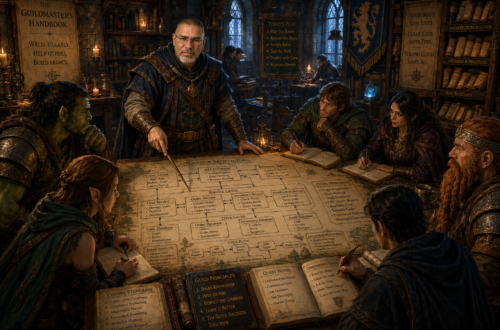
• Frank Jamison, depicted as a seasoned guildmaster and mentor, leads a group of younger adventurers at sunrise while gathered around a large map beside a mountain crossroads. Wearing practical fantasy adventuring attire, he points toward multiple roads stretching through forests, valleys, mountains, and distant cities, symbolizing different technology career paths. Around the group are travel wagons, lanterns, books, engineering diagrams, code-filled scrolls, learning roadmaps, and quest logs that represent sustainable skill development. A towering signpost lists various specialties, including web development, cloud architecture, cybersecurity, and machine learning. The scene emphasizes mentorship, planning, endurance, and choosing a path wisely, with warm golden light illuminating the vast landscape and reinforcing the article's theme of learning without burning out.
    The Guildmaster’s Handbook

    Learning Without Burning Out

    No warrior survives every battle at full speed. Pace yourself, or exhaustion becomes the enemy. In our last gathering at the guild hall, I spoke about choosing a path. Every developer eventually faces a decision about where to invest time, energy, and attention. Some are drawn toward frontend development. Others find themselves fascinated by backend systems, cybersecurity, cloud infrastructure, data science, or countless other specialties. Choosing a path provides direction, but direction alone is not enough. An adventurer who charges down the correct road at an unsustainable pace may still fail to reach the destination. One of the most important lessons I have learned throughout my career is that success…

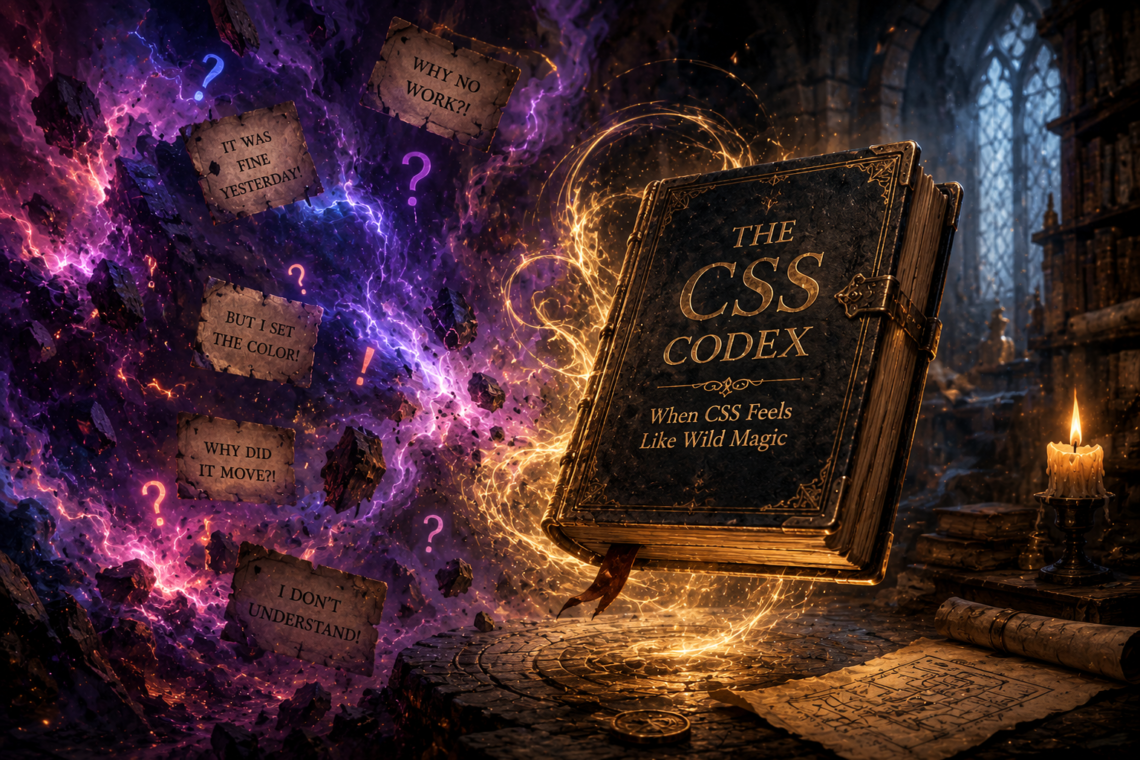
  • An ancient illuminated codex floats above a stone pedestal inside a dark fantasy library while chaotic purple and blue magical energy erupts around it. Torn parchment scraps swirl through the magical storm bearing frustrated messages such as Why Did It Move?, But I Set the Color!, It Was Fine Yesterday!, I Do Not Understand!, and Why No Work?. Glowing question marks and floating debris drift through the air, reinforcing the sense of confusion and unpredictability. The massive codex radiates warm golden light that contrasts with the surrounding chaos, suggesting hidden knowledge and order beneath the apparent magical disorder. Towering bookshelves, candles, scrolls, and arcane artifacts fill the background, creating a fantasy atmosphere that symbolizes discovering the rules behind seemingly unpredictable behavior.
    The CSS Codex

    When CSS Feels Like Wild Magic

    What appears to be chaos is often a spell whose rules remain unseen. Editor’s Note: Before joining The CSS Codex: Mastering the Rules of the Realm, When CSS Feels Like Wild Magic first appeared on RandomThoughtsInTraffic.com. This revised and expanded StackNScroll edition revisits one of the most persistent misconceptions in web development: the belief that CSS behaves unpredictably. New material connects the cascade, specificity, inheritance, layout calculations, positioning systems, rendering behavior, and architectural decision-making into a unified model that treats CSS as a deterministic system rather than a collection of disconnected techniques. The goal of this updated edition is not simply to explain why CSS can feel confusing, but to…

  • A party of four fantasy adventurers escapes from the dark entrance of a massive stone dungeon into a sunlit valley beyond. Viewed from behind, the group runs through an open fortress gate toward a bright landscape of mountains, rivers, and golden fields. Tattered banners and warning signs referencing specificity, complexity, and CSS-related pitfalls hang beside the entrance, while skulls, chains, and dungeon debris emphasize the dangers left behind. Leading the group is a cloaked adventurer resembling a seasoned guildmaster, with companions including a mage, warrior, and dwarf. Warm sunrise light floods the scene, symbolizing freedom, understanding, and escape from the challenges of the Specificity Dungeon.
    The CSS Codex

    Escaping the Specificity Dungeon

    Many adventurers descend seeking power. Few emerge with maintainable code. Editor’s Note: Before joining The CSS Codex: Mastering the Rules of the Realm, Escaping the Specificity Dungeon first appeared on RandomThoughtsInTraffic.com. This revised and expanded edition builds upon the original article with deeper exploration of specificity, selector architecture, cascade behavior, and long-term stylesheet maintainability. While the original article focused primarily on avoiding common specificity mistakes, this edition examines the underlying rules that govern selector conflicts and demonstrates how experienced developers design systems that rarely require specificity battles in the first place. Entering the Dungeon As we continue our journey through The CSS Codex, this week’s theme remains The Laws of…

  • An illuminated magical codex rests open atop an ornate stone throne in the center of a vast fantasy library. Streams of blue and gold arcane energy flow from surrounding scrolls, drafting tables, and enchanted tablets toward the glowing book. Above the throne, layered translucent diagrams resembling architectural blueprints, interconnected systems, and cascading structures overlap in the air, with one central design shining brightest. The grand hall is filled with bookshelves, maps, measuring instruments, and research materials beneath vaulted stone arches lit by warm torchlight and magical illumination. The scene evokes order, authority, craftsmanship, and the mastery of complex systems.
    The CSS Codex

    The Laws of the Cascade

    In every kingdom of styles, only one ruler may claim the throne. Editor’s Note: Before becoming Part I of The CSS Codex, The Laws of the Cascade was originally published on RandomThoughtsInTraffic.com. This updated edition expands on the original article with additional lessons, practical examples, and a deeper exploration of the rules governing how CSS resolves competing styles. The Invisible Throne When developers first begin learning CSS, they usually encounter it as a collection of individual instructions. A selector targets an element. A property changes its appearance. A value produces a visible result in the browser. At first, the relationship seems straightforward because the browser appears to simply follow instructions…

  • An ancient illuminated codex lies open at the center of a massive oak drafting table inside a grand fantasy library. The book's pages display intricate architectural diagrams made of interconnected circles, layered structures, branching pathways, geometric grids, and cascading systems illuminated by flowing blue and gold magical energy. Surrounding the codex are blueprints, maps, scrolls, compasses, measuring tools, and drafting instruments arranged in an organized workspace. Towering bookshelves filled with books and manuscripts rise beneath vaulted stone arches in the background. Warm lantern and torchlight blend with soft magical illumination, creating a scholarly atmosphere of knowledge, craftsmanship, structure, and discovery. The scene evokes a Dungeons & Dragons-inspired vision of system design and architecture, with the codex serving as the focal point of an orderly realm governed by hidden rules.
    The CSS Codex

    Mastering the Rules of the Realm

    True mastery begins when the rules cease to feel like restrictions and start revealing the shape of the world beneath them. Author’s Note: This article is an updated and expanded version of an introduction originally published on RandomThoughtsInTraffic.com. As the CSS Codex evolved from a concept into a complete twelve-part series, the original article was revised to better reflect the journey ahead and the lessons readers will encounter throughout the realm. The Reputation of an Unfairly Accused Language CSS has earned a reputation that few technologies in web development can match. It is blamed for broken layouts, mysterious overrides, inconsistent spacing, and hours spent adjusting styles until something finally appears…