
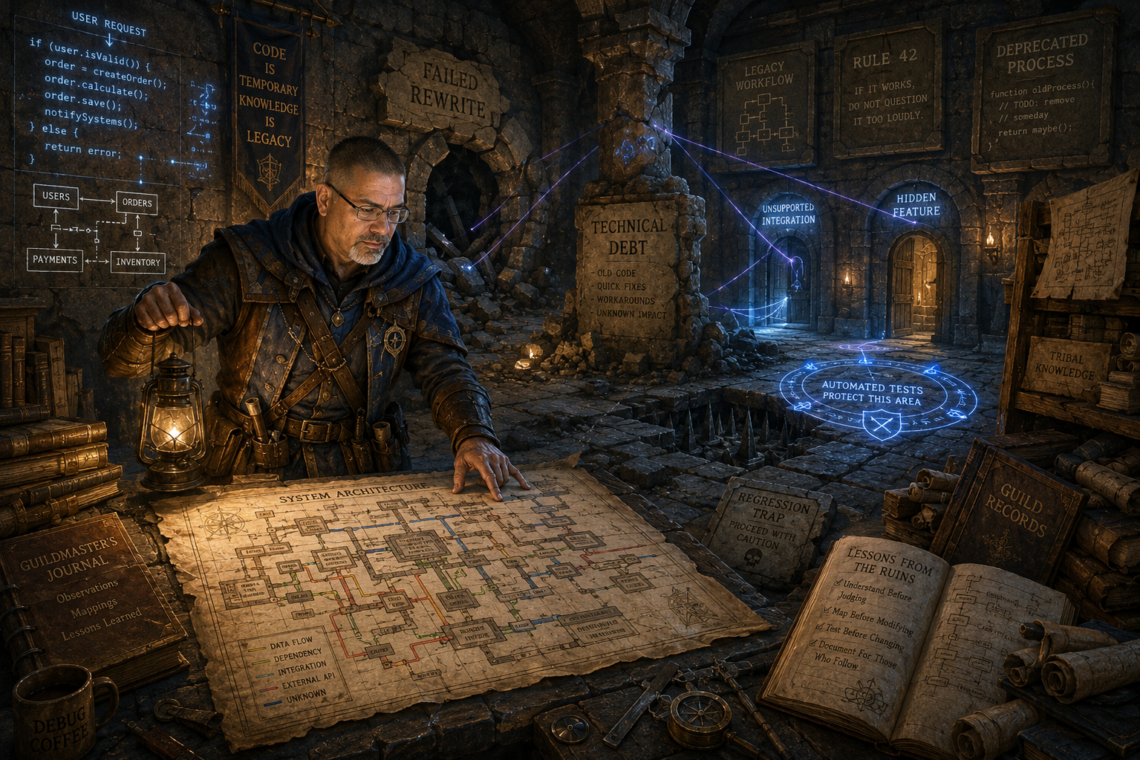
Legacy Code and Ancient Curses
Every developer eventually enters forgotten ruins and wonders what kind of sorcery built them.
Entering the Forgotten Ruins
Among all the challenges software engineers face throughout their careers, few are as universal as inheriting legacy code. Most developers begin their journey imagining they will spend their days creating new applications, experimenting with modern technologies, and designing elegant architectures from a blank canvas. While those opportunities certainly exist, they represent only a portion of professional software development. Much of our work involves maintaining, extending, repairing, and modernizing systems that already exist. Some of these applications are only a few years old. Others have survived multiple generations of developers and business leaders. Regardless of age, every mature codebase eventually becomes one of the great Trials of the Realm that engineers must learn to overcome.
I often compare legacy systems to ancient ruins hidden deep within a fantasy world. The original architects have long since departed. The maps are incomplete. Strange mechanisms continue functioning despite years of modifications and repairs. New chambers have been constructed atop older foundations. Secret passages connect distant parts of the structure. Every group of adventurers who passed through left traces of their work behind. Legacy applications evolve in much the same way. Each bug fix, enhancement request, regulatory change, and emergency production patch adds another layer to the structure until the system becomes a living history of the organization it serves.
One of the reasons legacy code intimidates newer developers is that it rarely presents itself in neat, understandable pieces. The architecture has often evolved through years of changing requirements. Teams have come and gone. Business priorities have shifted. Technologies that were once modern have become outdated. Looking at such a system can feel like staring at a sprawling dungeon map where several generations of cartographers each added their own notes in different ink. Yet the complexity itself is not the enemy. The real challenge is learning how to navigate it without becoming lost.
The First Trial: Understanding Before Judging
One of the first lessons I teach developing engineers is that legacy code is not automatically bad code. Age and quality are not the same thing. In fact, many legacy systems have remained in service precisely because they solved important business problems successfully for many years. They processed transactions, generated revenue, supported customers, survived audits, and handled edge cases that newer systems have not yet encountered. The application may no longer reflect current architectural trends, but it possesses something that many new projects lack: a proven record of surviving real-world conditions.
The temptation to judge older code quickly is one of the first traps waiting inside the ruins. A developer discovers a thousand-line function, an outdated framework, or variable names that no longer make sense. The immediate assumption is often that previous developers made poor decisions. Experience has taught me that this assumption is frequently incorrect. What appears to be bad design from a distance often turns out to be the result of business constraints, regulatory requirements, technical limitations, or production emergencies that occurred years earlier.
I learned this lesson repeatedly throughout my own career. More than once, I inherited applications containing logic that seemed unnecessarily complicated. Validation rules appeared duplicated. Database structures looked redundant. Certain workflows contained extra processing steps that felt inefficient. My first instinct was often to simplify what I found. Fortunately, experience encouraged me to investigate before making changes. Almost every investigation revealed a reason behind the complexity. Some rules existed because of legal requirements. Others addressed customer issues discovered after years of production use. A few represented lessons learned from expensive mistakes that the organization never wanted to repeat.
Archaeologists do not evaluate ancient castles according to modern construction standards. They study the environment, available resources, and historical context before drawing conclusions. Software engineers should adopt a similar mindset. Before deciding whether something should be changed, take time to understand why it exists. The answer often contains valuable knowledge that is not immediately visible in the code itself.
The Second Trial: Mapping the Dungeon
When I enter an unfamiliar codebase, my first objective is exploration rather than modification. Imagine an adventuring party arriving at the entrance of a forgotten dungeon. Charging directly into unexplored chambers is rarely a successful strategy. The wiser approach involves mapping corridors, identifying hazards, and understanding the layout before taking major actions. Legacy systems deserve the same level of respect. I spend time tracing workflows, documenting dependencies, understanding system boundaries, and identifying critical business processes before making significant changes.
One useful technique involves following a single request from beginning to end. Consider the following example:
</> C#

public OrderResult SubmitOrder(Order order)
{
    ValidateOrder(order);

    decimal total = CalculateTotal(order);

    SaveOrder(order, total);

    NotifyWarehouse(order);

    return new OrderResult
    {
        Success = true
    };
}
At first glance, the method appears simple. However, every function call opens another doorway deeper into the dungeon. What validation rules are being enforced? How are totals calculated? What happens during persistence? What occurs if warehouse notification fails? The visible code is often only the entrance hall. The real complexity frequently exists several layers beneath the surface.
As I investigate, I create my own maps. These may be diagrams showing service relationships, notes about database dependencies, or simple lists describing how data flows through the application. Many developers underestimate how valuable these records become over time. The act of documenting discoveries forces deeper understanding, and the resulting notes often become more useful than the original documentation that accompanied the system.
The developers who succeed in legacy environments are usually not the ones who move fastest. They are the ones who understand the terrain most thoroughly. Just as experienced adventurers spend time studying maps before entering dangerous territory, experienced engineers invest time in understanding systems before changing them.
The Third Trial: Deciphering Ancient Runes
Every mature application contains sections where intent has been obscured by time. Variable names may reflect business terminology that disappeared years ago. Comments may describe behavior that no longer exists. Function names may reference projects, departments, or initiatives that nobody on the current team remembers. These situations can be frustrating, but they should be approached with curiosity rather than criticism.
Consider this example:
</> JavaScript

if (custFlag7 && acctType === "A")
{
    applyRule42(customer);
}
The code is syntactically valid, but it communicates very little. What does custFlag7 represent? Why is account type A significant? What exactly is Rule 42? A developer might be tempted to rename everything immediately. However, meaningful improvements require understanding. I often trace the associated database records, review historical support tickets, examine requirements documentation, and speak with experienced users before making modifications. Those investigations frequently uncover important business context that never appeared in the source code.
Many legacy systems contain what I call buried knowledge. The code itself performs correctly, but the reasoning behind it has been lost. Recovering that knowledge requires detective work. Sometimes the answers come from old documentation. Sometimes they come from conversations with long-time employees. Occasionally they emerge only after tracing application behavior through multiple systems and comparing the results against business requirements.
The important lesson is that understanding should precede correction. When developers skip the investigation phase, they risk removing behavior that appears unnecessary but actually supports important business processes. Deciphering the runes takes time, but it prevents many costly mistakes.
The Fourth Trial: Hidden Traps and Secret Passages
During every exploration of a legacy system, there comes a moment when a seemingly simple change reveals unexpected complexity. A developer updates a database field and suddenly a report stops working. An API response changes and a downstream integration fails. A cleanup effort removes a piece of code that appeared unused, only to discover weeks later that it supported a rarely executed but critical business process. These are the hidden traps and secret passages that make mature systems both fascinating and dangerous.
Legacy applications frequently contain dependencies that are not immediately obvious. Years of enhancements, integrations, and business adaptations create connections that may not be visible from the code being modified. Consider the following query:
</> SQL

SELECT *
FROM Customers
WHERE Status = 'Active'
Many developers would immediately replace the wildcard selection with explicit column names. From a technical perspective, that may be a worthwhile improvement. However, before making the change, it is important to understand how the result set is consumed throughout the organization. Reports, exports, third-party integrations, and automated processes may rely upon assumptions that are not immediately visible. Technical correctness is important, but understanding operational consequences is equally important.
I encourage engineers to approach these situations with healthy skepticism. When something appears surprisingly simple, I often assume there is additional complexity hidden somewhere nearby. That assumption has saved me from countless mistakes. Mature systems rarely become complicated by accident. More often, complexity accumulates because the system has adapted to years of real-world demands.
The most successful developers learn to search for the hidden passage before moving the stone that covers it. They ask questions. They trace dependencies. They verify assumptions. This extra effort may feel slow in the moment, but it often prevents outages, regressions, and difficult conversations later.
The Fifth Trial: Breaking Ancient Curses Safely
Every legacy system contains ancient curses. In software development, these curses often appear as unintended side effects. A bug fix introduces a regression. A performance optimization breaks a workflow. A seemingly harmless refactor changes behavior that customers have relied upon for years. The challenge is not simply making changes. The challenge is making changes safely.
Automated testing serves as one of the most effective forms of protection against these dangers. Unfortunately, many legacy systems contain little or no automated test coverage. In these situations, I often begin by writing characterization tests. Rather than defining ideal behavior, characterization tests document current behavior. Their purpose is to establish a baseline that allows future modifications to proceed safely.
</> Python

def test_tax_calculation():
    result = calculate_tax(1000, "CA")

    assert result == 87.50
This test does not explain why the calculation produces a specific result. Instead, it records what the system currently does. Once behavior is documented, developers gain confidence that future changes will not accidentally alter important functionality. Over time, a growing collection of tests functions like magical wards protecting explored sections of the dungeon.
One particularly effective technique involves writing tests before refactoring legacy code. If I encounter a complex function that requires improvement, I first create tests that capture its current behavior. Only after those tests pass consistently do I begin making changes. This approach dramatically reduces risk and provides immediate feedback when something unexpected occurs. It also helps newer developers develop confidence because they can see tangible evidence that their modifications preserve expected behavior.
Testing also changes how developers think about legacy systems. Instead of fearing every modification, engineers gain the ability to experiment safely. Each successful test becomes another torch illuminating a previously dark corridor. Over time, the dungeon becomes less mysterious and more manageable.
The Sixth Trial: Resisting the Rewrite Spell
Few temptations are stronger than the rewrite spell. After spending time inside a legacy codebase, many developers begin imagining how much cleaner the system would be if everything were rebuilt from scratch. The architecture could be modernized. The code could be reorganized. Naming conventions could become consistent. Technical debt could disappear.
Unfortunately, the rewrite spell has defeated many adventurers.
This challenge helps explain why complete rewrites often fail. Teams become frustrated by accumulated complexity and conclude that starting over will solve the problem. They frequently underestimate how much knowledge is embedded within the existing system. Every unusual condition, exception handler, workaround, and validation rule represents a lesson learned through real-world experience. Recreating that knowledge from scratch is significantly harder than many organizations expect.
I have witnessed organizations spend years building replacement systems only to discover that the original application contained hundreds of undocumented business rules. Some surfaced when customers reported missing functionality. Others appeared when financial calculations no longer matched historical reports. Still others emerged during audits or compliance reviews. The new system may have looked cleaner, but it lacked years of operational wisdom.
Incremental refactoring often provides a safer alternative. Instead of rebuilding entire sections of the dungeon, developers can improve one corridor at a time. Consider the following code:
</> JavaScript

function processOrder(order)
{
    if(order.type === "standard")
    {
        processStandard(order);
    }

    if(order.type === "priority")
    {
        processPriority(order);
    }

    if(order.type === "international")
    {
        processInternational(order);
    }

    finalizeOrder(order);
}
A complete redesign may not be necessary. Small improvements can significantly improve maintainability while preserving existing behavior.
</> JavaScript

function processOrder(order)
{
    const handlers = {
        standard: processStandard,
        priority: processPriority,
        international: processInternational
    };

    handlers[order.type](order);

    finalizeOrder(order);
}
This refactoring improves readability and organization without introducing unnecessary risk. Over time, many small improvements often produce better results than one massive rewrite. Experienced Guildmasters know that restoring a ruin stone by stone is often safer than demolishing it and hoping to rebuild it perfectly.
The Seventh Trial: Earning the Trust of the Realm
Legacy systems often have guardians. These may be senior developers, business analysts, support personnel, managers, or stakeholders who have worked with the application for years. Arriving with a list of everything that should be rewritten rarely inspires confidence. Trust is earned through understanding, stewardship, and consistent results.
Throughout my career, I have found that small victories often create opportunities for larger improvements later. Fix a recurring defect. Improve a confusing workflow. Eliminate a source of operational frustration. Reduce the time required for a common task. As team members begin to see positive outcomes, they become more receptive to broader modernization efforts.
This lesson extends beyond technical decisions. Software development is ultimately a collaborative activity. The best solutions emerge when developers understand the needs of the people who depend upon the system. Before proposing major changes, spend time listening. Learn how users interact with the application. Understand what causes frustration and what creates value. Technical excellence matters, but trust determines whether improvements are adopted successfully.
Just as adventurers must earn the trust of a kingdom before being entrusted with its most important quests, engineers must often demonstrate stewardship before being granted authority over critical systems. Trust earned through action carries far more weight than trust requested through enthusiasm alone.
The Eighth Trial: Preserving the Guild Records
Every organization contains tribal knowledge that exists primarily within the minds of experienced employees. Critical deployment procedures, historical business decisions, customer-specific requirements, and operational workarounds may be known by only a handful of people. This creates risk because knowledge can vanish whenever those individuals change roles or leave the organization.
Part of our responsibility as engineers is transforming tribal knowledge into shared knowledge. When experienced team members explain important concepts, document them. When unusual workflows are discovered, record them. When hidden dependencies are identified, make them visible. Future developers should not be forced to rediscover the same lessons repeatedly.
Documentation is often viewed as a secondary task because it lacks the excitement of coding. However, I have come to view documentation as one of the most valuable forms of engineering work. A well-written document can save hundreds of hours of future investigation. A diagram can prevent costly misunderstandings. A carefully maintained knowledge base can preserve years of institutional experience.
Communication therefore becomes a critical survival skill. Many technical problems are actually knowledge problems. Before removing a feature, consult users. Before modifying a workflow, speak with stakeholders. Before simplifying a business rule, understand who depends upon it. Software exists to serve people, and those people often possess context that cannot be found anywhere in the codebase.
The greatest Guildmasters do not simply solve today’s problems. They leave behind maps, journals, and records that help future adventurers navigate the same terrain more effectively.
Lessons from the Ruins
Humility remains one of the most valuable tools an engineer can carry into these ruins. Early in my career, I often assumed that if something looked wrong, it probably was wrong. Experience repeatedly demonstrated otherwise. Complex systems contain layers of business history, operational realities, and technical tradeoffs that reveal themselves gradually. What appears irrational during an initial review may become completely understandable after a week of investigation.
The older I become as a developer, the more cautious I am about making immediate judgments. Legacy systems reward patience more than speed. They reward curiosity more than confidence. They reward investigation more than assumptions. The engineers who consistently succeed are often those who take the time to understand what others overlook.
Every legacy codebase contains lessons hidden beneath its implementation. Some lessons reveal successful architectural decisions. Others expose costly mistakes that future teams can avoid. Many demonstrate how software evolves in response to changing business needs and operational realities. Developers who learn to uncover those lessons gain insights that extend far beyond any specific technology stack or programming language.
When you eventually find yourself standing before a sprawling application built by developers you have never met, remember that you are facing one of the great Trials of the Realm. The corridors may be confusing. The maps may be incomplete. Ancient curses may still linger in forgotten corners of the system. Yet hidden within those ruins is knowledge accumulated through years of experience, experimentation, and problem solving.
Approach the dungeon with patience. Explore before you modify. Document what you learn. Respect the builders who came before you. Improve the paths where you can and preserve the lessons you discover. If future adventurers find the journey easier because of your work, then you have fulfilled one of the highest responsibilities of a Guildmaster. Legacy code may begin as an ancient curse, but for those willing to learn from it, it often becomes one of the greatest teachers in the entire realm.


You May Also Like

Working With Stakeholders Without Losing Sanity

Becoming the Developer You Once Needed