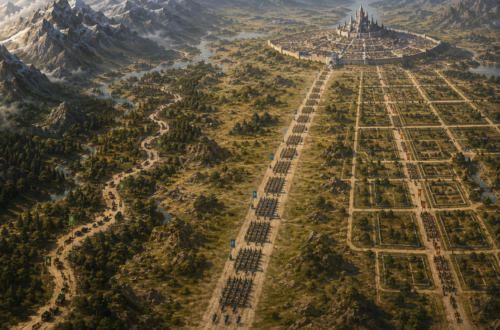

The Default Terrain of Normal Flow
Before roads are built and castles rise, the land already has a shape.
Editor’s Note: This article was originally published on RandomThoughtsInTraffic.com and has been revised and expanded for StackNScroll as part of The CSS Codex series. The original article introduced normal flow as the browser’s default layout behavior, but this edition explores the concept through the broader lens of layout strategy, document structure, responsiveness, and long-term maintainability. New material examines how block and inline formatting contexts influence layout decisions, how containers shape available space, why developers often abandon normal flow too early, and how modern layout systems continue to depend upon it. As part of this week’s theme, Mastering the Terrain: Layout as strategy, not guesswork, this revised edition offers a deeper understanding of the browser’s foundational layout engine and its role in every successful CSS architecture.
The Cartographer’s First Lesson
Throughout The CSS Codex, I have argued that CSS becomes dramatically easier once developers stop treating it as a collection of tricks and begin treating it as a system of rules. Every kingdom has laws. Every realm has boundaries. Every successful adventurer eventually learns that understanding the terrain matters more than memorizing shortcuts. Normal flow is one of the foundational laws of the realm because every layout system introduced later depends upon it.
When developers first learn CSS, they are usually focused on immediate results. A navigation bar needs to sit horizontally. A card needs to be centered. A sidebar needs to move to the left side of the screen. The pressure to solve practical problems often leaves little room to study the systems underlying those solutions. As a result, many developers learn Flexbox before understanding block elements, learn Grid before understanding document flow, and learn positioning before understanding how the browser naturally places content. They acquire tools without acquiring a map.
This week’s theme, Mastering the Terrain: Layout as strategy, not guesswork, exists because layout becomes significantly easier once the terrain is understood. Experienced adventurers do not begin a journey by selecting equipment. They begin by studying maps. They identify rivers, mountains, forests, roads, and settlements before deciding how to travel. CSS layout follows a remarkably similar pattern. Before Flexbox arranges content into rows, before Grid divides a page into regions, and before positioning removes elements from the document flow entirely, the browser already has a terrain.
That terrain is called normal flow.
The importance of normal flow is often overlooked because it functions quietly. Most developers notice it only when they accidentally violate its assumptions. Yet every web page depends upon it. Every article, dashboard, documentation site, application interface, and form begins with the browser interpreting HTML and arranging content according to the rules of normal flow. Understanding those rules transforms CSS from a collection of isolated techniques into a coherent system.
The King’s Road of Document Flow
Imagine an ancient road stretching across a kingdom. Long before cities were built and castles raised, that road connected distant regions of the realm. Merchants traveled upon it. Settlements emerged beside it. Trade routes expanded from it. Although new infrastructure appeared over time, the original road remained the foundation around which everything else developed.
Normal flow serves a similar purpose within CSS.
When a browser receives an HTML document, it does not wait for developers to provide detailed layout instructions. It immediately begins organizing content according to a predefined set of rules. Headings appear before paragraphs. Sections follow one another in sequence. Content occupies space according to its type and position within the document. The browser establishes order before any CSS declarations are applied.
Consider the following example.
</> HTML

<body>
    <header>
        <h1>The Adventurer's Gazette</h1>
    </header>

    <main>
        <section>
            <h2>Recent Quests</h2>
            <p>Several expeditions have departed for the northern mountains.</p>
        </section>

        <section>
            <h2>Guild Announcements</h2>
            <p>The annual gathering of cartographers begins next month.</p>
        </section>
    </main>

    <footer>
        <p>Published by the Royal Guild</p>
    </footer>
</body>
Even without CSS, this document remains understandable. The browser presents information in a meaningful sequence because the document’s structure already contains valuable information. The heading introduces the page. Sections divide content into logical topics. The footer concludes the experience. This observation reveals an important truth. HTML contributes significantly more to layout than many developers realize.
When mentoring newer developers, I often encourage them to temporarily disable their stylesheets and examine the resulting document. Doing so reveals how much organizational work the browser is already performing. If the page remains understandable without CSS, the structure is likely serving its purpose well. If the content immediately becomes confusing, the underlying HTML may require attention before additional styling is introduced.
One of the defining characteristics of experienced front-end engineers is their appreciation for document structure. They understand that CSS does not create organization from nothing. Instead, CSS enhances and refines an organization that should already exist within the markup itself. Normal flow rewards that discipline because it depends upon a meaningful structure to establish order.
The Caravan of Block Elements
One of the earliest lessons within normal flow involves block-level elements. These elements behave much like wagons traveling within a merchant caravan. Each wagon occupies its own section of the road. Once it reaches its destination, the next wagon follows behind it. The caravan progresses in a predictable sequence because every traveler understands where they belong.
Block-level elements behave in much the same way.
</> HTML

<section class="quest-board">
    <h2>Guild Quests</h2>

    <p>Recover the lost relic.</p>

    <p>Escort merchants through the mountain pass.</p>

    <p>Investigate reports of goblin raids.</p>
</section>
By default, the heading appears first. Each paragraph follows beneath it. Every block-level element occupies its own row within the available space. No special instructions are required, as the normal flow already defines the behavior.
To make the pattern easier to visualize, consider the following styling.
</> CSS

.quest-board {
    border: 2px solid #444;
    padding: 20px;
}

h2 {
    background-color: #d8c89a;
}

p {
    background-color: #f4f1e8;
}
The backgrounds reveal how each block element expands across the available width of its container before yielding space to the next element. This behavior explains why articles, documentation pages, reports, and forms often require relatively little layout code. The browser’s default behavior already aligns naturally with how people consume structured information.
An important architectural lesson emerges here. New developers often view normal flow as something to escape. Experienced developers frequently view it as something to preserve. Every time we leave normal flow, we accept additional responsibility. We become responsible for alignment, spacing, content growth, responsiveness, and edge cases that the browser previously handled for us. This does not mean advanced layout systems should be avoided. It means they should be introduced intentionally rather than reflexively.
One of the hallmarks of mature CSS architecture is recognizing when the default terrain is already solving most of the problem. Developers who understand block-level behavior often write less code because they spend less time fighting the browser’s existing capabilities. Rather than replacing normal flow immediately, they leverage it wherever possible and introduce more specialized tools only when the design truly requires them.
Travelers Within the Crowd
Not every traveler in the realm requires an entire wagon and a dedicated section of road. Most people move through markets, guild halls, and city streets alongside one another. They occupy only the space necessary for their journey and adapt naturally to the movement of those around them. Inline elements perform a similar role within CSS. While block elements establish the major roads of the kingdom, inline elements travel within those roads as part of the larger crowd.
Consider the following example.
</> HTML

<p>
    The ranger discovered a
    <strong>hidden passage</strong>
    beneath the ruins and recorded its
    location on a <em>worn map</em>.
</p>
The strong and emphasis elements do not create new rows. They do not push neighboring content beneath them or establish independent layout regions. Instead, they participate within the sentence itself. They occupy only the space required by their content and continue flowing alongside surrounding text. This distinction is one of the earliest and most important lessons within CSS because it introduces the idea that different categories of elements obey different layout rules.
Many developer frustrations originate from misunderstanding this difference. Widths, heights, margins, and positioning often behave differently than expected because inline elements belong to a separate part of the layout system. Once developers understand the distinction between block and inline behavior, many seemingly unpredictable outcomes suddenly become logical. The browser is not changing the rules. It is applying the correct rules to the type of element involved.
One reason normal flow remains so powerful is that it adapts naturally to changing content. Additional text creates additional height. Longer sentences wrap automatically. Larger fonts remain readable without requiring developers to manually reposition every element. The browser continuously recalculates the layout based on available space and content requirements. Much of what developers describe as responsiveness actually begins with the browser’s ability to manage content within normal flow.
A useful way to visualize inline elements is to imagine adventurers gathering in a guild hall before a quest. Each traveler occupies only the space necessary to stand, speak, and move. Nobody claims an entire room simply because they entered it. Inline elements behave similarly. They participate within an existing environment rather than establishing a new territory of their own.
The Walls That Shape the Kingdom
Roads are important, but roads alone do not define a kingdom. Mountains constrain travel. Rivers influence trade. City walls establish boundaries that determine how people move through urban spaces. In CSS, containers serve a similar purpose. They define the available space within which normal flow operates, and their influence is often far greater than many developers initially realize.
Consider the following structure.
</> HTML

<div class="guild-hall">
    <h1>Adventurers Guild</h1>

    <p>
        New assignments are posted every morning.
    </p>

    <p>
        Experienced explorers may apply for
        elite expeditions.
    </p>
</div>
Now apply the following styling.
</> CSS

.guild-hall {
    width: 700px;
    margin: 0 auto;
    padding: 20px;
    border: 3px solid #444;
}
The heading and paragraphs continue following the normal flow exactly as before. They still stack vertically and occupy the available width within their environment. What has changed is the environment itself. The container establishes boundaries that influence how content behaves. The terrain available to the elements has been reshaped without directly altering the elements.
One of the most valuable lessons I learned during my career was that many layout problems are not actually problems with the elements being inspected. Instead, they originate within the containers surrounding those elements. A paragraph that wraps unexpectedly, an image that appears misaligned, or a component that feels cramped often reveals more about its parent container than about the element itself. Developers who understand containers begin thinking in terms of environments rather than isolated pieces.
This perspective becomes increasingly valuable as projects grow. Small layouts can often survive without much planning. Large applications cannot. Just as kingdoms require districts, roads, walls, and boundaries to remain organized, complex interfaces benefit from containers that clearly define regions of responsibility. Understanding those boundaries makes layouts easier to reason about and significantly easier to maintain.
Border Disputes and Collapsing Margins
Among the many rules of normal flow, few generate more confusion than collapsing margins. Developers often discover this behavior while adjusting vertical spacing. They add margin to the bottom of one element and margin to the top of another, perform the arithmetic, and then discover that the browser has produced a different result. At first glance, the behavior appears strange. Once understood, however, it becomes remarkably logical.
Imagine two neighboring kingdoms sharing a border. Each kingdom recognizes the boundary, but the border itself does not double in size because both sides acknowledge its existence. There remains one shared boundary separating the territories. Margin collapsing follows a similar principle. When certain vertical margins meet under appropriate conditions, the browser treats them as a shared region rather than combining them into a larger space.
Consider the following example.
</> CSS

.quest-log {
    margin-bottom: 40px;
}

.guild-news {
    margin-top: 40px;
}
Many developers initially expect eighty pixels of space between these elements. Under normal flow, the browser frequently collapses the adjacent margins into a single forty-pixel space. The result feels surprising only when margins are viewed as independent physical objects. Once they are viewed as relationships between neighboring elements, the behavior becomes far easier to understand.
This lesson extends beyond margin collapsing itself. Effective CSS development often depends upon understanding relationships rather than memorizing isolated properties. The browser evaluates how elements interact and applies rules accordingly. Developers who understand those rules can reason about layout behavior rather than relying on trial and error. That shift from experimentation to understanding is one of the defining characteristics of professional growth.
The Apprentice Who Positioned Everything
Many years ago, I reviewed a project created by a developer who had recently discovered absolute positioning. The layout initially appeared impressive. Sidebars sat exactly where they were intended. Content aligned perfectly with mockups. Every section occupied a precise location on the screen. At first glance, it looked like a success.
Then the content changed.
Additional paragraphs were added to the main content area. A larger image appeared in one section. A new announcement banner was inserted near the top of the page. Suddenly, the layout began breaking apart. Content overlapped. Sections disappeared beneath one another. Elements that once aligned perfectly became increasingly fragile.
The core of the problem looked something like this.
</> CSS

.sidebar {
    position: absolute;
    left: 0;
}

.content {
    position: absolute;
    left: 300px;
}
The developer had abandoned normal flow long before it was necessary. Rather than allowing the browser to manage content growth naturally, the layout relied entirely upon manually positioned elements. Each new piece of content added complexity because the browser could no longer adjust the layout automatically.
This experience reinforced a lesson I have carried throughout my career. Every time we leave normal flow, we accept responsibility for behaviors the browser previously managed for us. Sometimes that tradeoff is worthwhile. Sometimes it is essential. The key is making that decision intentionally rather than reflexively. Experienced developers understand the cost of abandoning the terrain and do so only when the benefits justify the responsibility.
The Order of the Royal Decree
Every functioning kingdom depends upon order. Royal decrees follow established procedures. Messengers deliver information according to predictable routes. Citizens understand where important announcements belong because the system follows a logical structure. HTML documents operate according to a similar principle. The order of elements within the document influences far more than visual presentation.
Consider the following structure.
</> HTML

<main>
    <section class="quests">
        <h2>Available Quests</h2>
    </section>

    <section class="inventory">
        <h2>Guild Inventory</h2>
    </section>

    <section class="members">
        <h2>Guild Members</h2>
    </section>
</main>
The browser processes these sections in the order they appear. Quest information comes first. Inventory follows. Member information appears afterward. This behavior may seem obvious, but it influences accessibility, search engine interpretation, keyboard navigation, and countless other aspects of the user experience. Developers who understand normal flow recognize that document order is not merely an implementation detail. It is part of the architecture itself.
The Guild Master’s View of Layout
One of the most important changes that occurs as developers mature is a shift in the questions they ask. Early in a career, the question is often which tool to use to solve a problem. Should this use Flexbox? Should it use Grid? Should it be positioned absolutely? These are reasonable questions, but they often appear too early in the decision-making process. More experienced engineers tend to begin elsewhere. They first ask how the browser already wants to arrange the content.
A guild master preparing an expedition does not begin by assigning equipment. The first task is understanding the terrain. Dense forests require different preparations than deserts. Mountain passes present different challenges than open plains. Once the landscape is understood, selecting tools becomes far easier. CSS layout follows the same pattern. Understanding normal flow provides the context necessary to evaluate every other layout system within the language.
This week’s theme, Mastering the Terrain: Layout as strategy, not guesswork, exists because strategic decisions emerge from understanding. Guesswork emerges from uncertainty. Developers who understand the normal flow can often predict how a page will behave before writing a single line of CSS. They understand how content will stack, how spacing will be applied, and how the browser will react when content grows. That knowledge allows them to make deliberate decisions rather than reactive ones.
The browser is not an adversary attempting to sabotage layouts. It is a remarkably sophisticated rules engine. Learning those rules transforms CSS from a source of frustration into a source of predictability. In my experience, that realization marks one of the most significant turning points in a developer’s journey.
Stepping Beyond the Roads
Eventually, every adventuring party leaves the safety of established roads. Hidden ruins, forgotten temples, and dragon lairs rarely sit beside well-maintained highways. Exploration requires additional tools and techniques. Likewise, not every layout challenge can be solved through normal flow alone.
This is where developers encounter Flexbox, Grid, and positioning systems. Unfortunately, many developers discover these tools before understanding the foundation beneath them. They view advanced layout systems as replacements for normal flow rather than extensions of it. The result is often unnecessary complexity, as they solve problems with powerful tools the browser already handles reasonably well.
Understanding this relationship is one of the keys to becoming an effective front-end engineer. Advanced layout systems do not eliminate normal flow. Instead, they modify behavior within specific regions of a page while continuing to rely upon the larger layout engine surrounding them. Recognizing this distinction helps developers determine which system is responsible for a given behavior and makes debugging considerably easier.
A useful way to visualize this relationship is through a simple example.
Consider the following HTML.
</> HTML

<section class="party">
    <div>Fighter</div>
    <div>Wizard</div>
    <div>Rogue</div>
</section>
With no special layout instructions, the browser follows normal flow.
</> CSS

.party div {
    padding: 10px;
    border: 1px solid #444;
}
The result resembles this:
Fighter
Wizard
Rogue
Each element stacks vertically because div elements are block-level elements participating in normal flow.
Now consider the same markup with Flexbox applied.
</> CSS

.party {
    display: flex;
    gap: 20px;
}
The result changes.
Fighter Wizard RogueThe children now appear side by side, yet something important remains true. The party container itself still participates in normal flow relative to the rest of the document. Content above the container remains above it. Content below remains below it. Flexbox changes behavior within the container, but the broader terrain remains intact.
Developers who understand this distinction tend to make better architectural decisions because they recognize which responsibilities belong to normal flow and which belong to specialized layout systems.
Why Every Chronicle Follows the Path
One reason normal flow remains so important is that much of the web naturally aligns with it. Articles, documentation, tutorials, reports, forms, and educational resources are fundamentally sequential experiences. Readers begin at one point and move through information in a deliberate order. The browser’s default behavior supports that pattern remarkably well.
Consider a typical article structure.
</> HTML

<article>
    <h1>The Dragon's Atlas</h1>

    <p>
        Ancient maps reveal forgotten routes
        through the western mountains.
    </p>

    <h2>Known Passages</h2>

    <p>
        Several roads remain usable despite
        centuries of neglect.
    </p>

    <h2>Dangerous Regions</h2>

    <p>
        Travelers should avoid the southern
        ravines during the rainy season.
    </p>
</article>
Even without CSS, the document remains understandable. Headings introduce topics. Paragraphs provide supporting information. Sections unfold in a logical sequence. The browser’s default layout engine works well because the content itself is thoughtfully organized.
This observation reinforces an important lesson that extends beyond layout. Good HTML creates opportunities for good CSS. When the structure of a document reflects its content, the browser can provide a coherent reading experience before styling enters the equation. Developers who understand this relationship spend less time fighting layouts because the foundation is already supporting them.
I often compare this process to preparing campaign notes for a dungeon master. Well-organized notes make the adventure easier to run because important information appears where it is expected. Poorly organized notes create confusion regardless of how imaginative the campaign may be. HTML and CSS share a similar relationship. Structure creates clarity. Layout builds upon that clarity.
Building Castles Upon Solid Ground
Throughout my career, I have reviewed projects ranging from small personal websites to large enterprise applications. The most maintainable projects were rarely the ones with the most complicated CSS. Instead, they were projects built by developers who understood the browser’s foundational behavior before introducing additional complexity.
Many developers learn CSS as a collection of isolated techniques. They memorize properties. They search for snippets. They experiment until something appears to work. While this approach can produce short-term results, it often leaves significant gaps in understanding. Developers know what works, but they do not always know why it works. That distinction becomes increasingly important as projects grow larger and requirements become more demanding.
Architects do not begin castle construction by selecting decorative banners. They begin by studying the land. Elevation, water access, transportation routes, defensive advantages, and soil conditions all influence the final design. Strong foundations support successful structures. Weak foundations create problems that persist long after construction is complete.
Normal flow serves as that foundation within CSS. Every block element that stacks vertically, every inline element that participates within text, every container that defines available space, and every advanced layout system that builds upon those behaviors depend upon the browser’s default rules. Developers who understand those rules can make decisions with confidence because they understand the environment in which their code operates.
The Realm Beneath Every Quest
As we conclude this chapter of The CSS Codex, I want to return to the central lesson behind this week’s theme: Mastering the Terrain: Layout as strategy, not guesswork. The browser is not making arbitrary decisions. It is applying a consistent set of rules that govern how content occupies space. When those rules remain hidden, CSS can feel frustrating and unpredictable. Once those rules become visible, many frustrations disappear because developers can reason about behavior rather than react to it.
Normal flow is one of the most important of those rules. It governs how block elements stack, how inline elements participate within text, how document order influences presentation, and how containers shape the space available to content. Even when Flexbox, Grid, or positioning systems enter the picture, the browser continues to rely on the terrain established by normal flow. New roads may be built. New structures may appear. The land remains.
My goal throughout this article has not been to teach a collection of properties. Instead, it has been to illuminate the terrain beneath those properties. Understanding normal flow transforms the layout from experimentation into reasoning. Developers begin predicting outcomes before making changes. They learn to work alongside the browser rather than against it. Most importantly, they begin seeing CSS as a coherent system rather than a collection of unrelated features.
Many developers spend years learning layout systems while never learning the terrain beneath them. They memorize Flexbox properties, Grid syntax, and positioning techniques without fully understanding the foundation upon which those tools operate. Yet the terrain is where every layout begins. Before Flexbox. Before Grid. Before positioning. Before frameworks. The browser already knows how to build a readable page.
Understanding normal flow does not mean every layout should remain in normal flow. Kingdoms eventually require bridges, roads, fortifications, and specialized infrastructure. Likewise, developers eventually need Flexbox, Grid, and other layout systems. The difference is that experienced developers introduce those tools intentionally rather than reflexively. They understand what they are gaining, what responsibilities they are accepting, and why the tradeoff is worthwhile.
In Wednesday’s article, Three Layout Tactics for One Battlefield, we will examine a single layout challenge and solve it using three different approaches. By comparing those solutions side by side, we will see how terrain awareness influences tactical decisions. The goal is not merely learning additional tools. The goal is to learn when each tool best serves the realm’s needs.
Before roads are built and castles rise, the land already has a shape. Every successful kingdom begins by understanding that terrain. Every successful layout does as well.


You May Also Like

Mastering the Rules of the Realm

The Laws of the Cascade