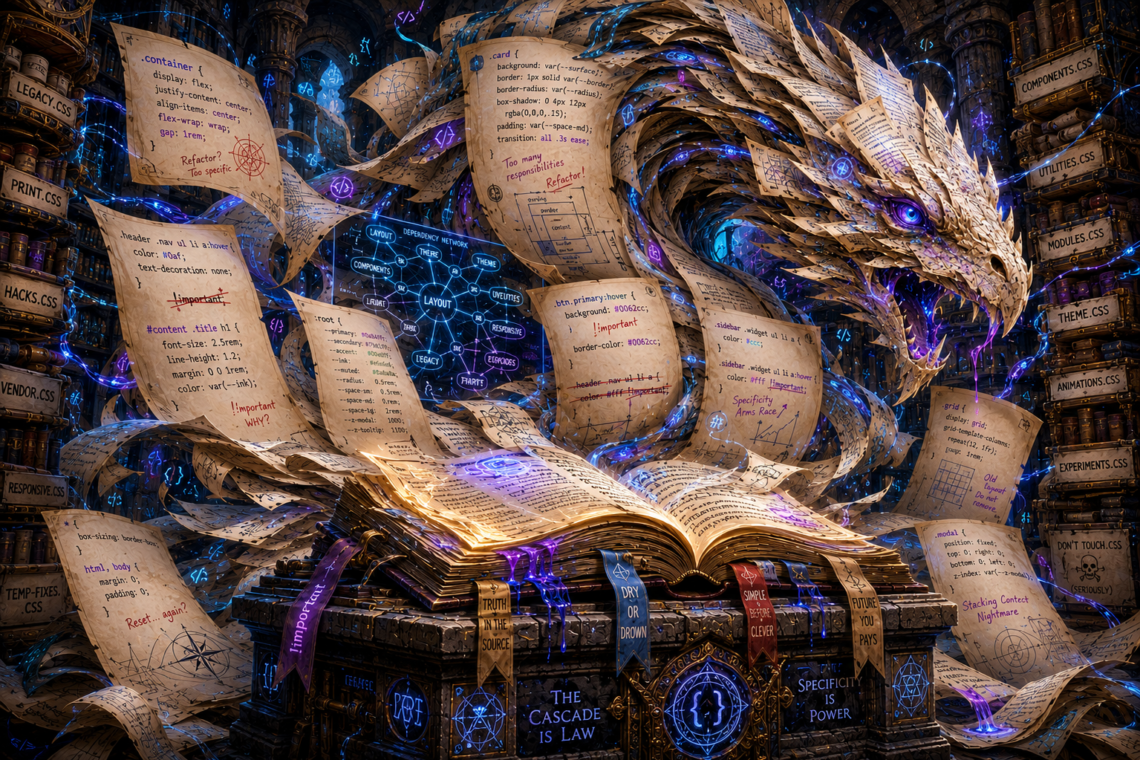
• An enormous ancient spellbook rests on a carved stone pedestal in a vast arcane archive as hundreds of stylesheet-like parchment pages erupt from its open pages and merge into a colossal serpentine creature made entirely of CSS rules, annotations, diagrams, revisions, and glowing magical symbols. The parchment monster coils through towering shelves filled with labeled codices while streams of luminous blue and violet magical energy connect scattered documents into a sprawling network of dependencies. Individual pages display selectors, properties, comments, crossed-out declarations, and specificity notes, emphasizing accumulated technical debt and architectural complexity. The scene is illuminated by glowing runes, magical ink, and dramatic volumetric light, creating the impression of a once-useful body of knowledge that has grown beyond its original purpose and become an intelligent living manifestation of an unmaintainable stylesheet.
    The CSS Codex

    When the Stylesheet Becomes the Monster

    Ignore a growing beast long enough and eventually it guards the dungeon. Editor’s Note: This article originally appeared on RandomThoughtsInTraffic.com and has been revised and expanded for StackNScroll as the closing chapter of The CSS Codex. The original edition explored how CSS codebases gradually become more difficult to maintain as shortcuts, overrides, and exceptions accumulate over time. This updated version expands that discussion with deeper examination of architectural drift, technical debt, component design, specificity management, long-term maintenance practices, and the warning signs that experienced engineers learn to recognize before problems become crises. It also serves as a capstone for the broader lessons explored throughout The CSS Codex, bringing together concepts…

  • Elevated cartographer-style view of a vast fantasy landscape featuring winding rivers, rolling plains, dense forests, rocky mountain ranges, coastal cliffs, and scattered distant settlements. Glowing golden pathways trace natural routes across the terrain, while subtle magical energy highlights the contours of valleys, ridgelines, and waterways. The scene emphasizes the land itself as the foundation upon which future roads, cities, and kingdoms will be built, rendered in a realistic Dungeons & Dragons-inspired fantasy style with cinematic lighting and expansive environmental detail.
    The CSS Codex

    The Default Terrain of Normal Flow

    Before roads are built and castles rise, the land already has a shape. Editor’s Note: This article was originally published on RandomThoughtsInTraffic.com and has been revised and expanded for StackNScroll as part of The CSS Codex series. The original article introduced normal flow as the browser’s default layout behavior, but this edition explores the concept through the broader lens of layout strategy, document structure, responsiveness, and long-term maintainability. New material examines how block and inline formatting contexts influence layout decisions, how containers shape available space, why developers often abandon normal flow too early, and how modern layout systems continue to depend upon it. As part of this week’s theme, Mastering…

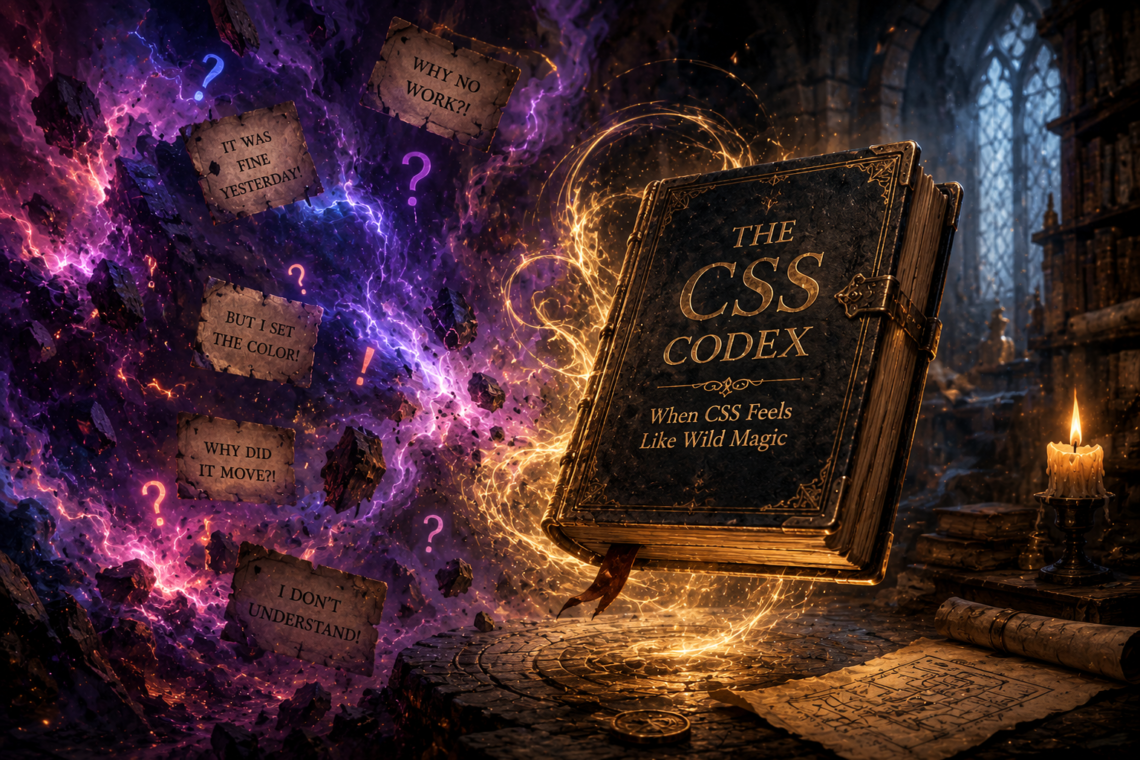
  • An ancient illuminated codex floats above a stone pedestal inside a dark fantasy library while chaotic purple and blue magical energy erupts around it. Torn parchment scraps swirl through the magical storm bearing frustrated messages such as Why Did It Move?, But I Set the Color!, It Was Fine Yesterday!, I Do Not Understand!, and Why No Work?. Glowing question marks and floating debris drift through the air, reinforcing the sense of confusion and unpredictability. The massive codex radiates warm golden light that contrasts with the surrounding chaos, suggesting hidden knowledge and order beneath the apparent magical disorder. Towering bookshelves, candles, scrolls, and arcane artifacts fill the background, creating a fantasy atmosphere that symbolizes discovering the rules behind seemingly unpredictable behavior.
    The CSS Codex

    When CSS Feels Like Wild Magic

    What appears to be chaos is often a spell whose rules remain unseen. Editor’s Note: Before joining The CSS Codex: Mastering the Rules of the Realm, When CSS Feels Like Wild Magic first appeared on RandomThoughtsInTraffic.com. This revised and expanded StackNScroll edition revisits one of the most persistent misconceptions in web development: the belief that CSS behaves unpredictably. New material connects the cascade, specificity, inheritance, layout calculations, positioning systems, rendering behavior, and architectural decision-making into a unified model that treats CSS as a deterministic system rather than a collection of disconnected techniques. The goal of this updated edition is not simply to explain why CSS can feel confusing, but to…