Stack n' Scroll

Code, Campaigns, and Lessons from the Digital Realm

June 2026
S M T W T F S
 123456
78910111213
14151617181920
21222324252627
282930  
« May    

Meta

  • Register
  • Log in
  • Entries feed
  • Comments feed
  • WordPress.org
Frank Jamison Avatar
  • A monumental fantasy castle is shown in dramatic cutaway cross section, revealing its immense stone foundations extending deep into bedrock beneath the kingdom. Glowing golden architectural lines, magical construction diagrams, geometric overlays, and blueprint-style annotations trace the load-bearing arches, columns, bridges, stairways, and vaulted chambers that support the entire structure. Warm sunlight illuminates the thriving realm above while cool blue light radiates from the hidden foundations below, symbolizing that enduring strength comes from carefully designed structure. The detailed editorial illustration evokes a Dungeons & Dragons-inspired architectural masterpiece, visually representing the unseen framework that supports a successful software system.
    Web Development Fundamentals

    The Full-Stack Campaign: The Bones of the Realm: Writing Semantic HTML That Holds

    April 8, 2026 /

    Strong kingdoms are built on structure long before they are decorated. Editor’s Note: This article is an expanded and substantially revised edition of an article originally published on RandomThoughtsInTraffic.com. While the original introduced semantic HTML as an important front-end development practice, this StackNScroll edition explores the subject through the broader disciplines of software architecture, browser interpretation, accessibility, maintainability, and long-term engineering thinking. New material examines how browsers parse documents before rendering interfaces, why semantic HTML influences every layer of the modern web stack, and how experienced engineers gradually learn to think differently about markup after years of maintaining production software. As part of this week’s Foundations of the Realm theme,…

    Read More
    Frank Jamison

    You May Also Like

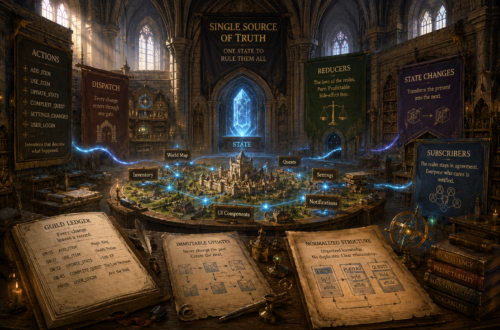
    A grand medieval fantasy guild hall serves as a visual metaphor for JavaScript state management. At the center of the vast stone chamber, a glowing magical crystal labeled State powers a detailed miniature kingdom displayed on a large round table. Blue streams of magical energy connect the crystal to labeled regions representing inventory, quests, notifications, settings, world map, and UI components, illustrating how shared application state flows throughout an entire system. Massive banners surrounding the hall depict engineering concepts including actions, dispatch, reducers, state changes, subscribers, immutable updates, normalized structure, and a guild ledger that records every change. Ancient books, engineering diagrams, drafting tools, glowing runes, and architectural details reinforce themes of organization, maintainability, and long-term software design in a painterly, Dungeons & Dragons-inspired editorial illustration.

    The Full-Stack Campaign: The Inventory System: Managing State Without Losing Control

    April 15, 2026
    A vast medieval royal armory stretches through a grand vaulted castle hall where hundreds of meticulously arranged suits of armor are displayed on pedestals, racks, and alcoves with perfect symmetry. Glowing golden magical construction lines, geometric drafting diagrams, measuring guides, and alignment grids overlay the architecture, emphasizing organization, hierarchy, and precision. Sunlight pours through towering stained-glass windows, illuminating polished steel armor, carved stone columns, architectural blueprints, measuring tools, and inventory ledgers. The richly detailed fantasy scene conveys craftsmanship, maintainability, and thoughtful design, symbolizing the principles of structured CSS layout and front-end architecture without depicting any people or action.

    The Full-Stack Campaign: Armor and Appearance: CSS Layout Without Chaos

    April 10, 2026
    Stamp Evaluation – Scott #985 (Used, Hinged, No Original Gum – Single Stamp) 3¢ Carmine Rose – Grand Army of the Republic, 1949 (Commemorative Issue – Rotary Press Printing, Perf 11 x 10½, Unwatermarked) Design Overview: Scott #985 commemorates the final national encampment of the Grand Army of the Republic. The design features an elderly Civil War veteran in the foreground, a younger soldier behind him, and the GAR emblem at left above the denomination. “United States Postage” anchors the lower tablet, while the commemorative inscription spans the top. Printed in carmine rose, the engraving retains strong color, clear portrait detail, and good contrast. Grading Breakdown: The centering grade is Fine/Very Fine 78. Visually, with the unaided eye, the perforation holes are easily seen to be clear of the design, but one or two margins are narrow. The bottom margin is the most narrow and establishes the centering limit. The left margin is the least narrow, while the right margin is more narrow than the top. All margins remain clearly outside the design and satisfy the Fine/Very Fine standard. The stamp presents pleasing overall balance, with the lower margin as the primary visual limitation. Soundness Evaluation: The faults present are two shorter perforations approximately half normal length and four fuzzy or ragged perforations. These faults constitute Minor Fault soundness. Minor Fault soundness combined with Fine/Very Fine centering yields a preliminary grade of Very Good 58. The group of shortened and ragged perforations is the controlling condition issue, while the stamp otherwise retains a clean appearance. Perforations and Margins: The perforations are generally complete, but several teeth show the shortened, fuzzy, or ragged condition noted in the fault list. These irregularities slightly soften the otherwise clean outline of the stamp. The bottom margin is closest to the design, the left margin is widest, and the right margin is narrower than the top. The frame remains visibly clear of the perforation holes on all four sides. Cancellation Evaluation: No visible cancellation appears on the face of the stamp. The portraits, GAR emblem, denomination, top inscription, and lower tablet are fully visible without postal markings crossing the design. For a used stamp, this creates a clean front presentation, though the absence of a visible cancel is treated conservatively and does not automatically produce a grade increase. Collector’s Note: Scott #985 is a historically appealing commemorative for collectors of Civil War memory, veterans’ organizations, patriotic themes, and late 1940s United States issues. The paired veteran-and-soldier design gives the stamp strong symbolic impact. Eye Appeal Adjustment: After centering and soundness are determined, eye appeal is considered. The stamp retains fresh carmine rose color, a sharp engraved impression, and an unobstructed design. The perforation faults have already been accounted for in soundness, and there is no heavy cancellation to penalize. No additional adjustment is warranted, so the preliminary grade remains 58. Final Numerical Grade Calculation: The centering grade is Fine/Very Fine 78. Minor Fault soundness reduces the grade by 20 points, producing a preliminary grade of Very Good 58. No cancellation deduction or other eye appeal adjustment is applied. The final numerical grade is 58. Summary: This used Scott #985 shows Fine/Very Fine 78 centering, with the bottom margin most narrow, the left margin widest, and the right margin narrower than the top. Minor Fault soundness lowers the preliminary grade to Very Good 58. Clean color and an unobstructed face support the result without changing it. Final Grade: Very Good 58.

    The Full-Stack Campaign: The First Map: How the Browser Shapes the World

    April 6, 2026
  • Stamp Evaluation – Scott #985 (Used, Hinged, No Original Gum – Single Stamp) 3¢ Carmine Rose – Grand Army of the Republic, 1949 (Commemorative Issue – Rotary Press Printing, Perf 11 x 10½, Unwatermarked) Design Overview: Scott #985 commemorates the final national encampment of the Grand Army of the Republic. The design features an elderly Civil War veteran in the foreground, a younger soldier behind him, and the GAR emblem at left above the denomination. “United States Postage” anchors the lower tablet, while the commemorative inscription spans the top. Printed in carmine rose, the engraving retains strong color, clear portrait detail, and good contrast. Grading Breakdown: The centering grade is Fine/Very Fine 78. Visually, with the unaided eye, the perforation holes are easily seen to be clear of the design, but one or two margins are narrow. The bottom margin is the most narrow and establishes the centering limit. The left margin is the least narrow, while the right margin is more narrow than the top. All margins remain clearly outside the design and satisfy the Fine/Very Fine standard. The stamp presents pleasing overall balance, with the lower margin as the primary visual limitation. Soundness Evaluation: The faults present are two shorter perforations approximately half normal length and four fuzzy or ragged perforations. These faults constitute Minor Fault soundness. Minor Fault soundness combined with Fine/Very Fine centering yields a preliminary grade of Very Good 58. The group of shortened and ragged perforations is the controlling condition issue, while the stamp otherwise retains a clean appearance. Perforations and Margins: The perforations are generally complete, but several teeth show the shortened, fuzzy, or ragged condition noted in the fault list. These irregularities slightly soften the otherwise clean outline of the stamp. The bottom margin is closest to the design, the left margin is widest, and the right margin is narrower than the top. The frame remains visibly clear of the perforation holes on all four sides. Cancellation Evaluation: No visible cancellation appears on the face of the stamp. The portraits, GAR emblem, denomination, top inscription, and lower tablet are fully visible without postal markings crossing the design. For a used stamp, this creates a clean front presentation, though the absence of a visible cancel is treated conservatively and does not automatically produce a grade increase. Collector’s Note: Scott #985 is a historically appealing commemorative for collectors of Civil War memory, veterans’ organizations, patriotic themes, and late 1940s United States issues. The paired veteran-and-soldier design gives the stamp strong symbolic impact. Eye Appeal Adjustment: After centering and soundness are determined, eye appeal is considered. The stamp retains fresh carmine rose color, a sharp engraved impression, and an unobstructed design. The perforation faults have already been accounted for in soundness, and there is no heavy cancellation to penalize. No additional adjustment is warranted, so the preliminary grade remains 58. Final Numerical Grade Calculation: The centering grade is Fine/Very Fine 78. Minor Fault soundness reduces the grade by 20 points, producing a preliminary grade of Very Good 58. No cancellation deduction or other eye appeal adjustment is applied. The final numerical grade is 58. Summary: This used Scott #985 shows Fine/Very Fine 78 centering, with the bottom margin most narrow, the left margin widest, and the right margin narrower than the top. Minor Fault soundness lowers the preliminary grade to Very Good 58. Clean color and an unobstructed face support the result without changing it. Final Grade: Very Good 58.
    Web Development Fundamentals

    The Full-Stack Campaign: The First Map: How the Browser Shapes the World

    April 6, 2026 /

    Every adventure begins with understanding the terrain beneath your feet. Editor’s Note: This article is an expanded and revised edition of a piece originally published on RandomThoughtsInTraffic.com. For its StackNScroll release, the material has been substantially updated with deeper coverage of browser architecture, rendering behavior, document parsing, resource loading, and the relationship between structure, presentation, and interactivity. New sections have been added to explain the browser’s rendering pipeline, introduce foundational performance concepts, and establish the technical groundwork for future articles in The Full-Stack Campaign. As part of this week’s Foundations of the Realm theme, the goal is to help readers develop accurate mental models of how browsers transform source code…

    Read More
    Frank Jamison

    You May Also Like

    A grand medieval fantasy guild hall serves as a visual metaphor for JavaScript state management. At the center of the vast stone chamber, a glowing magical crystal labeled State powers a detailed miniature kingdom displayed on a large round table. Blue streams of magical energy connect the crystal to labeled regions representing inventory, quests, notifications, settings, world map, and UI components, illustrating how shared application state flows throughout an entire system. Massive banners surrounding the hall depict engineering concepts including actions, dispatch, reducers, state changes, subscribers, immutable updates, normalized structure, and a guild ledger that records every change. Ancient books, engineering diagrams, drafting tools, glowing runes, and architectural details reinforce themes of organization, maintainability, and long-term software design in a painterly, Dungeons & Dragons-inspired editorial illustration.

    The Full-Stack Campaign: The Inventory System: Managing State Without Losing Control

    April 15, 2026
    A monumental fantasy castle is shown in dramatic cutaway cross section, revealing its immense stone foundations extending deep into bedrock beneath the kingdom. Glowing golden architectural lines, magical construction diagrams, geometric overlays, and blueprint-style annotations trace the load-bearing arches, columns, bridges, stairways, and vaulted chambers that support the entire structure. Warm sunlight illuminates the thriving realm above while cool blue light radiates from the hidden foundations below, symbolizing that enduring strength comes from carefully designed structure. The detailed editorial illustration evokes a Dungeons & Dragons-inspired architectural masterpiece, visually representing the unseen framework that supports a successful software system.

    The Full-Stack Campaign: The Bones of the Realm: Writing Semantic HTML That Holds

    April 8, 2026
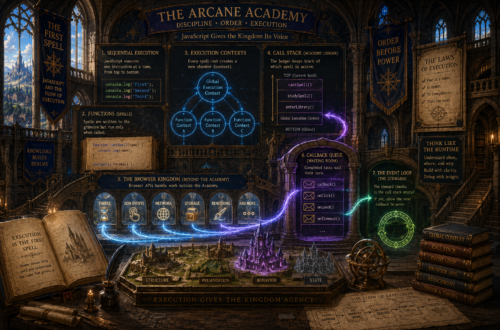
    A richly detailed Dungeons & Dragons-inspired fantasy illustration of the Arcane Academy, where the principles of JavaScript execution are represented as an organized system of magical scholarship and engineering. The vast medieval academy features towering stone arches, illuminated instructional panels, glowing diagrams, spellbooks, and magical energy flowing through the hall to illustrate sequential execution, functions, execution contexts, the Global Execution Context, the call stack, browser APIs, callback queues, and the event loop. At the center, streams of arcane energy connect the academy's systems, symbolizing how JavaScript gives a web application the ability to respond to user actions through disciplined, predictable execution. A detailed model of a fantasy kingdom at the bottom of the scene progresses from structure and presentation to behavior and state, reinforcing the journey of The Full-Stack Campaign and the idea that execution gives the kingdom agency.

    The Full-Stack Campaign: The First Spell: JavaScript and the Flow of Execution

    April 13, 2026
  • Elevated cartographer-style view of a vast fantasy landscape featuring winding rivers, rolling plains, dense forests, rocky mountain ranges, coastal cliffs, and scattered distant settlements. Glowing golden pathways trace natural routes across the terrain, while subtle magical energy highlights the contours of valleys, ridgelines, and waterways. The scene emphasizes the land itself as the foundation upon which future roads, cities, and kingdoms will be built, rendered in a realistic Dungeons & Dragons-inspired fantasy style with cinematic lighting and expansive environmental detail.
    CSS Architecture

    The CSS Codex: The Default Terrain of Normal Flow

    March 16, 2026 /

    Before roads are built and castles rise, the land already has a shape. Editor’s Note: This article was originally published on RandomThoughtsInTraffic.com and has been revised and expanded for StackNScroll as part of The CSS Codex series. The original article introduced normal flow as the browser’s default layout behavior, but this edition explores the concept through the broader lens of layout strategy, document structure, responsiveness, and long-term maintainability. New material examines how block and inline formatting contexts influence layout decisions, how containers shape available space, why developers often abandon normal flow too early, and how modern layout systems continue to depend upon it. As part of this week’s theme, Mastering…

    Read More
    Frank Jamison

    You May Also Like

    An ancient illuminated codex lies open on a richly detailed arcane workbench inside a fantasy scholar's study. The pages display glowing geometric diagrams composed of rectangular panels aligned along horizontal and vertical axes, representing structured layout systems rather than chaotic magic. Surrounding the codex are parchment blueprints, brass measuring instruments, crystals, and celestial devices illuminated by warm candlelight. Three glowing rune stones rest prominently in the foreground, symbolizing growth, shrinking, and foundation, reinforcing the theme that powerful enchantments are governed by precise rules. The scene conveys disciplined magical engineering, architectural planning, and the hidden structure behind seemingly magical systems.

    The CSS Codex: Flexbox Is Not a Shortcut Spell

    March 20, 2026
    Aerial fantasy battlefield viewed from a cartographer's perspective showing three distinct military routes converging on a fortified city. A winding road follows rivers and forests through rugged terrain on the left, a disciplined army advances in straight formations across open ground in the center, and a highly organized network of grid-like roads and districts stretches across the right side of the landscape. Mountains, rivers, valleys, forests, and strategic fortifications create a vast tactical environment that emphasizes planning, movement, and strategy rather than combat.

    The CSS Codex: Three Layout Tactics for One Battlefield

    March 18, 2026
    A vast circular stone chamber resembling an ancient arcane observatory is arranged in perfect symmetry around a glowing geometric artifact suspended at its exact center. Concentric rings, compass-like construction lines, and luminous geometric patterns radiate outward across the floor, while towering stone pillars and vaulted arches surround the space. Blue and gold magical energy flows evenly toward the central structure, which is composed of interlocking circles, squares, and polygons balanced in precise alignment. The scene conveys themes of geometry, order, spatial relationships, craftsmanship, and architectural mastery within a grand fantasy setting.

    The CSS Codex: The Geometry of Centering

    March 25, 2026
  • An ancient illuminated codex floats above a stone pedestal inside a dark fantasy library while chaotic purple and blue magical energy erupts around it. Torn parchment scraps swirl through the magical storm bearing frustrated messages such as Why Did It Move?, But I Set the Color!, It Was Fine Yesterday!, I Do Not Understand!, and Why No Work?. Glowing question marks and floating debris drift through the air, reinforcing the sense of confusion and unpredictability. The massive codex radiates warm golden light that contrasts with the surrounding chaos, suggesting hidden knowledge and order beneath the apparent magical disorder. Towering bookshelves, candles, scrolls, and arcane artifacts fill the background, creating a fantasy atmosphere that symbolizes discovering the rules behind seemingly unpredictable behavior.
    CSS Architecture

    The CSS Codex: When CSS Feels Like Wild Magic

    March 13, 2026 /

    What appears to be chaos is often a spell whose rules remain unseen. Editor’s Note: Before joining The CSS Codex: Mastering the Rules of the Realm, When CSS Feels Like Wild Magic first appeared on RandomThoughtsInTraffic.com. This revised and expanded StackNScroll edition revisits one of the most persistent misconceptions in web development: the belief that CSS behaves unpredictably. New material connects the cascade, specificity, inheritance, layout calculations, positioning systems, rendering behavior, and architectural decision-making into a unified model that treats CSS as a deterministic system rather than a collection of disconnected techniques. The goal of this updated edition is not simply to explain why CSS can feel confusing, but to…

    Read More
    Frank Jamison

    You May Also Like

    Aerial fantasy battlefield viewed from a cartographer's perspective showing three distinct military routes converging on a fortified city. A winding road follows rivers and forests through rugged terrain on the left, a disciplined army advances in straight formations across open ground in the center, and a highly organized network of grid-like roads and districts stretches across the right side of the landscape. Mountains, rivers, valleys, forests, and strategic fortifications create a vast tactical environment that emphasizes planning, movement, and strategy rather than combat.

    The CSS Codex: Three Layout Tactics for One Battlefield

    March 18, 2026
    An ancient illuminated codex lies open on a richly detailed arcane workbench inside a fantasy scholar's study. The pages display glowing geometric diagrams composed of rectangular panels aligned along horizontal and vertical axes, representing structured layout systems rather than chaotic magic. Surrounding the codex are parchment blueprints, brass measuring instruments, crystals, and celestial devices illuminated by warm candlelight. Three glowing rune stones rest prominently in the foreground, symbolizing growth, shrinking, and foundation, reinforcing the theme that powerful enchantments are governed by precise rules. The scene conveys disciplined magical engineering, architectural planning, and the hidden structure behind seemingly magical systems.

    The CSS Codex: Flexbox Is Not a Shortcut Spell

    March 20, 2026
    A massive geometric metal artifact composed of interlocking rectangular plates rests atop a glowing dwarven forge deep within a stone workshop. Molten gold light shines through the seams between the precisely fitted plates, illuminating measuring tools, rulers, compasses, calipers, and drafting instruments scattered across the forge floor. Sparks drift through the air as blazing furnaces burn beneath towering stone arches in the background. Intricate geometric engineering diagrams are carved into the workshop walls, reinforcing themes of precision, structure, craftsmanship, and refinement. The scene evokes the reforging of an ancient masterpiece through careful measurement and expert construction rather than combat or adventure.

    The CSS Codex: The Box Model Reforged

    March 23, 2026
  • Career Development (13)
  • CSS Architecture (10)
  • Software Architecture (5)
  • Web Development Fundamentals (5)

Career Development Clean Code Code Quality Code Reviews Component Design Continuous Learning CSS CSS Architecture CSS Best Practices CSS Cascade CSS Fundamentals CSS Layout Design Systems Developer Career Developer Education Developer Growth Dungeons and Dragons Engineering Culture Fantasy Theme Flexbox Front-End Development Frontend Development Full Stack Development Maintainable Code Maintainable CSS Mentorship Normal Flow Professional Growth Responsive Design Scalable CSS Semantic HTML Software Architecture Software Craftsmanship Software Development Software Engineering StackNScroll System Design Technical Debt Technical Leadership The CSS Codex The Full-Stack Campaign The Guildmaster's Handbook User Interface Design Web Development Web Development Fundamentals

Stack N' Scroll - 2026 ©