
The Cost of Power: From DOM Manipulation to Better Design
True mastery comes not from controlling every spell, but from knowing when to let the magic follow the design.
Editor’s Note: This article is an updated and expanded edition of an article originally published on RandomThoughtsInTraffic.com. For this StackNScroll edition, I have substantially expanded the original discussion by moving beyond the mechanics of DOM manipulation into the architectural thinking that allows frontend applications to remain maintainable as they mature. Along with new JavaScript examples, this revised edition explores application state, separation of concerns, and the engineering habits that distinguish software built for demonstrations from software built to survive years of growth. It also serves as a bridge into this week’s theme, Beyond the City Gates: Exploring the World Beyond the Browser, preparing us to understand why modern web applications extend far beyond the interface visible inside the browser.
The Wizard Who Mistook Power for Mastery
Every adventurer remembers the first time they acquired an artifact powerful enough to change the way they approached every challenge. It might have been a sword forged by legendary dwarven smiths, a staff capable of channeling destructive magic, or an enchanted ring whose abilities seemed limited only by the imagination of the person wearing it. Before discovering that artifact, victory depended upon careful planning, teamwork, and patience. Afterward, every obstacle suddenly appeared smaller because there was always one more spell to cast or one more magical ability waiting to solve the problem. The artifact itself was never the danger. The danger was quietly beginning to believe that every future challenge deserved exactly the same solution.
Software development offers its own version of that experience. When I first began building websites, HTML and CSS already felt deeply satisfying. Semantic HTML taught me that thoughtful structure made information easier for both browsers and people to understand. CSS demonstrated how carefully organized presentation could transform plain documents into polished user experiences without changing the underlying content. Every lesson built naturally upon the last, and each small success encouraged me to keep exploring what the browser was capable of becoming. Then I discovered JavaScript, and everything I believed the browser could do changed almost overnight.
The browser no longer behaved like a collection of static pages connected by hyperlinks. It became something interactive, responsive, and surprisingly alive. Buttons reacted immediately to user input. Navigation menus expanded without requiring an entirely new page to load. Validation messages appeared while forms were still being completed, rather than after they had already failed. Lists grew dynamically, content reorganized itself, and entire sections of an interface could appear or disappear with only a few lines of code. Every successful experiment reinforced the same conclusion. JavaScript was not simply another language to learn. It was the key that transformed websites into applications.
Like many developers, I embraced that discovery enthusiastically. Every project became another opportunity to make the browser feel a little smarter than it had the day before. Whenever I encountered something that could respond to user input, I immediately began imagining how JavaScript could improve the experience. If a section of content could appear dynamically rather than remain permanently visible, I wrote the code to make it happen. If a button could animate, I animated it. If users could receive immediate feedback instead of waiting for another page to load, I considered that a victory. Each completed feature felt like another spell carefully copied into an expanding spellbook, and every successful interaction strengthened my belief that becoming a better JavaScript developer simply meant learning more ways to manipulate the browser.
There is nothing inherently wrong with that stage of development because every engineer passes through it. Before we can learn restraint, we first need confidence. Before we can appreciate architecture, we need experience building software that eventually outgrows its original design. The problem is not discovering powerful tools. The problem is confusing the ability to solve today’s problem with the ability to build software that remains understandable tomorrow. Those are very different skills, and learning the difference marks one of the most important transitions in a developer’s career.
That lesson arrived much later than I expected. It did not come from reading documentation, completing online courses, or experimenting with another JavaScript library. It arrived while maintaining software that I believed I already understood. Every feature still worked exactly as intended. Users remained happy, bugs were relatively uncommon, and the browser continued presenting a polished experience. Yet every new change required a little more investigation than the last. Every enhancement demanded slightly more caution because changing one feature increasingly seemed to influence several others. The interface still looked elegant, but the architecture supporting it had quietly become far more complicated than I realized.
That realization fundamentally changed how I measured progress as a developer. Early in my career, success meant making the browser do something it had not done before. As my applications grew, success became something entirely different. I wanted software that another developer could understand without needing me to explain it. I wanted new features to fit naturally into the existing design instead of forcing me to rethink everything that had already been built. Most importantly, I wanted complexity to remain organized instead of accumulating one successful feature at a time. That change in perspective became the moment I stopped thinking only about programming and started thinking about engineering.
Power solves today’s problems.
Architecture determines whether tomorrow’s problems remain solvable.
The Comfortable Illusion
One reason direct DOM manipulation feels so rewarding is that it genuinely is the right solution for many situations. Every frontend developer should understand how JavaScript locates elements, responds to browser events, modifies attributes, updates text, and creates new interface components. Those skills are not optional. They form the foundation upon which every modern frontend framework is built, and without understanding those fundamentals, higher-level abstractions become collections of unfamiliar rules rather than logical engineering decisions. Before we can appreciate why experienced architects design entire kingdoms rather than individual buildings, we need to understand how those buildings are constructed.
Consider a simple expandable information panel. The example is intentionally small because the engineering lesson is unrelated to visual complexity. Instead, it demonstrates one of the most fundamental relationships in frontend development. A user performs an action, JavaScript responds, and the browser updates the interface to reflect that response.
</> HTML

<button id="detailsButton">Show Details</button>

<section id="details" hidden>
    <p>The ancient archive contains forgotten knowledge.</p>
</section>
The JavaScript required is refreshingly straightforward.
</> JavaScript

const button = document.querySelector("#detailsButton");
const details = document.querySelector("#details");

button.addEventListener("click", function () {
    details.hidden = !details.hidden;
});
I still enjoy examples like this because they demonstrate an important engineering principle without unnecessary distractions. Every variable has a clear purpose, every statement contributes directly to the interaction, and the relationship between cause and effect remains obvious from beginning to end. When teaching JavaScript, I often begin with examples very much like this because they help students understand how events, the Document Object Model, and browser rendering work together to create interactive experiences. There is elegance in solving a small problem with a small solution, and direct DOM manipulation deserves its place among every frontend developer’s core skills.
The illusion begins because this approach continues succeeding long after applications stop being simple. Another feature requires another event listener. Another interaction introduces another callback. Another panel receives another toggle function. Each individual addition appears completely reasonable because each one solves an immediate problem while preserving the behavior users expect. The browser happily executes every new instruction without ever suggesting that those independent decisions are gradually becoming interconnected. From the user’s perspective, the application simply continues improving.
Software rarely grows by accumulating independent features. It grows by accumulating relationships. Every new interaction quietly depends upon assumptions established by earlier interactions, and those assumptions eventually become far more significant than the individual features themselves. The browser faithfully displays the final result, but it offers no indication that multiple event listeners, helper functions, and conditional statements are now cooperating behind the scenes to produce that experience. By the time those relationships begin interfering with one another, the dungeon has become far larger than the map we started with, and understanding the architecture requires far more than reading one function at a time.
When the Dungeon Outgrows the Map
One of the great deceptions of software engineering is that complexity almost never announces its arrival. Applications do not suddenly become difficult to maintain because one developer writes a particularly poor function or because one unfortunate design decision derails an otherwise healthy project. Complexity grows quietly, hiding inside features that work exactly as intended. Every enhancement appears reasonable, every requirement feels independent, and every completed task reinforces the comforting belief that the application is simply becoming more capable. By the time developers begin noticing the cost of those decisions, the software has usually evolved far beyond the point where any single change can restore its original simplicity.
Imagine our expandable information panel continuing to evolve exactly as successful applications often do. The design team requests a smooth animation because the transition feels abrupt. Accessibility testing recommends updating ARIA attributes whenever the panel opens or closes so screen readers accurately communicate the current state. Another developer introduces a second button elsewhere on the page that performs the same action, while the product owner asks whether the panel should retain its previous state after a browser refresh. Soon afterward, another feature automatically closes the panel whenever the user clicks somewhere outside of it. None of these requests are unusual. Each one represents the sort of thoughtful refinement that improves the overall user experience, and each one requires only a handful of additional lines of JavaScript.
Individually, every enhancement appears remarkably small. Collectively, however, those enhancements begin changing something far more important than the interface itself. Instead of a single function controlling a single interaction, several pieces of code now influence the same behavior. One event listener opens the panel. Another closes it. A third updates accessibility information. A fourth restores the previous state after the page loads. Every function continues solving the problem it was originally written to solve, yet responsibility has quietly become distributed across multiple locations within the application. Understanding how the panel behaves now requires understanding how all of those independent pieces cooperate with one another because none of them possesses the complete picture by itself.
This is one of the defining moments in a developer’s career because it marks the transition from building features to designing systems. Features can often be understood in isolation because they solve one clearly defined problem. Systems introduce relationships, and relationships introduce dependencies that rarely appear while reading a single function. The browser faithfully presents the final result to the user, but it never explains how many different decisions contributed to producing that result. The interface continues to appear clean, polished, and responsive, while the architecture supporting it becomes progressively more difficult to reason about.
That hidden complexity is the real cost of power. JavaScript never becomes less capable. Every new technique expands what we can accomplish inside the browser. The challenge is that increased capability also increases the number of ways unrelated pieces of code can become unintentionally connected. Eventually, changing one feature requires understanding several others because the application has evolved into a network of relationships rather than a collection of isolated interactions. The browser never warns us that the dungeon has become larger than the map we started with. It simply continues executing every instruction while quietly allowing complexity to accumulate beneath the surface.
The Hall of Mirrors
I learned that lesson during a debugging session that should have lasted only a few minutes but eventually consumed most of an afternoon. A navigation panel occasionally closed when it should have remained open, yet the behavior refused to follow any predictable pattern. Sometimes I could reproduce the problem immediately. Other times, I performed the exact same sequence of actions repeatedly without the bug appearing even once. The inconsistency made the situation especially frustrating because intermittent failures almost always suggest that something deeper than a simple programming mistake is taking place.
Like most developers, I began by assuming the issue existed inside my most recent changes. I reviewed every event listener twice, stepped through functions one statement at a time, inspected variables in the debugger, and verified that each conditional expression evaluated exactly as expected. Every individual piece of code behaved correctly. Every function performed the task I had assigned to it. The longer I investigated, the more confusing the situation became, as the application continued to exhibit incorrect behavior while none of its individual components appeared responsible.
Every time I thought I had isolated the cause, another test disproved my theory. One change seemed to solve the problem until a different sequence of clicks caused it to return. Removing one event listener simply shifted the behavior somewhere else, while adding additional logging only confirmed that each function believed it was making the correct decision. Eventually, I realized the bug itself was teaching me something I had not yet understood. I was debugging individual functions when the real problem existed in the relationships between them. That shift in perspective became the turning point because it forced me to stop thinking about isolated pieces of code and to begin thinking about the architecture connecting them.
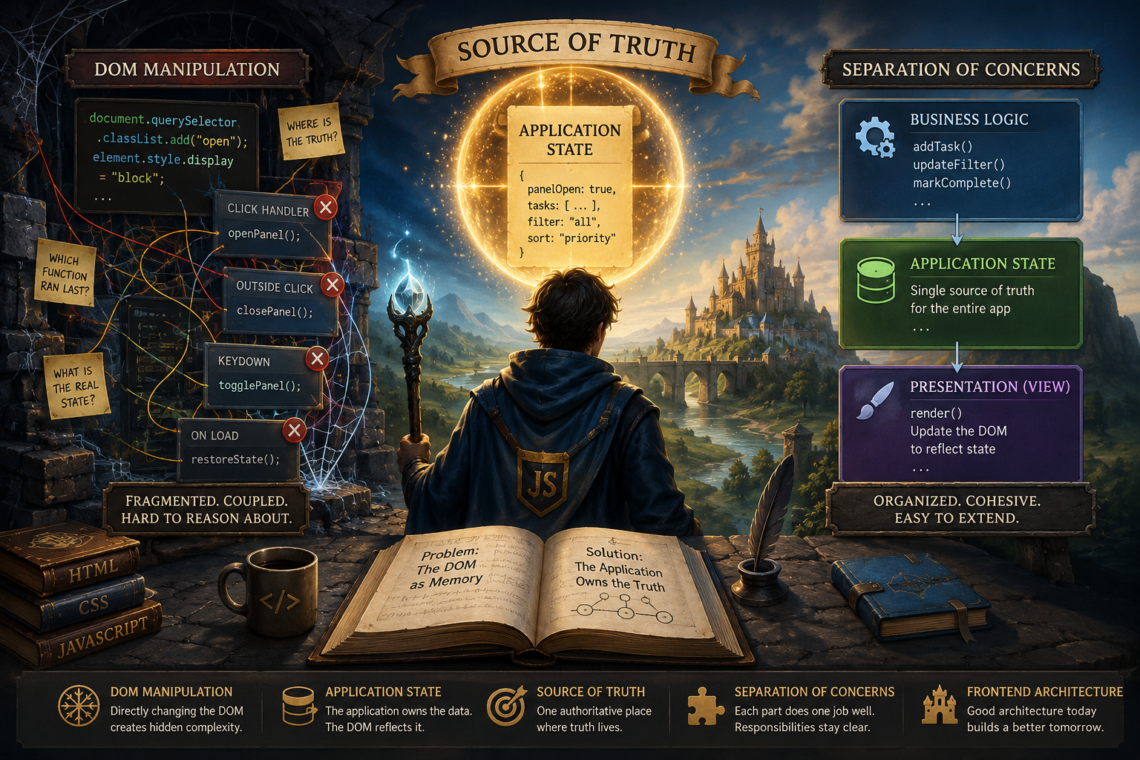
Once I started examining those relationships instead of the individual functions, the problem became surprisingly clear. One event listener checked whether a CSS class existed before deciding what to do. Another examined the hidden property of an element. A third responded to a click event without realizing another function had already modified the interface milliseconds earlier. None of those decisions were inherently wrong, and none of the functions contained obvious bugs. The real problem was that each function believed it understood the application’s current state, even though each observed only a small fragment of the overall picture.
Looking back, that experience reminds me of walking through an enchanted hall of mirrors. Every reflection appears convincing because it contains part of the truth, yet no single reflection reveals the entire room. I had unknowingly turned the Document Object Model into the application’s memory, repeatedly asking the browser what it believed to be true instead of allowing the application itself to own that knowledge. The DOM faithfully described what the interface currently looked like, but it could never explain why it looked that way or which sequence of events had produced the current result. I had mistaken the browser’s presentation for the application’s understanding, and that misunderstanding made debugging far more difficult than it needed to be.
By the end of that afternoon, the bug itself had been fixed. More importantly, the experience permanently changed the questions I asked while designing frontend software. Instead of wondering which element needed to change next, I began asking a much more important question.
Where should the application’s truth actually live?
The Kingdom Needs a Cartographer
The answer to that question permanently changed the way I approached frontend development because it forced me to separate two responsibilities that I had unconsciously treated as though they belonged together. The browser excels at presenting information, responding to user interactions, and rendering updates with impressive speed. Those responsibilities are exactly what the Document Object Model was designed to support. What the browser does not do particularly well is remember why something happened or determine whether a particular piece of information represents the application’s authoritative truth. The DOM faithfully describes the current interface, but it was never intended to become the application’s memory. Once I understood that distinction, many architectural patterns that had previously seemed unnecessarily complicated suddenly became practical solutions to problems I had already encountered.
Instead of asking the browser whether a panel was open, the application itself could simply know that information. Instead of searching through interface elements to determine which tasks had been completed, the application could already possess that knowledge before a single line of HTML was rendered. The browser would continue displaying everything the user needed to see, but it would no longer be responsible for defining reality. That responsibility would belong to the application itself, allowing every feature to start from the same understanding rather than constructing its own interpretation by examining whatever happens to be visible on the screen. For the first time, I understood that the browser should reflect the application’s state, not define it.
Consider our expandable information panel one more time, but now allow the application to maintain its own understanding of what is happening.
</> JavaScript

let state = {
    panelOpen: false
};

const panel = document.querySelector("#details");

function render() {

    panel.hidden = !state.panelOpen;

}

function togglePanel() {

    state.panelOpen = !state.panelOpen;

    render();

}
At first glance, this implementation appears slightly more elaborate than our original example. We now maintain a state object, introduce a rendering function, and deliberately separate the application’s data from the browser itself. For such a small demonstration, that additional structure may even seem unnecessary. Many developers look at code like this and wonder why anyone would voluntarily write more JavaScript to produce exactly the same visible behavior.
The answer becomes obvious the moment the application begins growing again. Suppose another feature needs to determine whether the panel is already open before displaying a notification. Another developer wants keyboard shortcuts to toggle the panel. Someone else introduces a settings page that remembers the user’s preferred layout between visits. Eventually, analytics begin tracking which panels users open most frequently, while another feature synchronizes interface preferences across multiple devices. Suddenly, every new capability depends upon the same information. If the browser remains the source of truth, every feature must independently inspect the interface before making a decision. If the application owns the state, however, every feature begins with exactly the same understanding because they all consult the same source of information. The browser no longer decides what is true. It simply communicates what the application already knows.
This is precisely why so many experienced developers eventually stop talking about DOM manipulation and start talking about state management. Once I understood that shift, modern frontend frameworks began making much more sense. React, Vue, Angular, Svelte, and many others are not successful because they somehow replace JavaScript. They are successful because they encourage developers to organize responsibilities rather than scatter them throughout the interface. Each framework approaches the problem differently, but they all begin with the same architectural observation. The application should own its state, while the browser should concentrate on presenting that state clearly and consistently.
Every Spell Has One Purpose
Understanding where application state belongs naturally led me to another principle that reshaped the way I think about software engineering. Good applications are not simply collections of useful features. They are collections of clearly defined responsibilities. Experienced engineers often describe this philosophy as separation of concerns, but beneath the formal terminology lies an idea that is surprisingly straightforward. Every part of the application should perform one primary job and do it exceptionally well. The more responsibilities we assign to a single function or component, the more difficult it becomes to understand, test, and modify without affecting unrelated parts of the system.
When I review some of my earliest JavaScript projects, I can immediately recognize where I ignored that principle. Event handlers updated the interface while simultaneously making business decisions. Rendering functions quietly modified application data because it seemed convenient at the time. Utility functions accessed the Document Object Model directly whenever they needed additional information, rather than receiving it through clearly defined parameters. None of those decisions appeared particularly harmful while the applications remained small. In fact, most of the code looked concise and efficient. The real cost emerged only after months of continued development, when every function had quietly accumulated knowledge about several different parts of the application.
Thoughtful architecture untangles those relationships by assigning each part of the application a clearly defined role. The application’s state describes what is currently true. Business logic determines how that truth changes when users interact with the software. Finally, the presentation layer communicates that truth through the browser. Each layer depends on the one before it without assuming responsibilities that belong elsewhere. Once those boundaries become clear, new features no longer feel like interruptions because the architecture already makes clear where they belong. Instead of inventing another pattern for every requirement, developers simply extend existing patterns.
Imagine our task manager continuing to evolve. Users can create tasks, assign priorities, mark work as complete, filter active items, sort responsibilities, and eventually search hundreds of tasks accumulated over months of work. Rather than allowing every interaction to manipulate the interface independently, each action updates the application’s state before asking the browser to render the current information. Every new capability follows the same architectural path, making the application easier to extend because developers spend their time enhancing a consistent design rather than inventing new approaches for each feature.
</> JavaScript

let state = {
    tasks: [],
    filter: "all",
    sort: "priority"
};

function addTask(task) {

    state.tasks.push(task);

    render();

}

function updateFilter(filter) {

    state.filter = filter;

    render();

}

function updateSort(order) {

    state.sort = order;

    render();

}

function render() {

    let visibleTasks = [...state.tasks];

    if (state.filter === "active") {

        visibleTasks = visibleTasks.filter(function (task) {
            return !task.completed;
        });

    }

    if (state.sort === "priority") {

        visibleTasks.sort(function (a, b) {
            return a.priority.localeCompare(b.priority);
        });

    }

    // Update the DOM
    // using visibleTasks

}
The most important lesson in this example is not the JavaScript syntax. It is the architecture. Three completely different user interactions all update the same source of truth before the browser renders the results. No function reaches into the interface searching for information. No event handler quietly assumes responsibility for rendering. Every piece of the application performs one well-defined job, allowing the overall system to remain understandable even as additional features continue arriving. By organizing responsibilities rather than merely code, we transform a growing collection of JavaScript functions into an application prepared to evolve rather than merely expand.
The spellbook has not become smaller.
It has become organized.
Designing the Kingdom Instead of Rearranging It
One misconception that shaped my early career was believing that becoming a better JavaScript developer meant learning every browser API I could find. Every new method felt like another powerful spell waiting to solve another category of problems, and there was certainly value in expanding that technical knowledge. The more comfortable I became with the language, however, the more I realized that experienced engineers were asking very different questions than I was. They were not impressed by how many DOM methods someone had memorized. They cared far more about whether the architecture made the software understandable, predictable, and maintainable. That realization completely changed the way I evaluated my own work because I stopped measuring success by how much JavaScript I had written and started measuring it by how much unnecessary complexity I had introduced.
The most humbling lessons rarely arrived while creating new software. They arrived months later when I returned to projects I had not touched for some time. I remember opening one application after several months away and realizing that I was reading my own code almost as though someone else had written it. Every feature still worked correctly. Every function still produced the behavior I intended. What had disappeared was the mental map connecting those functions. The architecture existed almost entirely inside my memory, and memory proved to be a far less reliable design document than I had ever imagined. Reconstructing those decisions forced me to appreciate how easily knowledge disappears when it exists only inside the mind of the person who originally wrote the code.
That experience permanently changed the way I approached software design. Today, whenever I write a new feature, I try to imagine another developer opening the project a year from now with no opportunity to ask me questions. Will they understand where application state lives? Will they recognize which functions are responsible for business logic and which simply render the interface? Will they be able to add a new capability without worrying that a seemingly unrelated feature might suddenly stop working? Those questions influence my design decisions far more than any clever programming technique because maintainable software is ultimately written for future developers as much as it is for today’s users.
Good architecture answers those questions before they are ever asked. When responsibilities remain clearly separated, developers spend less time reconstructing intent from implementation details because the organization naturally communicates how the system works. New features become easier to introduce because they extend existing patterns rather than inventing entirely new ones. Bugs become easier to isolate because every responsibility has an obvious owner, and refactoring becomes less intimidating because developers understand which parts of the application are affected by each change. Well-designed software quietly teaches future developers how it expects to be extended, reducing the need for lengthy documentation that attempts to explain decisions the architecture itself should already communicate.
Perhaps that is the greatest difference between writing code and designing software. Code solves today’s problem. Architecture continues solving tomorrow’s problems long after today’s implementation has been forgotten. The browser may faithfully execute every instruction we give it, but architecture determines whether the next developer can confidently understand those instructions without retracing every step we took to create them.
Beyond the City Gates
Everything we have explored throughout the frontend portion of The Full-Stack Campaign has been preparing us for something much larger than the browser itself. We began by learning how semantic HTML provides meaningful structure, exploring CSS as the language of presentation, discovering JavaScript as the source of interaction, and examining the Document Object Model as the browser’s representation of the page. Along the way, we gradually shifted our attention from writing individual features to designing systems capable of supporting those features as applications continued evolving. That progression was intentional because architecture becomes increasingly important as our software expands beyond a single web page.
Even the state object we introduced earlier illustrates an important limitation. It represents a dramatic improvement over relying exclusively on the DOM, yet it still exists only inside the browser’s memory. Refresh the page, and the application’s state disappears. Close the browser, and every variable, every object, and every function vanish with it. That behavior is perfectly acceptable while learning frontend development because the browser provides an ideal environment for experimenting with ideas. Production software, however, cannot depend upon memory that disappears whenever a user reloads the page or closes the browser.
Consider the applications we interact with every day. Online retailers remember shopping carts across multiple visits. Banks preserve account balances with extraordinary accuracy. Schools store grades, attendance records, assignments, and years of academic history. Streaming services remember what millions of people watched yesterday and recommend what they should watch tomorrow. None of that information can safely exist only inside a browser running on one person’s computer. Somewhere beyond the interface, another system accepts requests, stores information, enforces business rules, verifies permissions, coordinates thousands or even millions of users simultaneously, and responds to the browser with the information it needs to display. The browser remains an essential participant in that conversation, but it has never carried the responsibility alone.
Understanding where frontend responsibilities end makes the next stage of our journey feel remarkably natural. We have already learned that presentation should not own application state. We have learned that state should not be scattered throughout the Document Object Model. We have learned that responsibilities become easier to manage when each part of the application performs one primary job. The next logical question is no longer how the browser should organize itself. The next question is where responsibilities that do not belong inside the browser should live. Answering that question leads us beyond the city walls and into the larger world where every modern web application truly comes to life.
The Road Beyond the Walls
When I think back to the excitement I felt after first discovering JavaScript, I can still remember believing that mastery meant collecting as many techniques as possible. Every new API, every new browser feature, and every clever interaction felt like another powerful spell worth adding to my collection. Those skills absolutely mattered because they provided the confidence to build increasingly sophisticated applications. Over time, however, I realized that the developers I admired most were not distinguished by how many techniques they knew. They were distinguished by how thoughtfully they organized those techniques into systems that other people could understand, extend, and maintain.
Learning JavaScript made me a better programmer.
Learning when not to manipulate the DOM directly made me a better software engineer.
Perhaps that is the real cost of power. The more capable our tools become, the greater our responsibility to use them wisely. Every spell we add to the spellbook expands what we are capable of accomplishing, but wisdom lies in recognizing that the strongest wizard is not the one who casts the most spells. The strongest wizard is the one who understands which spell should be cast, which should remain untouched, and how every decision contributes to the health of the kingdom long after the adventure has ended.
Every kingdom eventually reaches its borders. Beyond those walls lies an even larger world filled with travelers, merchants, allies, rival kingdoms, and countless messages crossing the realm every second of every day. Everything we have learned about HTML, CSS, JavaScript, the DOM, application state, and architecture has prepared us for that journey. Until now, we have explored the visible kingdom inside the browser. The next stage of our adventure begins beyond the city gates, where every request leaves the familiar world of the interface and enters a realm dedicated to processing, protecting, storing, and returning the information that powers modern applications.
On Monday, our campaign continues with The Gate Beyond the UI: What a Server Actually Does. Together, we will follow requests as they leave the browser, discover who answers them, explore where business logic truly belongs, and begin to understand the invisible systems that quietly support every modern web application. The browser has been our training ground, but it has never been the entire kingdom. The city gates are finally opening. Beyond them lies the half of web development most users never see, but every software engineer must eventually understand.


You May Also Like

The Gate Beyond the UI: What a Server Actually Does
The First Spell: JavaScript and the Flow of Execution