
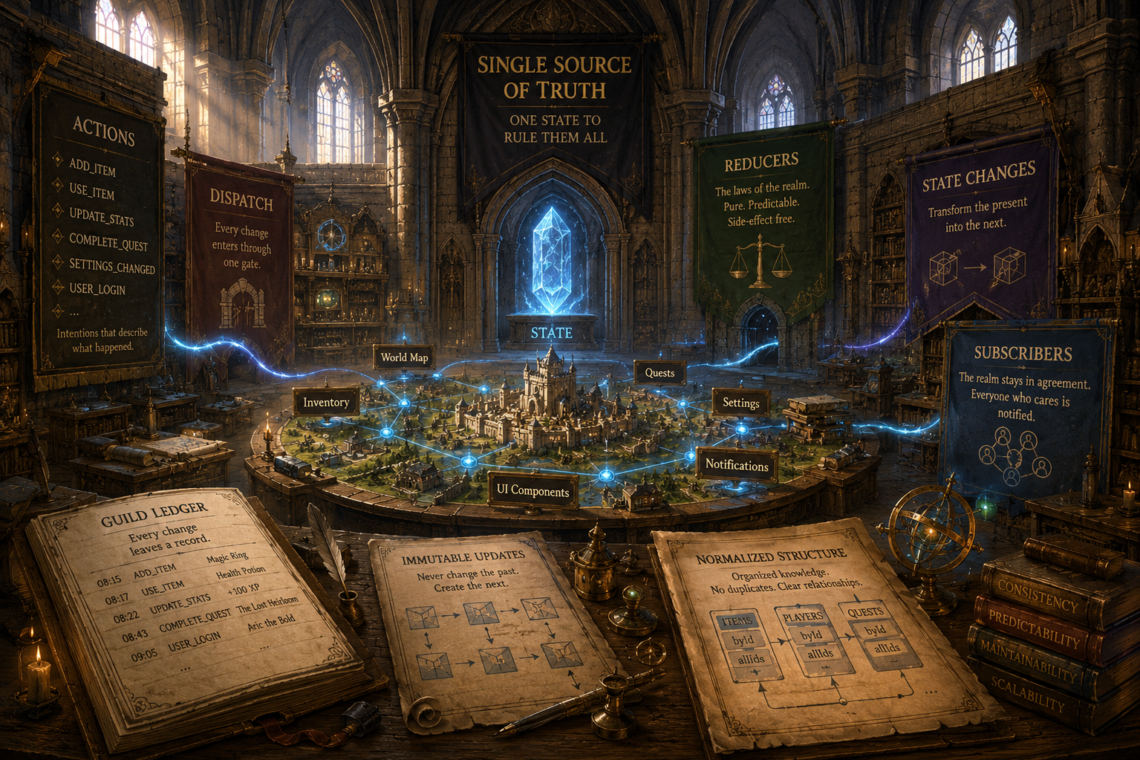
The Inventory System: Managing State Without Losing Control
Editor’s Note
This article is an updated and expanded edition of a lesson originally published on RandomThoughtsInTraffic.com. For this StackNScroll edition, I have substantially revised both the technical discussion and the engineering guidance to move beyond introducing JavaScript state and toward understanding the architectural decisions that allow interactive applications to grow without becoming fragile. New material explores immutable updates, centralized state transitions, shared application data, and engineering tradeoffs that emerge as software matures, all while reinforcing this week’s theme, The Spark of Adventure. My objective is not simply to explain state management, but to demonstrate why experienced engineers organize application state long before complexity demands it.
The Spark of Adventure: A Realm That Learns From Its Heroes
Over the past several articles, we have been building a kingdom one careful decision at a time. We began by understanding the world our applications inhabit when we explored how browsers interpret HTML. We strengthened that world with meaningful semantic structure, shaped its appearance with thoughtful CSS, and finally breathed life into it with JavaScript. Every lesson has reflected this week’s guiding principle: the realm is built. Now it must respond to the actions of its heroes. That principle introduces an entirely new responsibility because a world that responds to its heroes must also remember what those heroes have done.
One afternoon, several years ago, I found myself chasing what should have been a simple JavaScript bug. I was certain I knew where the problem lived because every symptom pointed toward the same function. I stepped through it repeatedly, inspected every variable, and watched every conditional evaluate exactly as expected. Nothing looked wrong because nothing in that function was wrong. Eventually, I discovered that another part of the application had quietly modified the same object several seconds earlier, leaving the code I was investigating to operate on assumptions that were no longer true.
That afternoon changed the way I thought about software architecture.
JavaScript had done exactly what I had asked it to do. The architecture I designed was the real source of the problem.
One lesson I have learned over the years is that software almost never feels complicated while I am building it. Complexity usually appears months later, when I return to code that once seemed perfectly obvious. Decisions that felt harmless become assumptions I no longer remember making, and relationships that once seemed simple gradually become difficult to untangle. Good architecture is less about solving today’s problem than protecting tomorrow’s understanding.
Looking back now, I can usually recognize the point where one of my older projects became harder to maintain. Interestingly, it was almost never because the code suddenly became more sophisticated. More often, it was because relationships between ordinary pieces of information quietly became more complicated than the structure supporting them. Individual functions still worked. Individual components still behaved correctly. The application had simply reached the point where too many parts depended upon the same information without sharing a common understanding of how that information should change.
One habit I have developed throughout my career is paying attention to which files I instinctively open first when a bug appears. If my first thought is that I need to search half the project, I usually take that as a sign that the architecture is no longer communicating clearly. Well-designed systems naturally narrow the scope of the investigation before I write the first line of debugging code. Good structure quietly answers questions that would otherwise consume an afternoon.
State management is one of the architectural disciplines that creates that kind of clarity. It is not a library, a framework, or a collection of advanced programming techniques reserved for enterprise software. It begins the first time an application remembers anything at all. Every variable that influences what a user sees, every object representing the application’s current understanding of reality, and every value that shapes future behavior becomes part of the application’s state. As applications become more capable, organizing that knowledge becomes just as important as collecting it.
Every application eventually reveals whether you organized its state or merely postponed organizing it.
The Quartermaster’s Hall: Understanding What State Really Is
Many developers first encounter the idea of state while learning React, Vue, Angular, or another modern framework. That sequence often creates the impression that state belongs to those frameworks when the opposite is actually true. Frameworks devote so much attention to state because every interactive application eventually faces the same engineering challenge, regardless of the technology used. Once I understood that relationship, learning new frameworks became much easier because I was no longer learning completely new ideas. I was simply learning different solutions to the same underlying problem.
At its simplest, state is everything an application knows about itself at a particular moment. That knowledge may include the authenticated user, the contents of a shopping cart, inventory items, search results, application settings, navigation choices, or values entered into a form. If changing a piece of information changes what the user experiences or how the application behaves, that information is part of the application’s state. The concept itself is remarkably simple. The challenge lies in accurately preserving that knowledge as the application continues to evolve.
The fantasy kingdom we have been constructing throughout this series serves as an apt analogy. Before every expedition leaves the castle, adventurers visit the quartermaster’s hall to receive equipment. Weapons are inspected, armor is fitted, provisions are counted, maps are distributed, and healing supplies are carefully recorded inside the guild ledger. None of that organization exists because the quartermaster enjoys maintaining records. It exists because every future decision depends upon an accurate understanding of what the expedition currently possesses. Once supplies begin changing hands, the records must change immediately, or every decision afterward becomes increasingly unreliable.
Applications operate according to exactly the same principle. The interface users see is simply a visible reflection of what the application currently believes to be true. When that belief matches reality, the software feels dependable because every interaction produces the expected result. When different parts of the application operate under different assumptions, subtle inconsistencies appear that users immediately recognize, even if they cannot explain them. A shopping cart displays the wrong quantity, a notification refuses to disappear, or a button remains enabled after an operation has already completed. Problems like these often appear unrelated, yet they frequently point toward the same underlying issue. Somewhere within the application, its understanding of reality has drifted away from reality itself.
The biggest transition in my own career occurred when I stopped evaluating individual functions in isolation and started asking a different question. Instead of wondering whether a particular function worked correctly, I began asking whether every part of the application shared the same understanding of what was currently true. That small shift in perspective influenced almost every architectural decision I made afterward. Individual functions can behave perfectly while the application as a whole still behaves incorrectly because they no longer agree about the world they are trying to represent.
The Adventurer’s Pack: Small Problems Have a Habit of Growing
Most software projects begin with remarkably little state. During the earliest stages of development, everything feels comfortably organized because every important value lives inside a handful of variables. Simplicity is one reason small projects feel enjoyable to build: the relationship between changing data and changing behavior remains immediately visible. I generally encourage newer developers to spend time building applications this way because understanding simple systems makes it much easier to recognize when those systems have reached their natural limits. Good engineering is rarely about introducing complexity early. It is about introducing it deliberately.
A small counter application illustrates this point.
</> JavaScript

let count = 0;

function increment() {
  count++;
  render();
}

function render() {
  document.getElementById("counter").textContent = count;
}
There is very little to criticize here because the problem itself remains appropriately small. When a value changes, the interface updates, and the cause-and-effect relationship becomes fully visible. At this stage, introducing reducers, centralized stores, or sophisticated architectural patterns would almost certainly distract from the lesson rather than improve the solution. Choosing the simplest design that completely solves today’s problem is often the most professional engineering decision available.
The difficulty appears when applications begin remembering many different pieces of information simultaneously. A shopping cart tracks products, quantities, discounts, shipping selections, taxes, and customer information. An online game remembers player statistics, inventory, quests, equipment, achievements, and locations. A project management application coordinates users, tasks, deadlines, permissions, notifications, and activity logs. Every new feature introduces another collection of information whose accuracy influences every other feature.
During the early years of my career, I often treated every new piece of state as another variable waiting to be declared. That approach worked surprisingly well until different parts of the application began depending on the same information. Eventually, I discovered that the real difficulty was not storing data. It was maintaining agreement on that data after dozens of features began modifying it for various reasons. Once multiple parts of the application believe different versions of reality, debugging shifts from solving problems to untangling misunderstandings.
Imagine the guild’s quartermaster attempting to manage supplies without maintaining a single authoritative inventory. One ledger tracks food, another tracks weapons, a third records healing potions, and individual adventuring parties keep handwritten copies of their own equipment lists. At first, everything appears manageable because the expedition is small. Eventually, someone borrows arrows from another group, another party consumes several potions during an unexpected encounter, and no record receives every update. By the time the next expedition prepares to leave, no one can confidently answer the simplest question: What do we actually have?
Software reaches exactly the same point. Two components maintain separate copies of the same user information. One updates while the other remains unchanged. A shopping cart displays one quantity while checkout processes another. A profile page still shows an outdated email address after the account settings have already been saved. None of these bugs requires complicated algorithms to create. They emerge naturally whenever applications lose track of which version of the truth they should believe.
One of the earliest architectural habits I adopted to combat this problem was identifying a single authoritative source for every important piece of information. Rather than allowing multiple copies of the same data to spread throughout the application, I began asking a much simpler question whenever I introduced new state. If this value changes tomorrow, where should that change happen first? Once I could answer that question consistently, many seemingly unrelated bugs quietly disappeared because every other part of the application learned to trust the same source.
That lesson extends well beyond JavaScript. Languages, frameworks, and libraries may offer different tools for managing state, but they all attempt to preserve the same engineering principle. A system becomes more dependable when every part of it agrees about what is true. Good state management is ultimately less about technology than about maintaining a consistent understanding of reality as software continues to evolve.
The Guild Ledger: Why State Changes Should Leave a Record
Once an application begins maintaining meaningful state, another important question naturally follows. How should that state change?
The simplest answer is to modify values directly whenever something happens. Early JavaScript programs often take exactly that approach because it feels natural.
</> JavaScript

player.gold += 100;
player.level++;
player.inventory.push("Magic Ring");
For small scripts, direct mutation often works well enough. The code is short, the effects are obvious, and very little can happen between one line and the next. As applications become larger, however, direct mutation quietly removes valuable information. After several different functions modify the same object, determining when, where, and why a particular value changed becomes increasingly difficult.
One realization gradually changed the way I approached this problem. Experienced engineers rarely think of a state change as merely updating a value. They think of it as recording an event that describes what happened.
Instead of asking the application to modify the inventory directly, they describe the action itself.
</> JavaScript

dispatch({
  type: "ADD_ITEM",
  payload: {
    id: 42,
    name: "Magic Ring"
  }
});
That small shift may appear cosmetic at first, yet it fundamentally changes the architecture. Rather than scattering updates throughout the codebase, every meaningful change now passes through a common language describing the application’s behavior. The state no longer changes mysteriously. It changes because a clearly defined action occurred.
The guild’s official ledger follows the same philosophy. The quartermaster does not simply notice that fewer healing potions remain on the shelf. A record explains that three potions were issued to the northern expedition before dawn. The inventory tells us what exists. The ledger tells us why it changed. Together, they create a history that future decisions can trust.
That distinction becomes increasingly valuable during debugging. Instead of searching through hundreds of functions looking for every place an object might have changed, developers can examine the sequence of actions that led to the current state. Questions that once required hours of investigation often become straightforward because the architecture preserves the story behind each update rather than only its final result.
The first time I worked with systems organized this way, the additional structure felt unnecessary. Writing actions seemed slower than directly modifying objects. Over time, I discovered that I spent far less time investigating unexpected behavior because every state transition had become intentional, visible, and easy to follow. The extra discipline paid for itself long before the application reached production.
The engineering lesson extends beyond any particular framework. Whether the implementation uses Redux, Vuex, Pinia, NgRx, or another state management library, the underlying philosophy remains remarkably consistent. Reliable systems rarely allow important information to change without leaving behind a clear explanation of what happened.
The King’s Decree: One Gate Through Which Every Change Must Pass
Once I began thinking of state changes as meaningful events rather than scattered updates, another question naturally followed. If every important change deserves to be recorded, where should those changes actually occur? Allowing every function in an application to update shared information independently ultimately recreates the confusion we worked so hard to eliminate. We have preserved history more effectively, but we still lack consistent governance.
Eventually, I realized that application state deserved something similar to the laws governing a kingdom. Every meaningful change should pass through a single, clearly defined process rather than allowing individual features to invent their own update rules. Once I adopted that perspective, reducers stopped looking like another programming pattern and started looking like an architectural boundary. They became the official place where the application’s business rules lived, making those rules easier to discover, understand, and maintain.
</> JavaScript

const initialState = {
  inventory: [
    { id: 1, name: "Health Potion", quantity: 3 },
    { id: 2, name: "Iron Sword", quantity: 1 }
  ]
};

function reducer(state, action) {
  switch (action.type) {

    case "USE_ITEM":
      return {
        ...state,
        inventory: state.inventory.map(item => {
          if (item.id === action.payload && item.quantity > 0) {
            return {
              ...item,
              quantity: item.quantity - 1
            };
          }

          return item;
        })
      };

    default:
      return state;
  }
}
The first time I encountered reducers, I honestly wondered whether experienced developers had simply discovered another way to make straightforward problems look complicated. The pattern felt far more formal than directly changing an object, and I questioned whether the additional structure justified the extra code. Several months later, I reopened one of those projects after working on something entirely different. The reducer became the first file I opened because it clearly described how the application’s world changed. Every meaningful business rule existed in one location, and understanding the software felt less like detective work and more like reading a well-organized handbook.
That experience permanently changed my opinion of architectural patterns. The best ones rarely make software easier to write. They make software easier to understand months or years later, when the excitement of building the original feature has long since faded. Good architecture should explain itself to the next developer who opens the project, even if that developer turns out to be me.
The Royal Messenger: Keeping the Realm in Agreement
Even after centralizing state changes inside reducers, another challenge quickly appeared. Knowing how the application’s state should change solved only half of the architectural problem. Once the application’s understanding of reality changed, every part of the interface that depended upon that information needed to learn about it. During the earliest stages of development, I simply called rendering functions directly after updating data. That approach worked remarkably well while only one portion of the interface depended upon the information. As applications matured, however, remembering every place that required refreshing gradually became another responsibility for the developer.
The guild’s royal messenger provides a useful analogy. Imagine the quartermaster updating the official inventory after an expedition returns from a dangerous quest. The records now accurately reflect the current supplies, yet the castle armory, the royal merchant, the expedition commanders, and the guild’s provisioning office all continue making decisions using yesterday’s information because nobody informed them that anything had changed. The ledger itself is perfectly accurate. The problem is that accurate information has not reached the rest of the kingdom.
Applications behave exactly the same way. One portion of the interface correctly displays the player’s remaining healing potions, while another still believes three remain. A notification refuses to disappear after the operation it represents has already completed. A disabled button unexpectedly becomes active because one component updated its internal data while another continued displaying outdated information. Problems like these often appear unrelated, yet they usually point toward the same architectural weakness. Different parts of the application no longer agree about what is true.
Eventually, I stopped asking each component to constantly check whether something had changed. Instead, I reversed the relationship. Rather than forcing every part of the interface to chase state, I let the state management system announce meaningful updates as they occurred. Components simply subscribed to those announcements and responded appropriately when new information became available.
</> JavaScript

const subscribers = [];

function subscribe(listener) {
  subscribers.push(listener);
}

function notify() {
  subscribers.forEach(listener => listener(state));
}

function dispatch(action) {
  state = reducer(state, action);
  notify();
}
The elegance of this approach becomes more obvious as applications continue growing. Components no longer need detailed knowledge of how state changes occur or which feature initiated the update. Their responsibility is simply to present the current state whenever it changes. The state management system assumes responsibility for coordinating communication while the individual components remain focused on their own concerns. Every new feature integrates with the existing communication system rather than requiring additional update logic scattered throughout the application.
One unexpected benefit of this approach appeared during debugging. I gradually realized I had stopped reminding myself which parts of the interface still needed refreshing because the architecture had quietly assumed that responsibility. Entire categories of synchronization bugs disappeared because every interested component received the same notification, rather than relying on me to remember one more update. Well-designed systems reduce the number of important things developers must remember because remembering is exactly what computers do better than people.
The Wizard’s Laboratory: Separating Discovery from Law
As applications become more capable, they inevitably begin interacting with systems beyond their own boundaries. They retrieve information from servers, save data to databases, authenticate users, communicate with third-party services, and respond to timers or background processes. Every one of these interactions introduces uncertainty because the application can no longer predict exactly when or how those external systems will respond. One of the most valuable architectural habits I have developed is keeping that uncertainty separate from the predictable process of managing application state.
Suppose our application retrieves inventory information from a server before updating the player’s backpack.
</> JavaScript

async function loadInventory() {
  const response = await fetch("/api/inventory");
  const items = await response.json();

  dispatch({
    type: "LOAD_INVENTORY",
    payload: items
  });
}
The important detail is not the network request itself. The important detail is what the reducer does not do. It never communicates with the server, waits for asynchronous operations, or performs work whose outcome cannot be predicted. Instead, the uncertain work completes first, and only then does the application dispatch an action describing the result. The reducer remains focused on transforming one valid application state into another. That separation preserves one of the most valuable qualities software can possess: predictability.
Early in my career, I often mixed network requests, interface updates, and business logic together because it felt convenient while the application remained small. The result usually worked, but understanding why it did so became progressively more difficult each time another feature appeared. Once I began separating uncertain work from predictable state transitions, debugging became noticeably calmer because each part of the application had a clearly defined responsibility. I no longer needed to understand everything simultaneously in order to understand anything.
The wizard’s laboratory offers an appropriate comparison. New magical discoveries emerge through experimentation, observation, and occasional failure. Those experiments are unpredictable because genuine discovery always involves uncertainty. Once those discoveries become accepted knowledge, however, they are carefully documented inside the kingdom’s official spellbooks. Future wizards rely upon established principles rather than repeating every experiment before casting a spell. Software architecture follows the same philosophy by separating unpredictable exploration from dependable rules. The experiments may remain uncertain, but the laws governing the kingdom remain stable.
One engineering principle has followed me through every language and framework I have learned. Whenever uncertainty begins spreading into parts of the application that should remain predictable, complexity grows much faster than the software itself. Protecting those boundaries consistently pays dividends long after the original implementation has faded from memory.
The Royal Archives: Organizing Knowledge for the Long Campaign
As applications continue growing, another challenge gradually replaces the earlier ones. The problem is no longer determining how state changes or ensuring every component receives updates. Instead, the difficulty becomes organizing increasingly large collections of information so they remain understandable years after they were first created. Arrays become nested inside objects, objects reference additional arrays, and duplicate information quietly appears in multiple places because copying data often feels easier than properly organizing relationships.
For several years, I accepted these increasingly complicated structures simply because they reflected how I happened to think about the application at the time. Unfortunately, software has very little interest in preserving the mental model that existed when it was first written. Projects continue evolving long after our original assumptions have disappeared. Every additional feature required searching through larger collections before updates could even begin. Duplicate information slowly drifted out of sync because changes to one copy did not automatically propagate to the others. The application still functioned, but understanding it required progressively more effort.
Eventually, I began organizing application state much more like a database. Instead of storing duplicate copies of information throughout the application, every important object received a unique identifier, while relationships referenced those identifiers. The resulting structure initially looked more complicated, yet it consistently became easier to understand as the projects continued expanding.
</> JavaScript

const state = {
  items: {
    byId: {
      1: {
        id: 1,
        name: "Health Potion",
        quantity: 3
      },
      2: {
        id: 2,
        name: "Iron Sword",
        quantity: 1
      }
    },
    allIds: [1, 2]
  }
};
At first glance, organizing state this way appears more verbose than maintaining a simple array of objects. Experience repeatedly taught me otherwise. Every item now exists in one authoritative location, eliminating synchronization problems caused by duplicate copies. Updates become more direct because the application already knows exactly where every object belongs. Instead of searching through increasingly complicated structures, the architecture itself provides an organized map of the application’s knowledge. Like a carefully maintained archive inside the royal library, every important record has a permanent home.
Updating an individual record reflects that same philosophy.
</> JavaScript

case "USE_ITEM": {
  const id = action.payload;
  const item = state.items.byId[id];

  return {
    ...state,
    items: {
      ...state.items,
      byId: {
        ...state.items.byId,
        [id]: {
          ...item,
          quantity: item.quantity - 1
        }
      }
    }
  };
}
Developers spend far more time navigating software than creating it. Every architectural decision should acknowledge that reality. Clear organization is rarely the fastest solution to write on a Tuesday afternoon, but it often becomes the fastest solution to understand on a Monday morning six months later. The applications that survive the longest are rarely the ones built with the cleverest code. More often, they are the ones whose structure continues explaining itself long after the original implementation has been forgotten.
Returning to the Guild Hall
Looking back across this week’s journey, I find it remarkable how naturally each lesson has built upon the last. We began by understanding the world our applications inhabit when we explored how browsers interpret our code. We strengthened that world with semantic HTML, refined its appearance through thoughtfully crafted CSS, and finally brought it to life with JavaScript. Each article added another capability to the kingdom, but this week’s theme, The Spark of Adventure, quietly changed our perspective. The realm is no longer simply something we build. It has become something that remembers, responds, and evolves alongside the heroes exploring it.
State management represents the moment where an interactive application begins behaving less like a collection of pages and more like a living system. Static websites can afford to forget because every page load begins with a clean slate. Interactive applications have no such luxury. Every button click, every completed form, every authenticated user, and every successful request becomes part of the application’s ongoing understanding of reality. Once those events begin influencing future behavior, preserving that understanding becomes one of the engineer’s most important responsibilities.
One of the most significant shifts in my own career occurred when I stopped asking which framework I should learn next and began asking which engineering problem that framework was attempting to solve. That small change in perspective transformed the way I approached every new technology afterward. Frameworks stopped feeling like collections of magical features and started feeling like carefully designed responses to problems developers had been facing for years. State management is one of the clearest examples of that progression, because every interactive application must solve the same fundamental challenge, regardless of the tools used to build it.
Looking back over the projects I have maintained over the years, I have reached another conclusion that continues to prove itself true. Very few applications become difficult because they contain unusually sophisticated algorithms. Most become difficult because relationships between ordinary pieces of information gradually become more complicated than the architecture supporting them. A variable that once belonged entirely to one function slowly becomes shared across several features. An object that originally represented one screen gradually becomes the foundation for half the application. Complexity almost never arrives all at once. It accumulates one perfectly reasonable decision at a time until yesterday’s assumptions no longer describe today’s software.
That gradual accumulation explains why thoughtful architecture matters so much. Good architecture rarely exists to impress other developers or demonstrate familiarity with fashionable patterns. It exists because software almost always survives longer than anyone expects. The code I write today may still be serving users years from now, long after I have forgotten the details of its implementation. Every thoughtful architectural decision becomes an investment in that future, reducing the effort required to understand, extend, and maintain the application as it continues growing.
Good engineers do not organize software because complexity already exists. They organize software because they know complexity is coming.
That single idea has influenced more of my engineering decisions than any framework, language feature, or design pattern I have learned. Waiting until an application becomes difficult before introducing better organization usually means paying interest on months or years of accumulated technical debt. Building thoughtful structures early allows future features to fit naturally into a system that already expects growth. The effort invested today quietly removes obstacles that tomorrow’s developers may never realize existed.
State management embodies that philosophy remarkably well. At its core, it is not really about variables, reducers, immutable updates, or normalized data structures. Those are simply tools that support a much larger objective. The real goal is creating applications whose understanding of reality remains trustworthy as the software evolves. Immutable updates make change easier to reason about. Reducers centralize business rules. Subscribers keep every part of the interface synchronized. Organized data structures reduce duplication and confusion. Together, they create software that continues making sense long after the excitement of writing the original feature has faded.
There is another benefit that I did not fully appreciate until I began working on larger teams. Thoughtful state management improves communication between developers just as much as it improves communication between components. When everyone understands where application state lives, how it changes, and which rules govern those changes, conversations become noticeably simpler. Instead of debating implementation details spread across dozens of files, the team shares a common understanding of how the application behaves. Good architecture creates a common language that allows engineers to spend more time solving problems and less time explaining assumptions.
Every kingdom eventually discovers that its greatest strength is not measured by the height of its castle walls or the sharpness of its swords. Its greatest strength lies in how well it preserves knowledge. Accurate records enable future leaders to make informed decisions rather than repeat yesterday’s mistakes. Careful inventories ensure that supplies remain available when they are needed most. Shared understanding allows thousands of people to work toward common goals without descending into confusion. Our applications deserve the same discipline because they, too, become more valuable as they accumulate history.
As engineers, we naturally enjoy building new features, experimenting with emerging technologies, and learning better tools. Those experiences keep our profession exciting, but they represent only part of the craft. Much of software engineering consists of creating systems that continue serving people long after the excitement of their creation has faded. State management belongs to that quieter category of engineering. Users rarely notice when an application is well designed because it simply behaves consistently. They notice immediately when it has been neglected because inconsistency erodes confidence faster than almost any visible defect.
The longer I build software, the more convinced I become that good architecture is rarely about cleverness. Clever solutions may impress another developer for a few minutes. Clear solutions continue helping developers for years. Every application carries an inventory of knowledge that grows with every feature, every interaction, and every decision made by its users. Our responsibility is not merely to collect that knowledge, but to organize it so thoroughly that the application never loses track of what it has learned.
Adventurers eventually stop measuring success by how much treasure they carry. They measure success by whether they can immediately find exactly what they need when the dragon finally appears. Software follows the same principle. Every feature we build becomes another item inside the application’s pack, and every new capability increases the importance of knowing precisely where that information belongs, who is responsible for maintaining it, and how it should change over time.
Eventually, experienced adventurers stop trusting memory and start trusting the inventory. Experienced engineers learn the same lesson. Good state management is not simply about storing information. It is about building an application whose memory remains trustworthy no matter how long the campaign lasts.
Next Friday, our adventure continues with The Cost of Power: From DOM Manipulation to Better Design. We now understand how applications remember their world through carefully managed state. The next challenge is deciding how that state should shape the user interface without allowing presentation logic to become tightly coupled to application behavior. Just as every experienced adventurer eventually learns that possessing great power requires discipline, every growing application eventually reaches the point where directly manipulating the Document Object Model becomes less effective than designing systems where the interface naturally reflects well-managed state. That lesson builds directly on everything we explored here and takes another important step toward becoming the kind of engineer who designs software that continues to serve both its users and its developers long after the first quest has ended.


You May Also Like
The First Spell: JavaScript and the Flow of Execution

Armor and Appearance: CSS Layout Without Chaos