Stack n' Scroll

Code, Campaigns, and Lessons from the Digital Realm

September 2026
S M T W T F S
 12345
6789101112
13141516171819
20212223242526
27282930  
« Aug    

Meta

  • Register
  • Log in
  • Entries feed
  • Comments feed
  • WordPress.org
Frank Jamison Avatar
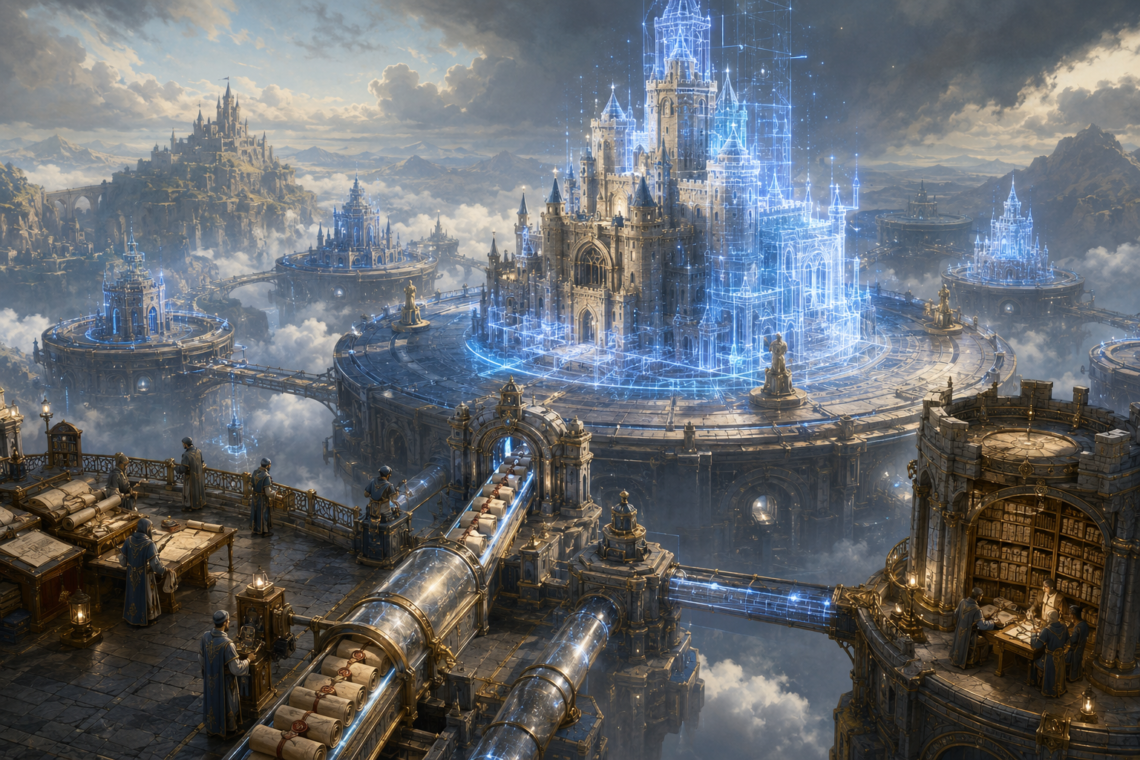
  • Wide fantasy illustration of a central glowing archive fortress connected to several smaller replicated archive towers by illuminated bridges, with one broken bridge representing network partition and inconsistent data across a distributed system.
    The Kingdom in the Clouds

    When Two Kings Claim the Throne: Consistency in Distributed Systems

    September 16, 2026 /

    Truth becomes complicated when the kingdom keeps more than one copy of it. When One Truth Becomes Many: Distributed Systems The Kingdom Keeps Copies for a Reason: Distributed Data and Replication In a small application, truth appears simple. A user changes an email address, the application saves it, and the next request retrieves the same value. One database, one authoritative record, and usually one short path between the person making the change and the system storing it. Distributed systems complicate that arrangement. Data may be copied across regions, databases, caches, queues, search indexes, and services. Replication improves availability and performance, but it also creates a difficult question: when several systems…

    Read More
    Frank Jamison

    You May Also Like

    A vast cloud kingdom of floating cities and towers connected by glowing aerial roads, gateways, and branching energy paths, symbolizing service communication, APIs, service discovery, load balancing, and reliable cloud-native networking.

    Roads Through the Sky: Connecting Cloud-Native Services

    September 4, 2026
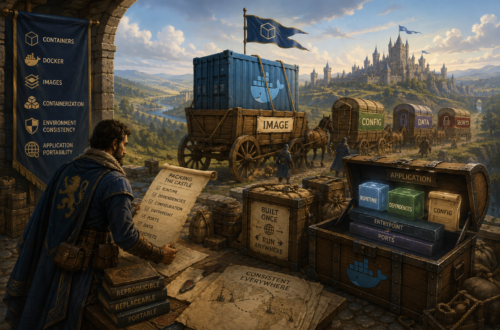
    A fantasy-tech illustration shows a medieval engineer preparing a containerized application for travel. A Docker-marked shipping container and wagons labeled Image, Config, Data, and Secrets travel toward a distant castle, while a packing checklist identifies runtime, dependencies, configuration, entrypoint, ports, data, and secrets. Banners and maps emphasize containers, Docker, images, environment consistency, reproducibility, and application portability.

    Packing the Castle: Understanding Containers

    August 24, 2026
    A vast medieval courier exchange above the clouds routes glowing message scrolls along branching bridges to distant castles as ravens carry additional dispatches across the kingdom.

    Messenger Ravens and Royal Couriers: Building with Messages and Events

    September 7, 2026
  • A vast medieval courier exchange above the clouds routes glowing message scrolls along branching bridges to distant castles as ravens carry additional dispatches across the kingdom.
    The Kingdom in the Clouds

    Messenger Ravens and Royal Couriers: Building with Messages and Events

    September 7, 2026 /

    Not every message requires the messenger to wait at the castle gate. A traveler arrives at the castle gate with an urgent request. The guard carries it to the steward, the steward consults the royal records, and the traveler remains outside until someone returns with an answer. This arrangement works when the traveler needs an immediate response, and the castle can provide one quickly. It becomes fragile when the work takes several minutes, the responsible official is unavailable, or five hundred travelers arrive at once. The problem is not that the road is poorly built. The problem is that every participant must remain available throughout the conversation. In the previous…

    Read More
    Frank Jamison

    You May Also Like

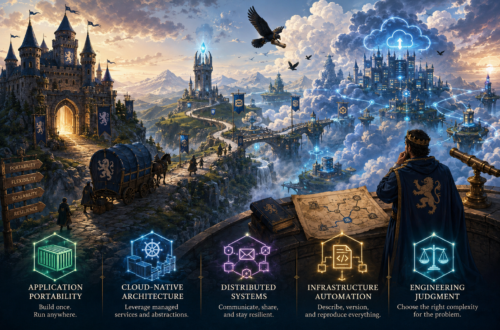
    A fantasy castle opens onto a winding road leading toward a futuristic kingdom floating among the clouds, connected by glowing networks and infrastructure. A crowned architect studies the realm from a stone overlook while visual symbols represent application portability, cloud-native architecture, distributed systems, infrastructure automation, and engineering judgment.

    The Kingdom in the Clouds: When Software Leaves the Castle

    August 23, 2026
    A vast cloud kingdom of floating cities and towers connected by glowing aerial roads, gateways, and branching energy paths, symbolizing service communication, APIs, service discovery, load balancing, and reliable cloud-native networking.

    Roads Through the Sky: Connecting Cloud-Native Services

    September 4, 2026
    Docker Compose, Containerization, Multi-Container Applications, Container Networking, Service Dependencies, Application Configuration, Local Development Environments, Docker, Containers, Distributed Systems, Application Architecture, Service Architecture, Development Environments, DevOps, The Kingdom in the Clouds

    The Caravan of Services: Composing Containerized Applications

    August 26, 2026
  • Fantasy cloud-city architecture showing a partially materialized castle forming from glowing blue magical blueprints, with smaller summoned towers, message scrolls moving through conduits, and a permanent archive connected nearby to represent serverless execution, event-driven architecture, scaling, stateless computing, cold starts, and managed storage.
    The Kingdom in the Clouds

    The Castle That Appears on Command: Serverless Architecture

    September 2, 2026 /

    Sometimes the finest fortress is the one that exists only when it is needed. A Fortress Without a Permanent Gate: What Serverless Actually Changes For most of software history, deploying an application meant giving it somewhere permanent to live. A server was provisioned, a runtime installed, and a process waited for requests whether anyone arrived or not. Virtual machines changed how servers were acquired, and containers changed how applications were packaged, but the assumption remained: something was running, and engineers were responsible for keeping it alive. Serverless challenges that assumption by asking whether the fortress needs to exist when nobody is visiting. The name is misleading because servers still exist.…

    Read More
    Frank Jamison

    You May Also Like

    Cutaway view of a vast wizard’s tower rising above the clouds, revealing layered workshops, storage chambers, managed systems, and small engineer-scholars operating within a provider-maintained infrastructure.

    Renting the Wizard’s Tower: Understanding Cloud Infrastructure

    August 31, 2026
    A grand fantasy war room contains a glowing tabletop map of a vast kingdom, with many castles connected by luminous roads and blue magical markers as robed strategists study the scene beneath towering banners, stone arches, and candlelight.

    The Keeper of a Thousand Castles: Understanding Kubernetes

    August 28, 2026
    Docker Compose, Containerization, Multi-Container Applications, Container Networking, Service Dependencies, Application Configuration, Local Development Environments, Docker, Containers, Distributed Systems, Application Architecture, Service Architecture, Development Environments, DevOps, The Kingdom in the Clouds

    The Caravan of Services: Composing Containerized Applications

    August 26, 2026
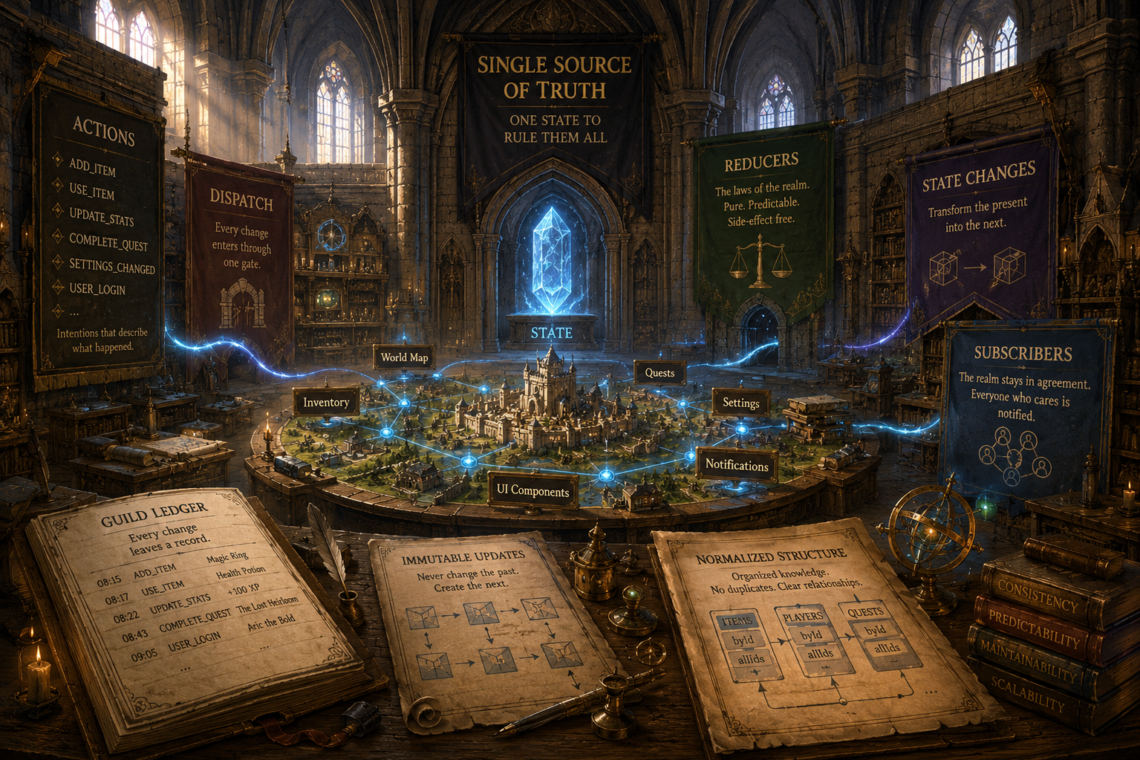
  • A grand medieval fantasy guild hall serves as a visual metaphor for JavaScript state management. At the center of the vast stone chamber, a glowing magical crystal labeled State powers a detailed miniature kingdom displayed on a large round table. Blue streams of magical energy connect the crystal to labeled regions representing inventory, quests, notifications, settings, world map, and UI components, illustrating how shared application state flows throughout an entire system. Massive banners surrounding the hall depict engineering concepts including actions, dispatch, reducers, state changes, subscribers, immutable updates, normalized structure, and a guild ledger that records every change. Ancient books, engineering diagrams, drafting tools, glowing runes, and architectural details reinforce themes of organization, maintainability, and long-term software design in a painterly, Dungeons & Dragons-inspired editorial illustration.
    The Full-Stack Campaign

    The Inventory System: Managing State Without Losing Control

    April 15, 2026 /

    Editor’s Note This article is an updated and expanded edition of a lesson originally published on RandomThoughtsInTraffic.com. For this StackNScroll edition, I have substantially revised both the technical discussion and the engineering guidance to move beyond introducing JavaScript state and toward understanding the architectural decisions that allow interactive applications to grow without becoming fragile. New material explores immutable updates, centralized state transitions, shared application data, and engineering tradeoffs that emerge as software matures, all while reinforcing this week’s theme, The Spark of Adventure. My objective is not simply to explain state management, but to demonstrate why experienced engineers organize application state long before complexity demands it. The Spark of Adventure:…


    Read More
    Frank Jamison

    You May Also Like

    Stamp Evaluation – Scott #985 (Used, Hinged, No Original Gum – Single Stamp) 3¢ Carmine Rose – Grand Army of the Republic, 1949 (Commemorative Issue – Rotary Press Printing, Perf 11 x 10½, Unwatermarked) Design Overview: Scott #985 commemorates the final national encampment of the Grand Army of the Republic. The design features an elderly Civil War veteran in the foreground, a younger soldier behind him, and the GAR emblem at left above the denomination. “United States Postage” anchors the lower tablet, while the commemorative inscription spans the top. Printed in carmine rose, the engraving retains strong color, clear portrait detail, and good contrast. Grading Breakdown: The centering grade is Fine/Very Fine 78. Visually, with the unaided eye, the perforation holes are easily seen to be clear of the design, but one or two margins are narrow. The bottom margin is the most narrow and establishes the centering limit. The left margin is the least narrow, while the right margin is more narrow than the top. All margins remain clearly outside the design and satisfy the Fine/Very Fine standard. The stamp presents pleasing overall balance, with the lower margin as the primary visual limitation. Soundness Evaluation: The faults present are two shorter perforations approximately half normal length and four fuzzy or ragged perforations. These faults constitute Minor Fault soundness. Minor Fault soundness combined with Fine/Very Fine centering yields a preliminary grade of Very Good 58. The group of shortened and ragged perforations is the controlling condition issue, while the stamp otherwise retains a clean appearance. Perforations and Margins: The perforations are generally complete, but several teeth show the shortened, fuzzy, or ragged condition noted in the fault list. These irregularities slightly soften the otherwise clean outline of the stamp. The bottom margin is closest to the design, the left margin is widest, and the right margin is narrower than the top. The frame remains visibly clear of the perforation holes on all four sides. Cancellation Evaluation: No visible cancellation appears on the face of the stamp. The portraits, GAR emblem, denomination, top inscription, and lower tablet are fully visible without postal markings crossing the design. For a used stamp, this creates a clean front presentation, though the absence of a visible cancel is treated conservatively and does not automatically produce a grade increase. Collector’s Note: Scott #985 is a historically appealing commemorative for collectors of Civil War memory, veterans’ organizations, patriotic themes, and late 1940s United States issues. The paired veteran-and-soldier design gives the stamp strong symbolic impact. Eye Appeal Adjustment: After centering and soundness are determined, eye appeal is considered. The stamp retains fresh carmine rose color, a sharp engraved impression, and an unobstructed design. The perforation faults have already been accounted for in soundness, and there is no heavy cancellation to penalize. No additional adjustment is warranted, so the preliminary grade remains 58. Final Numerical Grade Calculation: The centering grade is Fine/Very Fine 78. Minor Fault soundness reduces the grade by 20 points, producing a preliminary grade of Very Good 58. No cancellation deduction or other eye appeal adjustment is applied. The final numerical grade is 58. Summary: This used Scott #985 shows Fine/Very Fine 78 centering, with the bottom margin most narrow, the left margin widest, and the right margin narrower than the top. Minor Fault soundness lowers the preliminary grade to Very Good 58. Clean color and an unobstructed face support the result without changing it. Final Grade: Very Good 58.

    The First Map: How the Browser Shapes the World

    April 6, 2026
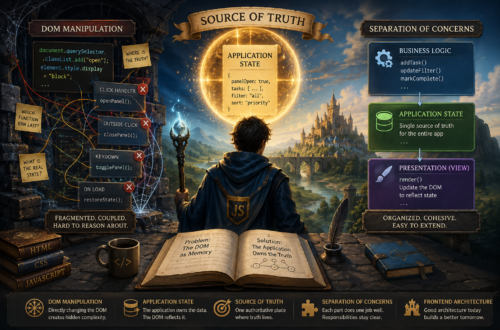
    A fantasy-inspired editorial illustration shows a developer wizard standing before a glowing magical orb labeled Source of Truth, symbolizing application state as the central authority in a web application. On the left, a dark stone chamber labeled DOM Manipulation is filled with tangled event listeners, sticky notes, and crisscrossing connections that represent tightly coupled code and hidden complexity. On the right, a bright architectural diagram labeled Separation of Concerns organizes business logic, application state, and presentation into distinct layers connected by a clear flow. An open spellbook in the foreground contrasts the problem of treating the DOM as memory with the solution of allowing the application to own its state. Books labeled HTML, CSS, and JavaScript, along with castles, mountains, and magical effects, reinforce the Dungeons & Dragons theme while illustrating the transition from direct DOM manipulation to maintainable frontend architecture.

    The Cost of Power: From DOM Manipulation to Better Design

    April 17, 2026
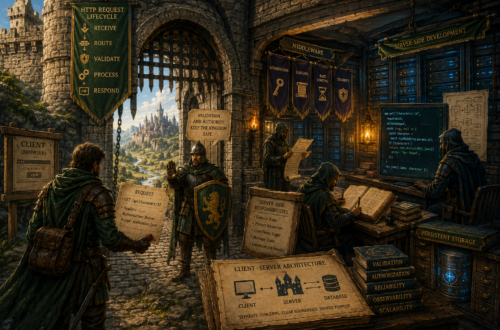
    Dungeons & Dragons-inspired fantasy illustration of a fortified kingdom gate representing the boundary between browser and server, with a traveler delivering a request through guarded checkpoints into a server-side stronghold where validation, middleware, application logic, persistent storage, and client-server communication are visualized as interconnected parts of the kingdom’s infrastructure.

    The Gate Beyond the UI: What a Server Actually Does

    April 20, 2026
  • The Architect's Grimoire (13)
  • The CSS Codex (13)
  • The Enchanted Workshop (13)
  • The Full-Stack Campaign (8)
  • The Guildmaster’s Handbook (13)
  • The Kingdom in the Clouds (9)

AI-Assisted Development Artificial Intelligence Backend Development Career Development Clean Code Cloud-Native Architecture Code Quality CSS Architecture CSS Best Practices Design Systems Developer Growth Developer Productivity Distributed Systems Dungeons and Dragons Engineering Culture Engineering Judgment Engineering Leadership Fantasy Theme Front-End Development Frontend Development Full Stack Development Human-AI Collaboration Maintainable Code Maintainable CSS Mentorship Professional Development Professional Growth Refactoring Responsive Design Software Architecture Software Craftsmanship Software Design Software Development Software Engineering StackNScroll System Design Technical Debt Technical Leadership The Architect's Grimoire The CSS Codex The Enchanted Workshop The Full-Stack Campaign The Guildmaster's Handbook The Kingdom in the Clouds Web Development

Stack N' Scroll - 2026 ©