The Kingdom in the Clouds: When Software Leaves the Castle
The strongest kingdoms are not bound to a single castle, but built to endure wherever their people must go.
For much of software history, we built applications as though we were building castles. The walls gave us boundaries. We knew where the application lived, where its data lived, and which machines carried the work. Even complicated systems offered a comforting sense of geography because their important pieces occupied places engineers could identify and understand. When something failed, there was usually a server, process, database, or network connection somewhere that could be examined.
Modern software has been steadily dismantling that certainty. Applications move between environments, workloads appear and disappear, and infrastructure can be created through code rather than assembled by hand. One application can become several cooperating services separated by machines, networks, regions, or cloud platforms. The walls that once made the kingdom easy to map have become increasingly difficult to find.
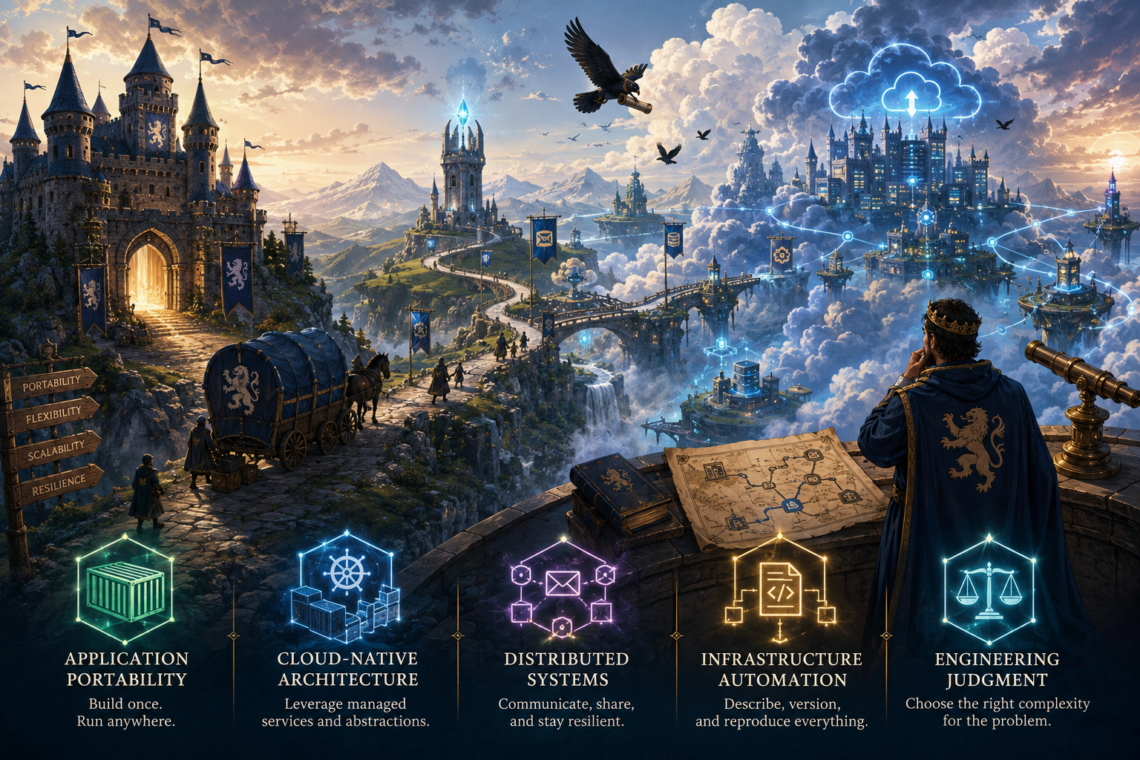
The Kingdom in the Clouds is a twelve-part StackNScroll journey through what happens when software leaves those familiar walls. Across four weeks, we will follow one evolving software kingdom as it becomes portable, moves into cloud infrastructure, spreads across distributed systems, and eventually becomes something engineers must reproduce, observe, operate, and govern. Each article adds another permanent piece to that kingdom while introducing an engineering problem created by its growing architecture. By the end, the question will no longer be simply how to build distributed systems, but how to decide which parts of a system deserve to be distributed at all.
Modern cloud architecture is often introduced as a collection of technologies. We learn containers, Kubernetes, serverless computing, message queues, Infrastructure as Code, observability, and dozens of other tools and patterns. Each deserves study, but treating them as an inventory can obscure the engineering story that connects them. Technologies tell us what we can build. Architecture requires us to understand why we would build it.
Every stage of this journey will give our kingdom a new capability. Portability allows applications to travel, orchestration allows workloads to be managed at greater scale, and cloud infrastructure changes how resources are acquired and operated. Distribution enables independent components to cooperate across boundaries, while automation and observability help engineers manage a kingdom that no longer exists in a single place. Every new capability, however, changes something engineers can safely assume. That is the thread we will follow through all twelve chapters.
Beyond the Walls: The Price of Architectural Freedom
A system contained within one application boundary gives engineers assumptions they may not even realize they are making. Calls between components are fast and local. Data can often be changed within familiar transactional boundaries. Deployment may involve a single principal artifact; logs may live together; and when the process disappears, engineers generally know which parts of the application disappeared with it. Those characteristics are not primitive weaknesses waiting for modern architecture to rescue them.
They are useful properties. Keeping software together can make it easier to understand, test, deploy, debug, and operate. A well-structured application running in a relatively simple environment can serve enormous numbers of users without becoming a constellation of independently deployed services. Some systems eventually encounter requirements that push against those boundaries, but complexity should be introduced only when the problem requires it, not because the architecture looks more sophisticated with it.
Applications may need to run reliably in different environments. Workloads may need to scale, teams may require greater deployment independence, or infrastructure may need to recover from failure. Systems may eventually need to communicate across regions or depend upon services outside their original boundaries. Each requirement can provide a legitimate reason to expand beyond the architecture that previously served the application.
That is where the architectural bargain begins. Moving beyond the castle walls gives software greater freedom, but freedom in architecture is rarely free. As components become more independent, some guarantees that arose from keeping them together weaken or disappear. Engineers gain flexibility in one dimension while accepting responsibility somewhere else.
Every step beyond the castle walls gives us something valuable, but every step also takes an assumption away.
That principle is the map for The Kingdom in the Clouds. Throughout the series, we will ask what capabilities an architectural approach gives us, which assumptions change as a result, and whether the resulting complexity is justified by the problem we are solving. Instead of treating cloud-native architecture as an inevitable destination, we will treat it as a sequence of engineering decisions that must earn their place.
Four Weeks Across the Kingdom: The Road Ahead
Our journey is divided into four stages, each representing a different change in how the kingdom operates. During Leaving the Castle, our software learns to travel through containers, composed services, and eventually orchestration. The progression takes us from Docker to Docker Compose and to Kubernetes, but the larger lesson concerns portability, reproducibility, and the separation of an application from any particular machine.
During Building Above the Clouds, the relationship between our software and its infrastructure changes. We will examine cloud infrastructure, serverless architecture, and the communication paths connecting cloud-native services. The question shifts from how the application travels to what happens when more of the kingdom depends upon infrastructure and services that the application team does not directly operate.
During The Distributed Realm, distance becomes part of the architecture. Messages and events travel between independent components, data can exist in more than one place, and dependencies can fail without the entire system failing at once. This is where assumptions that felt natural inside the castle become dangerous, and distributed systems begin demanding a different kind of engineering judgment.
Finally, during Ruling the Clouds, we turn from constructing the kingdom toward operating and evaluating it. Infrastructure becomes reproducible through code, observability helps us understand behavior scattered across many components, and the journey ends by asking whether the complexity we accumulated was justified. Learning how to distribute software is incomplete without learning when not to do it.
Those four stages form one architectural progression rather than separate excursions. The kingdom we pack during the first week is the kingdom we carry into the cloud during the second. The services we connect there become the distributed system whose communication, data, and failures we confront during the third. The infrastructure and complexity accumulated along the way become what we must automate, observe, and judge during the fourth.
By the final chapter, we will not be looking at the original castle with twelve technologies bolted onto its walls. We will have watched one software system evolve as its requirements changed, examining the engineering consequences of every major step along the way. The tools will change as the kingdom grows, but the architectural question remains consistent: what did we gain, what assumption did we surrender, and was the trade worth making?
Leaving the Castle: Where the Journey Begins
Next week, we begin at the gates with Leaving the Castle. Before our kingdom can spread across clouds, regions, services, and networks, the application itself must become less dependent on the particular machine on which it happens to run. That makes portability the natural first step in the journey.
We will follow that idea through three increasingly larger problems. First comes the application and its environment. Then comes a collection of services that must work together. Finally comes the challenge of managing many containerized workloads as one coherent system.
Containers, Docker Compose, and Kubernetes give us concrete ways to explore that progression, but the technologies are not the destination. The deeper transition is from environments that engineers manually preserve toward systems whose requirements and desired state can be described more explicitly. That pattern will return repeatedly as the kingdom grows.
Our first week therefore gives us the first opportunity to apply the question that will follow us throughout The Kingdom in the Clouds: What did we gain by leaving the castle, and which assumption did we leave behind?
Building Above the Clouds: When Infrastructure Changes Hands
Once the kingdom learns to travel, the next stage changes our relationship with the ground beneath it. Cloud computing does not eliminate infrastructure; it places increasingly powerful abstractions between application engineers and the physical systems that do the work. Compute, storage, databases, and other capabilities can increasingly be requested as services rather than assembled and maintained directly.
During Building Above the Clouds, we will explore what that shift means. Renting the Wizard’s Tower: Understanding Cloud Infrastructure examines the changing boundary of ownership and responsibility. The Castle That Appears on Command: Serverless Architecture pushes that abstraction further, while Roads Through the Sky: Connecting Cloud-Native Services confronts the challenges when independently running parts of the kingdom must communicate.
The important change is not simply that another organization owns the hardware. Cloud architecture changes where responsibilities sit and which parts of the system engineers must manage directly. Providers will change, products will evolve, and capabilities that seem remarkable today will eventually become ordinary infrastructure. The durable skill is learning to recognize the boundary between what the platform provides and what the engineering team must still design, secure, observe, and operate.
Abstraction can remove work without removing accountability. That idea will follow the kingdom as it rises into the clouds. We gain infrastructure that can appear faster, scale differently, and hide enormous amounts of operational machinery, but the system also becomes increasingly dependent upon contracts and services beyond the application itself. The farther infrastructure recedes behind an abstraction, the more important it becomes to understand what that abstraction promises and what remains our responsibility.
And once the kingdom depends upon distant towers, it needs roads between them.
The Distributed Realm: When Distance Changes the Rules
By the third week, the kingdom crosses its most important architectural boundary. Its pieces are no longer merely running in different places. They must cooperate while separated by networks, independent processes, and infrastructure that can change beneath them. This is where The Distributed Realm begins.
Our three chapters examine communication, shared truth, and failure. Messenger Ravens and Royal Couriers: Building with Messages and Events explores asynchronous communication. When Two Kings Claim the Throne: Consistency in Distributed Systems turns toward the complications of distributed data. The Unreliable Messenger: Designing for Failure Across the Network confronts what happens when the roads connecting our kingdom become unreliable.
These problems emerge from the same architectural decision we have been following since the beginning of the series: we moved things apart. Distance gives components independence, but it removes assumptions that were easy to make when those components shared the same process or machine. Communication can take time; another component can become unavailable while the rest of the system remains healthy; and different parts of the system can temporarily interpret the same event differently.
A diagram can make this architecture look deceptively clean. Services appear as orderly boxes connected by arrows, each with a clear responsibility and obvious relationship to its neighbors. The picture can suggest that we have merely taken pieces that once lived together and placed them in separate locations. In practice, the difficult engineering often lives in the arrows because those connections carry assumptions about timing, availability, ordering, and failure.
During The Distributed Realm, we will learn to examine those assumptions rather than treating a network boundary like a longer function call. The individual technologies will give us concrete examples, but the deeper lesson concerns relationships. A distributed system is defined as much by the behavior between its components as by the components themselves.
Messenger Ravens and Royal Couriers: Communication Across the Realm
The first stop in the distributed realm concerns how independent parts of a system exchange information. Some communication requires an immediate response, while other work can happen later. Some events matter to one consumer, while others may need to reach several parts of the kingdom. Those differences influence how tightly components depend upon one another’s availability and timing.
Messenger Ravens and Royal Couriers introduces message queues, event-driven architecture, publish-subscribe systems, asynchronous communication, event brokers, loose coupling, and eventual consistency. Rather than treating one communication style as inherently better than another, we will examine the relationships each creates between the participants.
The larger lesson concerns dependency. When one component requires another to answer immediately, their availability becomes connected in a particular way. When communication can be deferred or distributed through events, the relationship changes, as do the guarantees the architecture can make.
The messenger matters less than the promise we expect the messenger to keep. Instead of beginning with a technology and searching for somewhere to use it, we will begin with the relationship the system requires. Only then can we evaluate which communication model best represents that relationship.
When Two Kings Claim the Throne: What Does the Kingdom Know?
Communication eventually leads us toward a more difficult problem: data. In a simpler kingdom, engineers often behave as though there is a single authoritative version of the application’s current state. As systems spread, data may be replicated, services may own different portions of the domain, and information may not become visible everywhere at precisely the same moment.
When Two Kings Claim the Throne examines distributed data, consistency, availability, the CAP theorem, eventual consistency, replication, and distributed transactions. The purpose is not to memorize those concepts in isolation, but to understand the kinds of promises a distributed system can realistically make about its data.
This is where the business meaning of information becomes inseparable from architecture. Different kinds of data tolerate different kinds of uncertainty, and what is acceptable for one operation may be unacceptable for another. Technology can provide mechanisms and guarantees, but it cannot decide which guarantees the product actually requires.
The architect’s responsibility is to understand that distinction. Choosing the strongest available mechanism is not necessarily good engineering if its cost and complexity solve a problem the product does not have. The question is not merely where the kingdom stores its records, but what the kingdom must be able to trust about them.
The Unreliable Messenger: Failure Becomes Part of the Map
The final chapter of our third week confronts a truth that has been approaching since our software first crossed a network boundary: every road eventually closes. A service becomes unavailable, a request takes longer than expected, or a dependency fails while everything around it continues operating. These conditions arise when parts of a system are placed far enough apart that one can fail without every other part failing with it.
The Unreliable Messenger introduces network failures, timeouts, retries, circuit breakers, idempotency, partial failure, and resilience patterns. The patterns themselves are not the destination. The larger lesson is learning to design systems whose behavior remains deliberate when part of the kingdom becomes unavailable.
That requires engineers to consider failure while defining interactions rather than only after production exposes a weakness. Which work can wait, which operations can safely be attempted again, and which capabilities can temporarily degrade are architectural questions before they become implementation questions. Failure stops being merely an interruption and becomes one of the conditions the system was designed to face.
By the end of The Distributed Realm, the kingdom will have surrendered many of the comfortable assumptions it possessed behind the original castle walls. Location matters less, but communication requires more thought. Components gain independence, but their relationships become more complicated. The kingdom is larger and more capable, but it is also harder to understand.
That is why our final week begins not with another way to distribute the kingdom, but with learning how to rule what we have already built.
Ruling the Clouds: Learning to Govern What We Build
By the fourth week, our kingdom will have traveled a considerable distance from the application that first left the castle. Its workloads can move, its infrastructure can exist beyond machines the team directly controls, and its components can communicate across boundaries that introduce uncertainty into timing, availability, and data. We will have gained capabilities that would have been difficult to achieve within the original walls, but we will also have accumulated an architecture that is more difficult to reproduce, observe, and reason about.
Ruling the Clouds is about operating and evaluating the kingdom we have created. We begin with The Kingdom That Builds Itself: Infrastructure as Code, continue with Watching a Kingdom You Cannot See: Observability in Distributed Systems, and conclude with The Cloud Architect’s Crown: Choosing What Should Be Distributed. The progression moves from reproducing our infrastructure to understanding the behavior of the system running on it to deciding whether the architectural complexity we accumulated was justified.
The final week matters because architecture does not end when a system reaches production. Production is where architecture begins proving whether its promises were realistic. Environments must be changed without becoming mysterious, failures must be diagnosed across boundaries, and engineers who did not build the original system must eventually be able to understand it. A kingdom becomes mature when growth, failure, and change become ordinary events rather than emergencies.
The Kingdom That Builds Itself: Replacing Memory with Description
Throughout this journey, one idea will recur: important parts of a system become safer when engineers can describe their intended state rather than depend on someone remembering how they were assembled. During The Kingdom That Builds Itself, that principle expands to the infrastructure itself through Infrastructure as Code, Terraform, declarative infrastructure, reproducible environments, configuration management, automation, and GitOps.
The lasting lesson is larger than any particular infrastructure tool. Memory does not scale well as architecture. A production environment may work perfectly while still containing enormous hidden risk if nobody can confidently explain how to reproduce it. Turning infrastructure into something that can be described, reviewed, versioned, and recreated gives the kingdom another form of resilience.
The goal is not to eliminate human judgment from infrastructure. It is to preserve that judgment somewhere more durable than the memory of the person who originally made the decision. The plans become part of the kingdom, giving future engineers a way to understand not only what exists but also how the environment can be reconstructed.
The Observatory Above the Realm: Understanding What We Cannot See
Reproducible infrastructure still leaves another challenge. Once the system operates across many components, engineers need some way to understand what is happening inside it. A request that once traveled through one application may eventually cross several services and infrastructure components, leaving any individual machine or log with only a fragment of the story.
Watching a Kingdom You Cannot See introduces cloud observability, distributed tracing, logging, metrics, OpenTelemetry, correlation, and production diagnostics. These capabilities offer different ways to observe a kingdom whose behavior can no longer be understood from a single castle gate. The engineering objective, however, is not collecting the most telemetry. It is understanding the system well enough to investigate behavior engineers could not predict before production.
That distinction matters because distributed failures rarely align with the diagrams created during design meetings. The larger the kingdom becomes, the more deliberately we must build ways to see across its boundaries. Once we can build the kingdom, reproduce it, and understand how it behaves, we finally earn the right to ask the hardest question in the series.
The Cloud Architect’s Crown: Knowing When Enough Is Enough
After eleven chapters, we will have accumulated an impressive collection of architectural capabilities. Applications can travel, workloads can be coordinated, infrastructure can be obtained through cloud services, and components can communicate across distributed environments. We will have confronted messages, consistency, network failure, infrastructure automation, and observability. The kingdom that began inside familiar walls will have become something its original architects might barely recognize.
Then we will ask whether every part of it needed to make that journey.
The Cloud Architect’s Crown: Choosing What Should Be Distributed concludes The Kingdom in the Clouds with cloud-native architecture, distributed systems, architectural tradeoffs, microservices, modular monoliths, complexity, cost, and engineering judgment. The series does not end by introducing the most advanced technology available. It ends by evaluating the technologies and architectural choices we have already encountered.
Modern software engineering can make sophisticated architecture appear synonymous with mature architecture. A diagram filled with services, queues, gateways, clusters, replicas, and event streams can look impressive, but every one of those shapes represents something that must eventually be understood, deployed, secured, observed, maintained, and paid for. Complexity must earn its place.
Sometimes it does. Distributed architecture can solve genuine problems involving scale, resilience, deployment independence, geographic reach, organizational boundaries, or workload characteristics. Sometimes a simpler architecture can meet the same requirements with fewer operational costs and fewer ways for the system to surprise its engineers. The architect’s responsibility is not to automatically prefer one over the other, but to understand the trade-offs well enough to know the difference.
One Kingdom, Twelve Chapters: A Continuous Engineering Journey
These twelve articles therefore form one continuous journey rather than a collection of independent tutorials. Each chapter permanently expands the same conceptual kingdom, allowing us to look backward from the final architecture and understand why each major piece was introduced, what problem it addressed, and what new responsibility it brought. That follows the guiding principle behind the larger StackNScroll campaign: every article expands the world while engineering remains the reason the world exists.
We begin with software that needs to travel. Portability leads to containerized environments, multiple containers to composition, and growing workloads to orchestration. Cloud infrastructure gives the kingdom a more flexible place to live before distribution changes our assumptions about communication, shared information, and failure. By the final week, the challenge is no longer simply building the architecture but reproducing it, observing it, and deciding whether its complexity is still worth carrying.
Each chapter therefore asks some version of the same two questions: What capability did the kingdom gain? What assumption did the kingdom surrender to gain it? Those questions matter far longer than the individual tools we use to explore them. They turn the twelve chapters from a tour of cloud technologies into an examination of how architectural decisions change the guarantees engineers can rely upon.
Beyond the Tools: Learning the Questions That Survive
There will be plenty of technology along the way. Docker, Docker Compose, Kubernetes, cloud services, serverless computing, REST APIs, gRPC, message brokers, Terraform, OpenTelemetry, and other tools and patterns all have roles in the journey. We will examine them closely enough to understand what they provide and why engineers reach for them.
But The Kingdom in the Clouds is not a twelve-part certification guide. Technologies change too quickly for that to be the most valuable lesson. An engineer who understands only how to use a particular tool will eventually need to learn another, while an engineer who understands the problem that tool was created to solve has something more durable.
That distinction is especially important in cloud engineering. A command can create a resource, a configuration file can deploy a workload, and a managed service can eliminate pages of operational instructions. None automatically tells us whether the resulting architecture is appropriate. Engineering judgment begins one level higher by asking why the resource exists, what the workload requires, which responsibilities an abstraction removes, and which responsibilities remain ours.
A strong engineer can learn the next tool. A strong architect understands why the tool needs to exist.
The Deeper Journey: Learning Which Assumptions Still Hold
Containers, orchestration, cloud infrastructure, distributed systems, Infrastructure as Code, and observability may appear to be the subjects of The Kingdom in the Clouds. The deeper subject is assumptions. What can we assume about the machine running our application, whether another service is available, the order in which events occur, or the version of the data another component sees?
Every architectural boundary changes some of those answers. The farther our systems move from a single known environment, the more deliberately we must think about boundaries, communication, state, failure behavior, infrastructure, and visibility. Each new capability can make the kingdom stronger, but only when its architects understand the uncertainty that capability introduces.
The strongest distributed systems are not those whose engineers somehow eliminated uncertainty. They are the systems whose engineers understood where uncertainty existed and designed accordingly. That is the engineering habit we will spend the next twelve articles developing.
Opening the Gates: The Kingdom in the Clouds Begins
Next week’s theme is Leaving the Castle. Before our kingdom can rise into the clouds, its foundations must first learn to travel. On Monday, we begin the first chapter of The Kingdom in the Clouds, “Packing the Castle: Understanding Containers.”
We will start with containers, Docker, images, containerization, environment consistency, and application portability, but the larger lesson begins with a simple problem: how do we prevent an application from depending on a single carefully prepared machine? From there, the kingdom will grow one architectural decision at a time as we build the caravan, climb into cloud infrastructure, cross distributed roads, confront uncertainty, and learn to operate what we have created.
Only then will we decide how much of the kingdom ever needed to leave the castle. For now, the map is drawn, and the road ahead is visible. The castle has served us well.
It is time to open the gates.


You May Also Like
The Keeper of a Thousand Castles: Understanding Kubernetes
The Caravan of Services: Composing Containerized Applications