-
The Kingdom in the Clouds: When Software Leaves the Castle
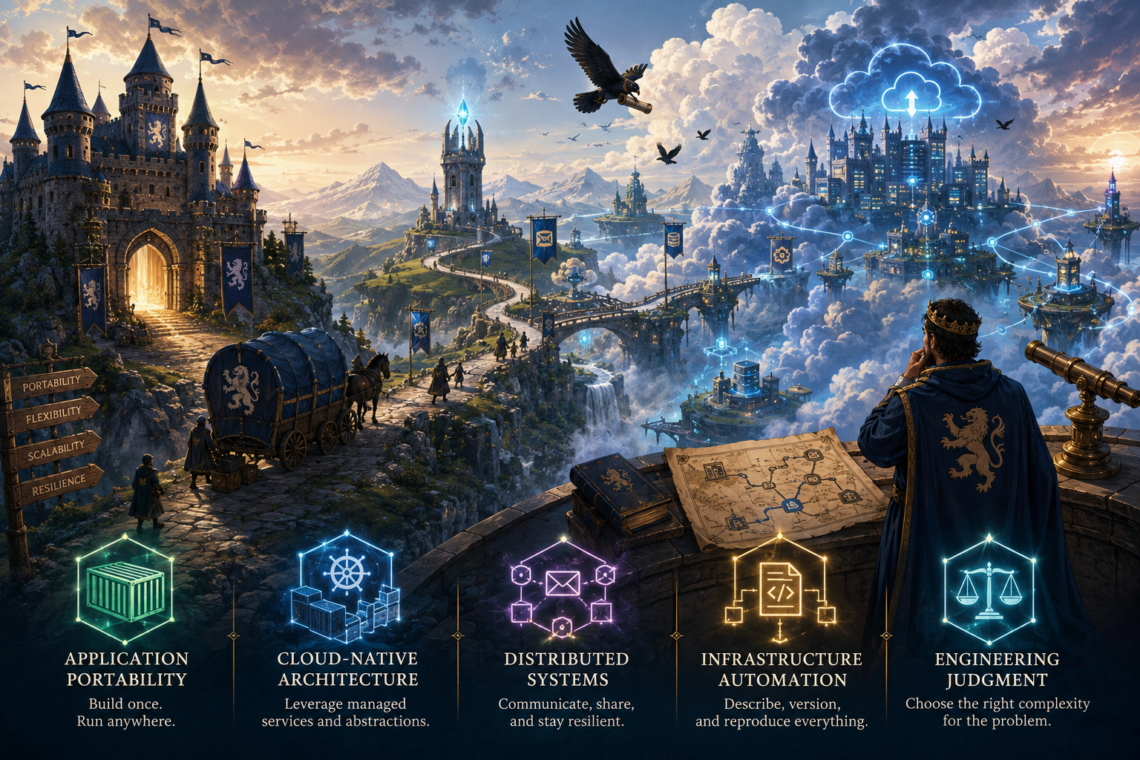
The strongest kingdoms are not bound to a single castle, but built to endure wherever their people must go. For much of software history, we built applications as though we were building castles. The walls gave us boundaries. We knew where the application lived, where its data lived, and which machines carried the work. Even complicated systems offered a comforting sense of geography because their important pieces occupied places engineers could identify and understand. When something failed, there was usually a server, process, database, or network connection somewhere that could be examined. Modern software has been steadily dismantling that certainty. Applications move between environments, workloads appear and disappear, and infrastructure…
-
The Automated Kingdom: When Excellence Becomes Routine
The greatest kingdoms flourish because excellence becomes routine. The most reliable software systems are often the least impressive. Their deployments happen without ceremony. Their monitoring catches problems before customers notice them. Their infrastructure quietly provisions itself, and their operational routines become so dependable that engineers gradually stop thinking about them. The greatest compliment those systems receive is that nobody considers them remarkable anymore. Like the finest kingdoms, their success has become ordinary because excellence has become routine. Travelers rarely praise the aqueducts that deliver clean water every day or the roads that quietly connect every village to the capital. They admire the thriving markets, magnificent libraries, and prosperous cities made…
-
Seeing Through the Crystal Ball: Observability Beyond Monitoring
A wise ruler never governs a kingdom they cannot see. Software architecture reaches an interesting stage after the obvious problems have been solved. The application survives deployments without drama, customers depend upon it every day, and the engineering team gradually shifts its attention from building features to operating a growing platform. Confidence naturally follows that maturity because the system appears stable, the infrastructure scales predictably, and production incidents become increasingly uncommon. Then, almost without warning, engineers begin encountering problems that refuse to fit neatly into familiar patterns. A handful of users report intermittent failures that nobody can reproduce. Response times drift upward despite healthy infrastructure metrics. A background process occasionally…