-
Renting the Wizard’s Tower: Understanding Cloud Infrastructure
Owning every stone is not the same as controlling the kingdom. In the previous chapter of The Kingdom in the Clouds, Kubernetes provided a way to coordinate workloads across multiple machines. Pods could be replaced, deployments could maintain the desired state, and services could provide changing workloads with stable ways to communicate. That solved an important orchestration problem, but it left a deeper question unanswered: where do those machines come from, who maintains them, and how much responsibility should belong to the team running the application? Every container eventually consumes real processor time, memory, storage, and network capacity somewhere. Cloud infrastructure begins with the recognition that those resources have not…
-
The Kingdom in the Clouds: When Software Leaves the Castle
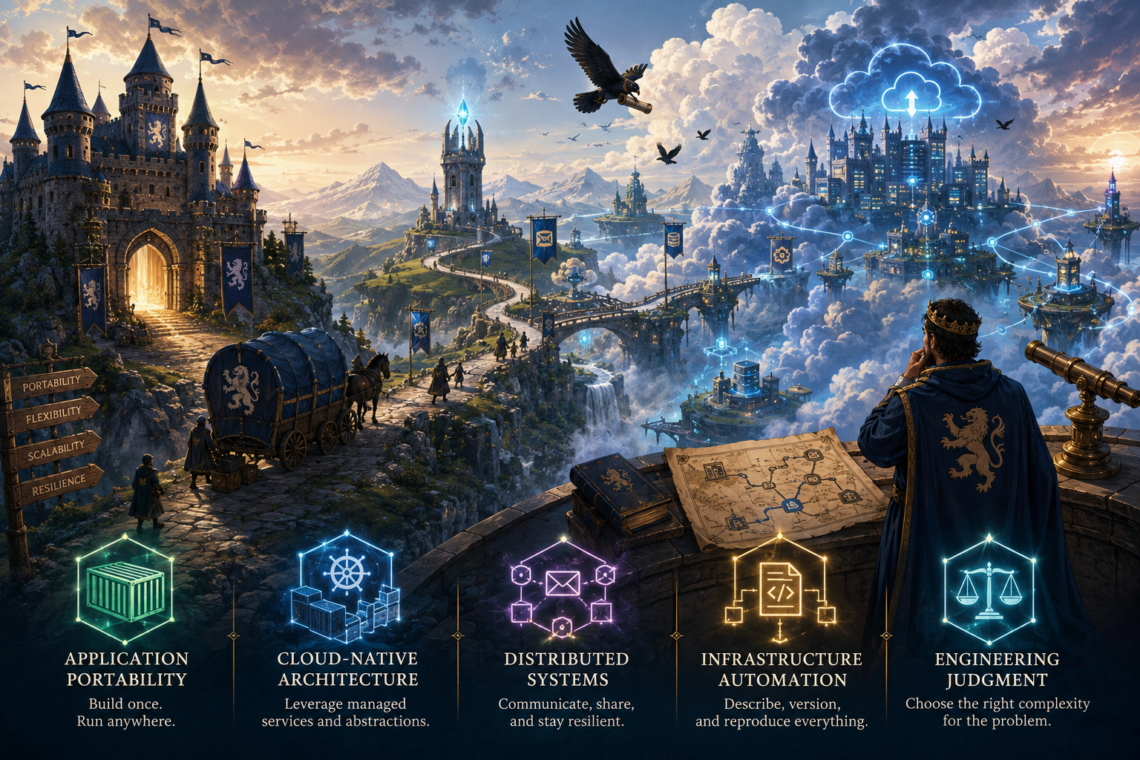
The strongest kingdoms are not bound to a single castle, but built to endure wherever their people must go. For much of software history, we built applications as though we were building castles. The walls gave us boundaries. We knew where the application lived, where its data lived, and which machines carried the work. Even complicated systems offered a comforting sense of geography because their important pieces occupied places engineers could identify and understand. When something failed, there was usually a server, process, database, or network connection somewhere that could be examined. Modern software has been steadily dismantling that certainty. Applications move between environments, workloads appear and disappear, and infrastructure…