
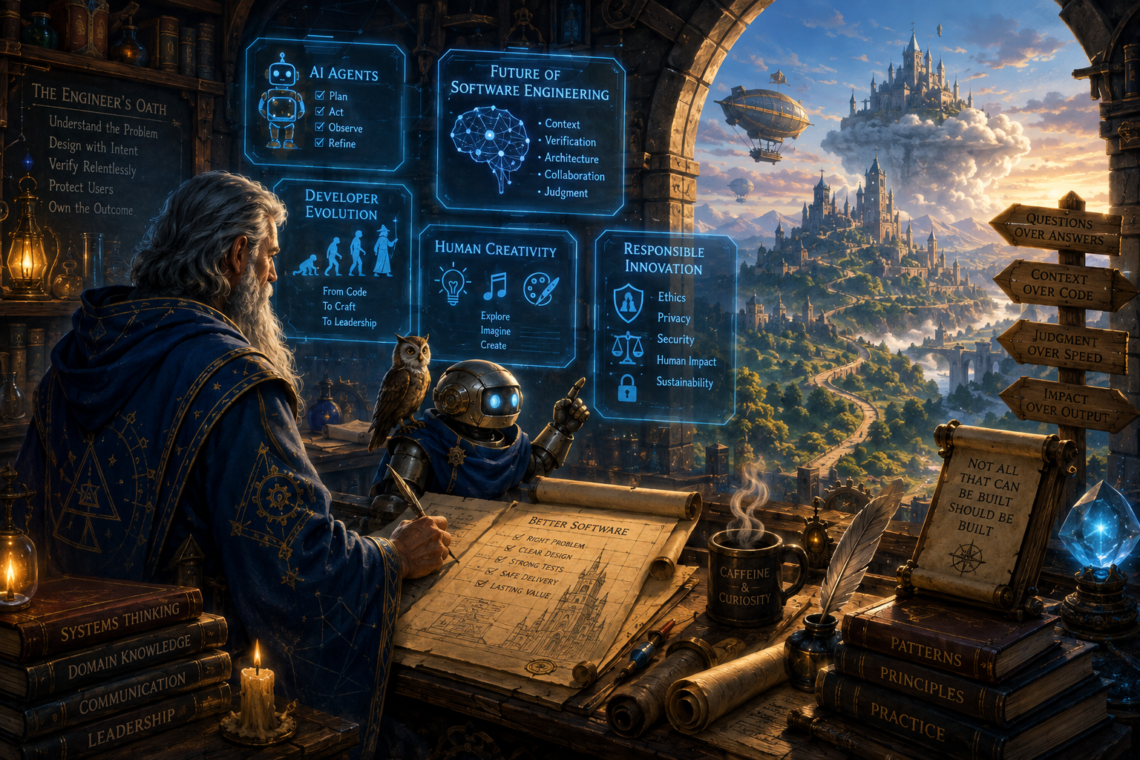
The Workshop of Tomorrow: The Future of AI-Assisted Software Engineering
Every generation of wizards inherits greater magic and greater responsibility.
There was a time when the most valuable object in a wizard’s workshop was the spellbook. It contained knowledge that had taken generations to discover and preserve, and a young wizard might spend years learning its incantations before being trusted to use them. Then imagine placing an enchanted tome on the workbench that could produce a new spell on demand, explain unfamiliar enchantments, repair damaged runes, and occasionally invent an incantation that sounded perfectly legitimate but summoned absolutely nothing. The workshop would become more productive almost overnight, but it would not become simpler. Software engineering has entered that workshop.
AI-assisted development has already changed how engineers write code, investigate systems, create tests, document decisions, explore architectures, prototype ideas, and diagnose problems. The important question is no longer whether AI will participate in software development because it already does. The more interesting question is what happens when generating an implementation becomes increasingly inexpensive, fast, and accessible. That question reaches beyond larger context windows or more capable coding assistants. It asks where engineers create value when producing the implementation itself requires less of their time.
The future of AI-assisted software engineering will not be determined primarily by how much code AI can generate. It will be determined by what engineers do with the leverage that generation creates. Faster implementation can produce better systems, but it can just as easily produce larger piles of poorly understood software. More capable tools can strengthen engineering judgment, or they can conceal its absence. The technology will continue changing, but that choice belongs to us.
The Ever-Filling Spellbook: When Code Becomes Cheap
For most of software history, implementation has been expensive. Turning an idea into working software required enough knowledge of languages, libraries, frameworks, databases, operating systems, and deployment environments to translate an abstract requirement into something a machine could execute. Even a modest application represented hundreds of individual decisions. Experienced engineers became valuable partly because they could make those decisions efficiently while avoiding mistakes they had already encountered. AI changes those economics by dramatically reducing the cost of producing a plausible first implementation.
An engineer can now describe a component, provide context and constraints, and receive an implementation in seconds. The result still requires verification, integration, testing, and refinement, but experimentation becomes considerably cheaper. Instead of spending hours constructing several possible approaches, an engineer can explore them quickly enough to compare their consequences before committing to one. This does not make engineering less important. It changes where engineering value accumulates.
When producing code is difficult, implementation skill becomes a bottleneck. When producing code becomes easier, understanding the problem becomes the bottleneck. Requirements, architecture, security, maintainability, failure modes, and user needs consume a larger share of the engineer’s attention. Producing another thousand lines of code becomes less impressive when those lines can appear before lunch. Knowing whether the system needed those thousand lines becomes considerably more valuable.
When code becomes cheaper to produce, judgment becomes more expensive to replace.
Software organizations have historically confused output with progress, and AI makes that mistake increasingly dangerous. A team equipped with capable tools can generate enormous quantities of implementation very quickly, but architecture, review, testing, and product understanding must improve alongside that capability. Otherwise, the organization has merely discovered a faster way to manufacture technical debt. The engineer of tomorrow therefore needs to become increasingly comfortable asking what problem is actually being solved, which constraints matter, what happens when a component fails, and what today’s decision costs six months from now. Those questions have always distinguished engineering from programming, but AI makes the distinction harder to ignore.
The Familiar Learns New Tricks: From Assistant to Agent
Most AI-assisted development still resembles working beside an unusually fast apprentice. We ask for something, provide context, inspect the result, make corrections, and continue. The engineer initiates most significant actions and evaluates what the AI produces. AI agents begin changing that relationship by accepting broader goals and performing more of the intermediate work themselves. The engineer moves farther from individual keystrokes and closer to directing a small guild of tireless magical apprentices.
An agent can potentially inspect a repository, identify relevant files, create a plan, modify components, run tests, observe failures, and revise its implementation. That is powerful, but every additional degree of autonomy introduces another decision the engineer may not observe directly. Resolving a defect, for example, may require an agent to infer intended behavior, identify the correct boundary for the change, choose dependencies, and decide whether nearby code should also be modified. Each decision can be technically plausible while still being wrong for the system.
The future engineer will therefore need to become skilled at defining boundaries for autonomous work. An effective instruction to an agent increasingly resembles a well-written engineering task rather than a clever prompt. It establishes the objective, relevant context, constraints, acceptable scope, verification criteria, and conditions under which the agent should request human guidance. Prompt engineering matters, but specifications, tests, architecture, context, and acceptance criteria matter more. The better our tools become at executing work, the more important engineers become at defining what successful work actually means.
The Guild Changes Shape: Engineering Beyond the Keyboard
As AI assumes more implementation work, engineers will spend different proportions of their time on the activities surrounding code. More effort can move toward exploring architectural alternatives, identifying tradeoffs, investigating unfamiliar systems, and testing assumptions before committing to an implementation. The opportunity is not simply to work faster. It is to investigate more possibilities before deciding which one deserves to survive.
Code review may increasingly focus on intent for the same reason. When substantial implementations can be generated quickly, manually reviewing every line becomes less scalable as the primary defense against mistakes. Teams will need stronger automated tests, clearer architectural boundaries, static analysis, security policies, and reliable observability. Human reviewers can then concentrate on whether a change belongs in the system, whether its assumptions are sound, and whether the resulting design remains understandable.
Documentation follows a similar pattern. AI can reduce the mechanical cost of producing explanations, summarize changes, and help engineers navigate unfamiliar components, but generated documentation still requires someone to determine whether it describes reality. AI removes portions of the mechanical work surrounding engineering and exposes the decisions underneath. As machines become increasingly capable of producing syntax, engineers must become better at the work beyond syntax: understanding context, evaluating consequences, and recognizing when a technically valid solution is nevertheless the wrong solution.
The Map Before the Spell: Context Becomes Infrastructure
The quality of AI-assisted engineering depends heavily on context. Production software rarely makes sense one file at a time because important decisions may be encoded in architecture documents, database schemas, tests, API contracts, deployment configuration, security policies, and years of institutional knowledge. Tomorrow’s engineering organizations will need to treat that context as infrastructure rather than optional documentation. An AI system cannot reliably respect a constraint it cannot discover. Neither can the new engineer who joins the team six months from now.
Repositories can tolerate a surprising amount of tribal knowledge when experienced people remain nearby to explain it. Someone remembers why two services must never communicate directly, why an unusual validation rule exists, or why an apparently obsolete configuration flag still matters. AI exposes the weakness of that arrangement because automated collaborators can act only on context made available to them. Hidden knowledge therefore becomes an operational constraint rather than merely a documentation problem.
Teams that want dependable AI assistance have another reason to maintain clear architectural boundaries, meaningful names, accurate documentation, executable tests, explicit conventions, and discoverable decisions. Architecture decision records can preserve why a path was chosen, tests can communicate intended behavior, and strong types and schemas can constrain generated implementations. The cleaner the map of the kingdom becomes, the less likely its magical assistants are to wander into the swamp. The workshop of tomorrow will not be defined merely by more capable models, but by software environments deliberately constructed so humans and AI can reason about them together.
The Guardrails Around the Summoning Circle: Verification at Machine Speed
As AI systems become more autonomous, verification has to evolve with them. An engineer can reasonably inspect a small generated function before accepting it, but that approach becomes weaker when an agent modifies many files, updates a schema, generates tests, and repairs failures along the way. Generated work can increase faster than the human capacity to review every detail carefully. That does not mean review disappears. It means verification must become more systematic.
Future AI-assisted workflows will increasingly need boundaries enforced by software rather than remembered by humans. Tests can verify expected behavior, type systems can constrain invalid states, static analysis can detect prohibited patterns, and security scanners can inspect changes before they move toward production. Architectural tests can enforce boundaries that once existed only on diagrams or in the memories of senior engineers. Together, these mechanisms create constraints that apply regardless of whether an implementation originated with a person or an AI system.
Tests therefore become more than protection against regression. In an AI-assisted environment, they are part of the language through which engineers communicate acceptable behavior to automated collaborators. Strong workflows can combine compilation, tests, static analysis, security policies, architectural constraints, and isolated execution before a human evaluates the resulting change. None individually proves correctness, but together they reduce the number of assumptions that survive solely because someone remembered to inspect them. The answer to faster code cannot simply be faster trust.
The Archmage Still Signs the Scroll: Responsibility Cannot Be Automated
Increasingly capable AI creates a temptation to confuse autonomy with responsibility. If an agent can investigate a problem, make a change, test it, and explain its reasoning, it begins to resemble an engineer performing engineering work. The resemblance is useful, but software does not carry professional accountability merely because it can perform sophisticated tasks. Someone still owns the decision, accepts the consequences, and determines whether the result belongs in production.
Imagine an AI-generated change that exposes customer information because a permission boundary was misunderstood. The meaningful organizational question is not whether the model intended to create the vulnerability. The engineering team chose the tool, supplied its context, established its permissions, accepted the change, and deployed the system. Greater automation may change where errors originate, but it does not remove responsibility from the people and organizations operating that automation. Delegating execution is not the same as delegating accountability.
This principle should influence how AI-assisted workflows are designed. Generating a test fixture is not equivalent to changing an authorization rule, and refactoring an internal utility is not equivalent to altering a payment calculation. Teams should establish levels of autonomy based on the consequences of being wrong, allowing some tasks to proceed automatically while requiring stronger oversight for sensitive work. We already apply least privilege to users, services, credentials, and infrastructure. AI agents deserve the same discipline.
The Apprentice Who Never Struggles: Learning in an AI-Assisted Profession
There is another problem hiding beneath increased productivity. Experienced engineers can use AI to skip work they already understand without necessarily losing the knowledge beneath it, but developing engineers do not always have that luxury. Some of the difficult work we are eager to automate is precisely the work through which expertise is formed. Removing every struggle may produce faster results while quietly removing experiences that teach engineers how systems behave.
Debugging provides a useful example. A developer tracing an unexpected value through an application is not merely fixing one defect. They are learning how control flows through the system, where state changes, how components interact, and how failures reveal themselves. If an AI agent identifies the cause and produces the repair immediately, the defect may disappear while much of that learning opportunity disappears with it. Similar lessons are hidden inside designing schemas, refactoring poor abstractions, learning unfamiliar APIs, and writing tests.
The better goal is deliberate AI use rather than avoidance. A developing engineer might design a solution and ask AI to critique it, investigate a defect before requesting additional hypotheses, or explain generated code before accepting it. AI can challenge reasoning and expose engineers to approaches they might not otherwise encounter without performing all the cognitive work for them. Senior engineers will need to protect these learning opportunities because the profession still needs people capable of supervising increasingly powerful systems. Supervision without understanding is simply dependence with a more impressive title.
The Empty Workbench: What Humans Should Keep Doing
As AI becomes capable of more work, trying to create a permanent list of tasks reserved for humans is unlikely to help. Capabilities will continue changing, and tasks that seem safely human today may eventually become routine for automated systems. A more durable boundary is based on where understanding and responsibility create value. Engineers should remain deeply involved when the problem requires interpreting context, weighing consequences, or deciding which constraints deserve to govern the solution.
Architecture is one example. AI can propose architectures, compare patterns, and analyze existing systems, but architecture ultimately expresses organizational priorities, business constraints, expected change, operational capacity, and acceptable risk. Product decisions have similar characteristics because user needs rarely arrive with the precision of an API contract. Engineers still need to distinguish requested solutions from underlying problems and recognize when changing an assumption could eliminate an entire technical problem.
Engineers should also maintain some direct contact with implementation. An abstraction that looks elegant from thirty thousand feet may become awkward when someone tries to use it, and a supposedly simple integration can reveal hidden complexity within a few implementation decisions. The future senior engineer may write less code than previous generations, but less should not automatically become none. The purpose is not to preserve typing as a ceremonial tradition. It is to keep architectural judgment grounded in the material from which software is actually built.
The Forge of Possibilities: Creativity When Prototypes Cost Less
One of the most promising consequences of AI-assisted engineering is cheaper curiosity. Traditional software development places a cost on experimentation because every prototype consumes engineering time, so teams naturally ration exploration. Ideas remain on whiteboards because proving or disproving them would cost too much. AI can reduce that cost enough to make experimentation a normal part of engineering decisions rather than an occasional luxury.
An engineer can prototype an alternative data model, compare two user experiences, or test a proposed service boundary before committing significant resources. These experiments do not eliminate judgment. They give judgment more evidence to work with. A failed afternoon prototype can be valuable precisely because it exposes a bad assumption before that assumption becomes architecture.
That requires learning to throw code away. When implementation is expensive, teams naturally become attached to what they have built, and prototypes acquire a gravitational pull toward production. When experimentation becomes cheaper, deleting an implementation that disproved an idea can represent success rather than waste. A productive day may therefore end with less code than it began with because several approaches were explored and discarded. As software generation becomes abundant, the advantage will not come from keeping everything AI can produce, but from knowing what deserves to survive.
The Library That Remembers: Preserving Human Decisions
AI-assisted development will generate code, plans, architectural alternatives, reviews, test scenarios, migration strategies, explanations, and countless small decisions. Most of that material should remain temporary, but some contains reasoning future engineers will need. Source control tells us what changed remarkably well, yet it does not always explain why one approach defeated the alternatives. AI can lower the cost of preserving that reasoning by summarizing discussions and connecting consequential decisions to the constraints that produced them.
The danger is creating an archive so enormous that nobody can find anything inside it. Information is useful only when future engineers can discover what matters and trust that it still describes the system. Teams will therefore need curation as much as generation. Important decisions should become durable artifacts, temporary exploration should be allowed to disappear, and documentation should have ownership and a lifecycle.
This is another place where the future resembles the best engineering practices of the past. Clear decisions, maintainable systems, explicit boundaries, reliable tests, and useful documentation were valuable before generative AI arrived. AI does not make those disciplines obsolete. It makes their absence increasingly expensive because humans and automated collaborators both depend on the engineering environment they inherit. The more powerful the workshop becomes, the more carefully we must organize it.
The Gatekeeper’s Oath: Responsible Innovation
The abundance created by AI-assisted development introduces a responsibility that cannot be delegated to the tools themselves. When software becomes easier to create, small teams can build sophisticated prototypes, individual engineers can explore ideas that once required entire departments, and organizations can automate processes that were previously too expensive to justify. That expansion of possibility is valuable, but possibility and wisdom have never been synonyms. Engineers must still decide which capabilities deserve to become production systems.
That means considering not only whether something can be built, but whether it should be built and under what conditions. Systems handling customer data, financial decisions, education, accessibility, or other consequential domains carry responsibilities that cannot be satisfied merely because their implementations pass automated tests. Privacy, security, transparency, maintainability, and human consequences belong inside the engineering discussion from the beginning. Adding them after deployment is the architectural equivalent of deciding the castle needs gates after the invading army has arrived.
Responsible innovation also means resisting the assumption that AI belongs everywhere. Some problems are already solved well by deterministic software, and a straightforward validation rule does not become better merely because a model can evaluate it. A conventional algorithm may be cheaper, faster, easier to test, and more predictable than an AI-based alternative. Engineers who understand both traditional software and AI will be better positioned to recognize where probabilistic systems create genuine value and where they merely introduce uncertainty. The mature engineer does not ask how much magic can be summoned. The mature engineer asks how much magic the problem deserves.
The New Character Sheet: Skills for the AI-Assisted Engineer
If implementation occupies a smaller portion of engineering work, the skills we value will shift accordingly. Programming knowledge remains foundational, but the differentiating skills increasingly involve reasoning across larger boundaries. Systems thinking, architecture, debugging, security, product understanding, communication, testing strategy, and operational awareness become more important when an engineer can move rapidly between implementation possibilities. AI increases the leverage attached to those skills rather than making them obsolete.
Problem decomposition may become one of the most valuable skills of all. AI performs better when a large, ambiguous objective is transformed into smaller tasks with explicit constraints and observable outcomes. Experienced engineers already do this by identifying the actual problem, separating concerns, exposing dependencies, recognizing risk, and sequencing work so uncertainty is reduced early. Communication becomes similarly important because vague requirements that confuse developers can also create unpredictable automated work. The engineer who can define the problem clearly will have more leverage than one who simply learns to generate more code.
Curiosity completes that character sheet. AI dramatically lowers the cost of entering unfamiliar technical territory, allowing engineers to explore libraries, compare technologies, investigate systems, and construct experiments more quickly. The strongest engineers will use that access to deepen their understanding rather than avoid acquiring it. They will remain willing to test assumptions and skeptical of convenient answers even when those answers arrive instantly. AI can amplify those habits, but it cannot substitute for developing them.
The Archmage’s Paradox: More Automation Requires More Understanding
There is a paradox at the center of AI-assisted software engineering. As our tools become capable of doing more, it becomes tempting to believe we need to understand less. In practice, greater delegation makes understanding the boundaries within which that authority operates even more important. An engineer supervising an agent that modifies an entire subsystem cannot rely on the direct observation available when manually writing a small function. They need enough architectural understanding to define boundaries and recognize when automated work crosses them.
We already see this principle elsewhere in engineering. Developers using managed databases may never configure their storage engines, but they still need to understand transactions, indexing, consistency, and failure behavior. Engineers deploying to cloud platforms may never touch a physical server, yet networking, identity, capacity, and resilience remain their concerns. Higher abstractions remove mechanical work while increasing the importance of conceptual understanding because mistakes can propagate across larger systems. AI follows the same pattern.
The work becomes less about controlling every keystroke and more about establishing the conditions under which good outcomes are likely. Programming has traveled this road from machine instructions to higher-level languages, from physical servers to virtual infrastructure, and from individually configured machines to declarative environments. AI-assisted development is another step up that abstraction ladder. The tools climb with us, but the responsibility does not stay behind.
The Last Lesson of the Workshop: Mastery Without Dependence
Across The Enchanted Workshop, we have treated AI less like an oracle and more like a tool that happens to possess an unusually large collection of spells. We learned to work alongside it, provide better context, verify generated answers, strengthen documentation and testing, modernize legacy systems, and prototype ideas quickly. We also walked through the dangerous rooms of the workshop, where hallucinated answers, insecure patterns, exposed information, unnecessary dependencies, and accelerated bad decisions demonstrated that powerful tools amplify mistakes as readily as good decisions.
The central lesson of this series was never really about AI. It was about engineering judgment. The familiar, the endless scribe, the tireless golem, the ancient spellbooks, the mimic, and the forbidden tomes each showed what happens when engineers gain greater leverage. The details changed from article to article, but responsibility remained with the engineer using the tool. Even the wizard who forgot magic demonstrated what happens when capability becomes dependence.
The future does not require engineers to choose between embracing AI and preserving traditional engineering skill. We should use AI where it removes mechanical effort, accelerates exploration, broadens understanding, and helps us produce better software. At the same time, we must preserve enough understanding to question its output and remain responsible for what reaches production. Mastery has never meant refusing better tools. It means becoming capable enough that the tool extends your reach without determining your direction.
Beyond the Workshop Doors: Engineering the Systems Beneath the Magic
There is one more lesson hidden underneath everything we have explored. AI-assisted development may make creating software faster, but the software we create still has to live somewhere. Applications consume memory and compute, services communicate across networks, data requires persistence, systems fail, traffic grows, and deployments need consistency. Production environments remain stubbornly indifferent to how quickly the code was generated. The magic of creation does not eliminate the engineering required to keep what we create alive.
When teams can prototype applications rapidly, the distance between an idea and a working demonstration shrinks, but the distance between a demonstration and a reliable production system does not necessarily shrink with it. A prototype that runs perfectly on one developer’s machine has not solved deployment, scaling, configuration, security, observability, networking, availability, or operational cost. AI can help implement those concerns, but it cannot make them disappear. Faster creation can therefore make infrastructure and operational understanding more important rather than less.
The next frontier of our journey lies outside the workshop. We are going to take the applications we have learned to build and carry them beyond the machines where they were created. We will examine what happens when software must run consistently across environments, when applications become cooperating services, when infrastructure becomes programmable, and when systems stretch across machines and eventually entire regions. We now need roads, caravans, castles, couriers, distant cities, and a kingdom capable of existing in more than one place.
Before we can build that kingdom, however, we need to solve a deceptively simple problem. The application sitting on our workbench depends on languages, runtimes, libraries, configuration, operating system behavior, and an environment that may exist nowhere else exactly as it does here. If we want to carry our software safely beyond the workshop, we need a reliable way to carry the environment it expects along with it. Before leaving the castle, we therefore need to answer one question:
How do we pack the castle?
The Workshop of Tomorrow
The future of AI-assisted software engineering will undoubtedly surprise us. Models will improve, agents will become more autonomous, and development environments will absorb capabilities that currently require separate tools. Practices that feel experimental today may eventually become ordinary. Predicting the exact shape of those tools is entertaining, but preparing for them does not require knowing which prediction wins.
We prepare by becoming better engineers. We define problems precisely, preserve useful context, design clear boundaries, automate verification, understand failure, protect sensitive information, communicate intent, and evaluate tradeoffs. We use AI to explore more possibilities without confusing possibility with progress. We allow machines to perform increasing amounts of implementation while refusing to outsource responsibility for the systems we create.
Every generation of engineers has inherited tools that would have looked like magic to the generation before it. Ours happens to be unusually good at talking back. That should inspire neither fear nor unquestioning devotion, but the same response engineers have always brought to powerful new abstractions: learn how they work, understand where they fail, use them where they create value, and recognize when their assumptions break. Every generation of wizards inherits greater magic and greater responsibility.
The Enchanted Workshop ends here, but our journey through software engineering does not. Next week we leave its doors behind and begin a new StackNScroll series:
The Kingdom in the Clouds
The strongest kingdoms are not bound to a single castle, but built to endure wherever their people must go.
Next week’s theme is Leaving the Castle. On Monday, we begin with Packing the Castle: Understanding Containers, where we will explore why modern applications are packaged with their environments, what containers actually provide, and why portability is about much more than making software run somewhere else.
The workshop doors are open. What we built inside is ready for a larger world.


You May Also Like

The Wizard Who Forgot Magic: Keeping Your Engineering Skills Sharp

Forbidden Tomes: AI, Security, and Responsible Engineering