

Writing Code Others Can Read
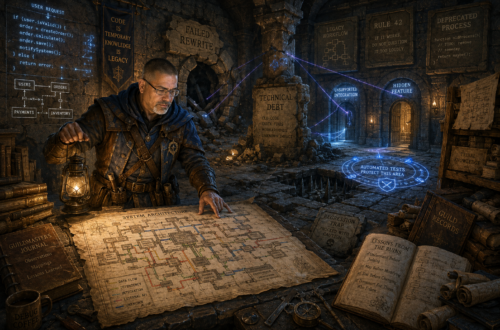
The guild hall is crowded with adventurers. Write clearly, or your allies become your next obstacle.
Life Inside the Guild Hall
One of the first misconceptions many developers carry into the profession is the belief that software development is primarily a solitary activity. Popular culture often reinforces this image. We imagine a lone programmer sitting in a dimly lit room, crafting brilliant solutions through sheer technical skill and determination. While moments of solitary work certainly exist, the reality is far different. Most software is built, maintained, reviewed, and expanded by teams. Success depends as much on communication as it does on technical ability.
This week’s theme is Surviving the Guild Hall, and few skills contribute more to survival than writing code others can read. Every engineer eventually works within a crowded guild hall filled with fellow adventurers. Some maintain systems you created. Others build features alongside you. New recruits arrive, experienced veterans depart, and projects evolve over time. In such an environment, code becomes a form of communication. If that communication fails, collaboration becomes difficult and progress slows.
Many developers spend years mastering programming languages, frameworks, and design patterns while investing comparatively little effort into readability. Unfortunately, unreadable code creates friction everywhere it appears. It slows reviews, complicates maintenance, frustrates teammates, and increases the likelihood of defects. The problem is not simply that unreadable code is difficult to understand. The problem is that software development depends upon shared understanding.
In a traditional adventuring guild, knowledge must pass from one member to another. Maps are copied. Journals are preserved. Lessons learned from previous expeditions are recorded and shared. Imagine a guild where every explorer kept their discoveries secret or documented them poorly. The organization would struggle to survive. Software teams face the same challenge. Every developer contributes knowledge to a shared system. Readable code ensures that knowledge remains accessible.
Why Readability Is a Survival Skill
Many engineers initially view readability as a matter of style. They assume it belongs in the same category as formatting preferences or naming conventions. In reality, readability is much more important. It directly affects how effectively a team can work together.
Consider the life cycle of a typical feature. A developer writes the code. Another developer reviews it. A tester verifies its behavior. Months later, someone modifies it to support a new requirement. Years later, another engineer investigates a production issue involving that feature. Throughout its lifetime, the code may be read dozens or even hundreds of times.
The surprising reality is that code spends far more time being read than written. A feature that takes three days to implement may remain in production for years. During that time, countless engineers interact with it. Every moment spent deciphering unclear logic represents time that could have been spent solving actual problems.
Experienced adventurers understand the value of preparation. Taking time to sharpen a blade, organize supplies, or update a map before departing often prevents much larger problems later. Readability operates according to the same principle. The effort invested today reduces friction tomorrow.
Readable code is not merely an act of courtesy. It is a practical survival strategy for teams working within complex systems.
Naming Things Like a Cartographer
Among all the skills a developer can develop, naming is one of the most valuable. Good names reduce confusion. They communicate intent. They help readers understand a system without requiring extensive investigation.
Consider this example:
<//> JavaScript

function p(a, b) {
    return a * 0.0825 + b;
}
The function works correctly, but understanding it requires interpretation. What do the variables represent? Why is the number 0.0825 important? What business rule is being applied?
Now consider this version:
</> JavaScript

function calculateOrderTotal(subtotal, shippingCost) {
    const SALES_TAX_RATE = 0.0825;

    return subtotal * SALES_TAX_RATE + shippingCost;
}
The functionality remains identical, but the readability improves dramatically. The names explain the purpose. The constant provides context. The code communicates its intent directly.
I often compare naming to the work of a cartographer. Imagine receiving a map where every location is labeled Area A, Area B, and Area C. The map technically contains information, but it communicates very little. Compare that to a map identifying villages, rivers, mountain passes, and trade routes. The second map provides context. It helps travelers understand their surroundings.
Software operates similarly. Names should describe concepts rather than merely satisfy syntax requirements. Variables should represent meaningful business ideas. Functions should describe actions. Classes should communicate responsibilities. Every name contributes to the overall readability of the system.
When choosing names, I encourage developers to optimize for clarity rather than brevity. Saving a few keystrokes rarely provides meaningful value. Helping future readers understand the code almost always does.
One Quest Per Function
Another common challenge appears when functions begin accumulating responsibilities. New developers often add additional behavior to existing functions because doing so seems efficient. Over time, however, those additions create complexity.
Consider the following example:
</> Python

def process_order(order):
    validate_order(order)

    total = calculate_total(order)

    save_order(order)

    update_inventory(order)

    generate_invoice(order)

    send_confirmation_email(order)

    notify_shipping_department(order)

    update_sales_reports(order)

    archive_order(order)

    return total
Nothing in this function is particularly difficult to understand individually. The challenge arises from the number of responsibilities being managed simultaneously. Validation, persistence, inventory management, invoicing, communication, reporting, and archival processes all exist within the same workflow.
A clearer approach might look like this:
</> Python

def process_order(order):
    validate_order(order)

    total = calculate_total(order)

    fulfill_order(order)

    create_business_records(order)

    return total
The implementation details still exist, but they are grouped into meaningful concepts. Readers can understand the overall process immediately while retaining the ability to explore deeper details when necessary.
In a guild hall, every adventurer has a role. The healer heals. The scout scouts. The blacksmith repairs equipment. Problems arise when responsibilities become unclear. Software benefits from the same principle. Functions should perform focused tasks. Clear boundaries make systems easier to understand and maintain.
Organizing the Guild Hall
Readable code extends beyond individual functions. The structure of the project itself plays a major role in maintainability. Developers should be able to locate functionality without embarking on a lengthy search.
Imagine entering a guild hall where maps are stored in the armory, swords are kept in the kitchen, and important records are scattered randomly throughout the building. Even experienced adventurers would struggle to operate efficiently in such an environment. Organization matters because it reduces effort.
The same principle applies to software projects. Files should be grouped logically. Directories should represent meaningful concepts. Modules should have clear responsibilities. Developers should be able to make reasonable assumptions about where functionality belongs.
Consistency also matters. If similar functionality appears in different locations according to different organizational rules, navigation becomes difficult. Predictable structure allows developers to focus on solving problems rather than searching for information.
Good organization often feels invisible when it works well. Developers move through the codebase naturally because everything appears where they expect it to be. That experience is not accidental. It is the result of deliberate design decisions.
Comments That Earn Their Keep
Comments are among the most misunderstood tools available to developers. Some engineers comment nearly every line. Others avoid comments entirely. Neither extreme is ideal.
Consider this example:
</> Java

// Increment counter by one
counter++;
The comment adds no meaningful value because the code already communicates the action clearly.
Now consider a different example:
</> Java

// Required by federal reporting regulations.
// Values must be rounded before annual calculations.
double roundedIncome = Math.round(totalIncome);
This comment preserves important context that may not be obvious from the implementation itself. A future developer could easily remove the rounding logic without understanding its significance.
Good comments explain why something exists rather than what it does. They capture business reasoning, historical context, architectural constraints, or regulatory requirements. In other words, they communicate information that the code cannot effectively communicate on its own.
Think of comments as notes left by previous adventurers. The most useful notes do not describe what everyone can already see. They warn about hidden dangers, explain unusual decisions, and preserve important knowledge.
Building Roads Others Can Follow
The interfaces we create for other developers are just as important as the implementations behind them. Whether building a library, service, or internal utility, we should strive to make our interfaces intuitive and predictable.
Developers should not require extensive documentation to perform common tasks. Good APIs communicate their purpose through structure and naming.
For example, consider these method names:
</> C#

CreateUser()
DeactivateUser()
UpdateUserProfile()
GetUserById()
Even without documentation, their purpose is clear.
Now compare them to names such as:
</> C#

ExecuteTask()
HandleRequest()
ProcessData()
While technically valid, they communicate far less information. Developers must investigate further before understanding how the interface should be used.
I often compare APIs to roads connecting settlements throughout a kingdom. Good roads clearly indicate where they lead and how they should be traveled. Poor roads create confusion and slow progress. Software interfaces follow the same principle.
Developers are far more likely to use systems correctly when those systems communicate clearly from the start.
Welcoming New Adventurers
Every development team eventually welcomes new guild members. Some arrive fresh from their training grounds. Others come from different organizations carrying their own experiences and habits. Regardless of their background, every newcomer faces the same challenge: learning an unfamiliar codebase.
This process becomes significantly easier when the code communicates its intent clearly. Readable code allows developers to build understanding incrementally. They can follow workflows, recognize patterns, and understand responsibilities without constantly seeking clarification from more experienced team members.
I have seen organizations where new developers became productive within a matter of weeks because the codebase was organized thoughtfully and written clearly. I have also seen organizations where onboarding stretched across months because understanding the system required deciphering undocumented assumptions and cryptic implementations. In both cases, the technology was similar. The difference was communication.
Imagine recruiting a new adventurer into a guild. If equipment is organized, maps are current, and procedures are documented, the recruit can contribute quickly. If knowledge exists only in the minds of a few veterans, progress becomes slow and frustrating. Readable code helps transform individual knowledge into shared knowledge.
A healthy guild does not depend upon a handful of experts remembering everything. It creates systems that allow knowledge to spread naturally throughout the organization.
The Guild Review
Code reviews are one of the most powerful opportunities teams have to improve readability. Unfortunately, many developers think of reviews primarily as a mechanism for finding bugs. While defect detection is certainly important, readability deserves equal attention.
When reviewing code, I often ask whether another developer could understand the implementation six months from now without additional explanation. If the answer is no, there is usually room for improvement. The code may function correctly, but maintainability involves more than correctness.
Reviews provide opportunities to evaluate naming, organization, abstractions, and communication. They allow teams to establish shared expectations and reinforce consistent practices across a project. More importantly, they encourage developers to think about the experience of future readers.
One useful exercise is asking whether the code explains itself. If an engineer must provide extensive verbal clarification during a review, the implementation may not be communicating effectively. Ideally, the code should tell most of its own story.
A strong review process strengthens the entire guild. Every discussion about readability improves not only the current feature but also the team’s collective standards.
Sharpening the Blade
Software systems rarely remain static. New requirements emerge. Business priorities shift. Technologies evolve. Features that once seemed complete eventually require modification. Over time, even well-designed systems accumulate complexity.
Refactoring exists to help manage that complexity. Unfortunately, many teams postpone refactoring because the software still works. While understandable, this approach often leads to growing technical debt. Systems become harder to understand, more expensive to modify, and increasingly fragile.
Experienced adventurers understand that equipment requires maintenance. Swords are sharpened before battles. Armor is repaired before it fails. Supplies are replenished before emergencies occur. These actions are not glamorous, but they are essential.
Refactoring follows the same philosophy. Small improvements performed consistently often prevent much larger problems later. Renaming confusing variables, extracting focused functions, simplifying conditional logic, and improving organization may seem minor individually. Collectively, however, they can dramatically improve maintainability.
Readable systems rarely emerge from a single brilliant design decision. More often, they result from many small improvements applied consistently over time.
Tests as Training Grounds
Many developers view tests exclusively as verification tools. While testing certainly serves that purpose, well-written tests also improve readability by documenting expected behavior.
Consider the following example:
</> Python

def test_inactive_users_cannot_access_reports():
    user = User(
        active=False,
        role="manager"
    )

    result = can_access_reports(user)

    assert result is False
Without examining the implementation, a reader learns an important business rule. The test communicates expectations clearly. It demonstrates how the system should behave under specific conditions.
Tests often become some of the most valuable documentation within a project because they provide concrete examples. They show how components interact. They illustrate edge cases. They reveal assumptions that might otherwise remain hidden.
In many ways, tests resemble training exercises conducted within the guild. Recruits learn procedures before encountering real-world situations. They observe examples, practice expected behaviors, and develop confidence through repetition.
Readable tests strengthen readable systems. Together, they create a clearer picture of how software is intended to function.
The Guild Archives
Although readable code is important, not every piece of knowledge belongs within the implementation itself. Some information is better preserved through documentation.
Architectural decisions, deployment procedures, regulatory requirements, integration details, and historical context often require dedicated documentation. While code can communicate behavior effectively, it cannot always explain why certain decisions were made.
I occasionally encounter developers who argue that all documentation should exist within the codebase. While admirable in theory, that philosophy often breaks down in practice. Certain forms of knowledge simply require additional context.
Think of documentation as the archives maintained by the guild. Maps, expedition logs, treaties, and records serve purposes that extend beyond individual adventures. Future generations benefit because important information was preserved rather than assumed.
The goal is not to choose between documentation and readable code. The goal is to ensure that each communicates the information it is best suited to communicate. Together, they create a more complete understanding of the system.
The Cost of Confusing Maps
Unreadable code creates costs that are often difficult to measure directly. Teams rarely track how many hours were spent deciphering confusing logic or investigating poorly named variables. Nevertheless, those costs accumulate over time.
Feature development slows because developers must first understand existing implementations. Bug investigations take longer because workflows are difficult to follow. Refactoring becomes riskier because relationships between components remain unclear. Eventually, entire areas of the system become places developers hesitate to modify.
I once worked with a system containing several thousand lines of tightly coupled business logic. Even small modifications required extensive investigation because responsibilities were poorly defined and naming conventions were inconsistent. The greatest challenge was not technical complexity. The greatest challenge was understanding.
Conversely, I have worked with systems of similar size that felt remarkably approachable. Their architecture was sophisticated. Their business rules were complex. Yet developers could navigate them confidently because the code communicated clearly.
This distinction is important. Complexity itself is not necessarily a problem. Many systems solve genuinely difficult challenges. The goal is not to eliminate complexity entirely. The goal is to ensure that complexity remains understandable.
Confusing maps do not make a kingdom larger. They simply make it harder to travel through.
Readability as Leadership
As developers advance in their careers, they often discover that communication becomes increasingly important. Junior engineers spend much of their time implementing features. Senior engineers spend a growing portion of their time helping others succeed.
Readable code is a form of leadership because it reduces friction for everyone who encounters it. Every clear function name saves another developer time. Every thoughtful abstraction improves understanding. Every effort to simplify complexity benefits the entire team.
The strongest engineers I have worked with were rarely the ones writing the most complicated code. Instead, they wrote code that invited collaboration. Other developers could understand it quickly and contribute confidently. Their systems felt approachable rather than intimidating.
This influence extends beyond individual projects. Junior developers learn patterns by reading existing code. Teams establish conventions based on examples they encounter regularly. Readable code becomes a form of mentorship that continues long after the original author has moved on.
In many respects, leadership is not about demonstrating how much you know. It is about making knowledge accessible to others.
The Guildmaster’s Inspection
Before committing code, I encourage developers to perform a final inspection. This process does not require elaborate checklists or lengthy ceremonies. A handful of thoughtful questions can reveal opportunities for improvement.
Can another developer understand this code without additional explanation?
Do names communicate intent clearly?
Does each function have a focused responsibility?
Do comments explain reasoning rather than mechanics?
Is the organization consistent with the rest of the project?
Could a new team member navigate this section confidently?
Would you understand these decisions six months from now?
These questions encourage developers to think beyond immediate functionality. They shift attention toward maintainability, collaboration, and long-term health. More importantly, they help ensure that code serves the entire guild rather than merely satisfying today’s requirements.
Guildmasters inspect equipment before adventurers depart on important quests. Developers should inspect readability before sending code into production.
Frank’s Final Thoughts
Surviving the guild hall requires more than technical skill. It requires the ability to work effectively alongside other adventurers. Every project involves collaboration. Every system eventually passes through multiple hands. Every codebase becomes a shared responsibility.
The temptation to write clever code will always exist. Compact solutions can feel satisfying. Complex implementations may appear impressive. Yet software rarely succeeds because it impressed its original author. Software succeeds because teams can understand it, maintain it, and extend it over time.
Readable code strengthens the guild. It reduces confusion, accelerates onboarding, improves reviews, simplifies maintenance, and encourages collaboration. Most importantly, it transforms individual knowledge into shared knowledge.
The developers most valued within successful teams are not always those who write the most sophisticated code. More often, they are the ones who help everyone around them succeed. They recognize that software development is not a solitary pursuit but a cooperative endeavor.
The guild hall is crowded with adventurers. New recruits arrive. Veterans move on. Quests change. Systems evolve. Through all of those changes, readable code remains one of the most valuable contributions a developer can make.
When you write code others can read, you are not simply improving a file. You are helping the entire guild survive.


You May Also Like

Scope Creep and Other Predators
Legacy Code and Ancient Curses