

The Curse of Premature Fortification
Not every empty field needs a fortress.
Software rarely becomes difficult to maintain because developers lacked technical ability. More often, intelligent engineers create long-term maintenance problems by solving challenges that have not yet appeared. A project begins with a handful of straightforward requirements, but its structure quickly expands to accommodate hypothetical integrations, future scalability, interchangeable components, and extension points that may never become necessary. Before long, the codebase grows steadily larger while the problem it exists to solve remains remarkably small. Long before the application reaches maturity, supporting the design requires nearly as much effort as advancing the product itself.
Good design prepares software to evolve as knowledge grows. Premature design attempts to predict knowledge before it exists. Those approaches appear almost identical during the excitement of a new project because both seem to value careful planning and long-term thinking. Their differences emerge only after years of real-world use, when assumptions made early in development continue shaping decisions long after the original circumstances have changed. Healthy systems welcome change because they are organized to accommodate learning rather than speculation.
This week, we conclude our exploration of the Foundations of the Kingdom by examining one of the most common architectural traps engineers encounter. Almost nobody sets out to create unnecessary complexity, and that is precisely what makes this mistake so persistent. It usually arrives through a series of deliberate decisions, each intended to protect the project from future problems. Like an ancient curse woven into the stones beneath a castle, premature fortification often appears to strengthen the kingdom while quietly making expansion more difficult.
Surveying the Empty Valley
Developers naturally admire sophisticated systems. Layered diagrams, carefully organized abstractions, dependency injection, service boundaries, and extensible frameworks project confidence because they resemble the software maintained by successful engineering organizations. It is easy to conclude that experienced architects begin every project by building equally elaborate foundations. Elaborate designs feel reassuring because they create the impression that every future has already been considered.
Long-lived applications tell a different story. The strongest systems rarely begin as the most sophisticated. Instead, they solve today’s problems cleanly while preserving the ability to respond intelligently when tomorrow introduces new requirements. Each abstraction, framework, configuration system, and service layer incurs ongoing maintenance costs from the moment it is introduced. When those investments solve genuine business problems, they become valuable assets. When they solve imagined ones, they quietly become obligations that everyone who works on the application afterward inherits.
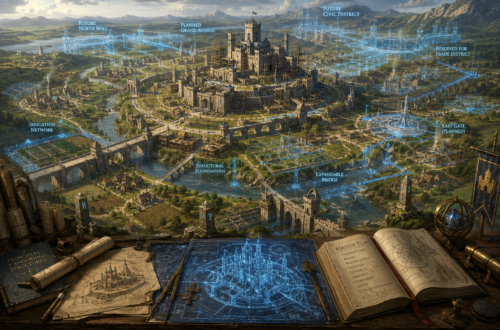
Imagine standing in an untouched valley where the king has approved the construction of a new settlement. Surveyors have marked the boundaries, a river winds through fertile farmland, and merchants already speak enthusiastically about the trade routes that may someday pass through the region. The location promises prosperity, but almost nothing has actually been built. The future appears bright, yet the present still consists of open fields waiting for the first stones to be laid.
An ambitious royal architect immediately begins designing massive curtain walls, towering gatehouses, fortified keeps, underground escape passages, and barracks capable of housing thousands of soldiers. Each defensive structure has been engineered with extraordinary care, and every wall anticipates a future siege. Anyone reviewing the plans would admire the architect’s technical ability and careful preparation. There is nothing technically wrong with the design. The problem is that the settlement still lacks its first farmhouse.
A wiser architect begins elsewhere. Wells provide dependable water that every future resident will need. Roads connect fields to marketplaces where trade can flourish, while bridges shorten travel between neighboring communities. Granaries preserve harvests through difficult winters, and workshops equip builders, blacksmiths, and merchants with the tools needed to expand the settlement. None of these projects appears nearly as impressive as towering stone fortifications, yet all of them create immediate value and make future growth easier rather than more difficult.
Software grows in much the same way. Infrastructure should enable progress rather than delay it. Speculative frameworks, plugin systems, abstraction layers, and configuration engines all consume development time that could have been spent delivering working software. They also introduce additional concepts that future developers must understand before confidently modifying even the smallest feature. Rarely does unnecessary complexity arrive all at once. It accumulates gradually until maintaining the structure demands more effort than improving the product it was meant to support.
When Tomorrow Begins Writing Today’s Code
Architectural mistakes seldom begin with poor engineering. More often, they begin with responsible questions from conscientious developers who genuinely want to build software capable of withstanding future growth. Those conversations usually revolve around possibilities rather than realities, making them sound both prudent and professional. The challenge is recognizing when healthy planning quietly becomes speculation.
What happens when the application supports multiple payment providers? Should international expansion influence today’s design? Will another implementation eventually replace this one? Questions like these deserve careful discussion because experienced engineers should always think beyond the next sprint. Problems arise only when hypothetical requirements are given the same weight as confirmed requirements and begin directing technical decisions before the software has earned them.
Mature codebases provide countless examples of this pattern. Plugin frameworks appear despite supporting only a single extension. Interfaces can be multiplied even though each abstraction has exactly one implementation. Repository layers separate business logic from databases that nobody realistically expects to be replaced, while event-driven designs emerge within applications whose components already communicate efficiently within the same process. None of those decisions reflects poor engineering. Quite the opposite. They usually reflect capable developers attempting to eliminate tomorrow’s work before tomorrow has actually arrived.
That last point is worth pausing on because it often hides in plain sight. Premature fortification does not eliminate the need for future work. It simply performs future work early, before there is enough information to know whether the work is necessary. Sometimes those predictions prove correct. More often, requirements evolve in unexpected directions, leaving behind infrastructure that solved a problem the application never actually encountered.
Unfortunately, speculative design creates very real costs today. Documentation grows because additional layers require explanation. Testing expands because more behaviors and configuration paths must be verified. New team members often spend more time learning infrastructure than learning business rules because the software has quietly grown larger than the problem domain itself. Before introducing another abstraction, it is worth remembering that every abstraction is a promise that tomorrow will resemble today, and that promise should never be made lightly.
Preparing Every Spell
Anyone who has played Dungeons & Dragons has probably watched a wizard spend considerable time deciding which spells to prepare before leaving the safety of town. The spellbook offers dozens of powerful possibilities, each capable of solving a different challenge somewhere in the realm. Fire resistance could become invaluable inside volcanic caverns, water breathing may save the party beneath an ancient lake, and teleportation might shorten a dangerous journey across the kingdom. Preparing for those possibilities feels responsible because any one of them could eventually become necessary.
Preparation, however, always involves tradeoffs. Every spell committed to memory leaves another unavailable until circumstances change. A wizard who prepares exclusively for dragons, underwater ruins, magical prisons, and distant mountain expeditions may discover that the first encounter involves nothing more than a handful of goblins waiting beside the road. The preparation was deliberate, but it focused on adventures that had not yet begun rather than on the challenge standing directly ahead. Software design faces the same temptation whenever today’s development time is consumed solving tomorrow’s imagined problems.
Flexibility Without Speculation
The most adaptable systems are rarely the ones containing the greatest number of abstractions. More often, they are the ones with the clearest responsibilities and the fewest unnecessary assumptions. Consider a shipping calculator for a new application. A design meeting could easily spend several days discussing dependency injection, interchangeable pricing engines, strategy patterns, provider models, and plugin architectures because international shipping may eventually become necessary. Each of those techniques has legitimate applications. The more important question is whether any of them solves the problem the software actually has today.
</> JavaScript

export function calculateShipping(weight) {
    if (weight < 5) {
        return 5.99;
    }

    return 12.99;
}
This implementation is intentionally uncomplicated, yet an important design decision has already been made. Every caller depends upon a single, well-defined boundary responsible for shipping calculations. Notice what the function does not attempt to solve. It does not anticipate international shipping, promotional campaigns, seasonal pricing, loyalty discounts, or carrier-specific business rules because none of those requirements exist yet. If those needs eventually arise, the existing boundary provides a natural place for the implementation to evolve without forcing changes elsewhere in the application.
The lesson is easy to overlook because simple code often appears less sophisticated than highly abstract designs. In reality, this approach leaves the team with more options, not fewer. The application delivers immediate value while remaining organized enough to accommodate future requirements as experience reveals what those requirements actually are. Like the first stones of a growing kingdom, strong foundations leave room for tomorrow without attempting to build tomorrow before it arrives.
Looking for Foundations Before Raising Walls
The longer a system remains in production, the easier it becomes to recognize which design decisions created lasting value and which simply created lasting work. Features come and go as business priorities evolve. Frameworks rise in popularity and eventually fade. Libraries are upgraded, replaced, or abandoned altogether. Through all of those changes, the software continues carrying the weight of decisions made years earlier. That reality makes restraint every bit as valuable as technical creativity.
One question consistently improves architectural discussions by redirecting attention away from assumptions and back toward evidence. Whenever a design conversation begins to expand beyond today’s requirements, I find it useful to ask a simple question: What evidence indicates this complexity is necessary today? That single question changes the discussion by replacing speculation with observation. Has another implementation actually appeared? Have performance measurements identified a genuine bottleneck? Has the business requested capabilities that the current design cannot reasonably support? When decisions begin with evidence rather than prediction, additional complexity tends to appear only where it creates meaningful value.
Many technical debates become surprisingly short once evidence enters the room. A plugin architecture becomes difficult to justify when there is only one plugin. An event bus loses much of its appeal when every component already communicates synchronously and performs well. A repository abstraction deserves closer scrutiny when there is only one data source and no realistic expectation that it will change. Instead of debating what might happen years from now, the team returns its attention to the problems the software is actually solving today.
That change in perspective quietly separates growing engineers from experienced architects. Early in our careers, it is natural to become fascinated by what software can do. Over time, that fascination gradually shifts toward understanding what software actually needs to do. Possibility remains important because it broadens our thinking, but necessity becomes the stronger guide when deciding what belongs in a production system. Mature systems are rarely the result of adding everything that might be useful. More often, they result from deliberately excluding everything that has not yet earned its place.
Building Doors Instead of Empty Rooms
Preparing for future growth does not require constructing every future feature. More often than not, it requires organizing today’s software so that tomorrow’s changes remain straightforward. Those goals may sound similar, but they produce very different systems. One attempts to predict the future. The other accepts that the future will almost certainly surprise us and prepares the application to adapt to it.
That distinction becomes easier to recognize when responsibilities are isolated instead of generalized. Imagine an application that currently sends order confirmations exclusively through email. An ambitious design might immediately introduce notification providers, delivery strategies, transport adapters, message factories, and configuration systems capable of supporting SMS, push notifications, webhooks, and communication channels that have not yet been imagined. On paper, the design appears wonderfully flexible because nearly every possibility has already been anticipated.
A simpler approach begins by acknowledging reality. Today, the application sends an email. Tomorrow may introduce additional delivery methods, but tomorrow has not arrived yet. Rather than constructing an entire notification framework, isolate the existing behavior behind a clear boundary.
</> JavaScript

export async function sendOrderConfirmation(order) {
    const message = buildConfirmationMessage(order);

    await emailService.send({
        to: order.customer.email,
        subject: "Order Confirmation",
        body: message
    });
}
This implementation accomplishes something more important than its simplicity first suggests. The rest of the application depends only on the responsibility of sending an order confirmation, not on the mechanics of how that message is delivered. If business requirements later introduce SMS notifications or mobile push messages, the implementation can evolve behind that boundary without forcing widespread changes elsewhere in the codebase.
Notice what this design deliberately avoids. There are no provider factories, notification strategies, plugin registries, or configuration-driven delivery pipelines because the application has not yet demonstrated a need for them. When additional delivery methods eventually become real business requirements, those abstractions can be introduced with confidence because the software has already revealed where they belong. The resulting design is usually cleaner because it reflects actual experience instead of educated guesses.
When an Abstraction Has Not Yet Earned Its Place
Perhaps the clearest example of premature fortification appears in interfaces and repository patterns. These are valuable tools, and almost every experienced developer has used them successfully. The mistake is not introducing an abstraction. The mistake is introducing it before the software has provided a reason for its existence.
Many projects begin with something like this:
</> JavaScript

interface PaymentGateway {
    processPayment(amount: number): Promise<void>;
}

class StripeGateway implements PaymentGateway {
    async processPayment(amount: number) {
        // Process payment with Stripe
    }
}
At first glance, this appears to be excellent design. The interface suggests flexibility, the implementation follows familiar design principles, and replacing Stripe someday appears straightforward. The problem is that the application only supports Stripe. There is no second implementation, no competing provider, and no immediate business requirement suggesting one is on the horizon. The interface has become another concept every developer must understand without reducing coupling in any meaningful way.
A simpler solution often communicates the application’s current reality more honestly.
</> JavaScript

class PaymentService {
    async processPayment(amount: number) {
        return stripe.charge(amount);
    }
}
There is nothing inherently superior about either approach. The important question is whether the software has earned the abstraction. If a second payment provider becomes an active project next quarter, introducing an interface becomes a natural refactoring supported by real business requirements. Until then, the simpler design expresses today’s needs without asking future developers to maintain infrastructure built for a future that may never arrive.
That is one of the quiet strengths of refactoring. It allows software to respond as knowledge improves, rather than pretending complete knowledge existed from the beginning. Good design is not determined by how many abstractions appear in the first release. It is determined by how gracefully the system evolves as those abstractions become genuinely useful.
The Weight Hidden Inside Every Stone
Premature fortification carries costs that architecture diagrams rarely reveal. Every abstraction introduces another concept that developers must understand before making changes confidently. Every configuration option creates another path that requires testing. Every extension point demands documentation explaining why it exists and when it should be used. None of those responsibilities appears especially expensive when viewed individually. Together, they determine whether a codebase remains approachable years after its original authors have moved on.
Imagine joining a project that has been in production for five years. A seemingly simple request arrives from the business, asking for a small adjustment to how taxes are calculated. The change sounds straightforward until the investigation begins. Before reaching twenty lines of business logic, you navigate service layers, repositories, factories, adapters, providers, dependency injection registrations, and configuration objects spread across multiple projects. Nothing is technically broken. The application simply contains far more infrastructure than the problem itself requires.
Simplifying those systems rarely reduces their capabilities. Instead, it makes them easier to understand, test, and change. New developers become productive more quickly because there are fewer concepts competing for their attention. Bug reports take less time to investigate because there are fewer places for unexpected behavior to hide. Features reach production sooner because engineering effort can return to solving business problems rather than navigating infrastructure that no longer delivers proportional value.
Long after implementation is complete, architectural decisions continue to collect interest. That interest is paid through onboarding, maintenance, documentation, testing, code reviews, and operational support. Responsible architects evaluate those long-term costs just as carefully as they evaluate future flexibility. Complexity should never exist simply because it can. It should exist because the software has clearly demonstrated that the investment is worthwhile.
Refactoring Is Part of Building the Kingdom
Some developers hesitate to begin with simple solutions because they worry that future refactoring represents failure. In reality, refactoring is one of the healthiest signs a software system can exhibit. It demonstrates that the design is responding to better information instead of remaining trapped by earlier assumptions. As understanding improves, the software should improve alongside it. Mature systems evolve because mature teams continue learning.
Viewed through that lens, refactoring stops feeling like repairing mistakes and begins feeling like continuing construction. The first version of a feature is rarely the final version because neither the developers nor the business fully understands the destination at the beginning of the journey. Production usage reveals patterns that planning sessions never could. Customer feedback exposes priorities that requirements documents never anticipated. Healthy systems welcome those discoveries because they were organized to evolve rather than remain frozen in their earliest assumptions.
The growth of a successful kingdom follows much the same pattern. Roads widen as commerce increases. Markets expand as merchants arrive from distant lands. New districts appear when the population outgrows the original settlement, and defensive walls are strengthened only after prosperity creates something worth defending. None of those changes represents failures in the original design. They represent a kingdom responding intelligently to new knowledge instead of pretending it possessed that knowledge from the very beginning.
Software deserves the same opportunity to mature. Build what today’s understanding justifies. Observe how the application behaves once it begins serving real users. Allow experience to guide each significant design decision, rather than asking speculation to do work it was never capable of. When additional complexity finally arrives, it should feel less like an ambitious prediction and more like the natural next step in a kingdom that has grown strong enough to support it.
The Architect Who Waits Builds the Stronger Kingdom
Experience eventually reveals an important truth about software engineering. As developers gain confidence, they often become less interested in predicting every possible future and more interested in building systems that can adapt to whatever future eventually arrives. That shift does not reflect a lack of ambition. It reflects an understanding that software development is a continual process of learning. Businesses evolve, customers surprise us, technologies mature, and priorities change. Successful systems are not the ones that eliminate uncertainty. They are the ones that remain healthy as uncertainty gradually becomes knowledge.
That perspective also changes how success is measured. A well-designed application is not one that anticipates every future requirement with perfect accuracy. It is one that absorbs new requirements without unnecessary disruption. Those goals may sound similar, but they reward very different behaviors. One emphasizes prediction. The other emphasizes resilience. Given enough time, resilience almost always proves to be the better investment because software inevitably outlives many of the assumptions made during its earliest days.
Accepting uncertainty is more difficult than it sounds. Engineers enjoy solving problems, and unanswered questions naturally invite increasingly elaborate solutions. The temptation is to eliminate uncertainty by planning for every possibility before it has a chance to arise. Unfortunately, software rarely rewards that approach. Real users have a remarkable habit of exposing priorities that requirements documents overlooked, while production environments reveal behaviors that planning sessions could never have anticipated. The strongest systems remain valuable because they were designed to learn rather than pretend the future had already been mapped.
Engineering Judgment Beyond Design Patterns
Learning design patterns, architectural styles, and modern frameworks is an important part of becoming a better engineer. Each broadens the range of problems we can solve and provides valuable insight into how experienced teams organize increasingly sophisticated systems. Those tools deserve careful study because they represent decades of accumulated engineering experience. The challenge is remembering that every tool exists to solve a particular class of problems rather than to justify its own use.
A master carpenter does not reach for the most specialized tool simply because it is available. The tool is selected because the work requires it. Software engineering benefits from the same discipline. Microservices, event-driven communication, distributed caching, dependency injection containers, service meshes, and sophisticated design patterns all solve legitimate engineering problems. They also introduce operational responsibilities that teams must understand, document, monitor, test, and maintain. Those costs become worthwhile only when the software genuinely benefits from them.
The same principle extends well beyond application code. Deployment pipelines become more sophisticated as release processes mature. Monitoring systems grow alongside operational needs. Security models evolve as applications expand into new environments. Database designs adapt as data volumes and usage patterns change. Mature engineering organizations rarely build every capability on the first day because experience consistently provides better guidance than speculation. Good architects collect tools throughout their careers, but wisdom comes from knowing when to leave most of them in the toolbox.
Engineering judgment grows by asking better questions instead of collecting more patterns. Rather than asking whether another abstraction is technically possible, ask whether it makes the application easier to understand. Rather than asking whether a framework might become useful someday, ask whether it solves a problem the team already faces today. Those questions gradually shift attention away from demonstrating technical sophistication and toward building software that remains approachable, maintainable, and valuable over many years.
Every Stone Should Earn Its Place
One principle has guided many of the architectural decisions I have made over the years: complexity should earn the right to exist. That standard applies equally to classes, services, frameworks, deployment pipelines, infrastructure, and design patterns. An interface earns its place when multiple implementations genuinely exist or are expected in the near future. A caching layer earns its place when performance measurements show that repeated work has become expensive. A messaging system earns its place when independent components truly benefit from asynchronous communication. Complexity is not the reward for careful planning. It is the response to demonstrated need.
Approaching software this way produces another important benefit. The codebase gradually tells the story of the application’s evolution rather than its predictions. Future developers can understand why a particular layer was introduced because the business need that justified it remains visible within the system. Design decisions become easier to maintain because every significant component continues to solve a problem the application actually has, rather than one someone imagined years earlier.
The same pattern appears throughout the growth of enduring kingdoms. Prosperous cities were not built by constructing every district before the first citizens arrived. Markets expanded as commerce increased. Roads stretched toward neighboring communities as trade flourished. Additional walls surrounded the city only after growth created something worth protecting. Each investment reflected the kingdom’s changing needs instead of its earliest ambitions. The realm grew stronger because each generation built confidently on proven foundations rather than repeatedly trying to predict the distant future.
Final Thoughts
Throughout this week’s exploration of the Foundations of the Kingdom, we have examined decisions that most users will never see, but every developer will eventually inherit. We began by discussing why castles need architects because thoughtful planning always matters. We then explored the importance of building for today’s quest while preparing for tomorrow’s empire. This final lesson reminds us that preparation and prediction are not the same thing. Strong systems prepare for growth without attempting to construct every future before it arrives.
The curse of premature fortification is dangerous precisely because it rarely feels like a mistake. It looks like responsible engineering. It encourages us to solve tomorrow’s problems before today’s users reveal what tomorrow will actually require. Over time, those well-intentioned decisions accumulate, making it more difficult to maintain the structure than to improve the product itself. Healthy software grows differently. It introduces complexity in response to evidence, experience, and genuine need, rather than to anticipation alone.
The longer I spend maintaining mature software systems, the more convinced I become that restraint is one of the least celebrated skills in software architecture. Knowing how to build an elaborate solution is valuable. Knowing when not to build it is often even more valuable. The strongest architects are not remembered for predicting every future requirement correctly. They are remembered because they created systems that continued serving their teams long after those predictions had been forgotten.
If there is one lesson I hope you carry into your next project, it is this: Every abstraction is a promise that tomorrow will resemble today. Make that promise only when experience has earned it. Technologies will continue to evolve. Frameworks will come and go. Today’s best practices will eventually become tomorrow’s legacy code. Sound engineering judgment, however, remains remarkably consistent. Build what today’s knowledge justifies, leave room for tomorrow’s discoveries, and allow experience to determine where the next stones belong.
Next week, we begin a new chapter of The Architect’s Grimoire with our next theme, Designing the Realm. Our first stop is The Roads Between Cities, where we will explore why the connections between software components often matter more than the components themselves. Well-designed modules can still become isolated kingdoms if communication between them is inefficient, tightly coupled, or poorly planned. Just as thriving kingdoms depend upon roads that move people, goods, and ideas, successful software depends upon thoughtfully designed pathways that allow information to flow cleanly throughout the system. Castles may define a kingdom’s skyline, but roads determine whether the kingdom can endure.


You May Also Like
Building for Today’s Quest or Tomorrow’s Empire?

When the Kingdom Burns: Designing for Failure Before Disaster Strikes