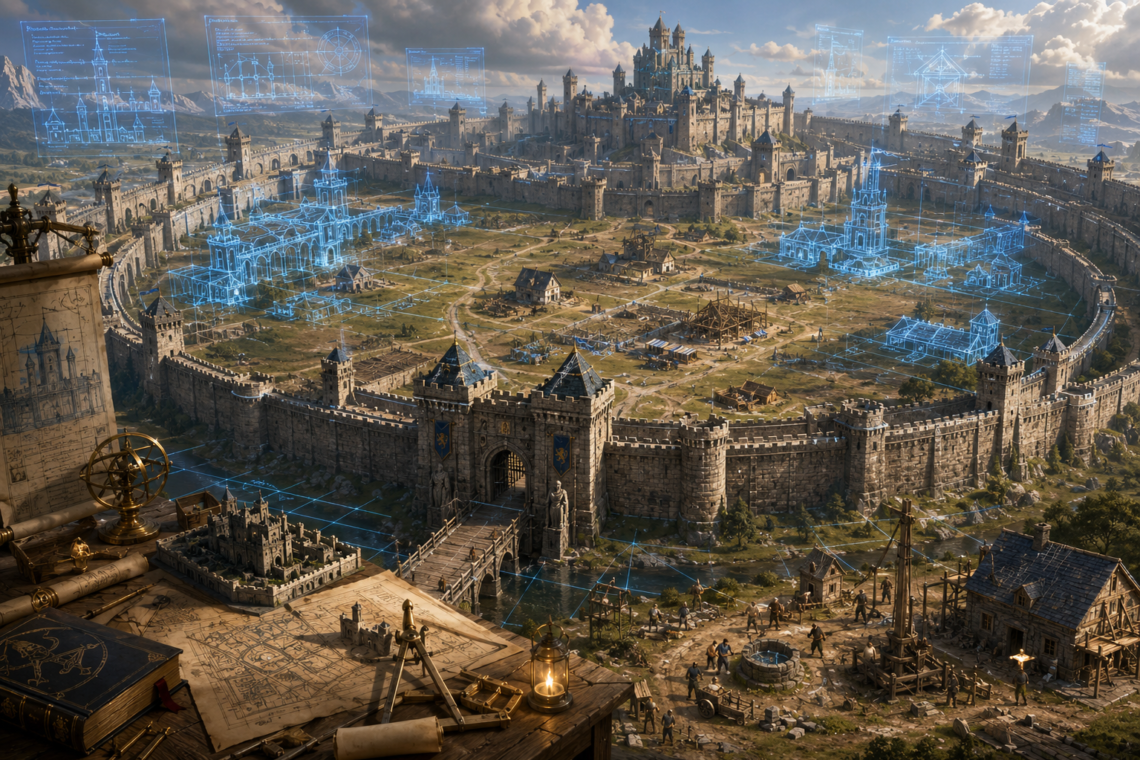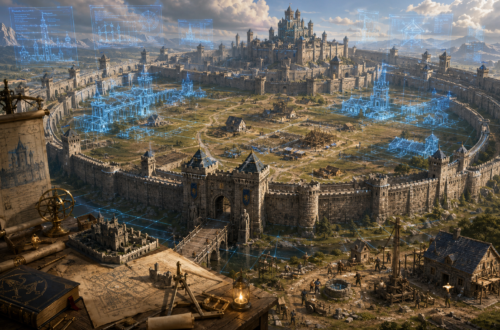
• A vast medieval fantasy kingdom is enclosed within enormous concentric stone walls, towering gatehouses, fortified keeps, and defensive towers that dominate the landscape. Despite the immense fortifications, the protected interior remains largely undeveloped, with only a few cottages, a small farmhouse, scattered construction sites, unfinished roads, and a partially built marketplace spread across open fields. Glowing blue magical architectural projections overlay the empty city, revealing ambitious plans for future districts, guild halls, towers, canals, and public buildings that have yet to be constructed. In the foreground, drafting tables, blueprints, surveying instruments, and engineering tools reinforce the theme of excessive planning, while a small group of builders focuses on practical structures such as a well and simple homes. The painterly Dungeons & Dragons-inspired scene symbolizes the software engineering concept of premature overengineering by contrasting overwhelming defensive infrastructure with a kingdom that has barely begun to grow.
    The Architect's Grimoire

    The Curse of Premature Fortification

    Not every empty field needs a fortress. Software rarely becomes difficult to maintain because developers lacked technical ability. More often, intelligent engineers create long-term maintenance problems by solving challenges that have not yet appeared. A project begins with a handful of straightforward requirements, but its structure quickly expands to accommodate hypothetical integrations, future scalability, interchangeable components, and extension points that may never become necessary. Before long, the codebase grows steadily larger while the problem it exists to solve remains remarkably small. Long before the application reaches maturity, supporting the design requires nearly as much effort as advancing the product itself. Good design prepares software to evolve as knowledge grows. Premature…

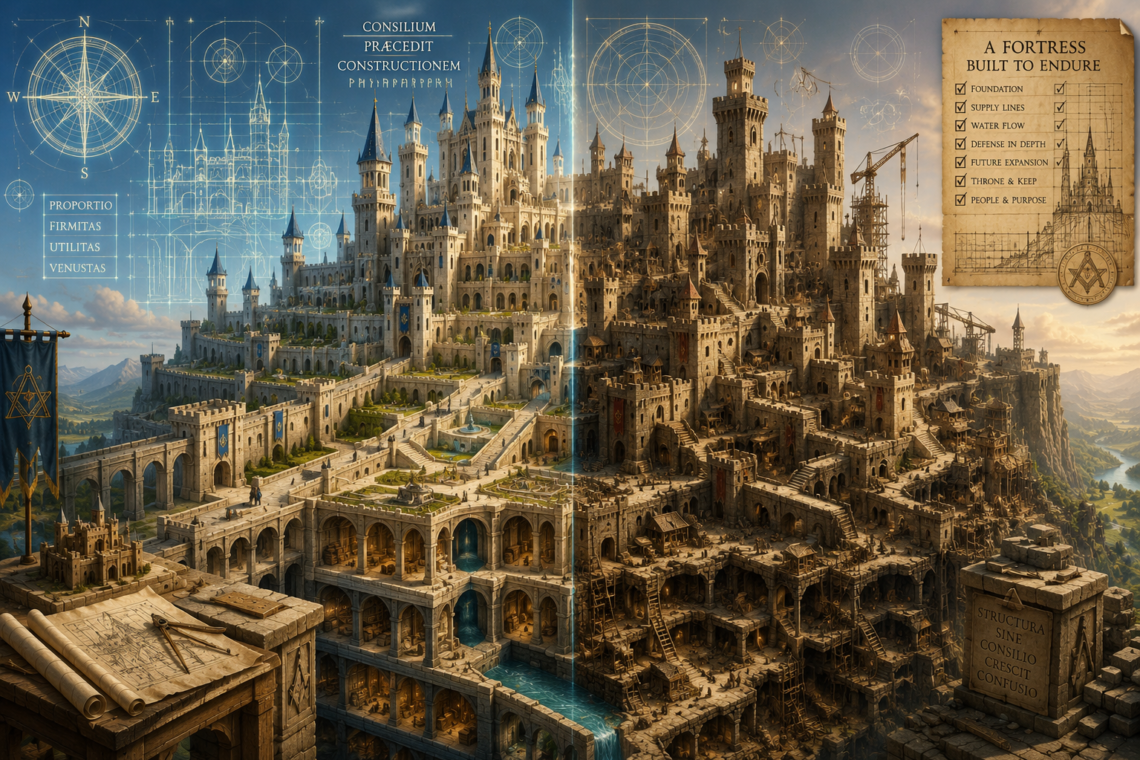
  • A vast medieval fantasy castle dominates the landscape, split into two contrasting halves to illustrate the importance of architectural planning. The left side features a beautifully organized fortress with symmetrical towers, interconnected courtyards, bridges, aqueducts, and orderly roads, overlaid with glowing magical blueprints, surveying grids, compass roses, and geometric construction diagrams. The right side remains impressive but is visibly less organized, with awkward tower placement, inefficient stairways, conflicting roads, and haphazard expansions that suggest growth without an overall plan. Artistic cutaway sections reveal deep stone foundations, underground chambers, drainage tunnels, and structural supports extending into bedrock. Tiny builders and stonemasons emphasize the immense scale of the castle, while warm morning light highlights the contrast between intentional design and organic growth, visually representing the role of software architecture in creating maintainable, long-lasting systems.
    The Architect's Grimoire

    Why Castles Need Architects

    Even the finest builders need someone who can see beyond the next wall. Foundations of the Kingdom Maintaining software taught me lessons that writing software never could. Early in my career, I assumed difficult applications were usually the result of poor programming. Whenever a simple change required hours of investigation, I expected to uncover careless decisions, rushed deadlines, or code that had simply been neglected for too long. The more systems I inherited, however, the less convincing that explanation became. Different companies, different teams, and different programming languages produced remarkably similar maintenance problems. As we begin Foundations of the Kingdom, one lesson rises above all the others: every enduring kingdom…