Stack n' Scroll

Code, Campaigns, and Lessons from the Digital Realm

July 2026
S M T W T F S
 1234
567891011
12131415161718
19202122232425
262728293031  
« Jun   Aug »

Meta

  • Register
  • Log in
  • Entries feed
  • Comments feed
  • WordPress.org
Frank Jamison Avatar
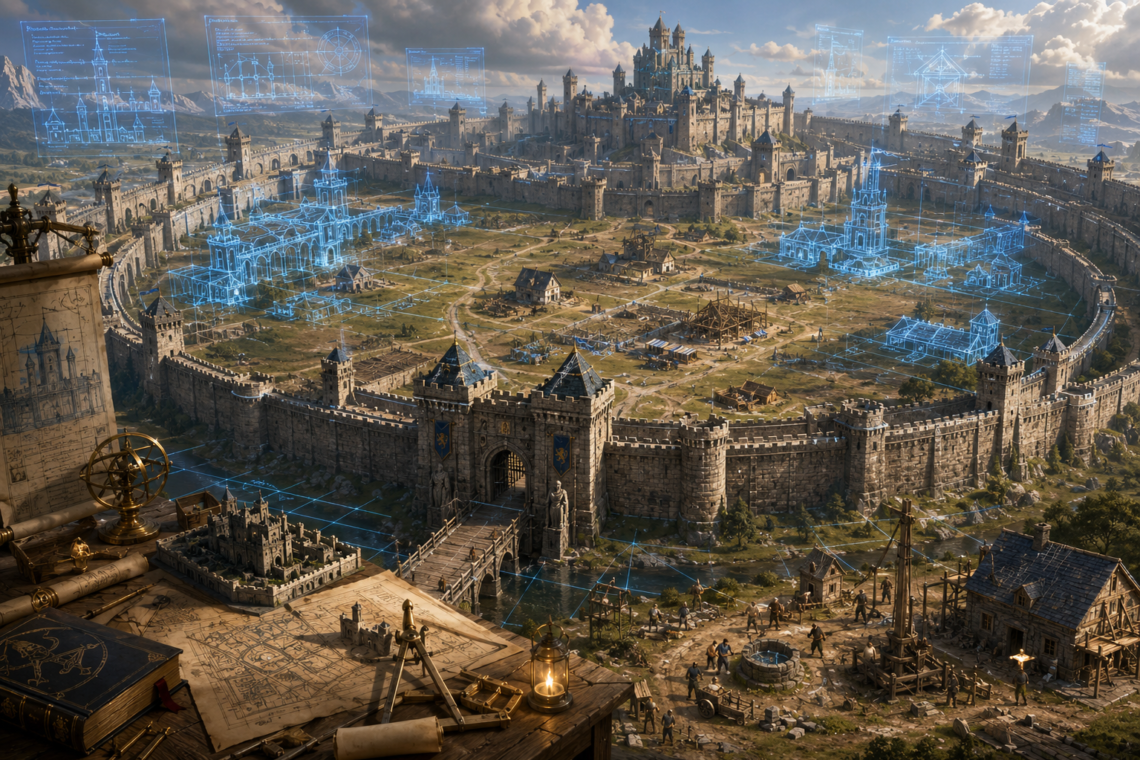
  • A vast medieval fantasy kingdom is enclosed within enormous concentric stone walls, towering gatehouses, fortified keeps, and defensive towers that dominate the landscape. Despite the immense fortifications, the protected interior remains largely undeveloped, with only a few cottages, a small farmhouse, scattered construction sites, unfinished roads, and a partially built marketplace spread across open fields. Glowing blue magical architectural projections overlay the empty city, revealing ambitious plans for future districts, guild halls, towers, canals, and public buildings that have yet to be constructed. In the foreground, drafting tables, blueprints, surveying instruments, and engineering tools reinforce the theme of excessive planning, while a small group of builders focuses on practical structures such as a well and simple homes. The painterly Dungeons & Dragons-inspired scene symbolizes the software engineering concept of premature overengineering by contrasting overwhelming defensive infrastructure with a kingdom that has barely begun to grow.
    The Architect's Grimoire

    The Curse of Premature Fortification

    July 3, 2026 /

    Not every empty field needs a fortress. Software rarely becomes difficult to maintain because developers lacked technical ability. More often, intelligent engineers create long-term maintenance problems by solving challenges that have not yet appeared. A project begins with a handful of straightforward requirements, but its structure quickly expands to accommodate hypothetical integrations, future scalability, interchangeable components, and extension points that may never become necessary. Before long, the codebase grows steadily larger while the problem it exists to solve remains remarkably small. Long before the application reaches maturity, supporting the design requires nearly as much effort as advancing the product itself. Good design prepares software to evolve as knowledge grows. Premature…
    Read More
    Frank Jamison

    You May Also Like

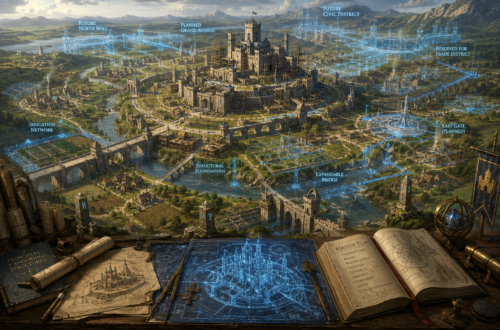
    A panoramic fantasy kingdom is shown in the early stages of carefully planned expansion, centered on a partially completed stone castle surrounded by villages, bridges, roads, and farmland. Glowing blue architectural overlays, magical surveying grids, and blueprint-style projections illustrate future city walls, districts, bridges, and infrastructure without physically constructing them. In the foreground, an architect's drafting table holds illuminated blueprints, manuscripts, measuring tools, compasses, and engineering instruments, reinforcing the theme of deliberate planning and long-term design. The peaceful medieval landscape emphasizes thoughtful growth, maintainability, and architectural foresight in a classic Dungeons & Dragons-inspired editorial fantasy style.

    Building for Today’s Quest or Tomorrow’s Empire?

    July 1, 2026
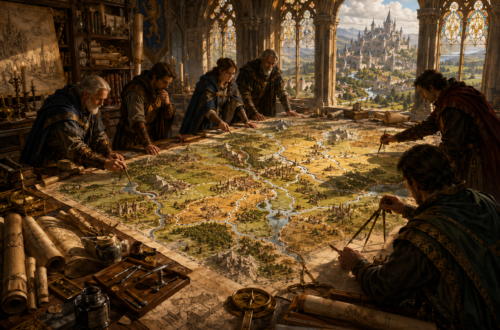
    A group of royal architects and cartographers gather around a massive illuminated kingdom map inside an ornate medieval planning hall. Using compasses, rulers, and drafting tools, they carefully define provincial boundaries that follow rivers, mountains, and trade routes. Shelves filled with scrolls, blueprints, and surveying instruments surround the room, while stained-glass windows reveal a thriving kingdom beyond. The detailed fantasy scene symbolizes thoughtful software architecture by illustrating the deliberate planning and organization required to establish meaningful boundaries within a growing system.

    Dividing the Kingdom: Finding the Right Boundaries

    July 8, 2026
    A wise wizard studies a glowing crystal orb overlooking a vast fantasy kingdom where medieval architecture merges with modern software engineering. Across a towering stone aqueduct, six banners illustrate a continuous delivery pipeline labeled Automation, CI/CD, Testing, Deployment, Infrastructure as Code, and Continuous Improvement, with engineers working at illuminated stations beneath each stage. A detailed map on the wizard's table mirrors the same workflow using symbols and pathways, while holographic diagrams and glowing blue interfaces blend seamlessly into the medieval setting. The composition symbolizes mature software engineering practices transforming disciplined processes into an automated, self-improving kingdom, with warm golden light contrasting against cool blue technological elements. The article title does not appear in the image.

    Seeing Through the Crystal Ball: Observability Beyond Monitoring

    July 20, 2026
  • The Architect's Grimoire (13)
  • The CSS Codex (13)
  • The Enchanted Workshop (13)
  • The Full-Stack Campaign (8)
  • The Guildmaster’s Handbook (13)
  • The Kingdom in the Clouds (9)

AI-Assisted Development Artificial Intelligence Backend Development Career Development Clean Code Cloud-Native Architecture Code Quality CSS Architecture CSS Best Practices Design Systems Developer Growth Developer Productivity Distributed Systems Dungeons and Dragons Engineering Culture Engineering Judgment Engineering Leadership Fantasy Theme Front-End Development Frontend Development Full Stack Development Human-AI Collaboration Maintainable Code Maintainable CSS Mentorship Professional Development Professional Growth Refactoring Responsive Design Software Architecture Software Craftsmanship Software Design Software Development Software Engineering StackNScroll System Design Technical Debt Technical Leadership The Architect's Grimoire The CSS Codex The Enchanted Workshop The Full-Stack Campaign The Guildmaster's Handbook The Kingdom in the Clouds Web Development

Stack N' Scroll - 2026 ©