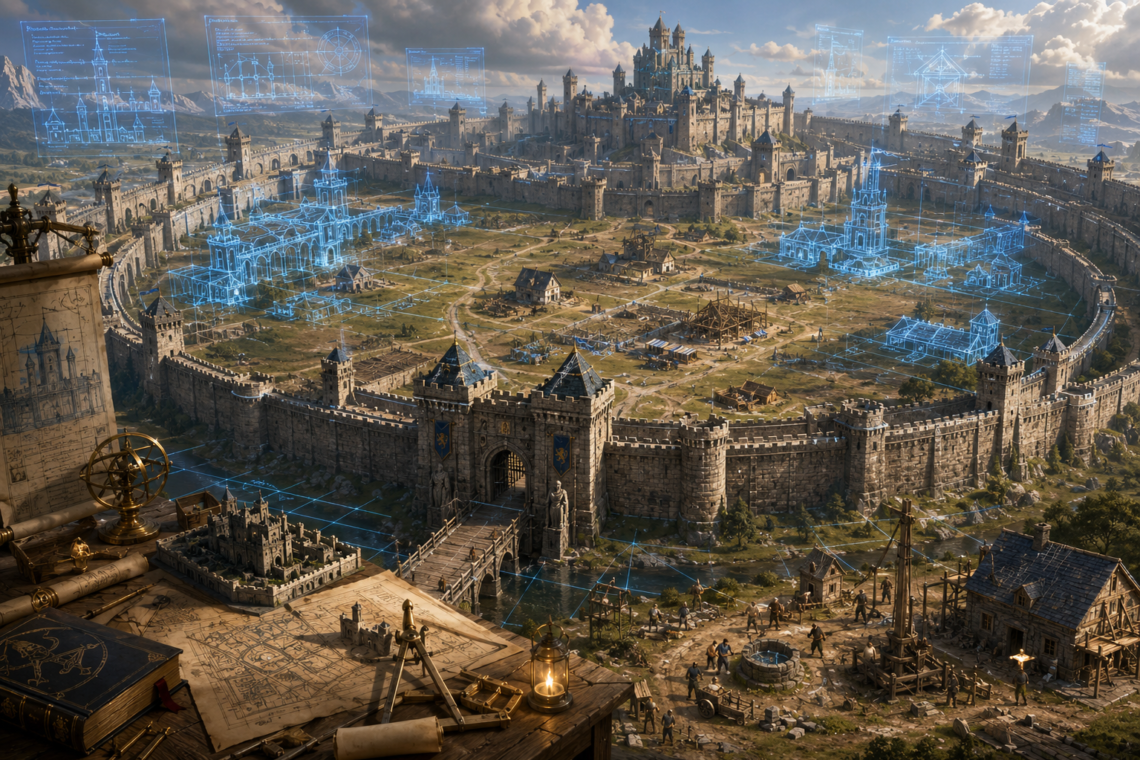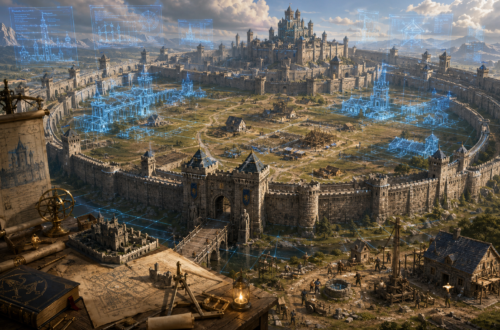
• A vast medieval fantasy kingdom is enclosed within enormous concentric stone walls, towering gatehouses, fortified keeps, and defensive towers that dominate the landscape. Despite the immense fortifications, the protected interior remains largely undeveloped, with only a few cottages, a small farmhouse, scattered construction sites, unfinished roads, and a partially built marketplace spread across open fields. Glowing blue magical architectural projections overlay the empty city, revealing ambitious plans for future districts, guild halls, towers, canals, and public buildings that have yet to be constructed. In the foreground, drafting tables, blueprints, surveying instruments, and engineering tools reinforce the theme of excessive planning, while a small group of builders focuses on practical structures such as a well and simple homes. The painterly Dungeons & Dragons-inspired scene symbolizes the software engineering concept of premature overengineering by contrasting overwhelming defensive infrastructure with a kingdom that has barely begun to grow.
    The Architect's Grimoire

    The Curse of Premature Fortification

    Not every empty field needs a fortress. Software rarely becomes difficult to maintain because developers lacked technical ability. More often, intelligent engineers create long-term maintenance problems by solving challenges that have not yet appeared. A project begins with a handful of straightforward requirements, but its structure quickly expands to accommodate hypothetical integrations, future scalability, interchangeable components, and extension points that may never become necessary. Before long, the codebase grows steadily larger while the problem it exists to solve remains remarkably small. Long before the application reaches maturity, supporting the design requires nearly as much effort as advancing the product itself. Good design prepares software to evolve as knowledge grows. Premature…

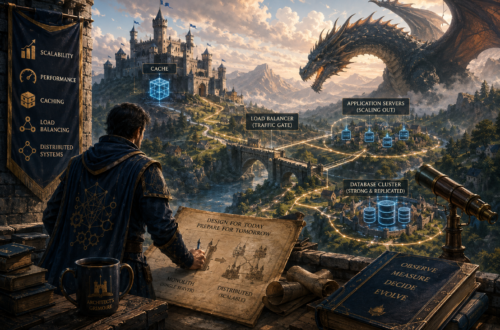
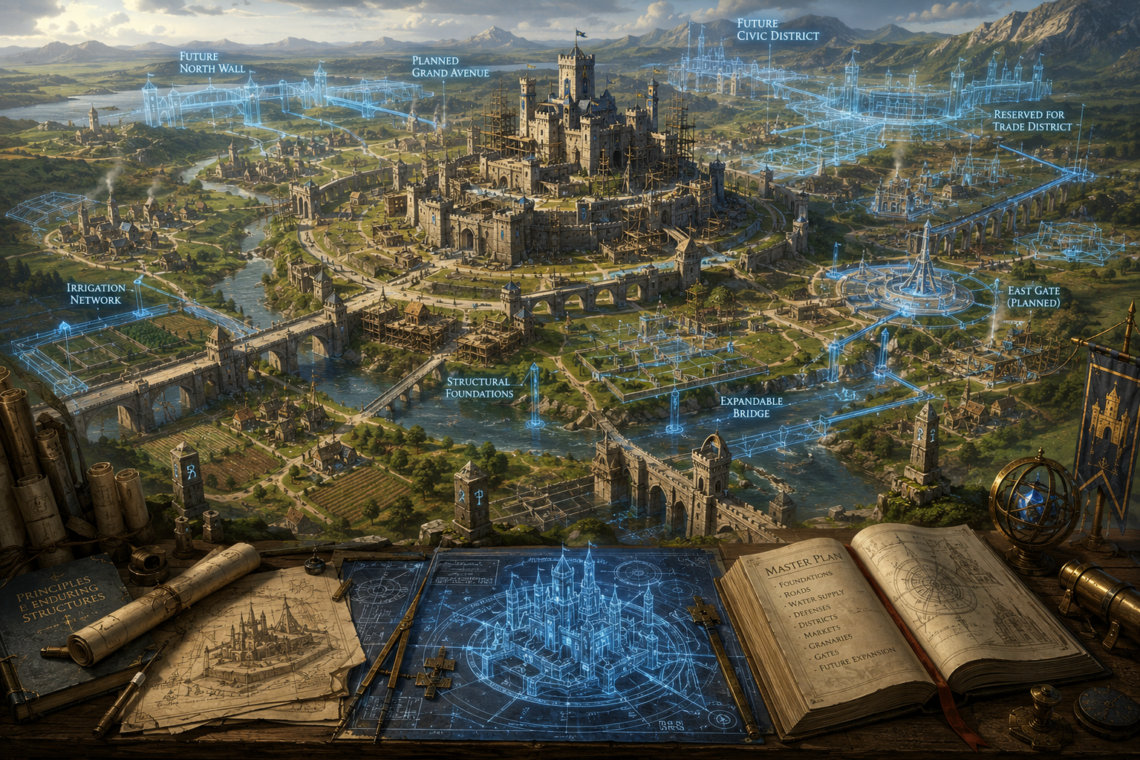
  • A panoramic fantasy kingdom is shown in the early stages of carefully planned expansion, centered on a partially completed stone castle surrounded by villages, bridges, roads, and farmland. Glowing blue architectural overlays, magical surveying grids, and blueprint-style projections illustrate future city walls, districts, bridges, and infrastructure without physically constructing them. In the foreground, an architect's drafting table holds illuminated blueprints, manuscripts, measuring tools, compasses, and engineering instruments, reinforcing the theme of deliberate planning and long-term design. The peaceful medieval landscape emphasizes thoughtful growth, maintainability, and architectural foresight in a classic Dungeons & Dragons-inspired editorial fantasy style.
    The Architect's Grimoire

    Building for Today’s Quest or Tomorrow’s Empire?

    Every shortcut is a promise the future must eventually keep. The First Road Beyond the Castle Gates Long before a kingdom becomes an empire, someone chooses where the first road will be built. Travelers may never remember who laid those stones, but generations will depend upon the decision. Software is built much the same way. Long before users celebrate new features, someone quietly decides how the application will grow, how its parts will work together, and whether future engineers will inherit a thriving kingdom or spend their days repairing crumbling foundations. When I first began writing software, I believed every project had a finish line. Complete the feature, fix the…