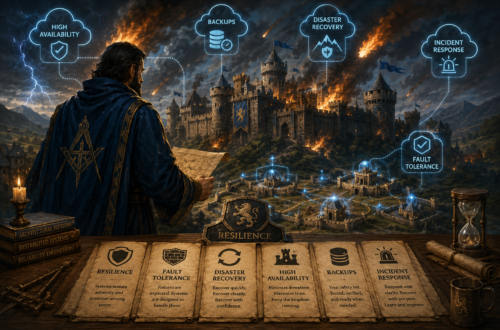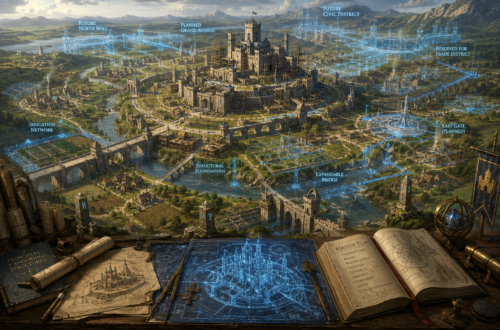
Stack n' Scroll

Code, Campaigns, and Lessons from the Digital Realm

August 2026
S M T W T F S
 1
2345678
9101112131415
16171819202122
23242526272829
3031  
« Jul    

Meta

  • Register
  • Log in
  • Entries feed
  • Comments feed
  • WordPress.org
Frank Jamison Avatar
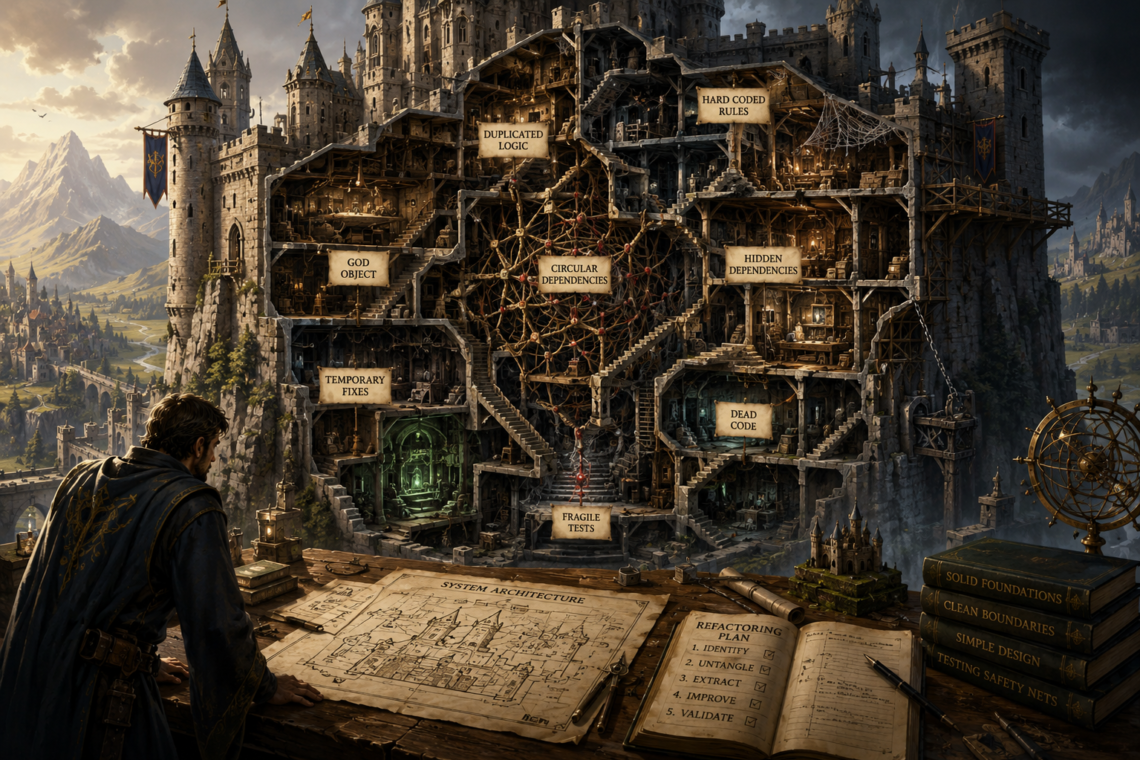
  • A detailed fantasy castle is shown in cross-section, revealing a maze of interconnected rooms, stairways, hidden passages, and structural layers that symbolize the complexity of a long-lived software system. At the center, tangled corridors and web-like connections represent circular dependencies and hidden coupling, while workshop-like chambers illustrate concepts such as duplicated logic, hard-coded rules, temporary fixes, fragile tests, dead code, and hidden dependencies. In the foreground, an architect studies blueprints and a refactoring plan spread across a drafting table, surrounded by engineering tools, manuscripts, and architectural diagrams. The surrounding kingdom is orderly and well maintained, contrasting with the increasingly convoluted interior of the castle. The painterly, Dungeons & Dragons-inspired editorial illustration uses fantasy architecture to represent technical debt, legacy systems, refactoring, and the challenge of maintaining software that has grown through years of incremental change.
    The Architect's Grimoire

    Hidden Traps in the Dungeon: Escaping Technical Debt

    July 15, 2026 /

    The deadliest dangers are often the ones built into the castle itself. No architect intentionally designs a maze. Every castle begins with a sensible plan. Corridors connect naturally, storerooms serve nearby kitchens, towers overlook vulnerable approaches, and every staircase leads somewhere meaningful. Yet castles that survive for generations rarely retain that original simplicity. New rulers expand old wings. Temporary passageways become permanent corridors. Storage rooms become workshops. Secret tunnels built during one crisis remain long after the danger has passed. Over time, the castle becomes increasingly difficult to navigate, not because its builders lacked skill, but because each generation solved the problems immediately before them. Long-lived software follows the same…
    Read More
    Frank Jamison

    You May Also Like

    A fantasy-inspired illustration depicts a master engineer overlooking a thriving medieval kingdom powered by invisible systems rather than heroic effort. In the foreground, a cloaked architect studies a blueprint illustrating a software delivery pipeline from code to build, test, deployment, and monitoring. Below, workshops, waterwheels, bridges, and aqueducts symbolize automated infrastructure supporting the bustling city above. Watchtowers overlook the realm while illuminated engineering panels represent automated testing, CI/CD pipelines, infrastructure as code, deployment automation, and monitoring. The scene conveys how automation, continuous improvement, and dependable engineering systems quietly enable a prosperous kingdom without drawing attention to themselves.

    The Automated Kingdom: When Excellence Becomes Routine

    July 22, 2026
    A sprawling medieval fantasy kingdom stretches across a lush valley, with a fortified castle serving as the central hub of an expansive network of roads, bridges, and satellite settlements that symbolize a scalable software architecture. A massive dragon circles above the kingdom, representing the challenges of system growth, while an architect studies detailed plans from a stone overlook in the foreground. Glowing pathways connect infrastructure throughout the realm, illustrating concepts such as load balancing, distributed systems, caching, and scalable services. The scene emphasizes thoughtful planning, resilient infrastructure, and measured expansion through richly detailed architecture and environmental storytelling, using a classic Dungeons & Dragons-inspired aesthetic to visualize modern software engineering principles.

    The Dragon Named Scale: Building Systems That Grow

    July 13, 2026
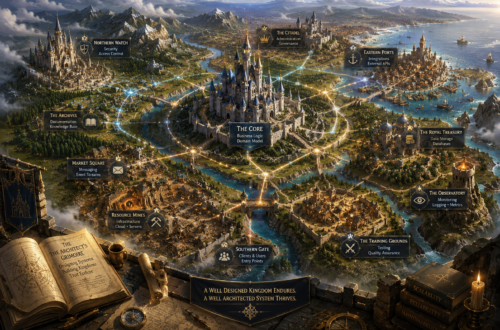
    An epic fantasy map-style illustration depicts a thriving kingdom viewed from above, with a grand central castle labeled "The Core" connected by glowing roads and magical pathways to surrounding regions. Each district represents a software architecture concept, including Northern Watch (Security and Access Control), Eastern Ports (Integrations and External APIs), The Royal Treasury (Data Storage and Databases), The Observatory (Monitoring and Metrics), The Training Grounds (Testing and Quality Assurance), Market Square (Messaging and Event Streams), Resource Mines (Infrastructure and Servers), The Archives (Documentation and Knowledge Base), and Southern Gate (Clients and Users). In the foreground, an open book titled The Architect's Grimoire rests on a stone table alongside maps, drafting tools, and architectural plans. A banner reads, "A Well Designed Kingdom Endures. A Well Architected System Thrives." The image uses fantasy kingdom imagery to visualize software architecture as an interconnected, carefully planned realm.

    Building Kingdoms That Endure

    June 28, 2026
  • The Architect's Grimoire (13)
  • The CSS Codex (13)
  • The Enchanted Workshop (9)
  • The Full-Stack Campaign (7)
  • The Guildmaster’s Handbook (13)

AI-Assisted Development Artificial Intelligence Backend Development Career Development Clean Code Code Quality CSS CSS Architecture CSS Best Practices CSS Fundamentals CSS Layout Design Systems Developer Education Developer Growth Developer Productivity Dungeons and Dragons Engineering Culture Engineering Judgment Engineering Leadership Fantasy Theme Front-End Development Frontend Development Full Stack Development Maintainable Code Maintainable CSS Mentorship Professional Development Professional Growth Refactoring Responsive Design Software Architecture Software Craftsmanship Software Design Software Development Software Engineering StackNScroll System Design Technical Debt Technical Leadership The Architect's Grimoire The CSS Codex The Enchanted Workshop The Full-Stack Campaign The Guildmaster's Handbook Web Development

Stack N' Scroll - 2026 ©