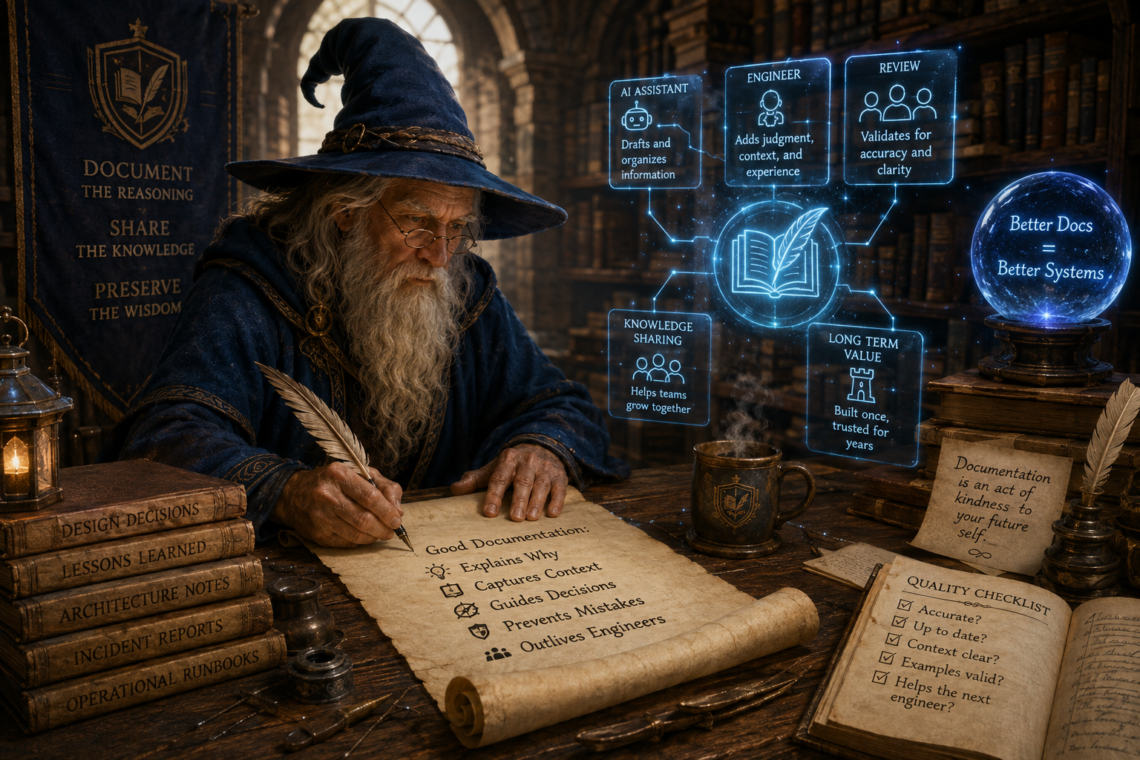
The Endless Scribe: Writing Documentation with AI
The fastest quill is worthless if no one can read what it writes.
Software has a remarkable ability to outlive the people who create it. A feature completed during a single sprint may continue serving customers for a decade. Entire engineering organizations evolve around systems whose original architects have long since moved on. New developers inherit the code, extend it, modernize it, and occasionally struggle against it without ever hearing the conversations that shaped its design. By the time software reaches maturity, its greatest challenge is rarely understanding what it does. The real challenge is understanding why thoughtful engineers decided it should behave that way.
The software itself may remain familiar, but the reasoning behind it slowly becomes a foreign language. Every design decision that goes undocumented slowly loses context as teams change, businesses evolve, and production systems grow beyond what their original creators imagined. Eventually, even well-written code begins asking questions it can no longer answer. That is the moment documentation stops being a convenience and becomes an essential engineering asset.
Artificial intelligence appears to offer an answer to one of software engineering’s oldest frustrations. Modern language models can generate API documentation, summarize repositories, draft architecture guides, create onboarding materials, write release notes, and explain unfamiliar code in minutes rather than days. For engineering teams whose documentation has steadily fallen behind years of development, that promise is understandably exciting. If AI can write almost effortlessly, perhaps documentation will finally remain synchronized with the software it describes.
The appeal is genuine because documentation has traditionally been viewed as a cost rather than an investment. Engineers naturally enjoy designing systems, solving production problems, and building new capabilities. Documentation often becomes the responsibility postponed until after the feature has shipped. Every experienced team has promised to return later and update the README, expand the architecture guide, or improve the deployment instructions. Unfortunately, later usually arrives after the discussions, tradeoffs, and design decisions have already faded from memory.
Throughout The Enchanted Workshop, we have repeatedly discovered that every magical tool follows the same principle. A familiar becomes valuable because of the wizard guiding it. A spell succeeds because it was crafted with precision. A crystal ball becomes trustworthy only after careful verification. Documentation follows exactly the same pattern. AI can write faster than any engineer who has ever lived, but speed has never been the quality that separates documentation people appreciate from documentation people actually trust.
Imagine descending into the Grand Archive beneath the royal workshop. Endless shelves stretch into the darkness, filled with beautifully illuminated manuscripts recording centuries of magical discovery. Every scroll is perfectly copied. Every volume is meticulously indexed. Every shelf is arranged with extraordinary care. Visiting scholars leave convinced they have witnessed the greatest library in the kingdom. Yet the master librarians quietly recognize a flaw hidden beneath its beauty. The archive has preserved every spell ever written, but it has forgotten many of the lessons that shaped those spells.
One manuscript describes the original Frost Barrier protecting the northern tower. A second records a revised version containing additional protective runes. A third replaces the enchantment almost entirely with a more complicated design. Every version survives in perfect condition, yet none explain why the earlier barriers failed. No apprentice reading those spellbooks learns that winter moisture accumulated within the tower walls, gradually weakening the stone until an entire section collapsed during an unusually harsh season. The implementation survived because every manuscript faithfully preserved it. The engineering judgment disappeared because no one thought to preserve the experience that inspired the redesign.
Software repositories often suffer from exactly the same illusion. Hundreds of pages of documentation create the appearance of organizational knowledge while leaving the most important engineering decisions undocumented. Future developers discover detailed API references, exhaustive configuration guides, and carefully formatted code comments. What they cannot find are the discussions explaining why asynchronous messaging replaced synchronous requests, why a seemingly redundant validation protects an expensive business process, or why a performance optimization was intentionally rejected in favor of operational simplicity. The repository contains plenty of information. It contains far less wisdom.
That distinction is the first lesson every experienced engineer eventually learns. Documentation is not measured by the number of pages it contains. It is measured by the number of costly mistakes it prevents. Source code explains what the computer does. Documentation should explain why experienced engineers decided the computer ought to do it that way. Every undocumented architectural decision eventually becomes someone else’s mystery, and every forgotten lesson eventually becomes someone else’s production incident.
The Librarian’s First Lesson
Nearly every software engineer remembers the first time they inherited a mature production system. At first, the unfamiliar code seems intimidating simply because it belongs to someone else. After careful reading, however, the implementation gradually reveals itself. Variables become meaningful. Design patterns emerge. Business workflows begin making sense. Then an unexpected decision appears. A timeout value seems oddly specific. A validation occurs in an unusual sequence. A cache expires after a surprisingly long interval. A configuration option appears unnecessarily restrictive. The implementation clearly works, yet the reasoning behind those choices remains invisible.
That experience permanently changes how documentation is viewed. Engineers eventually realize that comments should not compete with source code by repeating what every reader can already observe. Instead, documentation should preserve the conversations, assumptions, constraints, and tradeoffs that disappear the moment the original authors leave the project. Regulatory requirements, production incidents, customer commitments, architectural compromises, and operational lessons rarely survive inside the implementation itself. Those are precisely the details future engineers need before confidently modifying a mature system.
Consider a straightforward function that archives completed customer orders.
</> Python

def archive_orders(orders):
    eligible = [o for o in orders if o.status == "completed"]
    return archive_service.store(eligible)
Without additional context, an AI assistant will usually produce documentation like this.
</> Python

def archive_orders(orders):
    """
    Archives completed customer orders.

    Args:
        orders: Collection of customer orders.

    Returns:
        Archived completed orders.
    """
    eligible = [o for o in orders if o.status == "completed"]
    return archive_service.store(eligible)
The documentation is grammatically correct, consistently formatted, and technically accurate. It also contributes very little that an experienced engineer could not discover simply by reading the implementation. The comments translate Python into English without preserving a single engineering decision. Six months later, another developer still has no idea why archived orders must satisfy these particular conditions or what consequences might follow if those conditions are changed.
Now imagine the missing context. Completed orders remain editable for 90 days due to consumer protection laws in several countries. Enterprise customers negotiate permanent archival under contractual obligations. Healthcare transactions follow an entirely different retention policy. Canceled orders are intentionally excluded because another compliance system already manages them. Suddenly the filtering logic becomes the least interesting part of the function. The important information lies entirely outside the implementation, and that information belongs in documentation because source code alone can never explain it.
Experienced engineers therefore ask a very different question when reviewing documentation. They no longer ask whether comments accurately describe the implementation. They ask whether documentation explains the decisions behind the implementation. That subtle shift completely changes how AI should be used. Instead of generating explanations for code everyone can already read, AI should help preserve the engineering judgment that future developers cannot recover on their own.
The Endless Scribe Learns a Better Question
Within the Grand Archive works an apprentice whose handwriting has become legendary throughout the kingdom. The young scribe copies spellbooks at astonishing speed, producing flawless manuscripts before most scholars have finished reading the originals. Every page is immaculate. Every illustration is perfectly reproduced. Visiting dignitaries marvel at the apprentice’s efficiency and conclude that no greater record keeper has ever served the workshop.
One afternoon, the oldest wizard in the library presents the apprentice with a deceptively simple question.
Why was the Frost Barrier completely redesigned after the northern tower collapsed?
The apprentice searches every shelf. The original spell is there. The revised spell is there. Every later edition survives exactly as written. Yet nowhere in the archive can the apprentice find the answer. The books faithfully preserved the implementation while silently allowing the engineering lesson to disappear.
Artificial intelligence behaves much like that apprentice when engineers ask it to document source code without additional context. It can describe everything visible in the repository because the implementation is observable. It cannot reliably preserve design meetings, architecture reviews, customer negotiations, production incidents, or business discussions that were never added to the repository. The limitation is not intelligence. The limitation is information.
Experienced engineering organizations eventually recognize this distinction and change the role AI plays within their documentation process. Rather than asking AI to explain code, they ask it to connect engineering artifacts into a coherent narrative. Design proposals, pull request discussions, production retrospectives, architecture reviews, customer requirements, and operational notes serve as the source material for assembling documentation. AI stops behaving like an automated commenting tool and begins acting as an editorial assistant helping preserve institutional memory.
This approach also changes how documentation fits into the daily development workflow. Instead of waiting until a feature is complete, many teams capture knowledge continuously. An architect records the reasoning behind a design proposal. AI transforms that proposal into an initial Architecture Decision Record. During implementation, important design discussions from pull requests are summarized into updates for the project’s engineering handbook. Before the feature is merged, AI proposes revisions to the README, deployment guide, and onboarding documentation, allowing reviewers to verify that both the implementation and the supporting knowledge remain accurate.
That workflow demonstrates an important principle. AI is not replacing documentation. It is removing much of the mechanical work that once prevented engineers from documenting what truly mattered. Engineers remain responsible for preserving judgment. AI simply provides a faster, more organized way to capture it before the experience quietly disappears.
The Workshop Ledger
Every accomplished workshop keeps far more than blueprints. Alongside shelves of finished spellbooks sit ledgers describing failed experiments, abandoned designs, costly repairs, and discoveries that no future apprentice should be forced to learn through failure. Those records rarely explain how to cast a spell because the spellbook already serves that purpose. Instead, they explain why one technique replaced another, why an apparently elegant shortcut proved unreliable, and why an expensive decision ultimately saved the kingdom years later. Over time, these ledgers become more valuable than the blueprints themselves because they preserve engineering judgment instead of merely recording implementation.
Professional software organizations benefit from exactly the same philosophy. Architecture Decision Records explain why one design was selected instead of another. Operational runbooks capture hard-earned lessons from production incidents. Deployment guides preserve subtle sequencing requirements that nobody remembers until a release unexpectedly fails. Migration documents explain why a system evolved in a particular direction. Well-written pull requests often contain architectural discussions that deserve a permanent home instead of disappearing into version control history after the merge is complete. The most valuable documentation rarely describes what engineers built. It explains why they deliberately chose one path over several reasonable alternatives.
Artificial intelligence excels at transforming these scattered engineering artifacts into coherent documentation. Design meetings become architecture summaries. Pull request discussions become implementation guides. Incident timelines become troubleshooting references. Customer requirements become business rule documentation. Rather than starting every document with an empty page, engineers begin with an organized draft assembled from existing knowledge. The review process becomes dramatically more valuable because engineers spend their time refining important decisions instead of formatting paragraphs or rewriting information already scattered across half a dozen systems.
This distinction changes the entire purpose of AI-assisted documentation. The objective is no longer generating words as quickly as possible. The objective is preserving engineering knowledge before it quietly disappears. Teams stop asking AI to invent explanations and begin asking it to organize experience that already belongs to the organization. Documentation becomes less about describing software and more about preserving the reasoning that allowed the software to succeed in the first place.
The Cartographer’s Archive
One of the easiest mistakes organizations make after adopting AI is confusing complete documentation with useful documentation. Modern language models can produce hundreds of pages describing classes, APIs, configuration files, deployment steps, and database schemas with extraordinary consistency. Every heading appears polished. Every paragraph is grammatically correct. Every section looks professional. Yet when a production incident occurs, engineers often discover that the documentation answers dozens of questions nobody is asking while remaining silent about the handful of questions everyone desperately needs answered.
Imagine two maps of the same kingdom. The first identifies every road, every bridge, every stream, every village, and every forest with painstaking detail. It is comprehensive and technically flawless. The second omits many of those details, choosing instead to identify unstable bridges, seasonal flooding, dangerous mountain passes, dependable supply routes, and hidden shortcuts known only to experienced travelers. The second map contains less information, yet it provides significantly more value because it captures experience instead of simply recording geography. Travelers reach their destination safely not because they know everything about the kingdom, but because they know which details actually influence their decisions.
Documentation should strive to become the second map. Experienced engineers eventually stop asking whether documentation explains everything and begin asking whether it helps future developers make better decisions. An exhaustive configuration guide provides little value if it never explains which settings should almost never be changed. An API reference remains incomplete if it fails to record the business assumptions that shaped the interface. Documentation earns its place within a repository when it reduces uncertainty rather than increasing the amount of reading required before making a change.
One question has guided many successful documentation reviews throughout my career.
Will this help the next engineer make a better decision?
If the answer is no, the paragraph probably belongs in the editing pile instead of the repository. Documentation should compete for a reader’s attention the same way production code competes for CPU cycles. Every sentence should justify its existence because every unnecessary sentence makes an important one slightly harder to find.
Teaching the Endless Scribe
The quality of AI-generated documentation is determined long before the first sentence appears on the screen. It is determined by the quality of the engineering context provided to the model. This lesson mirrors what we explored in our discussion of prompt engineering. Better context consistently yields better results, whether AI is generating source code, summarizing architecture, or writing documentation. Experienced engineers therefore spend less effort searching for magical prompts and considerably more effort supplying meaningful engineering information.
Consider the difference between these two requests.
Document this payment service.The request is understandable, but it gives AI almost nothing beyond the implementation itself. The resulting documentation will almost certainly describe methods, classes, configuration values, and request flows because those are the only facts immediately available. While technically correct, the document will probably add little that another engineer could not discover by spending a few minutes reading the repository. It is documentation that sounds useful without preserving the knowledge that actually matters.
Now compare that with a request built around engineering judgment.
Create internal engineering documentation for this payment service.

Explain:

• Why this architecture was selected.
• Business rules that future developers must preserve.
• Regulatory requirements influencing implementation.
• Performance assumptions behind major design decisions.
• Operational risks affecting deployment.
• Known technical debt accepted intentionally.
• Planned areas for future improvement.

Avoid repeating implementation details that are already obvious from the source code.
The second prompt asks AI a fundamentally different question. Instead of translating the implementation into English, it organizes the reasoning behind it. The resulting document becomes valuable because it captures knowledge that would otherwise remain scattered across architecture reviews, issue trackers, meeting notes, customer discussions, and production retrospectives. AI stops behaving like an automated commenting tool and begins acting like an experienced technical editor helping engineers preserve institutional memory.
Documentation as Code
One of the healthiest changes modern engineering teams have embraced is treating documentation as another part of the codebase rather than a separate collection of files maintained only when someone remembers they exist. Documentation lives beside the software in version control. It evolves through pull requests. It receives peer review. It follows the same branching strategy, release cadence, and quality expectations as the implementation itself. When documentation changes alongside the software, engineers gain confidence that both represent the same understanding of the system.
Artificial intelligence fits naturally into this workflow because it excels at identifying relationships between implementation changes and documentation updates. Suppose an engineer introduces a distributed caching layer. AI can recognize that the deployment guide, architecture diagram, onboarding material, operational runbook, and Architecture Decision Record may all require review before the feature is considered complete. Rather than relying on memory alone, documentation becomes another artifact that evolves through the same engineering process as the code. AI is not replacing careful engineering review. It is making it much harder for valuable knowledge to quietly drift out of date.
A typical workflow might look something like this:
Feature Design
      ↓
AI drafts Architecture Decision Record
      ↓
Engineer reviews and revises
      ↓
Implementation completed
      ↓
Pull Request opened
      ↓
AI proposes README, runbook, and API updates
      ↓
Peer review verifies both code and documentation
      ↓
Merge and release
Notice that AI never replaces engineering judgment at any stage. It accelerates the repetitive work of organizing information, identifying documents affected by a change, and drafting revisions for review. Engineers continue to make every important decision, while AI removes much of the administrative effort that once discouraged teams from maintaining excellent documentation. The result is a development process in which documentation evolves continuously instead of becoming another forgotten task postponed until the next major release.
Documentation Debt Is Still Technical Debt
Engineers readily recognize outdated source code as technical debt, yet outdated documentation often escapes the same scrutiny. This inconsistency creates a hidden liability that rarely appears on sprint boards or project dashboards because it does not break a build or cause automated tests to fail. Instead, its costs accumulate quietly. New engineers require weeks instead of days to become productive. Production incidents take longer to resolve because critical operational knowledge exists only in someone’s memory. Design discussions repeatedly revisit architectural decisions that were carefully debated years earlier because nobody can locate the reasoning behind them. The software continues to function, but the organization’s ability to understand and safely evolve it steadily declines.
In many respects, inaccurate documentation is more dangerous than missing documentation. When engineers discover no documentation, they naturally investigate further before making changes. When they discover documentation that appears polished and authoritative, they instinctively trust it. An obsolete deployment guide can introduce downtime during an otherwise routine release. A stale architecture diagram can lead an incident response team to investigate the wrong subsystem. An outdated API example can quietly become the template for entirely new features built upon assumptions that are no longer true. Poor documentation rarely fails loudly. It quietly encourages confident mistakes that ripple through a codebase for months before anyone realizes the problem’s original source.
Artificial intelligence provides an opportunity to address this problem differently. Rather than treating documentation as a static deliverable completed at the end of a project, engineering teams can treat it as another continuously evolving artifact. AI can compare implementation changes against existing documentation, identify sections likely to be outdated, draft release notes from completed pull requests, and suggest revisions to operational guides before those discrepancies become institutional knowledge. None of these activities replace engineering review, but they dramatically reduce the mechanical effort required to keep documentation synchronized with reality. Documentation begins evolving at the same pace as the software itself, rather than lagging behind each release.
This shift represents a broader change in engineering philosophy. Documentation ceases to become an obligation completed after development and instead becomes another component of the software itself. Just as automated tests help protect implementation quality, continuously maintained documentation helps protect organizational understanding. Both reduce future maintenance costs by preserving information that would otherwise disappear over time. Good software survives deployments. Good documentation survives generations of engineers.
The Master Librarian’s Review
No matter how capable artificial intelligence becomes, every important document still requires an experienced editor. This should not be interpreted as a weakness of AI. It is simply recognition that software engineering remains a discipline built upon judgment rather than language generation. Language models produce remarkably convincing prose. Engineers determine whether that prose accurately reflects business requirements, operational realities, architectural intent, and years of accumulated production experience.
This observation echoes nearly every lesson explored throughout The Enchanted Workshop. We learned to verify AI-generated code before deploying it. We learned to question AI-generated answers before accepting them as fact. Documentation deserves exactly the same discipline because inaccurate explanations can survive unnoticed far longer than incorrect implementations. Broken code eventually encounters a compiler, a failing unit test, or a production incident. Incorrect documentation may continue to shape engineering decisions for years before anyone recognizes that it has quietly drifted away from reality. Trustworthy documentation therefore deserves the same careful review process as trustworthy software.
Experienced teams review documentation with the same rigor they apply to production code. They verify that architectural trade-offs have been accurately preserved. They confirm that business constraints still reflect current policy. They ensure examples match the latest implementation. They remove assumptions AI inferred but the engineering team never actually accepted. Most importantly, they ask whether the document genuinely helps the next engineer make better decisions rather than simply describing code that any competent developer could already understand. Every review strengthens the organization’s collective memory and reinforces confidence that the documentation can be trusted for future development.
One review checklist I have found particularly valuable asks four straightforward questions before documentation is approved.
- Does this explain why the decision was made?
- Will a future engineer understand the important tradeoffs?
- Does every example still match the current implementation?
- Would I trust this document during a production incident?
Notice that none of those questions concern writing style. They concern trust. Documentation succeeds not because every sentence is elegant, but because every important statement is dependable. The master librarian never judged a manuscript by the beauty of its handwriting alone. Its true value was determined by whether future generations could safely rely upon the knowledge it preserved.
The Guild’s Definition of Done
One of the healthiest cultural changes an engineering organization can make is expanding its definition of completed work. Delivering working software is certainly an important milestone, but experienced teams recognize that implementation alone rarely represents the end of the engineering effort. If future developers cannot understand the reasoning behind a solution, then part of the work remains unfinished regardless of how elegant the implementation may be. Documentation should therefore be viewed not as an optional deliverable, but as another expression of engineering quality.
Artificial intelligence makes this broader definition of done significantly easier to achieve. Rather than asking engineers to start every document on a blank page, AI assembles an organized first draft from design proposals, meeting notes, architecture reviews, pull requests, production retrospectives, and implementation details. Engineers spend their time evaluating engineering decisions rather than formatting documents or rewriting information that is already scattered across multiple systems. The repetitive work shrinks dramatically while the intellectual responsibility remains exactly where it belongs.
Organizations that integrate AI into their development workflow often discover that documentation becomes a natural extension of software delivery. Design discussions produce Architecture Decision Records. Pull request reviews generate updates to engineering guides. Release preparation includes AI-generated drafts of release notes that engineers verify before publication. Operational runbooks evolve alongside infrastructure changes as AI identifies which documents are affected by each implementation. Documentation no longer waits for a future cleanup effort; preserving knowledge has become another routine engineering activity performed continuously throughout development.
This approach produces an important long-term benefit that extends well beyond better documentation. Teams gradually develop the expectation that every meaningful engineering decision deserves to be preserved while the reasoning remains fresh. Instead of relying upon memory months later, they capture architectural judgment immediately. AI accelerates the process, but engineers remain responsible for deciding which lessons deserve to become part of the organization’s permanent record.
The Legacy Worth Leaving Behind
Every software system eventually becomes a conversation between generations of engineers. One team lays the foundation. Another expands the architecture. A third modernizes aging components. Years later, someone who has never met any of the original developers inherits responsibility for keeping the system healthy. That engineer inherits far more than source code. They inherit every design decision, every operational lesson, every architectural compromise, and every piece of engineering wisdom that previous teams chose to preserve.
Artificial intelligence has the potential to become one of the most valuable documentation tools our profession has ever possessed, but only if we ask it to preserve wisdom rather than merely generate words. The endless scribe of the Grand Archive can copy every spell with flawless handwriting, organize every manuscript with perfect consistency, and produce beautiful volumes faster than any human scholar could hope to match. Yet the scribe cannot determine which hard-earned lesson belongs in the margin for future generations. That responsibility still belongs to experienced engineers because experience, not eloquence, determines what deserves to be remembered.
Perhaps that is the greatest lesson hidden within the Workshop’s library. The kingdom never celebrated its scribes because they filled shelves with beautiful books. It celebrated them because each carefully preserved manuscript allowed the next generation of wizards to begin where the previous generation had ended. Knowledge accumulated instead of disappearing. Wisdom became an inheritance instead of a lesson every apprentice was forced to learn through failure. Documentation is not written for today’s engineer. It is written for the engineer who has not yet arrived.
As we continue this week’s theme, Crafting Better Magic, remember that every AI tool becomes more valuable when it amplifies engineering judgment instead of replacing it. Documentation exists to preserve the reasoning that future engineers cannot recover simply by reading source code. Artificial intelligence gives us the fastest quill our profession has ever possessed, but the value of every document will always be measured by the engineering wisdom it protects for those who follow.
On Wednesday, our journey through The Enchanted Workshop continues with The Tireless Golem: Building Better Tests with AI. Documentation tells future engineers what a system is intended to do and why those decisions were made. Automated tests prove that the system still behaves in accordance with those decisions. Together, they preserve both understanding and confidence, ensuring that every generation of engineers inherits software they can not only maintain, but also trust enough to improve.


You May Also Like
Forbidden Tomes: AI, Security, and Responsible Engineering
The Crystal Ball Lies Sometimes: Verifying AI Before You Trust It