• An elderly wizard in deep blue robes sits at a wooden desk inside a grand medieval library, carefully writing on a parchment with a feather quill. Shelves of ancient books fill the background beneath tall stone arches, creating the atmosphere of a magical archive. Around the wizard, glowing blue holographic panels illustrate an AI-assisted documentation workflow, showing an AI assistant drafting information, an engineer adding judgment and context, and a review process validating accuracy and clarity before documentation is shared. Stacks of books labeled Design Decisions, Lessons Learned, Architecture Notes, Incident Reports, and Operational Runbooks reinforce the importance of preserving engineering knowledge. A scroll on the desk highlights the qualities of effective documentation, including explaining why decisions were made, capturing context, guiding future decisions, preventing mistakes, and outliving the original engineers. Nearby, a documentation quality checklist emphasizes accuracy, current information, clear context, valid examples, and usefulness to future team members. A glowing crystal orb displays the message Better Docs = Better Systems, visually connecting thoughtful documentation, AI-assisted knowledge sharing, and long-term software maintainability.
    The Enchanted Workshop

    The Endless Scribe: Writing Documentation with AI

    The fastest quill is worthless if no one can read what it writes. Software has a remarkable ability to outlive the people who create it. A feature completed during a single sprint may continue serving customers for a decade. Entire engineering organizations evolve around systems whose original architects have long since moved on. New developers inherit the code, extend it, modernize it, and occasionally struggle against it without ever hearing the conversations that shaped its design. By the time software reaches maturity, its greatest challenge is rarely understanding what it does. The real challenge is understanding why thoughtful engineers decided it should behave that way. The software itself may remain…

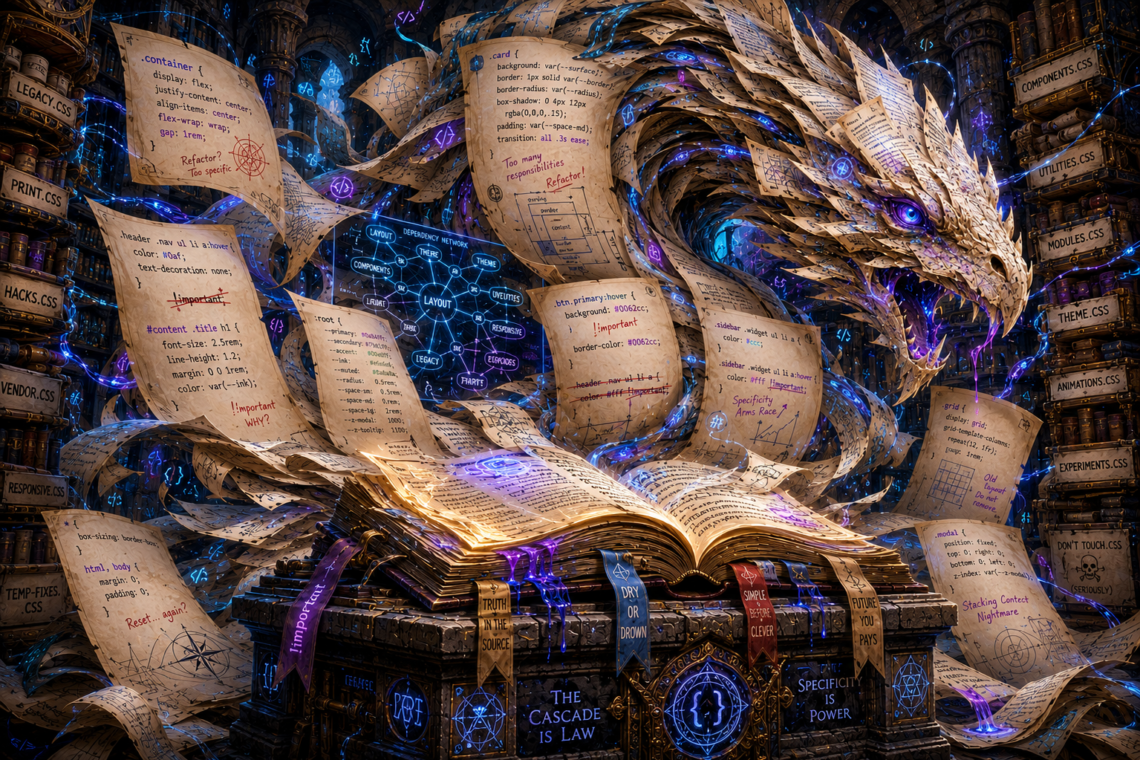
  • An enormous ancient spellbook rests on a carved stone pedestal in a vast arcane archive as hundreds of stylesheet-like parchment pages erupt from its open pages and merge into a colossal serpentine creature made entirely of CSS rules, annotations, diagrams, revisions, and glowing magical symbols. The parchment monster coils through towering shelves filled with labeled codices while streams of luminous blue and violet magical energy connect scattered documents into a sprawling network of dependencies. Individual pages display selectors, properties, comments, crossed-out declarations, and specificity notes, emphasizing accumulated technical debt and architectural complexity. The scene is illuminated by glowing runes, magical ink, and dramatic volumetric light, creating the impression of a once-useful body of knowledge that has grown beyond its original purpose and become an intelligent living manifestation of an unmaintainable stylesheet.
    The CSS Codex

    When the Stylesheet Becomes the Monster

    Ignore a growing beast long enough and eventually it guards the dungeon. Editor’s Note: This article originally appeared on RandomThoughtsInTraffic.com and has been revised and expanded for StackNScroll as the closing chapter of The CSS Codex. The original edition explored how CSS codebases gradually become more difficult to maintain as shortcuts, overrides, and exceptions accumulate over time. This updated version expands that discussion with deeper examination of architectural drift, technical debt, component design, specificity management, long-term maintenance practices, and the warning signs that experienced engineers learn to recognize before problems become crises. It also serves as a capstone for the broader lessons explored throughout The CSS Codex, bringing together concepts…