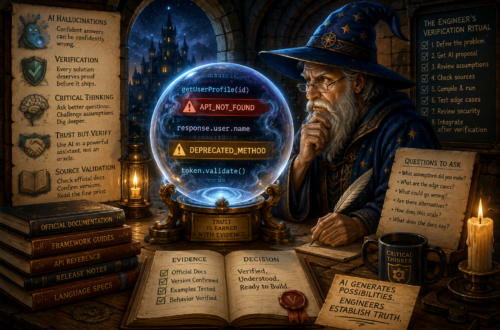

The Wizard’s New Apprentice: Working Alongside AI
The greatest familiar is still only as wise as the wizard who commands it.
Every generation of software engineers encounters a tool that promises to change the profession forever. Assembly language gave way to higher-level languages. Manual deployments yielded to continuous integration and continuous delivery. Virtual machines evolved into cloud platforms. Each innovation made building software faster, but none diminished the importance of sound engineering judgment. Artificial intelligence represents the latest transformation in that long history. It is a remarkable addition to the workshop, but it remains exactly that: an addition. The craft itself has not changed nearly as much as the tools we use to practice it.
The excitement surrounding AI is understandable. Within seconds, it can generate classes, explain unfamiliar frameworks, draft documentation, propose unit tests, identify potential defects, and even suggest architectural alternatives. For engineers who have spent years writing repetitive boilerplate or searching documentation, the experience can feel almost magical. Yet every experienced developer eventually learns that software engineering has never been limited by typing speed. The greatest challenges have always involved understanding problems, evaluating tradeoffs, and making decisions that continue serving a system years after the original implementation has faded into memory.
That distinction forms the foundation of this first chapter of The Enchanted Workshop. Throughout this week’s theme, Meeting the Familiar, we will explore how artificial intelligence fits naturally into the engineering profession without replacing the skills that define it. Fantasy literature offers an unexpectedly useful metaphor. A wizard’s familiar is an intelligent companion that extends the wizard’s reach, performs valuable work, and faithfully follows direction. Even the most gifted familiar, however, does not decide which spells deserve to be cast or what consequences those spells might carry. Wisdom remains the responsibility of the wizard.
Artificial intelligence occupies much the same role within modern software engineering. It extends our capabilities, accelerates repetitive tasks, and provides another perspective during problem-solving. It does not assume ownership of production systems, negotiate conflicting business requirements, or accept responsibility for architectural decisions. Those duties continue to belong to the engineers building the software. Understanding that distinction is perhaps the single most important lesson any developer can learn as AI becomes an increasingly common companion inside the workshop.
The greatest engineering advantage AI provides is not faster code generation. It is more time to practice engineering judgment.
Entering the Workshop
Imagine walking into the workshop of an accomplished archmage. The room is filled with carefully organized shelves of spellbooks, drafting tables covered in architectural drawings, and cabinets containing decades of accumulated knowledge. Nothing about the workshop appears chaotic because every tool exists for a purpose. Near one table sits a young familiar, carefully copying manuscripts, organizing scrolls, and preparing materials for the day’s work. The familiar is diligent, attentive, and remarkably capable, but nobody mistakes it for the master of the workshop. Its value comes from extending the master’s abilities rather than replacing them.
Software engineering has always embraced this model of assistance. Compilers translate human-readable code into machine instructions without deciding what the software should accomplish. Version control systems preserve history without determining which changes belong in production. Continuous integration servers execute thousands of automated tests without understanding the business value those tests protect. Every successful engineering tool amplifies human capability while leaving responsibility exactly where it belongs.
Artificial intelligence simply represents the most capable assistant we have welcomed into the workshop so far.
Viewing AI through this lens immediately changes the conversation. Instead of asking whether AI can build software, experienced engineers begin asking whether AI helps them build better software. They evaluate suggestions against architectural principles rather than accept them simply because they appear plausible. They question generated implementations with the same curiosity they would apply during a peer review. Most importantly, they recognize that accountability never transfers simply because a machine proposed the solution.
That final point deserves emphasis because it shapes every professional engineering decision that follows. When production fails, customers do not care whether defective code originated from a human developer or an AI assistant. Systems still require recovery. Teams still conduct postmortems. Engineers still improve the architecture to prevent similar failures. Ownership remains unchanged because responsibility has never depended upon who typed the code.
The keyboard may belong to AI, but the architecture always belongs to the engineer.
That sentence will remain true regardless of how sophisticated future language models become.
The Familiar’s First Lessons
Much of the public discussion surrounding AI focuses on speed. Demonstrations highlight how quickly an application can be scaffolded or how many lines of code appear after a single prompt. Those demonstrations are impressive, but they measure only one dimension of professional software development. Production systems rarely struggle because engineers type too slowly. They struggle because seemingly reasonable decisions accumulate into unnecessary complexity, because assumptions prove incorrect, or because today’s shortcut quietly becomes tomorrow’s technical debt.
Consider a team building a new payment platform. AI can rapidly generate REST endpoints, validation classes, persistence layers, configuration files, and dozens of accompanying unit tests. Within minutes, an impressive amount of software exists. Everything compiles successfully. Static analysis reports no obvious issues. The generated code even follows familiar framework conventions.
Yet none of those accomplishments answer the questions that ultimately determine whether the system succeeds.
Should payment authorization and settlement belong within the same bounded context? How should retries behave when communication with an external provider becomes unreliable? Which operations require strong consistency, and where is eventual consistency acceptable? How should audit records be preserved for future regulatory requirements? Which components deserve redundancy because their failure would interrupt revenue generation?
These questions cannot be answered by pattern matching alone. They require business understanding, operational experience, architectural philosophy, and thoughtful consideration of competing priorities. AI can offer suggestions for each discussion, but it cannot determine which tradeoffs best serve a particular organization. That responsibility belongs to engineers because only engineers possess the broader context in which those decisions must be made.
Perhaps that explains why experienced software architects often appear remarkably calm about AI adoption. They recognize that generating code has never represented the profession’s greatest challenge. Knowing which code deserves to exist has always been considerably more difficult.
Every line of generated code is borrowed confidence until an engineer truly understands it.
The Wizard’s Workbench
Recognizing AI as an apprentice rather than an oracle naturally changes how we assign work. Throughout history, apprentices have learned by handling repetitive yet meaningful tasks, freeing experienced craftspeople to focus on decisions requiring deeper expertise. The same pattern applies inside modern development teams. AI excels at accelerating activities that benefit from broad knowledge but require relatively little architectural judgment.
Documentation is an excellent example. Producing accurate API descriptions, summarizing design documents, or generating initial implementation notes often consumes valuable engineering time without demanding extensive creative reasoning. Likewise, generating an initial suite of unit tests, proposing data transformation logic, or drafting repetitive configuration files allows engineers to concentrate on more significant architectural concerns. These are exactly the kinds of responsibilities a capable apprentice should perform.
Suppose you have implemented a utility to validate user email addresses throughout an application. Writing comprehensive test cases can be repetitive, even though those tests remain essential for long-term reliability. Rather than manually creating dozens of nearly identical scenarios, you might ask AI to draft an initial collection of tests.
</> Java

@Test
void rejectsInvalidEmailAddresses() {
    assertFalse(EmailValidator.isValid("example"));
    assertFalse(EmailValidator.isValid("@domain.com"));
    assertFalse(EmailValidator.isValid("user@"));
    assertFalse(EmailValidator.isValid("user@@domain.com"));
}

@Test
void acceptsValidEmailAddresses() {
    assertTrue(EmailValidator.isValid("alice@example.com"));
    assertTrue(EmailValidator.isValid("bob.smith@company.org"));
}
The value of this interaction is not that AI produced a useful starting point. The real value emerges during the engineer’s review. Business rules may require additional validation beyond standard email formats. Security requirements may demand protection against malformed input. Historical production incidents may reveal edge cases that no general-purpose language model could reasonably anticipate. The apprentice accelerates the first draft, while the engineer ensures the finished work reflects the realities of the system it must serve.
That pattern illustrates one of the healthiest ways to collaborate with AI. The familiar performs diligent work, but the wizard inspects every spell before it leaves the workshop.
Teaching the Familiar
One of the first lessons every experienced engineer learns after adopting AI is that the quality of the answers rarely exceeds the quality of the conversation. Many developers initially expect AI to function like a search engine that simply returns the correct solution after a single request. They become frustrated when the response feels generic or misses important architectural details. The disappointment usually stems from a misunderstanding of how productive collaboration actually works. AI begins every conversation with broad technical knowledge but almost no understanding of your specific application. Like a new apprentice entering an unfamiliar workshop, it knows many techniques but none of your established practices.
Imagine hiring a talented junior engineer on Monday morning. By lunchtime, you would not ask them to redesign your payment platform without first explaining the business domain, architectural standards, deployment process, coding conventions, and long-term objectives. Instead, you would spend time introducing the workshop itself. You would explain how previous decisions were made, why certain patterns exist, and what kinds of tradeoffs your organization values. Only then would meaningful engineering begin.
Artificial intelligence deserves the same introduction.
Context extends far beyond source code. It includes business requirements, architectural principles, performance expectations, security standards, operational history, deployment environments, coding conventions, and the lessons your team has already learned through years of maintaining the application. None of those ideas appear inside a single function, yet together they determine whether a proposed solution strengthens the system or quietly undermines it. Without that context, AI fills the gaps with reasonable assumptions. Unfortunately, software architecture rarely rewards reasonable assumptions.
Experienced engineers therefore spend surprisingly little time asking AI for code and considerably more time describing the environment in which that code must exist. They explain the workshop before requesting another tool from the workbench. That small shift produces dramatically better results because it replaces guessing with understanding.
AI becomes more intelligent as your engineering context becomes more complete.
The Apprentice Cannot Read Your Spellbook
There is another misconception that quietly limits many AI conversations. Developers often believe prompt engineering is primarily about discovering clever wording or hidden phrases that somehow unlock perfect responses. The reality is considerably less mysterious and far more useful. Effective prompt engineering resembles good technical communication rather than magical incantation. Clear requirements have always produced better software, whether those requirements are shared with another engineer or with an AI assistant.
Consider two requests for the same feature.
The first provides almost no architectural context.
Create a REST API for managing users.The second treats AI like an engineer joining an established project.
Create a Spring Boot REST API for managing users.

Requirements:
- Existing PostgreSQL database
- JWT authentication already implemented
- Soft deletes only
- Optimistic locking required
- Follow existing layered architecture
- Standardized API error responses
- Prioritize maintainability over cleverness
- Include unit tests for business logic
Notice that the second request does not rely on clever wording or obscure prompt techniques. Instead, it communicates the same information an experienced software architect would provide during a project kickoff meeting. It explains the existing system before discussing implementation. Every requirement narrows the design space until AI no longer needs to invent missing details.
This observation reveals something surprisingly encouraging. Good prompt engineering is largely an extension of good software engineering. Developers who already write thoughtful design documents, maintain clear requirements, and communicate effectively during code reviews often become productive AI users almost immediately. They are simply applying the same professional habits to a different collaborator.
That is why I suspect prompt engineering will eventually become less of a specialized discipline and more of an ordinary engineering skill. As AI becomes another member of the workshop, communicating effectively with it will feel no more unusual than writing a design specification or reviewing a pull request.
When the Familiar Begins Guessing
One characteristic distinguishes human teammates from artificial intelligence in an important way. Experienced engineers are usually comfortable admitting uncertainty. They say things such as I believe this is correct, I need to verify that assumption, or I have not used that framework recently. Those statements provide valuable information because they communicate confidence alongside technical advice.
AI rarely does the same.
Language models frequently produce fluent, confident explanations regardless of whether the underlying information is completely accurate. They may reference nonexistent APIs, suggest unsupported framework features, invent configuration options, or confidently recommend patterns that conflict with official documentation. None of these behaviors stem from dishonesty. They arise because the model is designed to generate coherent language rather than independently verify every technical statement.
That distinction changes how experienced engineers consume AI-generated advice. They approach every recommendation with the same mindset they would bring to reviewing work submitted by a capable junior developer. They assume the suggestion deserves consideration, but not unquestioned acceptance. Documentation is verified. Framework behavior is confirmed. Generated code is compiled. Performance claims are measured instead of believed.
This habit is not skepticism for its own sake. It is simply disciplined engineering.
One sentence has guided software development long before artificial intelligence entered the profession.
Trust is earned through verification, never through confidence.
AI has merely provided another opportunity to practice that principle.
The Second Draft Is Where the Magic Happens
Perhaps the greatest mistake developers make is expecting AI to produce the final answer immediately. Experienced engineers know that software almost never reaches production in its first draft. Architecture evolves through discussion. Code improves through review. Designs become clearer after successive refinements. Artificial intelligence follows exactly the same pattern.
One productive workflow is to allow AI to produce an intentionally imperfect first draft that serves as a foundation for engineering discussion rather than a completed implementation.
Imagine asking AI to generate a discount calculation for an e-commerce application.
</> Java

public BigDecimal calculateDiscount(Customer customer, Order order) {
    if (customer.isPremium()) {
        return order.getSubtotal().multiply(new BigDecimal("0.15"));
    }

    return BigDecimal.ZERO;
}
At first glance, the implementation appears perfectly reasonable. An inexperienced engineer might accept it immediately because it compiles, reads well, and satisfies the initial requirement. An experienced engineer, however, begins asking deeper questions.
What happens when promotional campaigns overlap with premium discounts? Should discounts apply before or after taxes? Is the discount percentage configurable? How will future loyalty programs integrate with this design? Should pricing rules belong inside a dedicated pricing service instead of the order model? None of those questions criticize the generated code. They recognize that architecture lives beyond individual methods.
The resulting implementation often looks quite different after thoughtful review. Validation is added. Business rules become configurable. Pricing responsibilities move into dedicated services. Additional unit tests protect edge cases discovered during discussion. The final implementation remains partially inspired by AI, but it now reflects the understanding of engineers who know the system, the business, and the people who will maintain it.
AI accelerates the first draft. Experience creates the final design.
That distinction may be the healthiest way to think about human and artificial intelligence working together. The apprentice prepares the materials, but the master craftsman still shapes the finished work.
The Master’s Responsibility
As artificial intelligence becomes a permanent fixture within software engineering, an interesting pattern is beginning to emerge. The engineers who benefit the most are rarely those who have memorized the greatest number of prompts or experimented with every new AI model. Instead, they are almost always the engineers with the strongest architectural foundations. Years spent designing maintainable systems, debugging production failures, conducting thoughtful code reviews, and balancing technical tradeoffs provide the context that transforms AI from an entertaining novelty into a genuinely valuable engineering partner.
That observation should encourage every developer investing time in the fundamentals of software engineering. Learning system design, clean architecture, testing strategies, operational excellence, and effective communication has not become less valuable because AI can generate code. Those disciplines have become even more important. Artificial intelligence can produce implementations for nearly any problem. Determining whether the problem itself has been correctly understood remains the responsibility of experienced engineers.
This shift represents one of the most significant changes our profession has experienced in decades. Writing software is becoming progressively less expensive, while making good engineering decisions continues to increase in value. Organizations still succeed because their engineers understand customers, anticipate operational failures, design maintainable systems, and communicate architectural intent clearly. None of those responsibilities disappear simply because code generation becomes faster.
Perhaps that explains why many experienced software architects appear remarkably optimistic about AI rather than fearful of it. They recognize that software engineering has never been primarily about producing source code. It has always been about solving meaningful problems while balancing competing technical, operational, and business concerns. Artificial intelligence changes how we implement solutions. It does not change why thoughtful engineers remain indispensable.
AI can accelerate implementation, but only experience accelerates wisdom.
Preparing Better Wizards
Healthy AI adoption rarely begins with selecting a particular model or purchasing a new development tool. It begins by strengthening the engineering habits that organizations should already value. Teams that communicate clearly, document architectural decisions, review code carefully, and invest in mentorship almost always discover that AI naturally complements those practices. Teams struggling with inconsistent standards or unclear ownership often find that AI merely accelerates existing problems.
Consider the rhythm followed by many successful engineering teams. Requirements are clarified before implementation begins. Multiple design alternatives are discussed before selecting a direction. AI helps explore ideas, generate prototypes, draft documentation, and automate repetitive tasks. Engineers carefully review every recommendation before incorporating it into the codebase. Automated tests verify expected behavior. Human reviewers evaluate maintainability, readability, architectural consistency, and long-term consequences before approving deployment.
Notice what never changes throughout that workflow. Human engineers establish the objectives, define the quality standards, and ultimately accept responsibility for the finished system. AI makes every stage more efficient, but it never inherits ownership of the outcome.
This distinction becomes especially clear when reviewing AI-generated implementations. An experienced engineer rarely accepts the first version exactly as presented. Instead, the generated code becomes the beginning of an engineering conversation.
Imagine AI proposes the following implementation.
</> Java

// AI-generated first draft

public BigDecimal calculateDiscount(Customer customer, Order order) {
    if (customer.isPremium()) {
        return order.getSubtotal().multiply(new BigDecimal("0.15"));
    }

    return BigDecimal.ZERO;
}
Rather than deploying this implementation unchanged, an experienced engineer begins refining it.
</> Java

// Engineer-reviewed design

public BigDecimal calculateDiscount(Customer customer, Order order) {
    DiscountPolicy policy = discountPolicyProvider.getPolicy(customer);

    return policy.calculate(order);
}
The second version is not necessarily shorter or more impressive. It is simply more maintainable. Business rules become configurable rather than embedded directly into application logic. New discount strategies can be introduced without modifying existing code. Testing becomes easier because each policy can be verified independently. AI supplied a useful starting point, but engineering judgment transformed that draft into a design capable of evolving alongside the business.
That workflow captures the healthiest relationship between human expertise and artificial intelligence.
The first draft belongs to the apprentice. The finished design belongs to the engineer.
The Familiar Reflects Its Wizard
Fantasy literature often portrays familiars as reflections of the wizards who command them. Patient masters cultivate disciplined companions. Careless masters produce careless results. The familiar amplifies the habits that already exist within the workshop rather than creating entirely new ones.
Artificial intelligence behaves remarkably similarly.
Engineers who communicate clearly usually receive clearer responses. Engineers who consistently provide architectural context obtain recommendations that align naturally with their existing systems. Teams that value maintainability frequently discover AI suggesting maintainable solutions because they repeatedly reinforce those priorities during every interaction. Conversely, organizations lacking discipline often find AI generating increasingly inconsistent software because inconsistency has become part of the context being supplied.
This observation reveals perhaps the central lesson of the entire article.
Artificial intelligence does not replace engineering maturity. It magnifies it.
That realization has profound implications for organizations preparing the next generation of software engineers. Technical education should continue emphasizing software architecture, testing, communication, debugging, and critical thinking because those disciplines determine how effectively AI can be applied. Experienced mentors remain indispensable because they teach judgment rather than syntax. AI can explain a design pattern. A mentor explains when not to use it. AI can generate an elegant algorithm. A mentor explains why elegance sometimes introduces unnecessary complexity. Those lessons emerge only through experience.
Every significant technological advancement has rewarded engineers who continued strengthening their foundations instead of chasing shortcuts. Artificial intelligence is proving no different.
The Workshop Doors Stand Open
Software engineering has entered another remarkable chapter. Like object-oriented programming, automated testing, cloud computing, containerization, and continuous delivery before it, artificial intelligence will permanently reshape the profession. Routine implementation will become increasingly automated. Repetitive work will continue disappearing into the background. Engineers will solve larger and more ambitious problems because the mechanical effort required to build software continues to decline.
Yet the profession itself remains surprisingly familiar.
Reliable systems will still depend upon thoughtful architecture. Successful organizations will still value maintainability over cleverness, resilience over convenience, and clear communication over unnecessary complexity. Production software will continue rewarding engineers who think carefully before acting, collaborate generously with teammates, and remain humble enough to question their own assumptions. Those qualities have defined outstanding software engineers for decades, and they will continue defining them long after today’s AI models have been replaced by tomorrow’s.
Every wizard remembers the day they first met their familiar. At the time, it often seemed like acquiring a remarkable new tool. Only years later did they realize the relationship quietly shaped every spell they cast thereafter. Software engineering is entering a similar age. Artificial intelligence will become a trusted companion for nearly every developer, but the engineers who flourish will be those who never forget that wisdom guides the magic, not the other way around.
Throughout this week’s theme, Meeting the Familiar, we are laying the foundation for a new kind of engineering partnership, one built not upon replacing human expertise but upon extending it. The workshop has gained an extraordinarily capable apprentice. Our responsibility is learning how to teach it well.
On Wednesday, we will continue our journey with Speaking the Language of Spells: Prompt Engineering That Works. There we will discover that productive AI conversations are not built upon secret prompts or magical phrases. They are built upon the same qualities that have always distinguished exceptional engineers: clarity, context, precision, and thoughtful communication. Every accomplished wizard eventually learns that powerful magic begins long before the spell is spoken. The same is true for engineers learning to work alongside artificial intelligence. The conversation itself is where the real craftsmanship begins.


You May Also Like
The Mimic in the Library: Trusting AI Without Being Fooled
The Tireless Golem: Building Better Tests with AI