Stack n' Scroll

Code, Campaigns, and Lessons from the Digital Realm

October 2026
S M T W T F S
 123
45678910
11121314151617
18192021222324
25262728293031
« Sep    

Meta

  • Register
  • Log in
  • Entries feed
  • Comments feed
  • WordPress.org
Frank Jamison Avatar
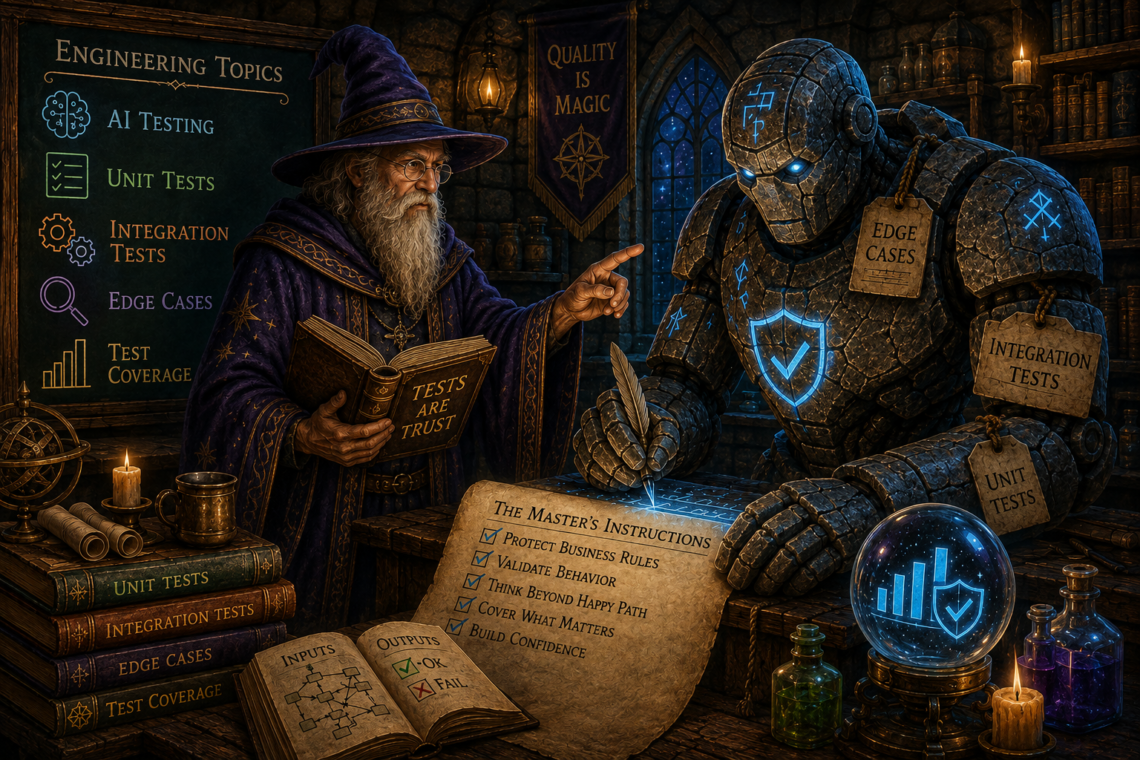
  • A wise wizard in a candlelit medieval workshop mentors a towering stone golem whose glowing blue runes illuminate the room as it carefully writes magical symbols onto a workbench. Behind them, a chalkboard labeled "Engineering Topics" lists AI Testing, Unit Tests, Integration Tests, Edge Cases, and Test Coverage, while a banner reading "Quality Is Magic" hangs above shelves of spellbooks and alchemical supplies. The wizard studies an open book titled Tests Are Trust while pointing toward the golem's work, symbolizing human guidance directing AI-assisted software testing. Nearby, books, scrolls, and a parchment labeled The Master's Instructions emphasize protecting business rules, validating behavior, thinking beyond the happy path, covering what matters, and building confidence. A glowing crystal ball displaying test coverage metrics and engineering-themed books reinforce the article's message that AI is a tireless assistant whose effectiveness depends on the quality of the instructions it receives.
    The Enchanted Workshop

    The Tireless Golem: Building Better Tests with AI

    August 5, 2026 /

    A servant who never sleeps must still be taught what success looks like. Software engineers have always searched for ways to reduce repetitive work without sacrificing quality. Compilers eliminated many manual mistakes. Continuous integration ensured that code could be validated automatically after every change. Static analysis exposed entire categories of defects before applications ever reached production. Each advancement freed engineers to spend more time solving meaningful problems instead of repeating mechanical tasks. Artificial intelligence represents another step along that path, but it introduces a subtle temptation. Because AI can generate code remarkably quickly, it is easy to assume it can generate equally effective tests with little oversight. Many developers discover…

    Read More
    Frank Jamison

    You May Also Like

    An elderly wizard in deep blue robes sits at a wooden desk inside a grand medieval library, carefully writing on a parchment with a feather quill. Shelves of ancient books fill the background beneath tall stone arches, creating the atmosphere of a magical archive. Around the wizard, glowing blue holographic panels illustrate an AI-assisted documentation workflow, showing an AI assistant drafting information, an engineer adding judgment and context, and a review process validating accuracy and clarity before documentation is shared. Stacks of books labeled Design Decisions, Lessons Learned, Architecture Notes, Incident Reports, and Operational Runbooks reinforce the importance of preserving engineering knowledge. A scroll on the desk highlights the qualities of effective documentation, including explaining why decisions were made, capturing context, guiding future decisions, preventing mistakes, and outliving the original engineers. Nearby, a documentation quality checklist emphasizes accuracy, current information, clear context, valid examples, and usefulness to future team members. A glowing crystal orb displays the message Better Docs = Better Systems, visually connecting thoughtful documentation, AI-assisted knowledge sharing, and long-term software maintainability.

    The Endless Scribe: Writing Documentation with AI

    August 3, 2026
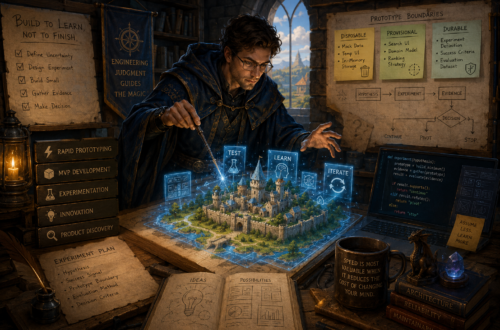
    A fantasy-inspired software engineer in a medieval workshop uses glowing blue magic to build a miniature castle prototype, surrounded by diagrams for prototype boundaries, experimentation, and decision-making, with references to rapid prototyping, MVP development, innovation, and product discovery.

    Building New Kingdoms Overnight: Rapid Prototyping with AI

    August 19, 2026
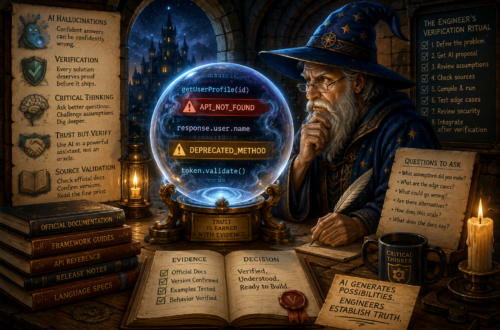
    A thoughtful wizard studies a glowing crystal ball inside a medieval observatory transformed into a software engineering workspace. The crystal ball displays realistic-looking code alongside prominent warning messages indicating nonexistent APIs and deprecated methods, symbolizing AI hallucinations. Surrounding the wizard are official documentation books, verification checklists, engineering notes, and a ritual board outlining a disciplined software validation process. Additional notes encourage asking critical questions, verifying assumptions, and consulting authoritative sources before trusting AI-generated solutions. The scene combines fantasy and technology to illustrate the importance of critical thinking, source validation, and professional judgment in AI-assisted software development.

    The Crystal Ball Lies Sometimes: Verifying AI Before You Trust It

    July 31, 2026
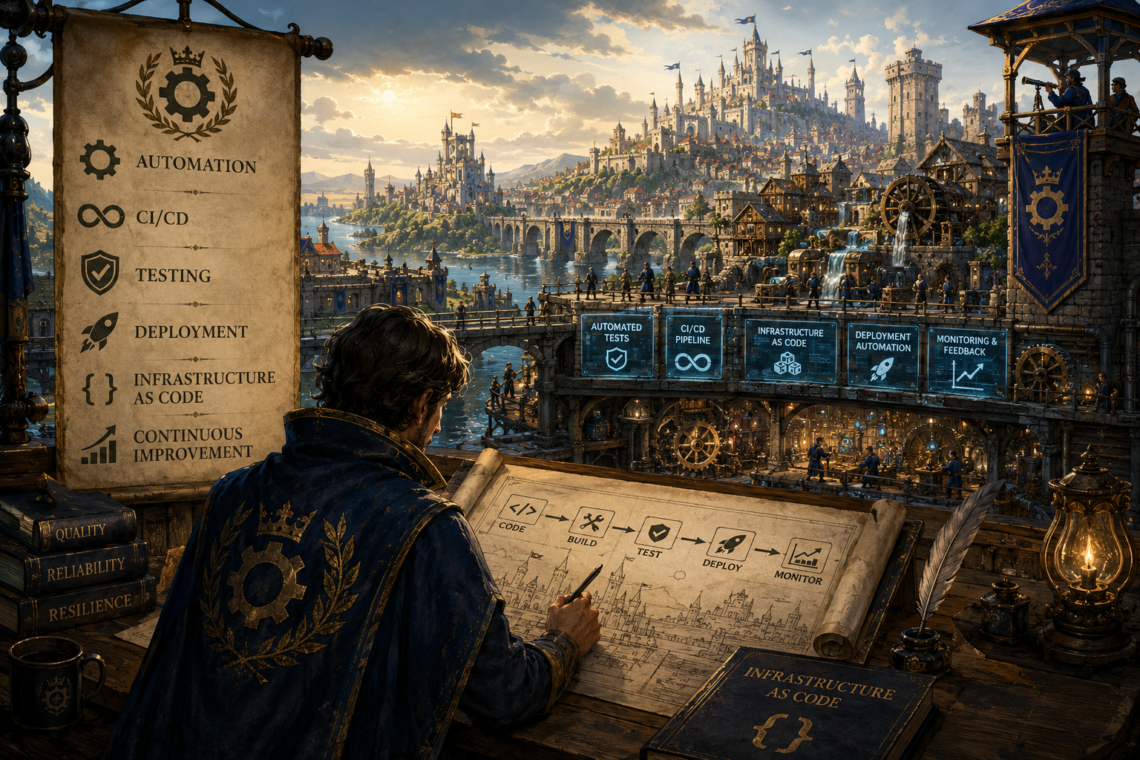
  • A fantasy-inspired illustration depicts a master engineer overlooking a thriving medieval kingdom powered by invisible systems rather than heroic effort. In the foreground, a cloaked architect studies a blueprint illustrating a software delivery pipeline from code to build, test, deployment, and monitoring. Below, workshops, waterwheels, bridges, and aqueducts symbolize automated infrastructure supporting the bustling city above. Watchtowers overlook the realm while illuminated engineering panels represent automated testing, CI/CD pipelines, infrastructure as code, deployment automation, and monitoring. The scene conveys how automation, continuous improvement, and dependable engineering systems quietly enable a prosperous kingdom without drawing attention to themselves.
    The Architect's Grimoire

    The Automated Kingdom: When Excellence Becomes Routine

    July 22, 2026 /

    The greatest kingdoms flourish because excellence becomes routine. The most reliable software systems are often the least impressive. Their deployments happen without ceremony. Their monitoring catches problems before customers notice them. Their infrastructure quietly provisions itself, and their operational routines become so dependable that engineers gradually stop thinking about them. The greatest compliment those systems receive is that nobody considers them remarkable anymore. Like the finest kingdoms, their success has become ordinary because excellence has become routine. Travelers rarely praise the aqueducts that deliver clean water every day or the roads that quietly connect every village to the capital. They admire the thriving markets, magnificent libraries, and prosperous cities made…

    Read More
    Frank Jamison

    You May Also Like

    A wise wizard studies a glowing crystal orb overlooking a vast fantasy kingdom where medieval architecture merges with modern software engineering. Across a towering stone aqueduct, six banners illustrate a continuous delivery pipeline labeled Automation, CI/CD, Testing, Deployment, Infrastructure as Code, and Continuous Improvement, with engineers working at illuminated stations beneath each stage. A detailed map on the wizard's table mirrors the same workflow using symbols and pathways, while holographic diagrams and glowing blue interfaces blend seamlessly into the medieval setting. The composition symbolizes mature software engineering practices transforming disciplined processes into an automated, self-improving kingdom, with warm golden light contrasting against cool blue technological elements. The article title does not appear in the image.

    Seeing Through the Crystal Ball: Observability Beyond Monitoring

    July 20, 2026
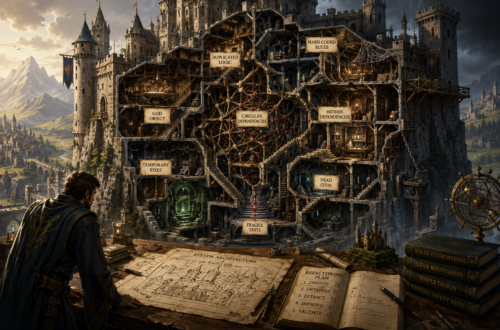
    A detailed fantasy castle is shown in cross-section, revealing a maze of interconnected rooms, stairways, hidden passages, and structural layers that symbolize the complexity of a long-lived software system. At the center, tangled corridors and web-like connections represent circular dependencies and hidden coupling, while workshop-like chambers illustrate concepts such as duplicated logic, hard-coded rules, temporary fixes, fragile tests, dead code, and hidden dependencies. In the foreground, an architect studies blueprints and a refactoring plan spread across a drafting table, surrounded by engineering tools, manuscripts, and architectural diagrams. The surrounding kingdom is orderly and well maintained, contrasting with the increasingly convoluted interior of the castle. The painterly, Dungeons & Dragons-inspired editorial illustration uses fantasy architecture to represent technical debt, legacy systems, refactoring, and the challenge of maintaining software that has grown through years of incremental change.

    Hidden Traps in the Dungeon: Escaping Technical Debt

    July 15, 2026
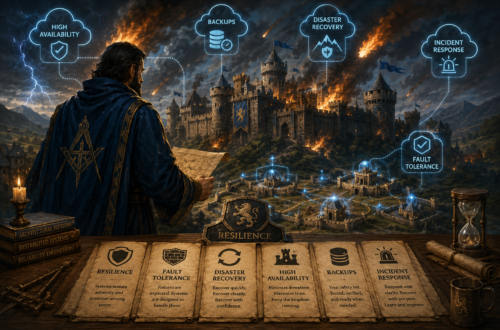
    A fantasy-inspired digital illustration depicts a royal architect standing over maps and plans as a massive stone castle burns under a night sky filled with flaming projectiles. Although sections of the fortress are engulfed in flames, smaller fortified districts below remain connected by glowing blue pathways, symbolizing resilient system architecture and fault isolation. Floating holographic icons represent High Availability, Backups, Disaster Recovery, Fault Tolerance, and Incident Response, visually linking medieval defenses with modern software engineering concepts. Scrolls and architectural plans in the foreground reinforce themes of preparation, recovery, and thoughtful design, while the dramatic contrast between destruction and continuity emphasizes that resilient systems are designed to withstand failure rather than prevent it entirely.

    When the Kingdom Burns: Designing for Failure Before Disaster Strikes

    July 17, 2026
  • The Architect's Grimoire (13)
  • The CSS Codex (13)
  • The Enchanted Workshop (13)
  • The Full-Stack Campaign (8)
  • The Guildmaster’s Handbook (13)
  • The Kingdom in the Clouds (9)

AI-Assisted Development Artificial Intelligence Backend Development Career Development Clean Code Cloud-Native Architecture Code Quality CSS Architecture CSS Best Practices Design Systems Developer Growth Developer Productivity Distributed Systems Dungeons and Dragons Engineering Culture Engineering Judgment Engineering Leadership Fantasy Theme Front-End Development Frontend Development Full Stack Development Human-AI Collaboration Maintainable Code Maintainable CSS Mentorship Professional Development Professional Growth Refactoring Responsive Design Software Architecture Software Craftsmanship Software Design Software Development Software Engineering StackNScroll System Design Technical Debt Technical Leadership The Architect's Grimoire The CSS Codex The Enchanted Workshop The Full-Stack Campaign The Guildmaster's Handbook The Kingdom in the Clouds Web Development

Stack N' Scroll - 2026 ©