• A massive ancient spellbook rests open on an ornate stone lectern at the center of a grand wizard's archive. The book's pages are filled with intricate geometric diagrams, arcane constructions, layered annotations, and evidence of repeated revisions, including crossed-out symbols and inserted bookmarks. Floating above the spellbook is a complex network of glowing blue and gold magical sigils connected by delicate lines and circular structures, appearing increasingly organized toward the center. Surrounding the lectern are stacks of weathered grimoires, loose parchment diagrams, quills, measuring instruments, compasses, and scholarly tools scattered across a richly detailed workspace. Warm lantern light illuminates the archive while magical energy radiates upward from the book, creating an atmosphere of careful refinement, accumulated knowledge, and the ongoing maintenance of a powerful arcane reference.
    The CSS Codex

    Refactoring the Spellbook

    Every spellbook gathers clutter until a wizard dares to rewrite it. Editor’s Note: This article is an expanded and revised edition of a piece originally published on RandomThoughtsInTraffic.com. While the original article focused primarily on the practical need to clean up aging stylesheets, this StackNScroll edition explores refactoring as a long-term architectural discipline within CSS systems. New material examines design tokens, specificity management, component ownership, incremental refactoring strategies, dead code removal, and the relationship between technical debt and maintainability during long-lived projects. As part of this week’s theme, The Long Campaign, the article focuses on how experienced developers preserve the health of stylesheets over months and years of continuous development,…

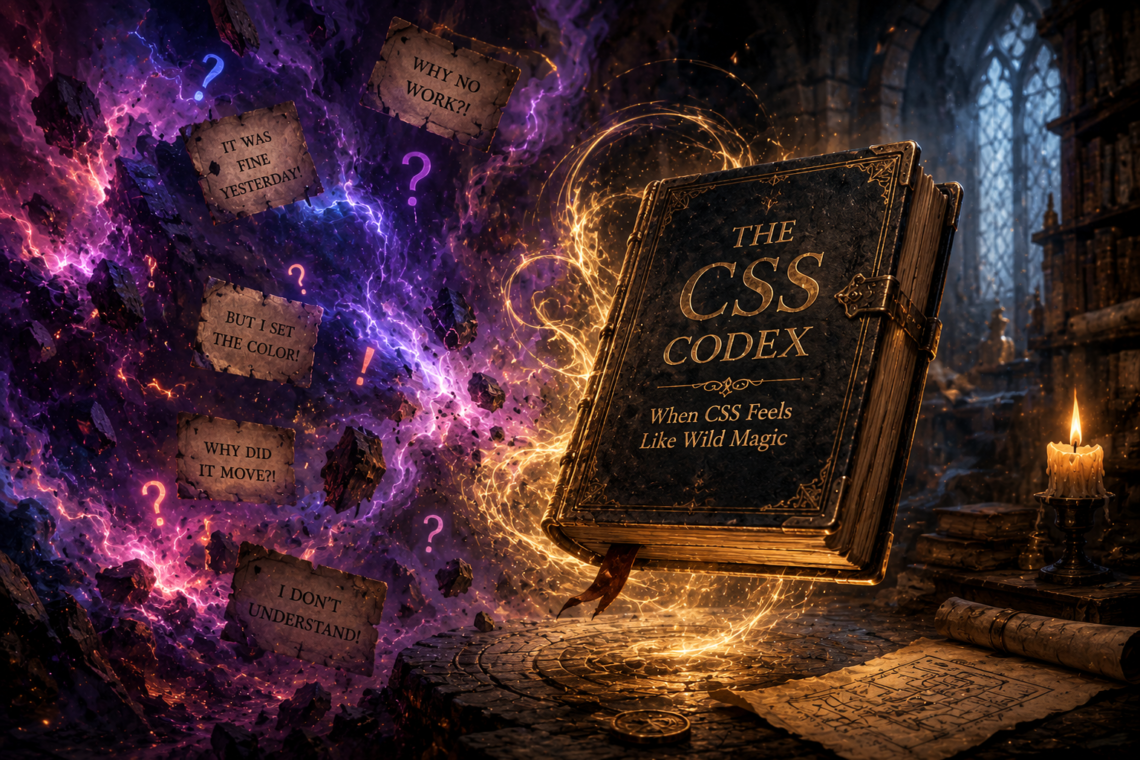
  • An ancient illuminated codex floats above a stone pedestal inside a dark fantasy library while chaotic purple and blue magical energy erupts around it. Torn parchment scraps swirl through the magical storm bearing frustrated messages such as Why Did It Move?, But I Set the Color!, It Was Fine Yesterday!, I Do Not Understand!, and Why No Work?. Glowing question marks and floating debris drift through the air, reinforcing the sense of confusion and unpredictability. The massive codex radiates warm golden light that contrasts with the surrounding chaos, suggesting hidden knowledge and order beneath the apparent magical disorder. Towering bookshelves, candles, scrolls, and arcane artifacts fill the background, creating a fantasy atmosphere that symbolizes discovering the rules behind seemingly unpredictable behavior.
    The CSS Codex

    When CSS Feels Like Wild Magic

    What appears to be chaos is often a spell whose rules remain unseen. Editor’s Note: Before joining The CSS Codex: Mastering the Rules of the Realm, When CSS Feels Like Wild Magic first appeared on RandomThoughtsInTraffic.com. This revised and expanded StackNScroll edition revisits one of the most persistent misconceptions in web development: the belief that CSS behaves unpredictably. New material connects the cascade, specificity, inheritance, layout calculations, positioning systems, rendering behavior, and architectural decision-making into a unified model that treats CSS as a deterministic system rather than a collection of disconnected techniques. The goal of this updated edition is not simply to explain why CSS can feel confusing, but to…