-
Roads Through the Sky: Connecting Cloud-Native Services
A distributed kingdom survives only when its distant cities know how to speak. A single castle can rely on hallways. The kitchen knows where the pantry is, guards can walk directly to the armory, and a steward who needs an answer can cross the courtyard and ask for it. Once the kingdom spreads across distant cities, those assumptions disappear. The treasury may live in one region, the guild registry in another, and the market serving the public somewhere else entirely. Each city can function perfectly on its own and still leave the kingdom paralyzed if the roads between them are unreliable or poorly governed. Cloud-native systems inherit the same problem.…
-
The Dragon Named Scale: Building Systems That Grow
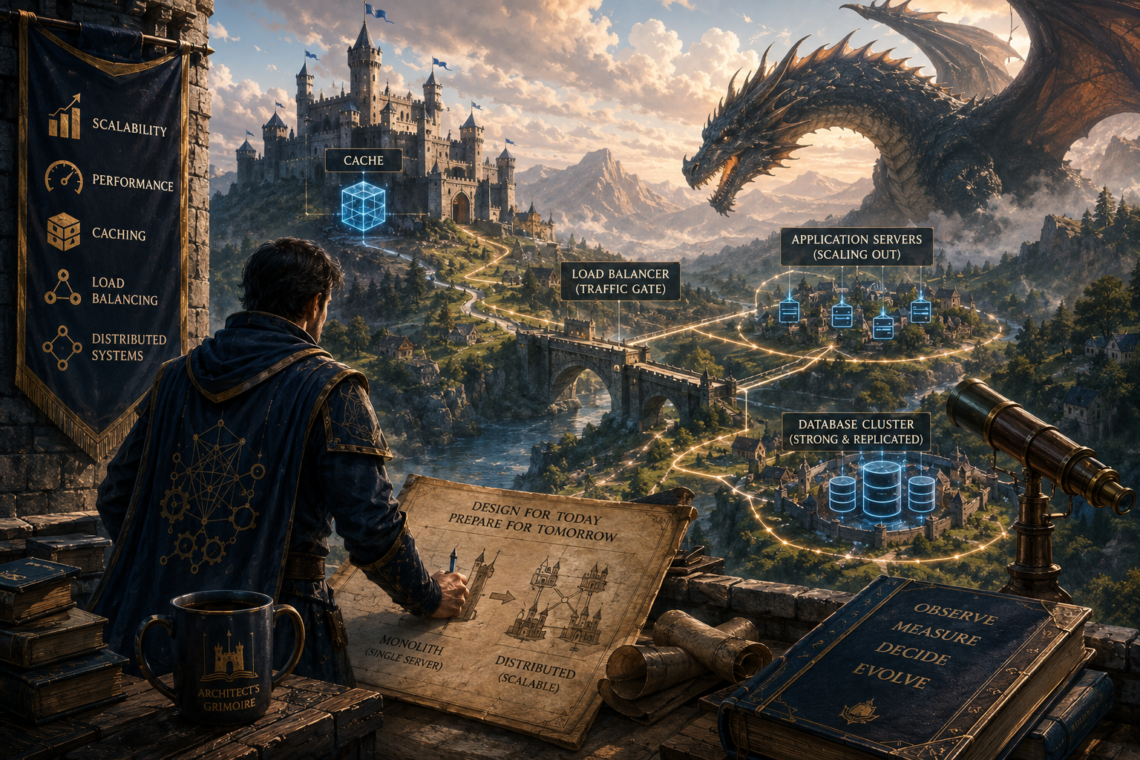
The Dragon Named Scale: Building Systems That Grow Every growing kingdom eventually attracts dragons. Success changes software in ways that are easy to underestimate. The application that comfortably serves a handful of users suddenly supports thousands. Database queries that once completed in milliseconds begin competing for resources. Features that once lived peacefully beside one another begin interacting in unexpected ways. None of these changes necessarily mean the original architecture was flawed. They simply reflect a reality every successful system eventually encounters. Growth exposes assumptions that remained invisible while the kingdom was still small. The fantasy kingdoms that have accompanied us throughout The Architect’s Grimoire offer another lesson worth carrying into…
-
Dividing the Kingdom: Finding the Right Boundaries
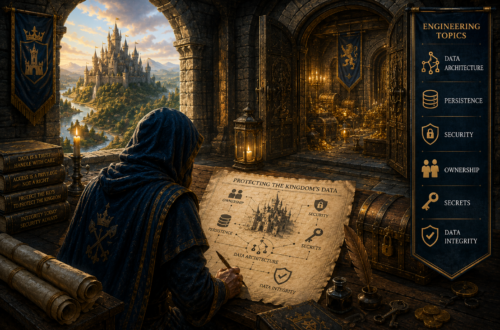
A realm divided too soon may fall before it ever grows. Software architecture has a way of making every difficult decision appear deceptively simple. A whiteboard fills with neatly drawn boxes connected by clean lines, and suddenly an application that once fit comfortably into a single project has become a collection of independent services. Every box promises greater flexibility, cleaner organization, and limitless room for future growth. Years spent designing, maintaining, and repairing production systems eventually teach every architect the same lesson. Every boundary carries a cost that will be paid long after the diagram has been erased. This week, as we continue Designing the Realm, we are moving beyond…
-
Building Kingdoms That Endure
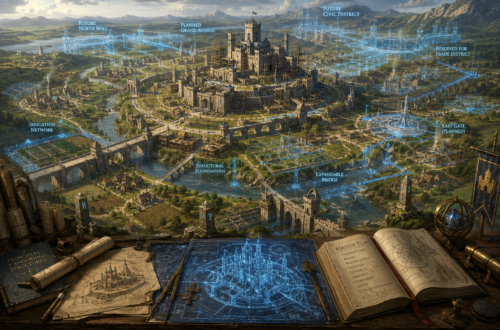
Every enduring kingdom begins with a blueprint. Every developer learns to build. The best developers learn what to build next. No kingdom becomes legendary because its masons laid beautiful stones. No empire survives because its carpenters built magnificent gates or its blacksmiths forged exceptional swords. History remembers kingdoms that endured because someone looked beyond the next building and imagined how an entire realm would one day function. Roads connected cities before merchants ever traveled them. Walls protected districts that had not yet been built. Aqueducts carried water to neighborhoods that existed only on parchment. Long before the first stone was laid, someone had already begun designing the future. Software follows…