-
Roads Through the Sky: Connecting Cloud-Native Services
A distributed kingdom survives only when its distant cities know how to speak. A single castle can rely on hallways. The kitchen knows where the pantry is, guards can walk directly to the armory, and a steward who needs an answer can cross the courtyard and ask for it. Once the kingdom spreads across distant cities, those assumptions disappear. The treasury may live in one region, the guild registry in another, and the market serving the public somewhere else entirely. Each city can function perfectly on its own and still leave the kingdom paralyzed if the roads between them are unreliable or poorly governed. Cloud-native systems inherit the same problem.…
-
The Keeper of a Thousand Castles: Understanding Kubernetes
When the kingdom grows beyond a few castles, someone must decide where every banner flies. A single container is easy to understand. You package an application, start it, expose a port, and watch it run. Add a database, cache, and supporting service, and Docker Compose can organize the small caravan well enough for development and modest deployments. The trouble begins when that caravan becomes a kingdom. Once dozens or hundreds of containers must remain available across multiple machines, the difficult question is no longer how to start them. The difficult question becomes who keeps track of everything after you stop watching. Imagine a kingdom dotted with castles. Each needs guards,…
-
The Caravan of Services: Composing Containerized Applications
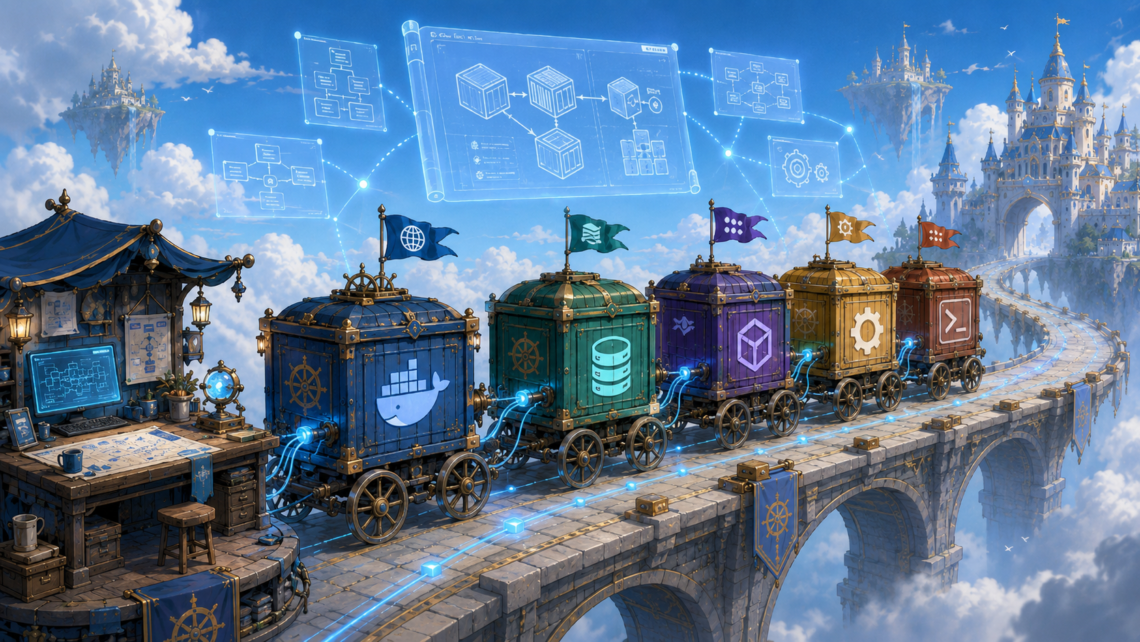
One wagon may travel alone, but a kingdom moves as a caravan. Beyond the Castle Gate: From Containers to Applications Packing a workshop into a container solves an important problem, but it does not solve the entire journey. In the previous chapter of The Kingdom in the Clouds, we explored how containers package an application together with the runtime, libraries, and dependencies it needs to operate consistently. That gives engineers a portable unit that can travel from a development machine to a test environment and eventually into production with far fewer surprises. Yet most modern applications are not single workshops sealed inside single wagons. They are collections of services, databases,…