Stack n' Scroll

Code, Campaigns, and Lessons from the Digital Realm

August 2026
S M T W T F S
 1
2345678
9101112131415
16171819202122
23242526272829
3031  
« Jul    

Meta

  • Register
  • Log in
  • Entries feed
  • Comments feed
  • WordPress.org
Frank Jamison Avatar
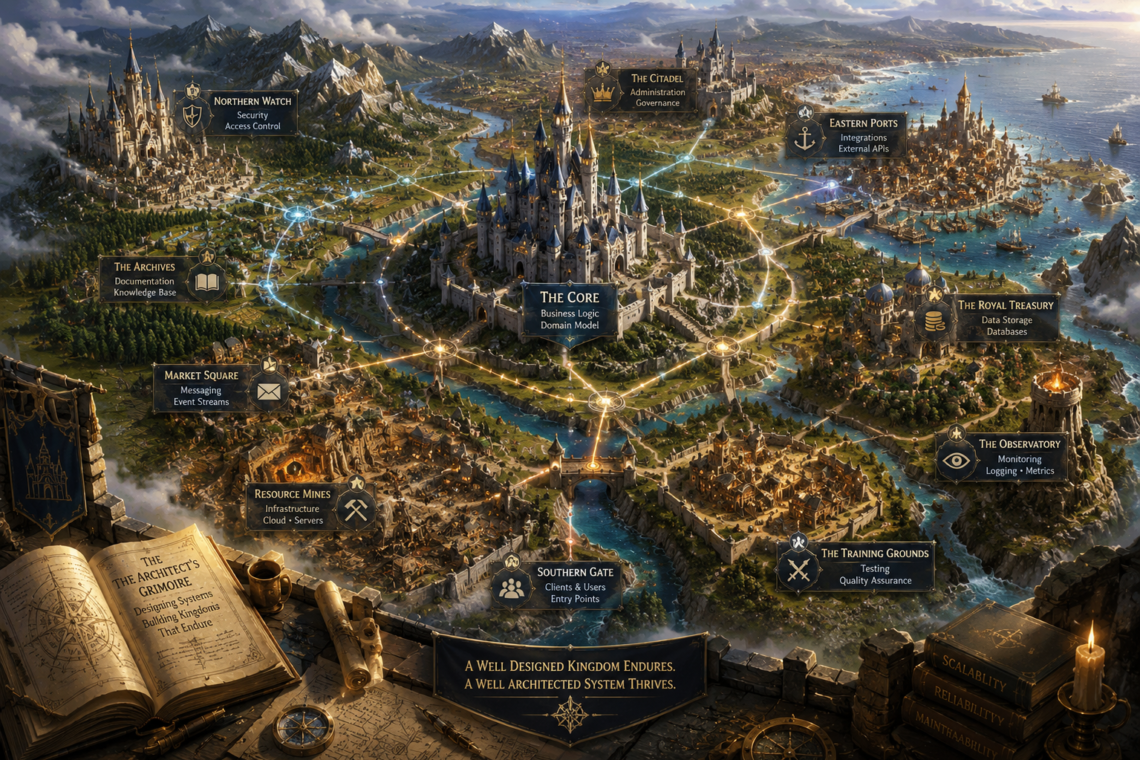
  • An epic fantasy map-style illustration depicts a thriving kingdom viewed from above, with a grand central castle labeled "The Core" connected by glowing roads and magical pathways to surrounding regions. Each district represents a software architecture concept, including Northern Watch (Security and Access Control), Eastern Ports (Integrations and External APIs), The Royal Treasury (Data Storage and Databases), The Observatory (Monitoring and Metrics), The Training Grounds (Testing and Quality Assurance), Market Square (Messaging and Event Streams), Resource Mines (Infrastructure and Servers), The Archives (Documentation and Knowledge Base), and Southern Gate (Clients and Users). In the foreground, an open book titled The Architect's Grimoire rests on a stone table alongside maps, drafting tools, and architectural plans. A banner reads, "A Well Designed Kingdom Endures. A Well Architected System Thrives." The image uses fantasy kingdom imagery to visualize software architecture as an interconnected, carefully planned realm.
    The Architect's Grimoire

    Building Kingdoms That Endure

    June 28, 2026 /

    Every enduring kingdom begins with a blueprint. Every developer learns to build. The best developers learn what to build next. No kingdom becomes legendary because its masons laid beautiful stones. No empire survives because its carpenters built magnificent gates or its blacksmiths forged exceptional swords. History remembers kingdoms that endured because someone looked beyond the next building and imagined how an entire realm would one day function. Roads connected cities before merchants ever traveled them. Walls protected districts that had not yet been built. Aqueducts carried water to neighborhoods that existed only on parchment. Long before the first stone was laid, someone had already begun designing the future. Software follows…

    Read More
    Frank Jamison

    You May Also Like

    A detailed fantasy castle is shown in cross-section, revealing a maze of interconnected rooms, stairways, hidden passages, and structural layers that symbolize the complexity of a long-lived software system. At the center, tangled corridors and web-like connections represent circular dependencies and hidden coupling, while workshop-like chambers illustrate concepts such as duplicated logic, hard-coded rules, temporary fixes, fragile tests, dead code, and hidden dependencies. In the foreground, an architect studies blueprints and a refactoring plan spread across a drafting table, surrounded by engineering tools, manuscripts, and architectural diagrams. The surrounding kingdom is orderly and well maintained, contrasting with the increasingly convoluted interior of the castle. The painterly, Dungeons & Dragons-inspired editorial illustration uses fantasy architecture to represent technical debt, legacy systems, refactoring, and the challenge of maintaining software that has grown through years of incremental change.

    Hidden Traps in the Dungeon: Escaping Technical Debt

    July 15, 2026
    A fantasy-inspired illustration depicts a master engineer overlooking a thriving medieval kingdom powered by invisible systems rather than heroic effort. In the foreground, a cloaked architect studies a blueprint illustrating a software delivery pipeline from code to build, test, deployment, and monitoring. Below, workshops, waterwheels, bridges, and aqueducts symbolize automated infrastructure supporting the bustling city above. Watchtowers overlook the realm while illuminated engineering panels represent automated testing, CI/CD pipelines, infrastructure as code, deployment automation, and monitoring. The scene conveys how automation, continuous improvement, and dependable engineering systems quietly enable a prosperous kingdom without drawing attention to themselves.

    The Automated Kingdom: When Excellence Becomes Routine

    July 22, 2026
    A vast medieval fantasy castle dominates the landscape, split into two contrasting halves to illustrate the importance of architectural planning. The left side features a beautifully organized fortress with symmetrical towers, interconnected courtyards, bridges, aqueducts, and orderly roads, overlaid with glowing magical blueprints, surveying grids, compass roses, and geometric construction diagrams. The right side remains impressive but is visibly less organized, with awkward tower placement, inefficient stairways, conflicting roads, and haphazard expansions that suggest growth without an overall plan. Artistic cutaway sections reveal deep stone foundations, underground chambers, drainage tunnels, and structural supports extending into bedrock. Tiny builders and stonemasons emphasize the immense scale of the castle, while warm morning light highlights the contrast between intentional design and organic growth, visually representing the role of software architecture in creating maintainable, long-lasting systems.

    Why Castles Need Architects

    June 29, 2026
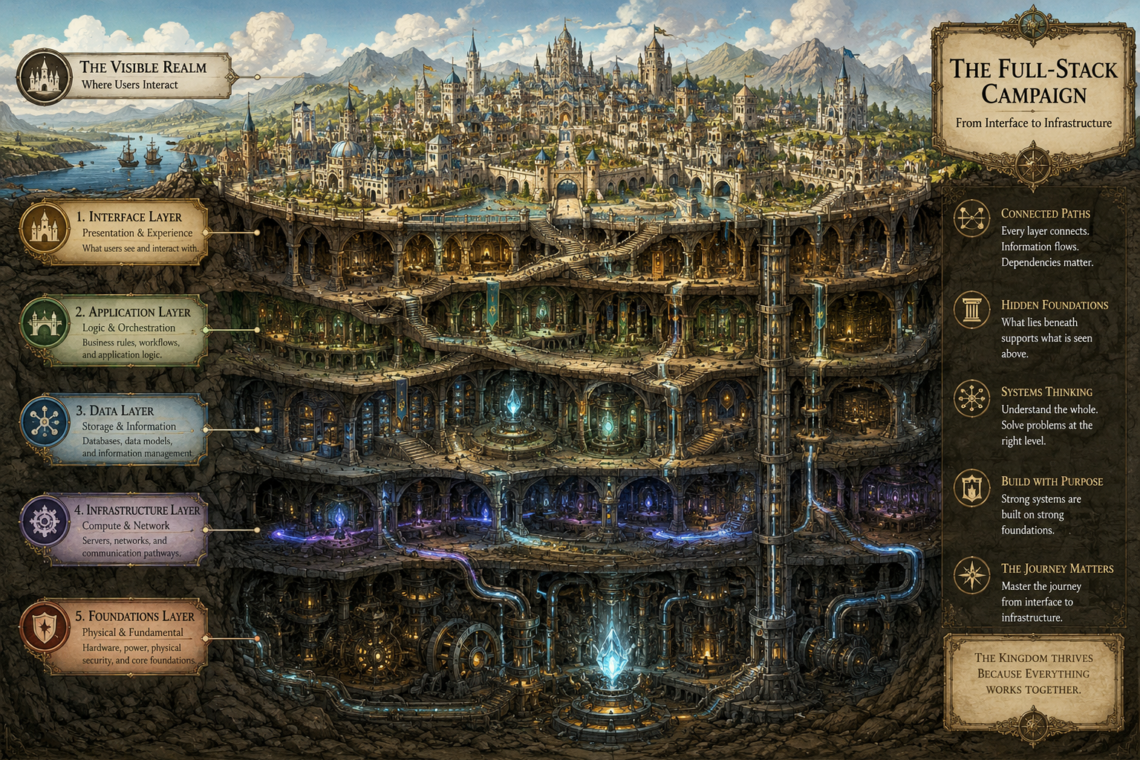
  • Detailed fantasy cross-section illustration titled The Full-Stack Campaign: From Interface to Infrastructure. A sprawling medieval fantasy kingdom filled with castles, towers, bridges, marketplaces, and guild halls sits on the surface beneath a bright sky. The ground beneath the city is cut away to reveal multiple interconnected underground layers extending deep into the earth. Massive stone roads, elevators, tunnels, aqueducts, glowing magical conduits, and engineering works connect hidden chambers, archives, vaults, transit networks, and subterranean fortresses. The deepest levels contain enormous dwarven-style machinery, crystal power systems, and foundational infrastructure supporting the realm above. Informational panels label each layer of the kingdom, visually illustrating how visible systems depend upon increasingly complex hidden foundations. The image conveys themes of architecture, interconnected systems, dependencies, and the journey from user-facing experiences to the infrastructure that supports them.
    The Full-Stack Campaign

    From Interface to Infrastructure

    April 4, 2026 /

    Before adventurers can explore the world, they must understand the rules that shape it. Editor’s Note Before appearing as the opening chapter of The Full-Stack Campaign: From Interface to Infrastructure, this article first appeared on RandomThoughtsInTraffic.com as an exploration of why developers often struggle when their knowledge remains confined to a single layer of the technology stack. This revised and expanded edition examines how information travels through modern web applications, explores the relationships between browsers, APIs, servers, databases, and infrastructure, and establishes the systems-oriented mindset that guides the remainder of the series. New material includes expanded architectural examples, a deeper discussion of specialization within software development, and a practical examination…
    Read More
    Frank Jamison

    You May Also Like

    A grand medieval fantasy guild hall serves as a visual metaphor for JavaScript state management. At the center of the vast stone chamber, a glowing magical crystal labeled State powers a detailed miniature kingdom displayed on a large round table. Blue streams of magical energy connect the crystal to labeled regions representing inventory, quests, notifications, settings, world map, and UI components, illustrating how shared application state flows throughout an entire system. Massive banners surrounding the hall depict engineering concepts including actions, dispatch, reducers, state changes, subscribers, immutable updates, normalized structure, and a guild ledger that records every change. Ancient books, engineering diagrams, drafting tools, glowing runes, and architectural details reinforce themes of organization, maintainability, and long-term software design in a painterly, Dungeons & Dragons-inspired editorial illustration.

    The Inventory System: Managing State Without Losing Control

    April 15, 2026
    Stamp Evaluation – Scott #985 (Used, Hinged, No Original Gum – Single Stamp) 3¢ Carmine Rose – Grand Army of the Republic, 1949 (Commemorative Issue – Rotary Press Printing, Perf 11 x 10½, Unwatermarked) Design Overview: Scott #985 commemorates the final national encampment of the Grand Army of the Republic. The design features an elderly Civil War veteran in the foreground, a younger soldier behind him, and the GAR emblem at left above the denomination. “United States Postage” anchors the lower tablet, while the commemorative inscription spans the top. Printed in carmine rose, the engraving retains strong color, clear portrait detail, and good contrast. Grading Breakdown: The centering grade is Fine/Very Fine 78. Visually, with the unaided eye, the perforation holes are easily seen to be clear of the design, but one or two margins are narrow. The bottom margin is the most narrow and establishes the centering limit. The left margin is the least narrow, while the right margin is more narrow than the top. All margins remain clearly outside the design and satisfy the Fine/Very Fine standard. The stamp presents pleasing overall balance, with the lower margin as the primary visual limitation. Soundness Evaluation: The faults present are two shorter perforations approximately half normal length and four fuzzy or ragged perforations. These faults constitute Minor Fault soundness. Minor Fault soundness combined with Fine/Very Fine centering yields a preliminary grade of Very Good 58. The group of shortened and ragged perforations is the controlling condition issue, while the stamp otherwise retains a clean appearance. Perforations and Margins: The perforations are generally complete, but several teeth show the shortened, fuzzy, or ragged condition noted in the fault list. These irregularities slightly soften the otherwise clean outline of the stamp. The bottom margin is closest to the design, the left margin is widest, and the right margin is narrower than the top. The frame remains visibly clear of the perforation holes on all four sides. Cancellation Evaluation: No visible cancellation appears on the face of the stamp. The portraits, GAR emblem, denomination, top inscription, and lower tablet are fully visible without postal markings crossing the design. For a used stamp, this creates a clean front presentation, though the absence of a visible cancel is treated conservatively and does not automatically produce a grade increase. Collector’s Note: Scott #985 is a historically appealing commemorative for collectors of Civil War memory, veterans’ organizations, patriotic themes, and late 1940s United States issues. The paired veteran-and-soldier design gives the stamp strong symbolic impact. Eye Appeal Adjustment: After centering and soundness are determined, eye appeal is considered. The stamp retains fresh carmine rose color, a sharp engraved impression, and an unobstructed design. The perforation faults have already been accounted for in soundness, and there is no heavy cancellation to penalize. No additional adjustment is warranted, so the preliminary grade remains 58. Final Numerical Grade Calculation: The centering grade is Fine/Very Fine 78. Minor Fault soundness reduces the grade by 20 points, producing a preliminary grade of Very Good 58. No cancellation deduction or other eye appeal adjustment is applied. The final numerical grade is 58. Summary: This used Scott #985 shows Fine/Very Fine 78 centering, with the bottom margin most narrow, the left margin widest, and the right margin narrower than the top. Minor Fault soundness lowers the preliminary grade to Very Good 58. Clean color and an unobstructed face support the result without changing it. Final Grade: Very Good 58.

    The First Map: How the Browser Shapes the World

    April 6, 2026
    A richly detailed Dungeons & Dragons-inspired fantasy illustration of the Arcane Academy, where the principles of JavaScript execution are represented as an organized system of magical scholarship and engineering. The vast medieval academy features towering stone arches, illuminated instructional panels, glowing diagrams, spellbooks, and magical energy flowing through the hall to illustrate sequential execution, functions, execution contexts, the Global Execution Context, the call stack, browser APIs, callback queues, and the event loop. At the center, streams of arcane energy connect the academy's systems, symbolizing how JavaScript gives a web application the ability to respond to user actions through disciplined, predictable execution. A detailed model of a fantasy kingdom at the bottom of the scene progresses from structure and presentation to behavior and state, reinforcing the journey of The Full-Stack Campaign and the idea that execution gives the kingdom agency.

    The First Spell: JavaScript and the Flow of Execution

    April 13, 2026
  • The Architect's Grimoire (13)
  • The CSS Codex (13)
  • The Enchanted Workshop (9)
  • The Full-Stack Campaign (7)
  • The Guildmaster’s Handbook (13)

AI-Assisted Development Artificial Intelligence Backend Development Career Development Clean Code Code Quality CSS CSS Architecture CSS Best Practices CSS Fundamentals CSS Layout Design Systems Developer Education Developer Growth Developer Productivity Dungeons and Dragons Engineering Culture Engineering Judgment Engineering Leadership Fantasy Theme Front-End Development Frontend Development Full Stack Development Maintainable Code Maintainable CSS Mentorship Professional Development Professional Growth Refactoring Responsive Design Software Architecture Software Craftsmanship Software Design Software Development Software Engineering StackNScroll System Design Technical Debt Technical Leadership The Architect's Grimoire The CSS Codex The Enchanted Workshop The Full-Stack Campaign The Guildmaster's Handbook Web Development

Stack N' Scroll - 2026 ©