Stack n' Scroll

Code, Campaigns, and Lessons from the Digital Realm

August 2026
S M T W T F S
 1
2345678
9101112131415
16171819202122
23242526272829
3031  
« Jul    

Meta

  • Register
  • Log in
  • Entries feed
  • Comments feed
  • WordPress.org
Frank Jamison Avatar
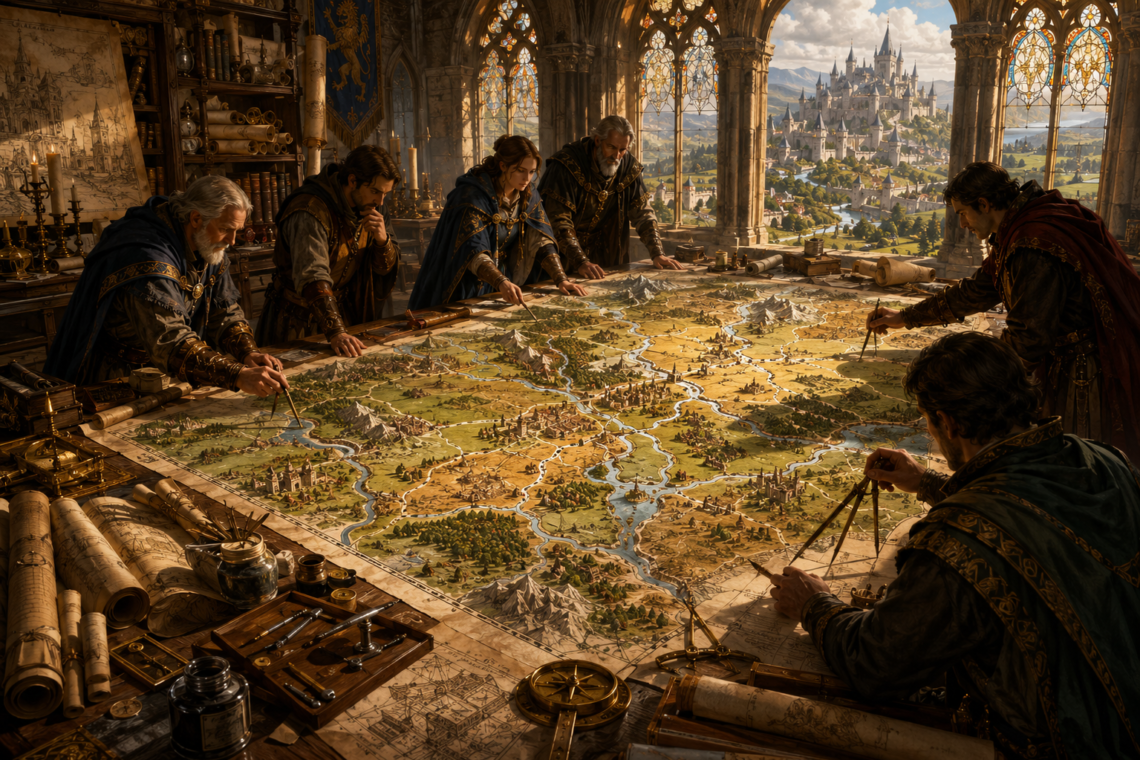
  • A group of royal architects and cartographers gather around a massive illuminated kingdom map inside an ornate medieval planning hall. Using compasses, rulers, and drafting tools, they carefully define provincial boundaries that follow rivers, mountains, and trade routes. Shelves filled with scrolls, blueprints, and surveying instruments surround the room, while stained-glass windows reveal a thriving kingdom beyond. The detailed fantasy scene symbolizes thoughtful software architecture by illustrating the deliberate planning and organization required to establish meaningful boundaries within a growing system.
    The Architect's Grimoire

    Dividing the Kingdom: Finding the Right Boundaries

    July 8, 2026 /

    A realm divided too soon may fall before it ever grows. Software architecture has a way of making every difficult decision appear deceptively simple. A whiteboard fills with neatly drawn boxes connected by clean lines, and suddenly an application that once fit comfortably into a single project has become a collection of independent services. Every box promises greater flexibility, cleaner organization, and limitless room for future growth. Years spent designing, maintaining, and repairing production systems eventually teach every architect the same lesson. Every boundary carries a cost that will be paid long after the diagram has been erased. This week, as we continue Designing the Realm, we are moving beyond…

    Read More
    Frank Jamison

    You May Also Like

    A vast medieval fantasy kingdom is enclosed within enormous concentric stone walls, towering gatehouses, fortified keeps, and defensive towers that dominate the landscape. Despite the immense fortifications, the protected interior remains largely undeveloped, with only a few cottages, a small farmhouse, scattered construction sites, unfinished roads, and a partially built marketplace spread across open fields. Glowing blue magical architectural projections overlay the empty city, revealing ambitious plans for future districts, guild halls, towers, canals, and public buildings that have yet to be constructed. In the foreground, drafting tables, blueprints, surveying instruments, and engineering tools reinforce the theme of excessive planning, while a small group of builders focuses on practical structures such as a well and simple homes. The painterly Dungeons & Dragons-inspired scene symbolizes the software engineering concept of premature overengineering by contrasting overwhelming defensive infrastructure with a kingdom that has barely begun to grow.

    The Curse of Premature Fortification

    July 3, 2026
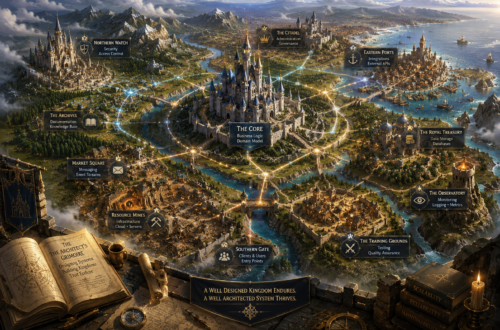
    An epic fantasy map-style illustration depicts a thriving kingdom viewed from above, with a grand central castle labeled "The Core" connected by glowing roads and magical pathways to surrounding regions. Each district represents a software architecture concept, including Northern Watch (Security and Access Control), Eastern Ports (Integrations and External APIs), The Royal Treasury (Data Storage and Databases), The Observatory (Monitoring and Metrics), The Training Grounds (Testing and Quality Assurance), Market Square (Messaging and Event Streams), Resource Mines (Infrastructure and Servers), The Archives (Documentation and Knowledge Base), and Southern Gate (Clients and Users). In the foreground, an open book titled The Architect's Grimoire rests on a stone table alongside maps, drafting tools, and architectural plans. A banner reads, "A Well Designed Kingdom Endures. A Well Architected System Thrives." The image uses fantasy kingdom imagery to visualize software architecture as an interconnected, carefully planned realm.

    Building Kingdoms That Endure

    June 28, 2026
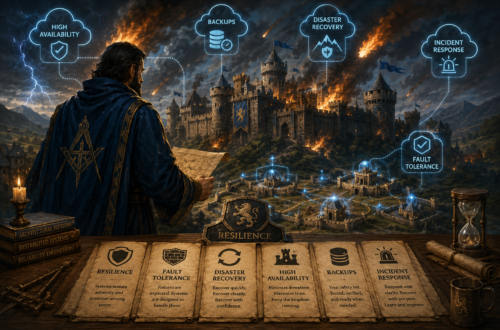
    A fantasy-inspired digital illustration depicts a royal architect standing over maps and plans as a massive stone castle burns under a night sky filled with flaming projectiles. Although sections of the fortress are engulfed in flames, smaller fortified districts below remain connected by glowing blue pathways, symbolizing resilient system architecture and fault isolation. Floating holographic icons represent High Availability, Backups, Disaster Recovery, Fault Tolerance, and Incident Response, visually linking medieval defenses with modern software engineering concepts. Scrolls and architectural plans in the foreground reinforce themes of preparation, recovery, and thoughtful design, while the dramatic contrast between destruction and continuity emphasizes that resilient systems are designed to withstand failure rather than prevent it entirely.

    When the Kingdom Burns: Designing for Failure Before Disaster Strikes

    July 17, 2026
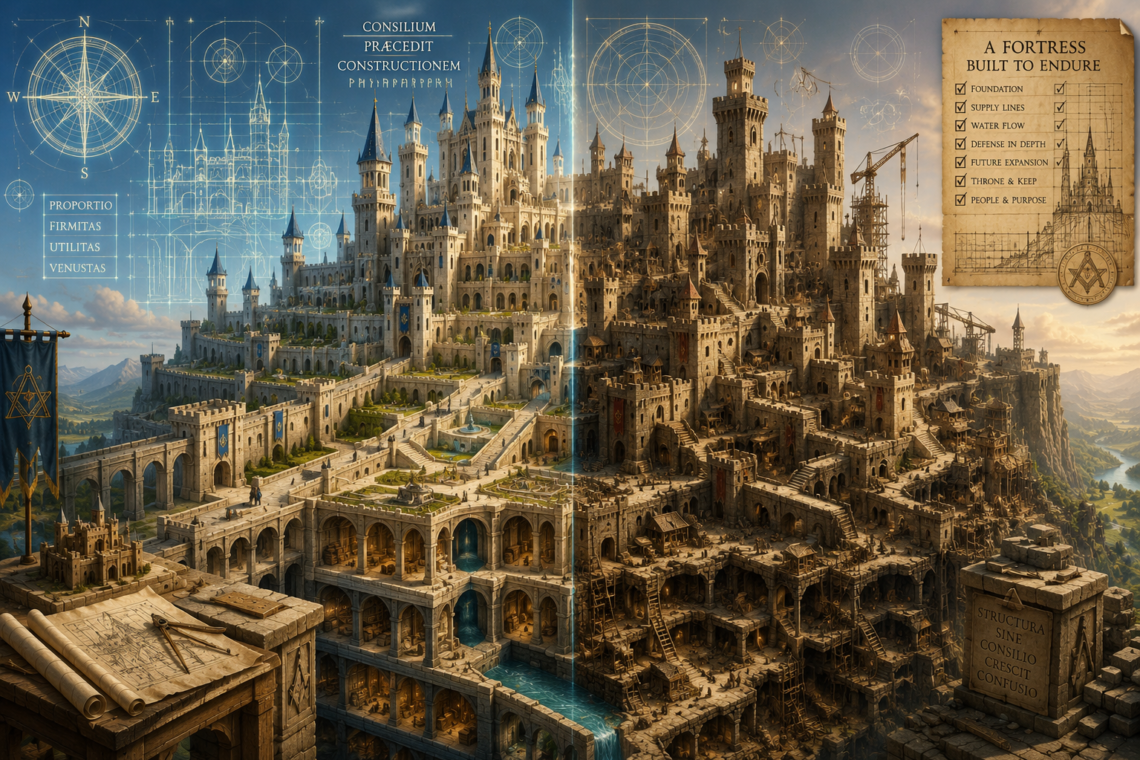
  • A vast medieval fantasy castle dominates the landscape, split into two contrasting halves to illustrate the importance of architectural planning. The left side features a beautifully organized fortress with symmetrical towers, interconnected courtyards, bridges, aqueducts, and orderly roads, overlaid with glowing magical blueprints, surveying grids, compass roses, and geometric construction diagrams. The right side remains impressive but is visibly less organized, with awkward tower placement, inefficient stairways, conflicting roads, and haphazard expansions that suggest growth without an overall plan. Artistic cutaway sections reveal deep stone foundations, underground chambers, drainage tunnels, and structural supports extending into bedrock. Tiny builders and stonemasons emphasize the immense scale of the castle, while warm morning light highlights the contrast between intentional design and organic growth, visually representing the role of software architecture in creating maintainable, long-lasting systems.
    The Architect's Grimoire

    Why Castles Need Architects

    June 29, 2026 /

    Even the finest builders need someone who can see beyond the next wall. Foundations of the Kingdom Maintaining software taught me lessons that writing software never could. Early in my career, I assumed difficult applications were usually the result of poor programming. Whenever a simple change required hours of investigation, I expected to uncover careless decisions, rushed deadlines, or code that had simply been neglected for too long. The more systems I inherited, however, the less convincing that explanation became. Different companies, different teams, and different programming languages produced remarkably similar maintenance problems. As we begin Foundations of the Kingdom, one lesson rises above all the others: every enduring kingdom…
    Read More
    Frank Jamison

    You May Also Like

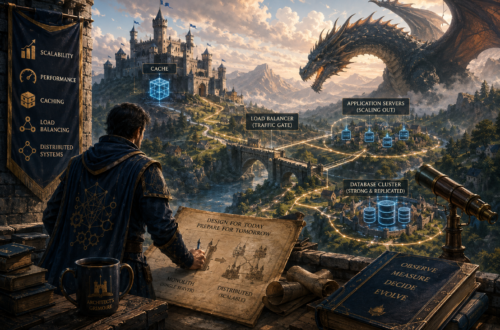
    A sprawling medieval fantasy kingdom stretches across a lush valley, with a fortified castle serving as the central hub of an expansive network of roads, bridges, and satellite settlements that symbolize a scalable software architecture. A massive dragon circles above the kingdom, representing the challenges of system growth, while an architect studies detailed plans from a stone overlook in the foreground. Glowing pathways connect infrastructure throughout the realm, illustrating concepts such as load balancing, distributed systems, caching, and scalable services. The scene emphasizes thoughtful planning, resilient infrastructure, and measured expansion through richly detailed architecture and environmental storytelling, using a classic Dungeons & Dragons-inspired aesthetic to visualize modern software engineering principles.

    The Dragon Named Scale: Building Systems That Grow

    July 13, 2026
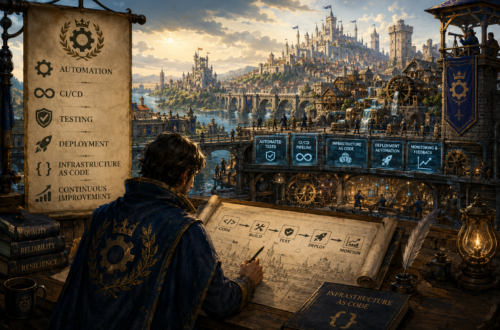
    A fantasy-inspired illustration depicts a master engineer overlooking a thriving medieval kingdom powered by invisible systems rather than heroic effort. In the foreground, a cloaked architect studies a blueprint illustrating a software delivery pipeline from code to build, test, deployment, and monitoring. Below, workshops, waterwheels, bridges, and aqueducts symbolize automated infrastructure supporting the bustling city above. Watchtowers overlook the realm while illuminated engineering panels represent automated testing, CI/CD pipelines, infrastructure as code, deployment automation, and monitoring. The scene conveys how automation, continuous improvement, and dependable engineering systems quietly enable a prosperous kingdom without drawing attention to themselves.

    The Automated Kingdom: When Excellence Becomes Routine

    July 22, 2026
    An epic fantasy map-style illustration depicts a thriving kingdom viewed from above, with a grand central castle labeled "The Core" connected by glowing roads and magical pathways to surrounding regions. Each district represents a software architecture concept, including Northern Watch (Security and Access Control), Eastern Ports (Integrations and External APIs), The Royal Treasury (Data Storage and Databases), The Observatory (Monitoring and Metrics), The Training Grounds (Testing and Quality Assurance), Market Square (Messaging and Event Streams), Resource Mines (Infrastructure and Servers), The Archives (Documentation and Knowledge Base), and Southern Gate (Clients and Users). In the foreground, an open book titled The Architect's Grimoire rests on a stone table alongside maps, drafting tools, and architectural plans. A banner reads, "A Well Designed Kingdom Endures. A Well Architected System Thrives." The image uses fantasy kingdom imagery to visualize software architecture as an interconnected, carefully planned realm.

    Building Kingdoms That Endure

    June 28, 2026
  • The Architect's Grimoire (13)
  • The CSS Codex (13)
  • The Enchanted Workshop (9)
  • The Full-Stack Campaign (7)
  • The Guildmaster’s Handbook (13)

AI-Assisted Development Artificial Intelligence Backend Development Career Development Clean Code Code Quality CSS CSS Architecture CSS Best Practices CSS Fundamentals CSS Layout Design Systems Developer Education Developer Growth Developer Productivity Dungeons and Dragons Engineering Culture Engineering Judgment Engineering Leadership Fantasy Theme Front-End Development Frontend Development Full Stack Development Maintainable Code Maintainable CSS Mentorship Professional Development Professional Growth Refactoring Responsive Design Software Architecture Software Craftsmanship Software Design Software Development Software Engineering StackNScroll System Design Technical Debt Technical Leadership The Architect's Grimoire The CSS Codex The Enchanted Workshop The Full-Stack Campaign The Guildmaster's Handbook Web Development

Stack N' Scroll - 2026 ©