Stack n' Scroll

Code, Campaigns, and Lessons from the Digital Realm

August 2026
S M T W T F S
 1
2345678
9101112131415
16171819202122
23242526272829
3031  
« Jul    

Meta

  • Register
  • Log in
  • Entries feed
  • Comments feed
  • WordPress.org
Frank Jamison Avatar
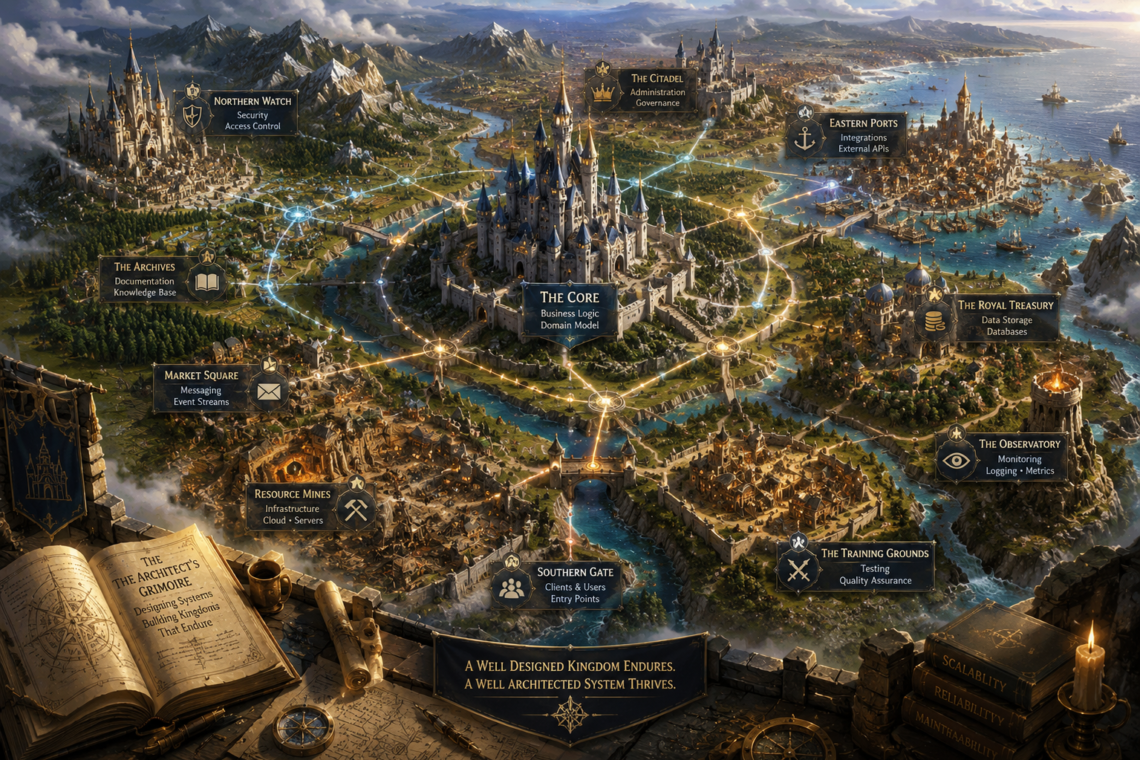
  • An epic fantasy map-style illustration depicts a thriving kingdom viewed from above, with a grand central castle labeled "The Core" connected by glowing roads and magical pathways to surrounding regions. Each district represents a software architecture concept, including Northern Watch (Security and Access Control), Eastern Ports (Integrations and External APIs), The Royal Treasury (Data Storage and Databases), The Observatory (Monitoring and Metrics), The Training Grounds (Testing and Quality Assurance), Market Square (Messaging and Event Streams), Resource Mines (Infrastructure and Servers), The Archives (Documentation and Knowledge Base), and Southern Gate (Clients and Users). In the foreground, an open book titled The Architect's Grimoire rests on a stone table alongside maps, drafting tools, and architectural plans. A banner reads, "A Well Designed Kingdom Endures. A Well Architected System Thrives." The image uses fantasy kingdom imagery to visualize software architecture as an interconnected, carefully planned realm.
    The Architect's Grimoire

    Building Kingdoms That Endure

    June 28, 2026 /

    Every enduring kingdom begins with a blueprint. Every developer learns to build. The best developers learn what to build next. No kingdom becomes legendary because its masons laid beautiful stones. No empire survives because its carpenters built magnificent gates or its blacksmiths forged exceptional swords. History remembers kingdoms that endured because someone looked beyond the next building and imagined how an entire realm would one day function. Roads connected cities before merchants ever traveled them. Walls protected districts that had not yet been built. Aqueducts carried water to neighborhoods that existed only on parchment. Long before the first stone was laid, someone had already begun designing the future. Software follows…

    Read More
    Frank Jamison

    You May Also Like

    A sprawling medieval fantasy kingdom stretches across a lush valley, with a fortified castle serving as the central hub of an expansive network of roads, bridges, and satellite settlements that symbolize a scalable software architecture. A massive dragon circles above the kingdom, representing the challenges of system growth, while an architect studies detailed plans from a stone overlook in the foreground. Glowing pathways connect infrastructure throughout the realm, illustrating concepts such as load balancing, distributed systems, caching, and scalable services. The scene emphasizes thoughtful planning, resilient infrastructure, and measured expansion through richly detailed architecture and environmental storytelling, using a classic Dungeons & Dragons-inspired aesthetic to visualize modern software engineering principles.

    The Dragon Named Scale: Building Systems That Grow

    July 13, 2026
    A panoramic fantasy kingdom is shown in the early stages of carefully planned expansion, centered on a partially completed stone castle surrounded by villages, bridges, roads, and farmland. Glowing blue architectural overlays, magical surveying grids, and blueprint-style projections illustrate future city walls, districts, bridges, and infrastructure without physically constructing them. In the foreground, an architect's drafting table holds illuminated blueprints, manuscripts, measuring tools, compasses, and engineering instruments, reinforcing the theme of deliberate planning and long-term design. The peaceful medieval landscape emphasizes thoughtful growth, maintainability, and architectural foresight in a classic Dungeons & Dragons-inspired editorial fantasy style.

    Building for Today’s Quest or Tomorrow’s Empire?

    July 1, 2026
    A group of royal architects and cartographers gather around a massive illuminated kingdom map inside an ornate medieval planning hall. Using compasses, rulers, and drafting tools, they carefully define provincial boundaries that follow rivers, mountains, and trade routes. Shelves filled with scrolls, blueprints, and surveying instruments surround the room, while stained-glass windows reveal a thriving kingdom beyond. The detailed fantasy scene symbolizes thoughtful software architecture by illustrating the deliberate planning and organization required to establish meaningful boundaries within a growing system.

    Dividing the Kingdom: Finding the Right Boundaries

    July 8, 2026
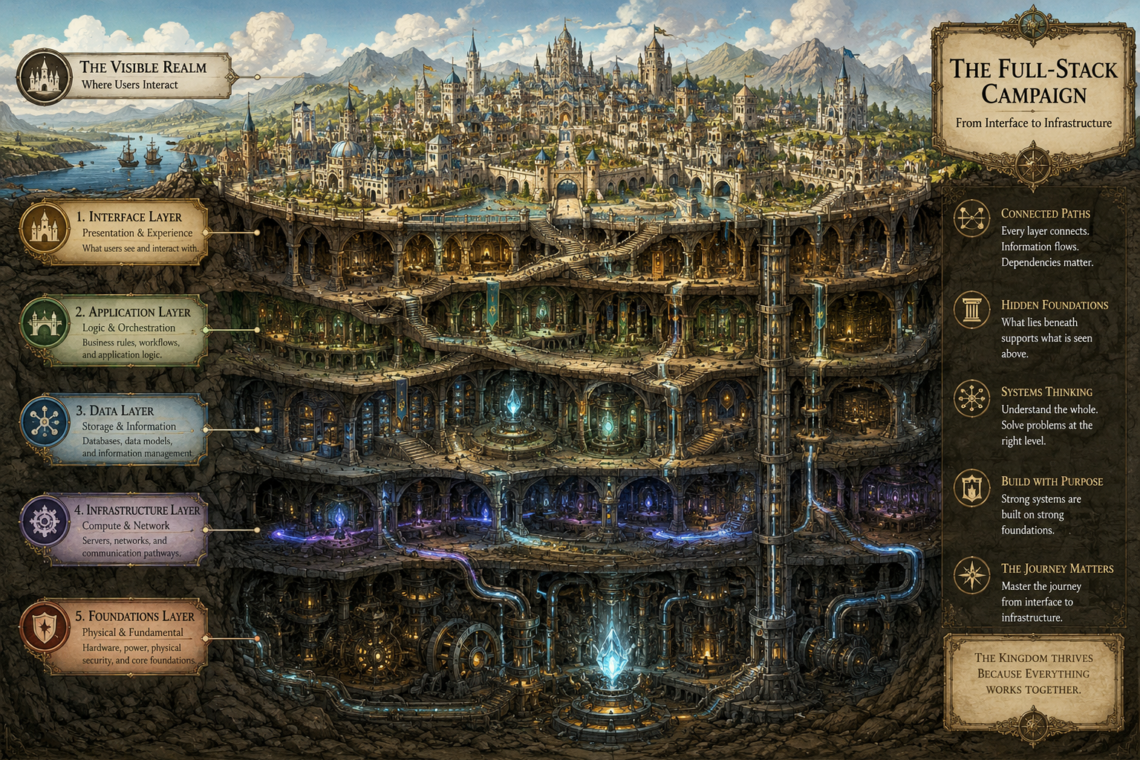
  • Detailed fantasy cross-section illustration titled The Full-Stack Campaign: From Interface to Infrastructure. A sprawling medieval fantasy kingdom filled with castles, towers, bridges, marketplaces, and guild halls sits on the surface beneath a bright sky. The ground beneath the city is cut away to reveal multiple interconnected underground layers extending deep into the earth. Massive stone roads, elevators, tunnels, aqueducts, glowing magical conduits, and engineering works connect hidden chambers, archives, vaults, transit networks, and subterranean fortresses. The deepest levels contain enormous dwarven-style machinery, crystal power systems, and foundational infrastructure supporting the realm above. Informational panels label each layer of the kingdom, visually illustrating how visible systems depend upon increasingly complex hidden foundations. The image conveys themes of architecture, interconnected systems, dependencies, and the journey from user-facing experiences to the infrastructure that supports them.
    The Full-Stack Campaign

    From Interface to Infrastructure

    April 4, 2026 /

    Before adventurers can explore the world, they must understand the rules that shape it. Editor’s Note Before appearing as the opening chapter of The Full-Stack Campaign: From Interface to Infrastructure, this article first appeared on RandomThoughtsInTraffic.com as an exploration of why developers often struggle when their knowledge remains confined to a single layer of the technology stack. This revised and expanded edition examines how information travels through modern web applications, explores the relationships between browsers, APIs, servers, databases, and infrastructure, and establishes the systems-oriented mindset that guides the remainder of the series. New material includes expanded architectural examples, a deeper discussion of specialization within software development, and a practical examination…
    Read More
    Frank Jamison

    You May Also Like

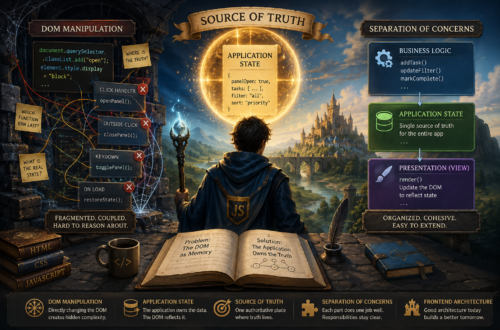
    A fantasy-inspired editorial illustration shows a developer wizard standing before a glowing magical orb labeled Source of Truth, symbolizing application state as the central authority in a web application. On the left, a dark stone chamber labeled DOM Manipulation is filled with tangled event listeners, sticky notes, and crisscrossing connections that represent tightly coupled code and hidden complexity. On the right, a bright architectural diagram labeled Separation of Concerns organizes business logic, application state, and presentation into distinct layers connected by a clear flow. An open spellbook in the foreground contrasts the problem of treating the DOM as memory with the solution of allowing the application to own its state. Books labeled HTML, CSS, and JavaScript, along with castles, mountains, and magical effects, reinforce the Dungeons & Dragons theme while illustrating the transition from direct DOM manipulation to maintainable frontend architecture.

    The Cost of Power: From DOM Manipulation to Better Design

    April 17, 2026
    A grand medieval fantasy guild hall serves as a visual metaphor for JavaScript state management. At the center of the vast stone chamber, a glowing magical crystal labeled State powers a detailed miniature kingdom displayed on a large round table. Blue streams of magical energy connect the crystal to labeled regions representing inventory, quests, notifications, settings, world map, and UI components, illustrating how shared application state flows throughout an entire system. Massive banners surrounding the hall depict engineering concepts including actions, dispatch, reducers, state changes, subscribers, immutable updates, normalized structure, and a guild ledger that records every change. Ancient books, engineering diagrams, drafting tools, glowing runes, and architectural details reinforce themes of organization, maintainability, and long-term software design in a painterly, Dungeons & Dragons-inspired editorial illustration.

    The Inventory System: Managing State Without Losing Control

    April 15, 2026
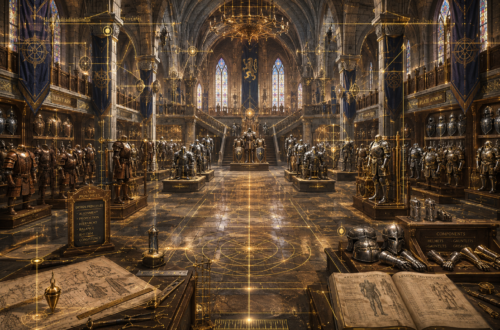
    A vast medieval royal armory stretches through a grand vaulted castle hall where hundreds of meticulously arranged suits of armor are displayed on pedestals, racks, and alcoves with perfect symmetry. Glowing golden magical construction lines, geometric drafting diagrams, measuring guides, and alignment grids overlay the architecture, emphasizing organization, hierarchy, and precision. Sunlight pours through towering stained-glass windows, illuminating polished steel armor, carved stone columns, architectural blueprints, measuring tools, and inventory ledgers. The richly detailed fantasy scene conveys craftsmanship, maintainability, and thoughtful design, symbolizing the principles of structured CSS layout and front-end architecture without depicting any people or action.

    Armor and Appearance: CSS Layout Without Chaos

    April 10, 2026
  • The Architect's Grimoire (13)
  • The CSS Codex (13)
  • The Enchanted Workshop (9)
  • The Full-Stack Campaign (7)
  • The Guildmaster’s Handbook (13)

AI-Assisted Development Artificial Intelligence Backend Development Career Development Clean Code Code Quality CSS CSS Architecture CSS Best Practices CSS Fundamentals CSS Layout Design Systems Developer Education Developer Growth Developer Productivity Dungeons and Dragons Engineering Culture Engineering Judgment Engineering Leadership Fantasy Theme Front-End Development Frontend Development Full Stack Development Maintainable Code Maintainable CSS Mentorship Professional Development Professional Growth Refactoring Responsive Design Software Architecture Software Craftsmanship Software Design Software Development Software Engineering StackNScroll System Design Technical Debt Technical Leadership The Architect's Grimoire The CSS Codex The Enchanted Workshop The Full-Stack Campaign The Guildmaster's Handbook Web Development

Stack N' Scroll - 2026 ©