Stack n' Scroll

Code, Campaigns, and Lessons from the Digital Realm

October 2026
S M T W T F S
 123
45678910
11121314151617
18192021222324
25262728293031
« Sep    

Meta

  • Register
  • Log in
  • Entries feed
  • Comments feed
  • WordPress.org
Frank Jamison Avatar
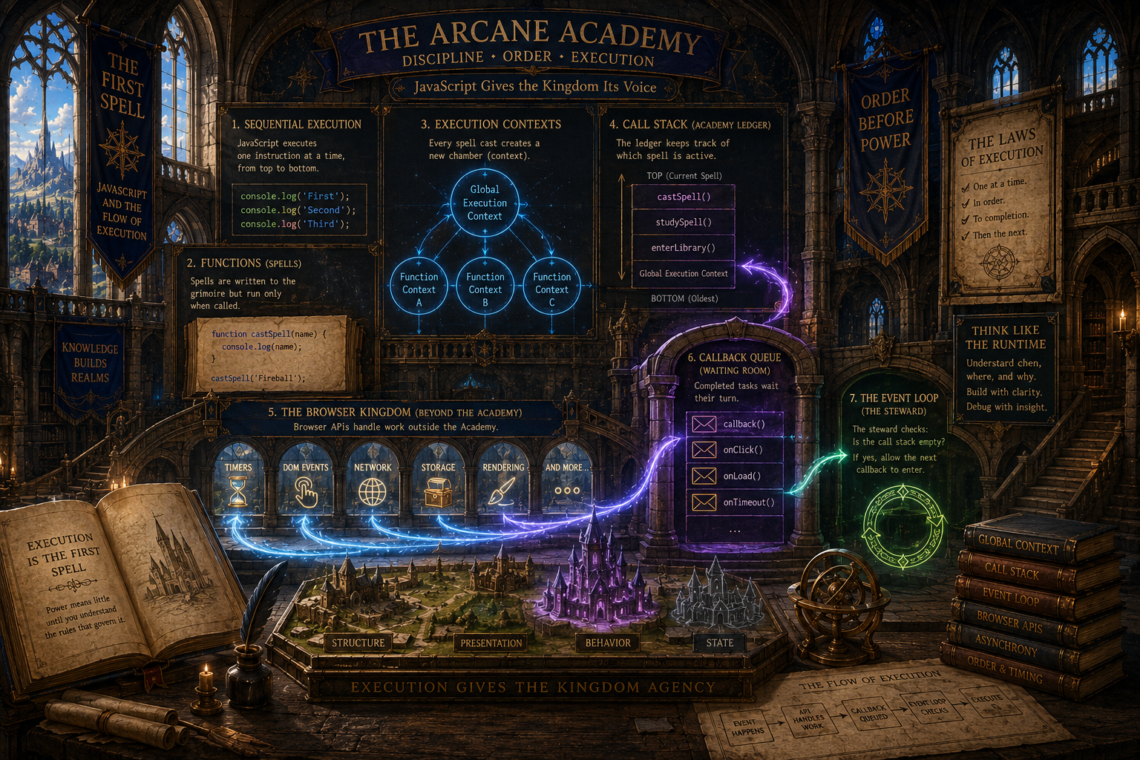
  • A richly detailed Dungeons & Dragons-inspired fantasy illustration of the Arcane Academy, where the principles of JavaScript execution are represented as an organized system of magical scholarship and engineering. The vast medieval academy features towering stone arches, illuminated instructional panels, glowing diagrams, spellbooks, and magical energy flowing through the hall to illustrate sequential execution, functions, execution contexts, the Global Execution Context, the call stack, browser APIs, callback queues, and the event loop. At the center, streams of arcane energy connect the academy's systems, symbolizing how JavaScript gives a web application the ability to respond to user actions through disciplined, predictable execution. A detailed model of a fantasy kingdom at the bottom of the scene progresses from structure and presentation to behavior and state, reinforcing the journey of The Full-Stack Campaign and the idea that execution gives the kingdom agency.
    The Full-Stack Campaign

    The First Spell: JavaScript and the Flow of Execution

    April 13, 2026 /

    The realm is built. Now it must respond to its heroes’ actions. Editor’s Note This article is an updated edition of an article originally published on RandomThoughtsInTraffic.com. For its StackNScroll.com edition, it has been substantially revised and expanded to shift the discussion from introductory JavaScript syntax toward the engineering principles that govern execution inside the browser. New material explores execution contexts, the Global Execution Context, the call stack, browser APIs, callback queues, and the event loop, and connects these concepts to the architecture of modern front-end applications. The objective of this edition is to help developing engineers build an accurate mental model of how JavaScript executes so that every framework,…
    Read More
    Frank Jamison

    You May Also Like

    A vast medieval royal armory stretches through a grand vaulted castle hall where hundreds of meticulously arranged suits of armor are displayed on pedestals, racks, and alcoves with perfect symmetry. Glowing golden magical construction lines, geometric drafting diagrams, measuring guides, and alignment grids overlay the architecture, emphasizing organization, hierarchy, and precision. Sunlight pours through towering stained-glass windows, illuminating polished steel armor, carved stone columns, architectural blueprints, measuring tools, and inventory ledgers. The richly detailed fantasy scene conveys craftsmanship, maintainability, and thoughtful design, symbolizing the principles of structured CSS layout and front-end architecture without depicting any people or action.

    Armor and Appearance: CSS Layout Without Chaos

    April 10, 2026
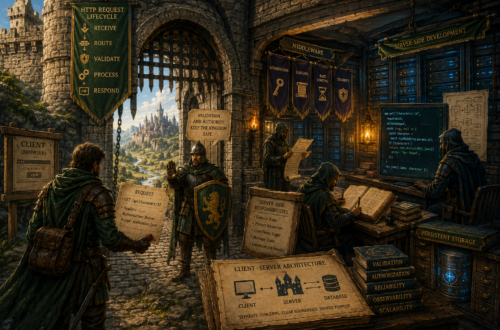
    Dungeons & Dragons-inspired fantasy illustration of a fortified kingdom gate representing the boundary between browser and server, with a traveler delivering a request through guarded checkpoints into a server-side stronghold where validation, middleware, application logic, persistent storage, and client-server communication are visualized as interconnected parts of the kingdom’s infrastructure.

    The Gate Beyond the UI: What a Server Actually Does

    April 20, 2026
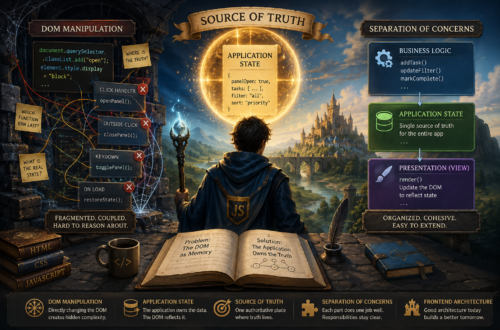
    A fantasy-inspired editorial illustration shows a developer wizard standing before a glowing magical orb labeled Source of Truth, symbolizing application state as the central authority in a web application. On the left, a dark stone chamber labeled DOM Manipulation is filled with tangled event listeners, sticky notes, and crisscrossing connections that represent tightly coupled code and hidden complexity. On the right, a bright architectural diagram labeled Separation of Concerns organizes business logic, application state, and presentation into distinct layers connected by a clear flow. An open spellbook in the foreground contrasts the problem of treating the DOM as memory with the solution of allowing the application to own its state. Books labeled HTML, CSS, and JavaScript, along with castles, mountains, and magical effects, reinforce the Dungeons & Dragons theme while illustrating the transition from direct DOM manipulation to maintainable frontend architecture.

    The Cost of Power: From DOM Manipulation to Better Design

    April 17, 2026
  • The Architect's Grimoire (13)
  • The CSS Codex (13)
  • The Enchanted Workshop (13)
  • The Full-Stack Campaign (8)
  • The Guildmaster’s Handbook (13)
  • The Kingdom in the Clouds (9)

AI-Assisted Development Artificial Intelligence Backend Development Career Development Clean Code Cloud-Native Architecture Code Quality CSS Architecture CSS Best Practices Design Systems Developer Growth Developer Productivity Distributed Systems Dungeons and Dragons Engineering Culture Engineering Judgment Engineering Leadership Fantasy Theme Front-End Development Frontend Development Full Stack Development Human-AI Collaboration Maintainable Code Maintainable CSS Mentorship Professional Development Professional Growth Refactoring Responsive Design Software Architecture Software Craftsmanship Software Design Software Development Software Engineering StackNScroll System Design Technical Debt Technical Leadership The Architect's Grimoire The CSS Codex The Enchanted Workshop The Full-Stack Campaign The Guildmaster's Handbook The Kingdom in the Clouds Web Development

Stack N' Scroll - 2026 ©