Stack n' Scroll

Code, Campaigns, and Lessons from the Digital Realm

October 2026
S M T W T F S
 123
45678910
11121314151617
18192021222324
25262728293031
« Sep    

Meta

  • Register
  • Log in
  • Entries feed
  • Comments feed
  • WordPress.org
Frank Jamison Avatar
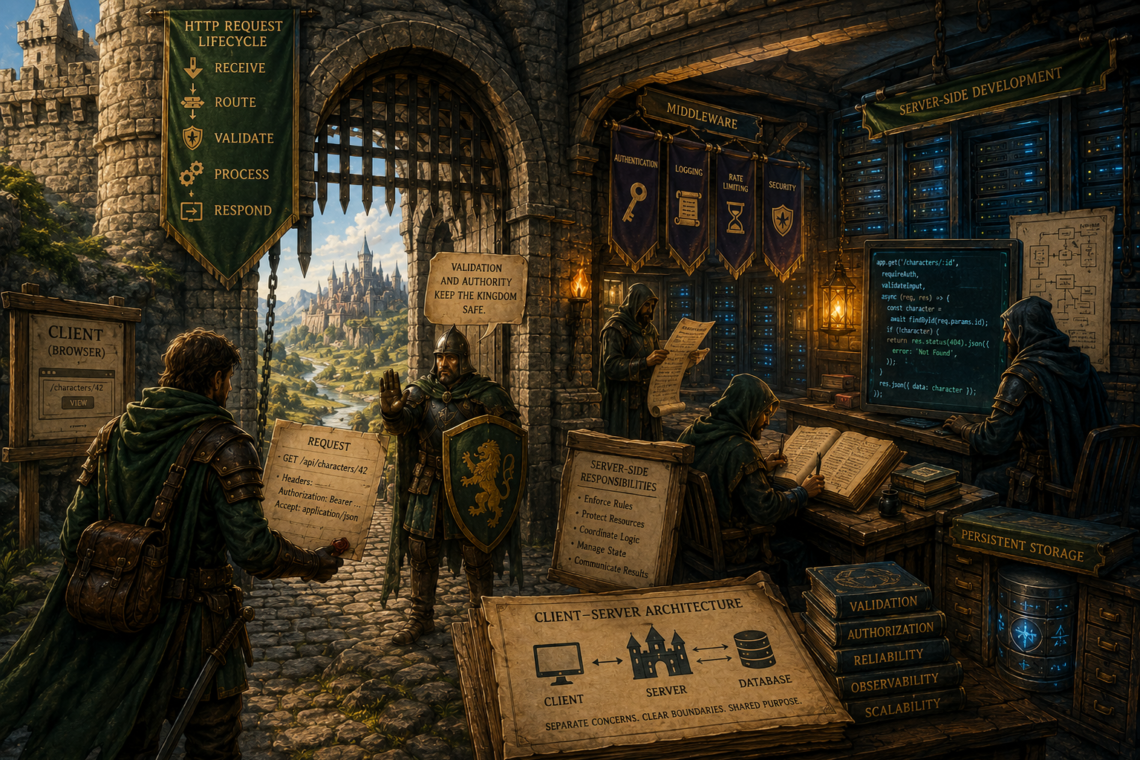
  • Dungeons & Dragons-inspired fantasy illustration of a fortified kingdom gate representing the boundary between browser and server, with a traveler delivering a request through guarded checkpoints into a server-side stronghold where validation, middleware, application logic, persistent storage, and client-server communication are visualized as interconnected parts of the kingdom’s infrastructure.
    The Full-Stack Campaign

    The Gate Beyond the UI: What a Server Actually Does

    April 20, 2026 /

    Every adventurer eventually passes beyond the city gates, where servers receive the requests that keep the kingdom running. Editor’s Note: This article originally appeared on RandomThoughtsInTraffic.com as an introduction to the boundary between browser code and server-side development. For this StackNScroll edition, I have revised and expanded the discussion to more carefully trace the request lifecycle and explore routing, validation, HTTP responses, middleware, persistence, and the server’s role as an authority boundary. These additions connect this week’s Beyond the City Gates theme to a practical learning objective: understanding not merely how to create a server, but why certain responsibilities must move beyond the browser as an application grows. The result…
    Read More
    Frank Jamison

    You May Also Like

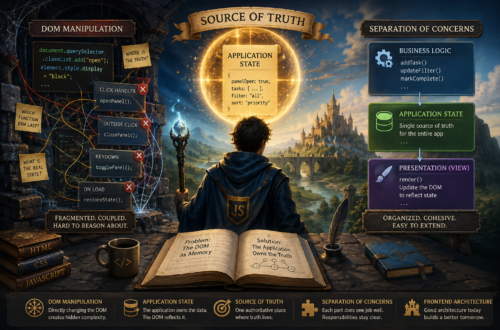
    A fantasy-inspired editorial illustration shows a developer wizard standing before a glowing magical orb labeled Source of Truth, symbolizing application state as the central authority in a web application. On the left, a dark stone chamber labeled DOM Manipulation is filled with tangled event listeners, sticky notes, and crisscrossing connections that represent tightly coupled code and hidden complexity. On the right, a bright architectural diagram labeled Separation of Concerns organizes business logic, application state, and presentation into distinct layers connected by a clear flow. An open spellbook in the foreground contrasts the problem of treating the DOM as memory with the solution of allowing the application to own its state. Books labeled HTML, CSS, and JavaScript, along with castles, mountains, and magical effects, reinforce the Dungeons & Dragons theme while illustrating the transition from direct DOM manipulation to maintainable frontend architecture.

    The Cost of Power: From DOM Manipulation to Better Design

    April 17, 2026
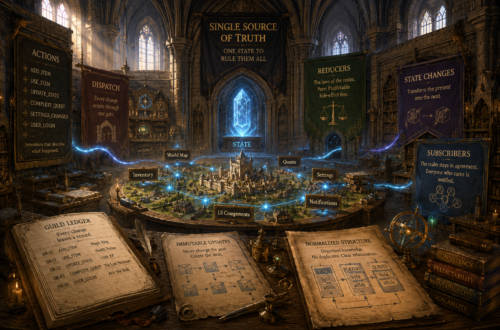
    A grand medieval fantasy guild hall serves as a visual metaphor for JavaScript state management. At the center of the vast stone chamber, a glowing magical crystal labeled State powers a detailed miniature kingdom displayed on a large round table. Blue streams of magical energy connect the crystal to labeled regions representing inventory, quests, notifications, settings, world map, and UI components, illustrating how shared application state flows throughout an entire system. Massive banners surrounding the hall depict engineering concepts including actions, dispatch, reducers, state changes, subscribers, immutable updates, normalized structure, and a guild ledger that records every change. Ancient books, engineering diagrams, drafting tools, glowing runes, and architectural details reinforce themes of organization, maintainability, and long-term software design in a painterly, Dungeons & Dragons-inspired editorial illustration.

    The Inventory System: Managing State Without Losing Control

    April 15, 2026
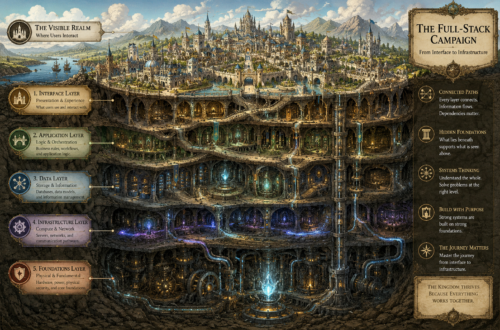
    Detailed fantasy cross-section illustration titled The Full-Stack Campaign: From Interface to Infrastructure. A sprawling medieval fantasy kingdom filled with castles, towers, bridges, marketplaces, and guild halls sits on the surface beneath a bright sky. The ground beneath the city is cut away to reveal multiple interconnected underground layers extending deep into the earth. Massive stone roads, elevators, tunnels, aqueducts, glowing magical conduits, and engineering works connect hidden chambers, archives, vaults, transit networks, and subterranean fortresses. The deepest levels contain enormous dwarven-style machinery, crystal power systems, and foundational infrastructure supporting the realm above. Informational panels label each layer of the kingdom, visually illustrating how visible systems depend upon increasingly complex hidden foundations. The image conveys themes of architecture, interconnected systems, dependencies, and the journey from user-facing experiences to the infrastructure that supports them.

    From Interface to Infrastructure

    April 4, 2026
  • The Architect's Grimoire (13)
  • The CSS Codex (13)
  • The Enchanted Workshop (13)
  • The Full-Stack Campaign (8)
  • The Guildmaster’s Handbook (13)
  • The Kingdom in the Clouds (9)

AI-Assisted Development Artificial Intelligence Backend Development Career Development Clean Code Cloud-Native Architecture Code Quality CSS Architecture CSS Best Practices Design Systems Developer Growth Developer Productivity Distributed Systems Dungeons and Dragons Engineering Culture Engineering Judgment Engineering Leadership Fantasy Theme Front-End Development Frontend Development Full Stack Development Human-AI Collaboration Maintainable Code Maintainable CSS Mentorship Professional Development Professional Growth Refactoring Responsive Design Software Architecture Software Craftsmanship Software Design Software Development Software Engineering StackNScroll System Design Technical Debt Technical Leadership The Architect's Grimoire The CSS Codex The Enchanted Workshop The Full-Stack Campaign The Guildmaster's Handbook The Kingdom in the Clouds Web Development

Stack N' Scroll - 2026 ©