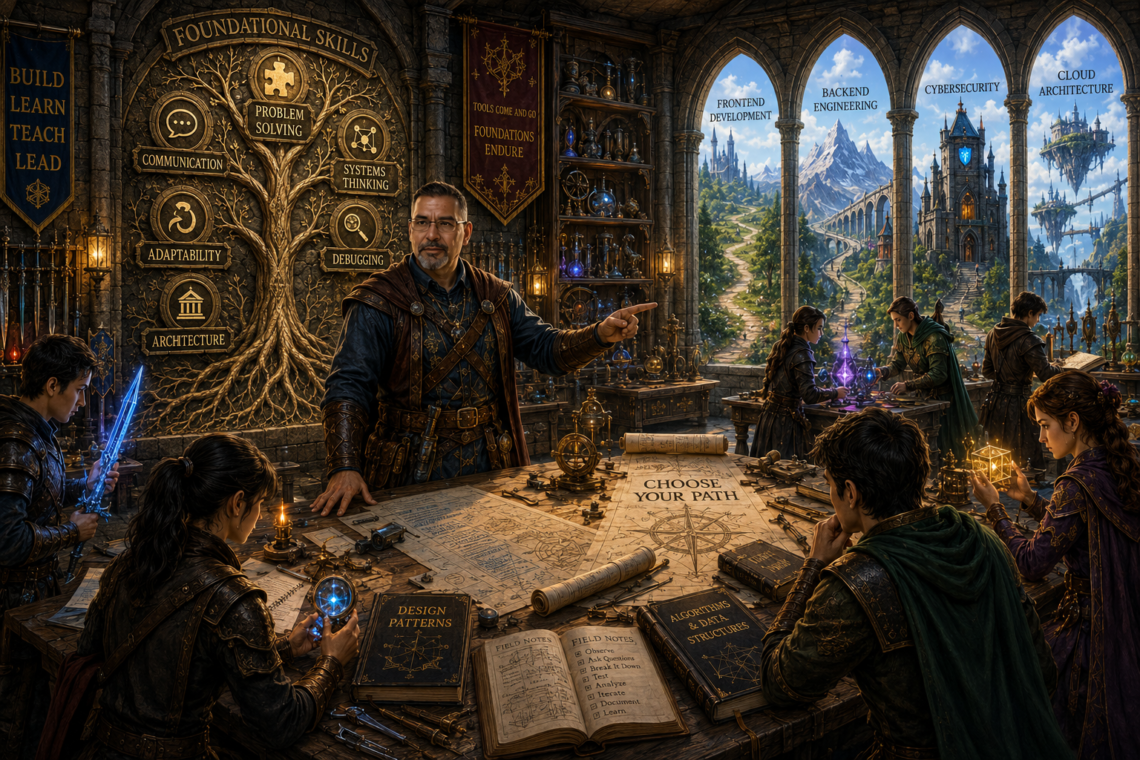
• Frank Jamison, portrayed as a seasoned guildmaster and veteran engineer, stands in a grand fantasy training hall guiding young adventurers toward foundational skills rather than magical treasures. A towering stone skill tree labeled Communication, Problem Solving, Systems Thinking, Adaptability, Debugging, and Architecture dominates the wall behind him. Apprentices study maps, engineering blueprints, notebooks, drafting tools, and glowing artifacts around a massive wooden training table marked Choose Your Path. Through large arched windows, fantasy landscapes represent different technology career paths including Frontend Development, Backend Engineering, Cybersecurity, and Cloud Architecture. Warm torchlight and subtle blue magical illumination create a wise, instructional atmosphere emphasizing mentorship, learning, and long-term skill development.
    The Guildmaster’s Handbook

    Building Skills That Actually Matter

    The realm rewards more than talent. Learn the skills that survive beyond tutorials and trends. When new adventurers first enter a guild hall, they tend to focus on the same question. Which class should I choose? Some are drawn to warriors because they appear dependable and powerful. Others are fascinated by wizards because of the possibilities that magic provides. Rangers, rogues, clerics, and bards all offer their own attractions. New developers often approach technology in exactly the same way. They ask whether they should become frontend developers, backend engineers, cybersecurity specialists, cloud architects, or data professionals. While the question is understandable, I have learned over the years that it is…

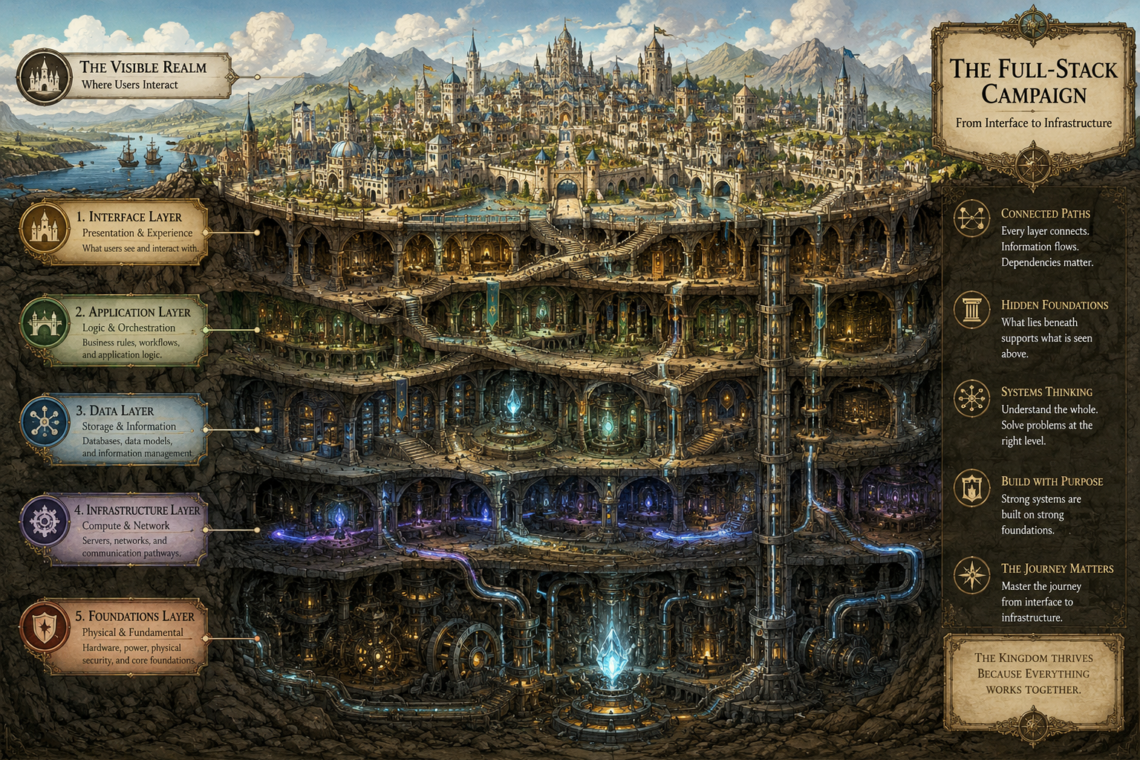
  • Detailed fantasy cross-section illustration titled The Full-Stack Campaign: From Interface to Infrastructure. A sprawling medieval fantasy kingdom filled with castles, towers, bridges, marketplaces, and guild halls sits on the surface beneath a bright sky. The ground beneath the city is cut away to reveal multiple interconnected underground layers extending deep into the earth. Massive stone roads, elevators, tunnels, aqueducts, glowing magical conduits, and engineering works connect hidden chambers, archives, vaults, transit networks, and subterranean fortresses. The deepest levels contain enormous dwarven-style machinery, crystal power systems, and foundational infrastructure supporting the realm above. Informational panels label each layer of the kingdom, visually illustrating how visible systems depend upon increasingly complex hidden foundations. The image conveys themes of architecture, interconnected systems, dependencies, and the journey from user-facing experiences to the infrastructure that supports them.
    The Full-Stack Campaign

    From Interface to Infrastructure

    Before adventurers can explore the world, they must understand the rules that shape it. Editor’s Note Before appearing as the opening chapter of The Full-Stack Campaign: From Interface to Infrastructure, this article first appeared on RandomThoughtsInTraffic.com as an exploration of why developers often struggle when their knowledge remains confined to a single layer of the technology stack. This revised and expanded edition examines how information travels through modern web applications, explores the relationships between browsers, APIs, servers, databases, and infrastructure, and establishes the systems-oriented mindset that guides the remainder of the series. New material includes expanded architectural examples, a deeper discussion of specialization within software development, and a practical examination…