Stack n' Scroll

Code, Campaigns, and Lessons from the Digital Realm

September 2026
S M T W T F S
 12345
6789101112
13141516171819
20212223242526
27282930  
« Aug    

Meta

  • Register
  • Log in
  • Entries feed
  • Comments feed
  • WordPress.org
Frank Jamison Avatar
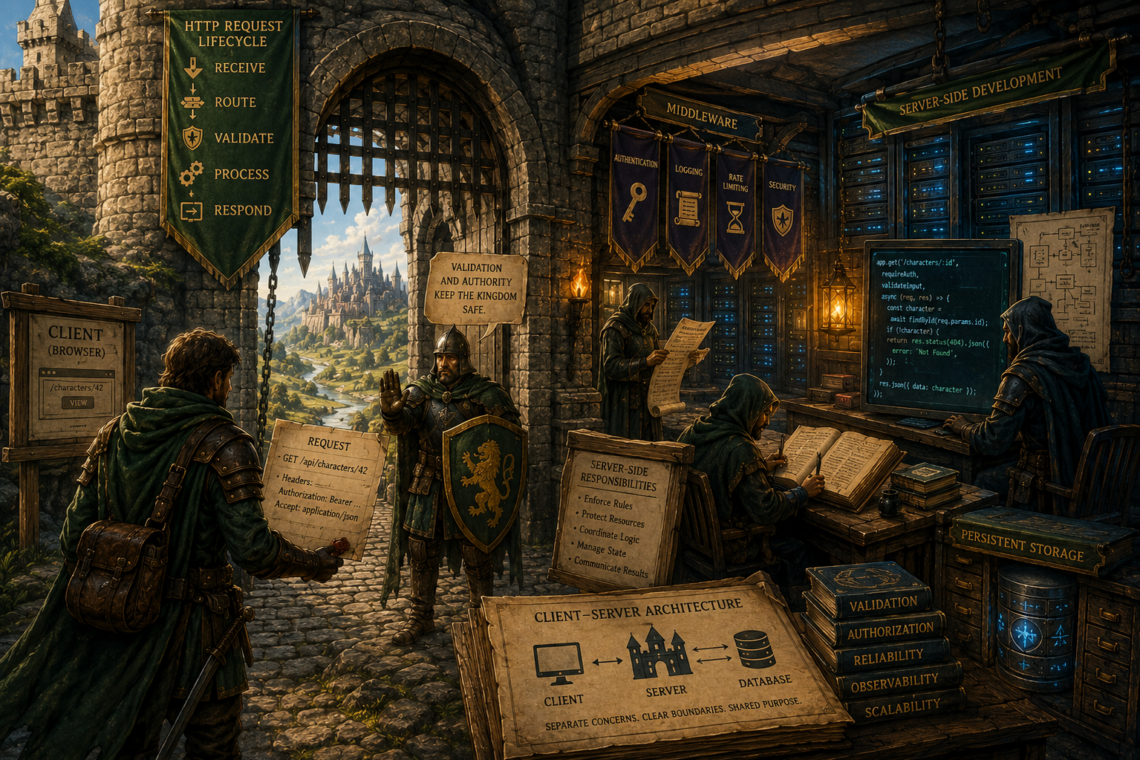
  • Dungeons & Dragons-inspired fantasy illustration of a fortified kingdom gate representing the boundary between browser and server, with a traveler delivering a request through guarded checkpoints into a server-side stronghold where validation, middleware, application logic, persistent storage, and client-server communication are visualized as interconnected parts of the kingdom’s infrastructure.
    The Full-Stack Campaign

    The Gate Beyond the UI: What a Server Actually Does

    April 20, 2026 /

    Every adventurer eventually passes beyond the city gates, where servers receive the requests that keep the kingdom running. Editor’s Note: This article originally appeared on RandomThoughtsInTraffic.com as an introduction to the boundary between browser code and server-side development. For this StackNScroll edition, I have revised and expanded the discussion to more carefully trace the request lifecycle and explore routing, validation, HTTP responses, middleware, persistence, and the server’s role as an authority boundary. These additions connect this week’s Beyond the City Gates theme to a practical learning objective: understanding not merely how to create a server, but why certain responsibilities must move beyond the browser as an application grows. The result…
    Read More
    Frank Jamison

    You May Also Like

    A monumental fantasy castle is shown in dramatic cutaway cross section, revealing its immense stone foundations extending deep into bedrock beneath the kingdom. Glowing golden architectural lines, magical construction diagrams, geometric overlays, and blueprint-style annotations trace the load-bearing arches, columns, bridges, stairways, and vaulted chambers that support the entire structure. Warm sunlight illuminates the thriving realm above while cool blue light radiates from the hidden foundations below, symbolizing that enduring strength comes from carefully designed structure. The detailed editorial illustration evokes a Dungeons & Dragons-inspired architectural masterpiece, visually representing the unseen framework that supports a successful software system.

    The Bones of the Realm: Writing Semantic HTML That Holds

    April 8, 2026
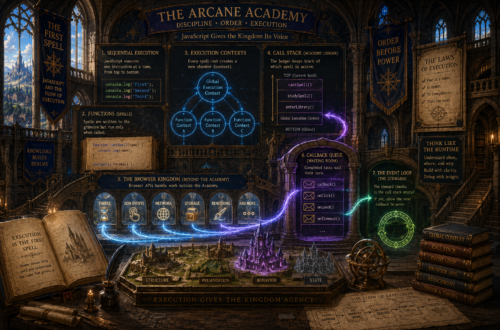
    A richly detailed Dungeons & Dragons-inspired fantasy illustration of the Arcane Academy, where the principles of JavaScript execution are represented as an organized system of magical scholarship and engineering. The vast medieval academy features towering stone arches, illuminated instructional panels, glowing diagrams, spellbooks, and magical energy flowing through the hall to illustrate sequential execution, functions, execution contexts, the Global Execution Context, the call stack, browser APIs, callback queues, and the event loop. At the center, streams of arcane energy connect the academy's systems, symbolizing how JavaScript gives a web application the ability to respond to user actions through disciplined, predictable execution. A detailed model of a fantasy kingdom at the bottom of the scene progresses from structure and presentation to behavior and state, reinforcing the journey of The Full-Stack Campaign and the idea that execution gives the kingdom agency.

    The First Spell: JavaScript and the Flow of Execution

    April 13, 2026
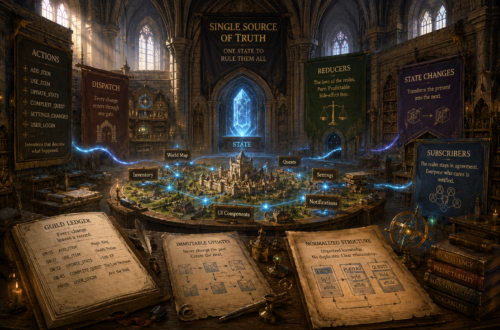
    A grand medieval fantasy guild hall serves as a visual metaphor for JavaScript state management. At the center of the vast stone chamber, a glowing magical crystal labeled State powers a detailed miniature kingdom displayed on a large round table. Blue streams of magical energy connect the crystal to labeled regions representing inventory, quests, notifications, settings, world map, and UI components, illustrating how shared application state flows throughout an entire system. Massive banners surrounding the hall depict engineering concepts including actions, dispatch, reducers, state changes, subscribers, immutable updates, normalized structure, and a guild ledger that records every change. Ancient books, engineering diagrams, drafting tools, glowing runes, and architectural details reinforce themes of organization, maintainability, and long-term software design in a painterly, Dungeons & Dragons-inspired editorial illustration.

    The Inventory System: Managing State Without Losing Control

    April 15, 2026
  • The Architect's Grimoire (13)
  • The CSS Codex (13)
  • The Enchanted Workshop (13)
  • The Full-Stack Campaign (8)
  • The Guildmaster’s Handbook (13)
  • The Kingdom in the Clouds (8)

AI-Assisted Development Artificial Intelligence Backend Development Career Development Clean Code Cloud-Native Architecture Code Quality CSS Architecture CSS Best Practices CSS Fundamentals CSS Layout Design Systems Developer Growth Developer Productivity Distributed Systems Dungeons and Dragons Engineering Culture Engineering Judgment Engineering Leadership Fantasy Theme Front-End Development Frontend Development Full Stack Development Human-AI Collaboration Maintainable Code Mentorship Professional Development Professional Growth Refactoring Responsive Design Software Architecture Software Craftsmanship Software Design Software Development Software Engineering StackNScroll System Design Technical Debt Technical Leadership The Architect's Grimoire The CSS Codex The Enchanted Workshop The Full-Stack Campaign The Guildmaster's Handbook Web Development

Stack N' Scroll - 2026 ©