Stack n' Scroll

Code, Campaigns, and Lessons from the Digital Realm

September 2026
S M T W T F S
 12345
6789101112
13141516171819
20212223242526
27282930  
« Aug    

Meta

  • Register
  • Log in
  • Entries feed
  • Comments feed
  • WordPress.org
Frank Jamison Avatar
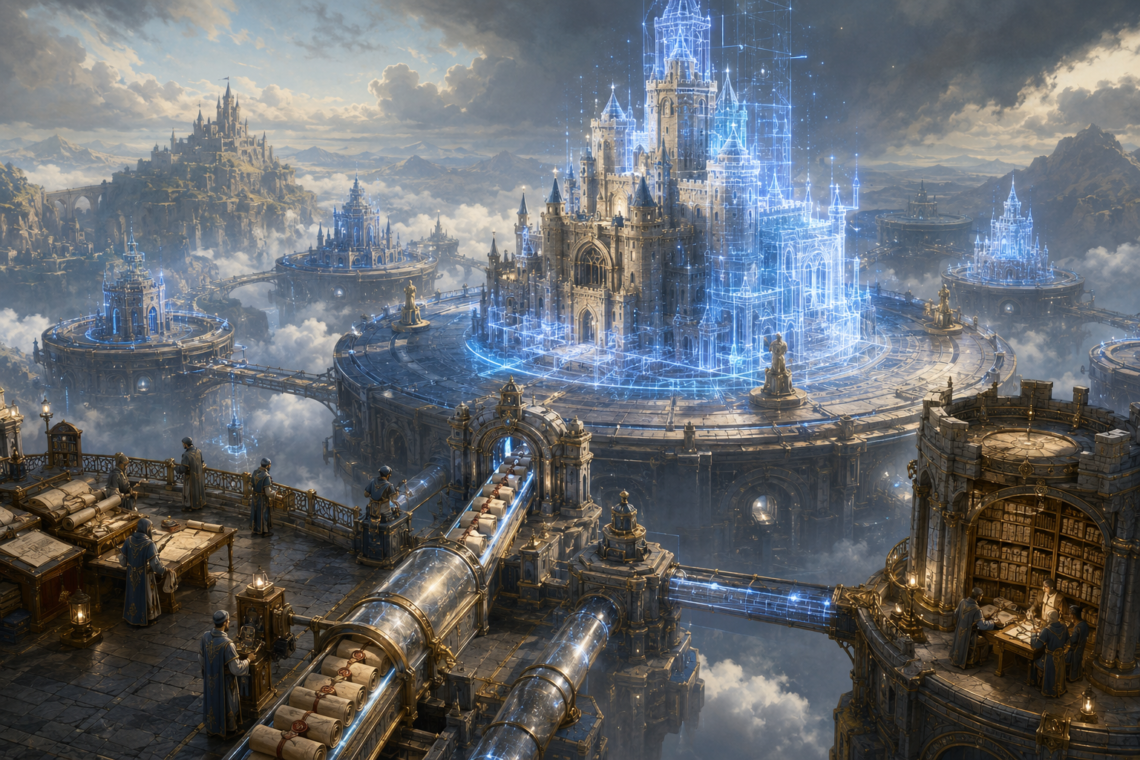
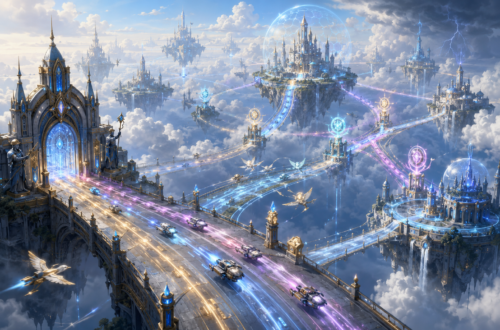
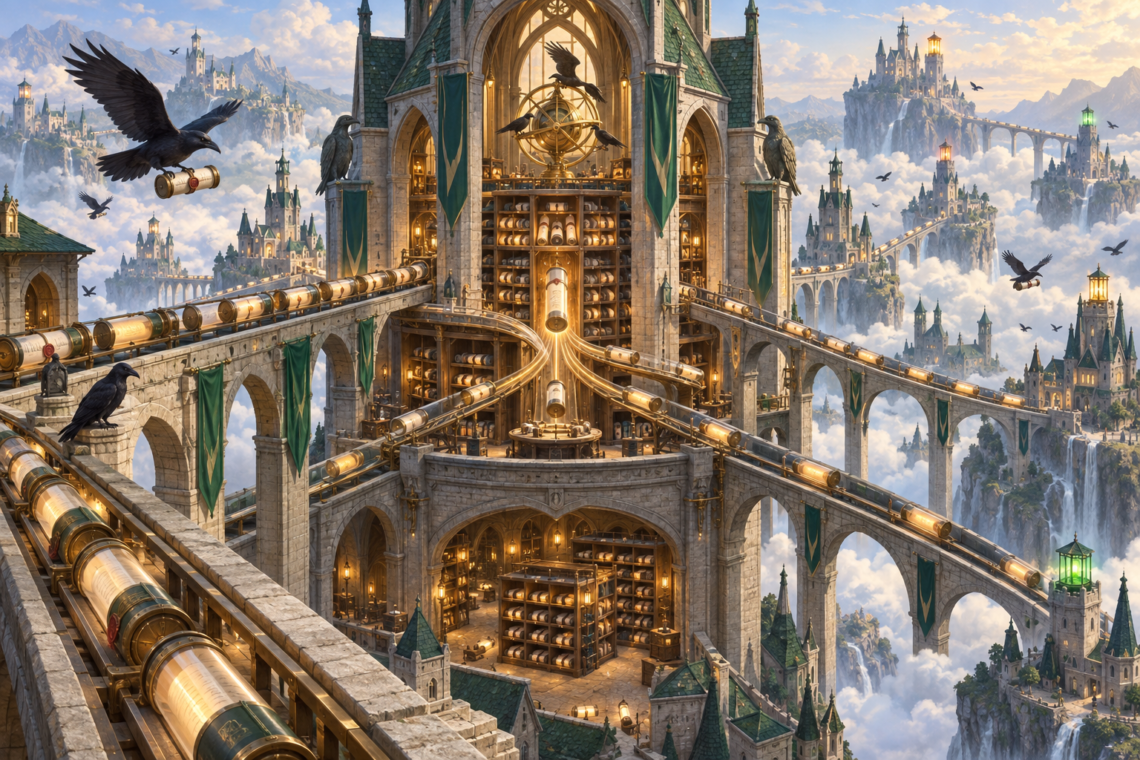
  • A vast medieval courier exchange above the clouds routes glowing message scrolls along branching bridges to distant castles as ravens carry additional dispatches across the kingdom.
    The Kingdom in the Clouds

    Messenger Ravens and Royal Couriers: Building with Messages and Events

    September 7, 2026 /

    Not every message requires the messenger to wait at the castle gate. A traveler arrives at the castle gate with an urgent request. The guard carries it to the steward, the steward consults the royal records, and the traveler remains outside until someone returns with an answer. This arrangement works when the traveler needs an immediate response, and the castle can provide one quickly. It becomes fragile when the work takes several minutes, the responsible official is unavailable, or five hundred travelers arrive at once. The problem is not that the road is poorly built. The problem is that every participant must remain available throughout the conversation. In the previous…

    Read More
    Frank Jamison

    You May Also Like

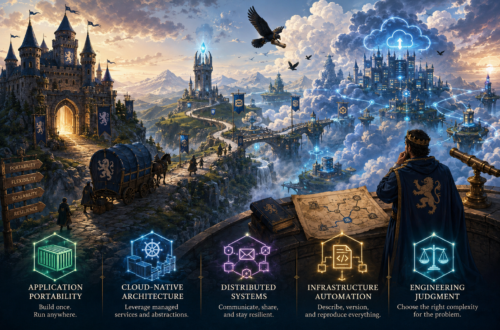
    A fantasy castle opens onto a winding road leading toward a futuristic kingdom floating among the clouds, connected by glowing networks and infrastructure. A crowned architect studies the realm from a stone overlook while visual symbols represent application portability, cloud-native architecture, distributed systems, infrastructure automation, and engineering judgment.

    The Kingdom in the Clouds: When Software Leaves the Castle

    August 23, 2026
    A vast cloud kingdom of floating cities and towers connected by glowing aerial roads, gateways, and branching energy paths, symbolizing service communication, APIs, service discovery, load balancing, and reliable cloud-native networking.

    Roads Through the Sky: Connecting Cloud-Native Services

    September 4, 2026
    Fantasy cloud-city architecture showing a partially materialized castle forming from glowing blue magical blueprints, with smaller summoned towers, message scrolls moving through conduits, and a permanent archive connected nearby to represent serverless execution, event-driven architecture, scaling, stateless computing, cold starts, and managed storage.

    The Castle That Appears on Command: Serverless Architecture

    September 2, 2026
  • Fantasy cloud-city architecture showing a partially materialized castle forming from glowing blue magical blueprints, with smaller summoned towers, message scrolls moving through conduits, and a permanent archive connected nearby to represent serverless execution, event-driven architecture, scaling, stateless computing, cold starts, and managed storage.
    The Kingdom in the Clouds

    The Castle That Appears on Command: Serverless Architecture

    September 2, 2026 /

    Sometimes the finest fortress is the one that exists only when it is needed. A Fortress Without a Permanent Gate: What Serverless Actually Changes For most of software history, deploying an application meant giving it somewhere permanent to live. A server was provisioned, a runtime installed, and a process waited for requests whether anyone arrived or not. Virtual machines changed how servers were acquired, and containers changed how applications were packaged, but the assumption remained: something was running, and engineers were responsible for keeping it alive. Serverless challenges that assumption by asking whether the fortress needs to exist when nobody is visiting. The name is misleading because servers still exist.…

    Read More
    Frank Jamison

    You May Also Like

    A grand fantasy war room contains a glowing tabletop map of a vast kingdom, with many castles connected by luminous roads and blue magical markers as robed strategists study the scene beneath towering banners, stone arches, and candlelight.

    The Keeper of a Thousand Castles: Understanding Kubernetes

    August 28, 2026
    Cutaway view of a vast wizard’s tower rising above the clouds, revealing layered workshops, storage chambers, managed systems, and small engineer-scholars operating within a provider-maintained infrastructure.

    Renting the Wizard’s Tower: Understanding Cloud Infrastructure

    August 31, 2026
    A fantasy castle opens onto a winding road leading toward a futuristic kingdom floating among the clouds, connected by glowing networks and infrastructure. A crowned architect studies the realm from a stone overlook while visual symbols represent application portability, cloud-native architecture, distributed systems, infrastructure automation, and engineering judgment.

    The Kingdom in the Clouds: When Software Leaves the Castle

    August 23, 2026
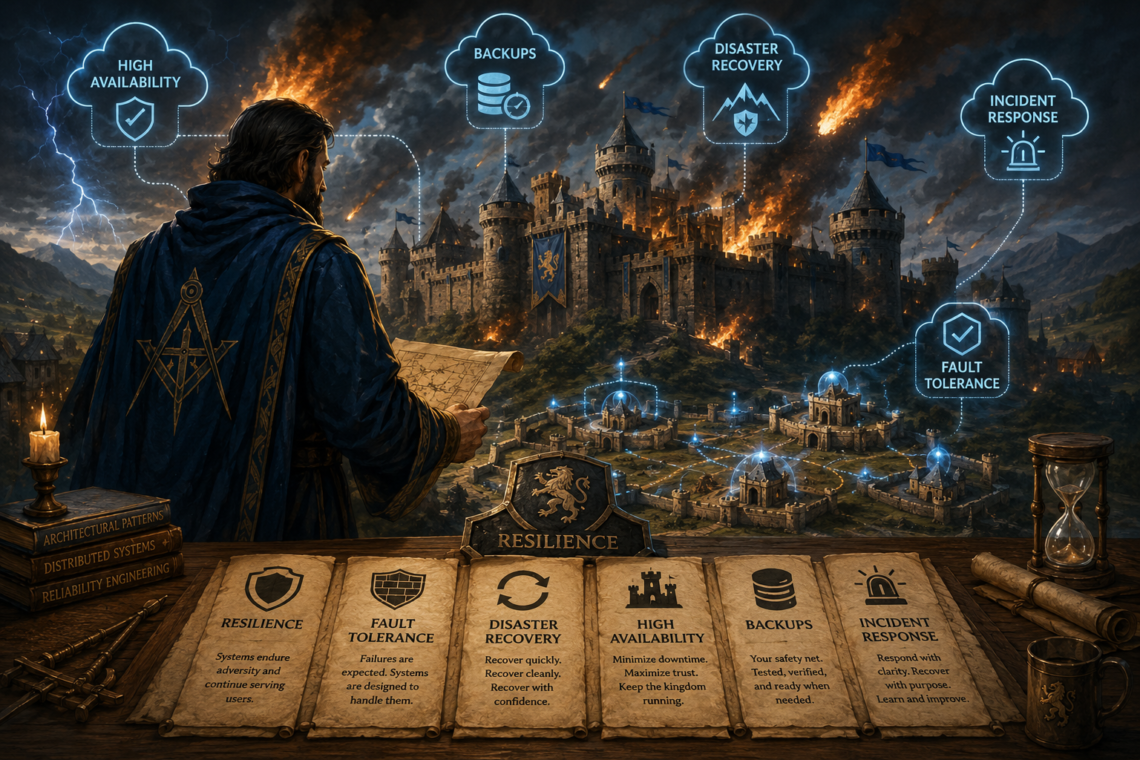
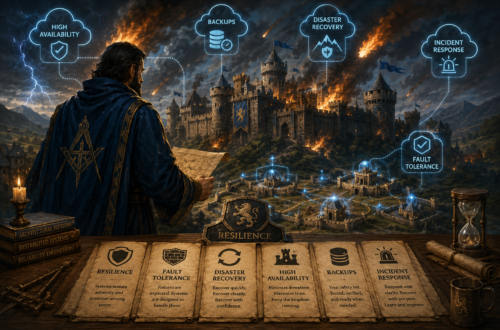
  • A fantasy-inspired digital illustration depicts a royal architect standing over maps and plans as a massive stone castle burns under a night sky filled with flaming projectiles. Although sections of the fortress are engulfed in flames, smaller fortified districts below remain connected by glowing blue pathways, symbolizing resilient system architecture and fault isolation. Floating holographic icons represent High Availability, Backups, Disaster Recovery, Fault Tolerance, and Incident Response, visually linking medieval defenses with modern software engineering concepts. Scrolls and architectural plans in the foreground reinforce themes of preparation, recovery, and thoughtful design, while the dramatic contrast between destruction and continuity emphasizes that resilient systems are designed to withstand failure rather than prevent it entirely.
    The Architect's Grimoire

    When the Kingdom Burns: Designing for Failure Before Disaster Strikes

    July 17, 2026 /

    Hope is a poor evacuation plan. There is a quiet confidence that settles over every engineering team after enough successful deployments. Systems remain stable for months. Monitoring dashboards glow green. Customers continue using the software without incident, and the last major outage slowly fades into memory. Over time, it becomes easy to mistake reliability for a permanent characteristic of the software instead of recognizing it as the product of thousands of careful engineering decisions. That confidence is understandable, but it is also one of the greatest risks a software organization can face. Software rarely fails because developers expect it to fail. More often, it fails because teams gradually stop imagining…

    Read More
    Frank Jamison

    You May Also Like

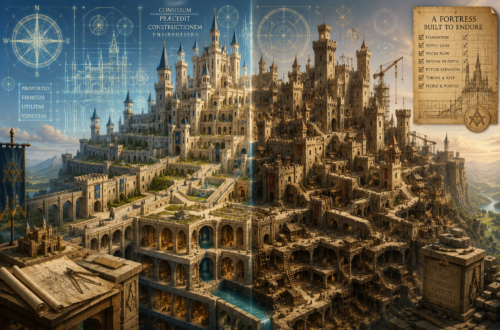
    A detailed fantasy castle is shown in cross-section, revealing a maze of interconnected rooms, stairways, hidden passages, and structural layers that symbolize the complexity of a long-lived software system. At the center, tangled corridors and web-like connections represent circular dependencies and hidden coupling, while workshop-like chambers illustrate concepts such as duplicated logic, hard-coded rules, temporary fixes, fragile tests, dead code, and hidden dependencies. In the foreground, an architect studies blueprints and a refactoring plan spread across a drafting table, surrounded by engineering tools, manuscripts, and architectural diagrams. The surrounding kingdom is orderly and well maintained, contrasting with the increasingly convoluted interior of the castle. The painterly, Dungeons & Dragons-inspired editorial illustration uses fantasy architecture to represent technical debt, legacy systems, refactoring, and the challenge of maintaining software that has grown through years of incremental change.

    Hidden Traps in the Dungeon: Escaping Technical Debt

    July 15, 2026
    A wise wizard studies a glowing crystal orb overlooking a vast fantasy kingdom where medieval architecture merges with modern software engineering. Across a towering stone aqueduct, six banners illustrate a continuous delivery pipeline labeled Automation, CI/CD, Testing, Deployment, Infrastructure as Code, and Continuous Improvement, with engineers working at illuminated stations beneath each stage. A detailed map on the wizard's table mirrors the same workflow using symbols and pathways, while holographic diagrams and glowing blue interfaces blend seamlessly into the medieval setting. The composition symbolizes mature software engineering practices transforming disciplined processes into an automated, self-improving kingdom, with warm golden light contrasting against cool blue technological elements. The article title does not appear in the image.

    Seeing Through the Crystal Ball: Observability Beyond Monitoring

    July 20, 2026
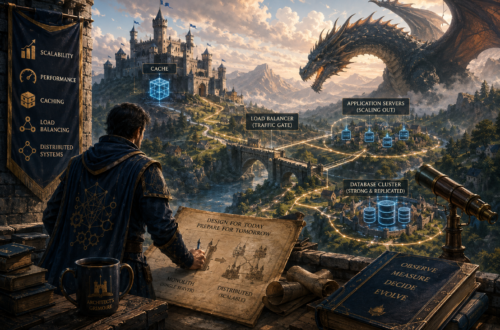
    A sprawling medieval fantasy kingdom stretches across a lush valley, with a fortified castle serving as the central hub of an expansive network of roads, bridges, and satellite settlements that symbolize a scalable software architecture. A massive dragon circles above the kingdom, representing the challenges of system growth, while an architect studies detailed plans from a stone overlook in the foreground. Glowing pathways connect infrastructure throughout the realm, illustrating concepts such as load balancing, distributed systems, caching, and scalable services. The scene emphasizes thoughtful planning, resilient infrastructure, and measured expansion through richly detailed architecture and environmental storytelling, using a classic Dungeons & Dragons-inspired aesthetic to visualize modern software engineering principles.

    The Dragon Named Scale: Building Systems That Grow

    July 13, 2026
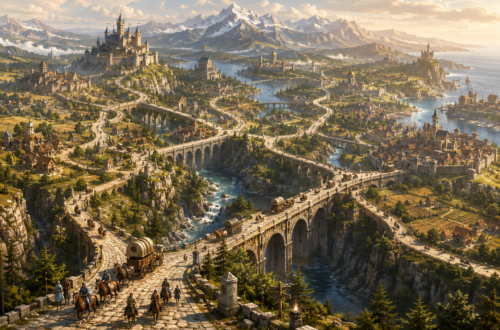
  • A sweeping high-angle fantasy landscape depicts a thriving medieval kingdom interconnected by an extensive network of beautifully engineered stone roads and towering arched bridges. Magnificent walled cities, castles, villages, ports, and mountain fortresses are linked across rivers, cliffs, forests, fertile farmland, and snow-capped peaks, emphasizing the infrastructure that unites the realm. Merchant caravans, mounted couriers, travelers, and supply wagons move peacefully along the highways beneath warm golden morning light, illustrating dependable communication, cooperation, and thoughtful planning. The image symbolizes well-designed software architecture, with the roads representing trusted APIs that seamlessly connect independent systems into a unified, flourishing kingdom.
    The Architect's Grimoire

    The Roads Between Cities: Building APIs Worth Trusting

    July 6, 2026 /

    Kingdoms prosper because their roads are trusted as much as their walls. A castle can stand for centuries and still preside over a dying realm. Towering walls may discourage invaders, magnificent keeps may inspire admiration, and disciplined soldiers may protect the capital, but none of those accomplishments guarantee prosperity. A thriving civilization depends upon something far less glamorous. Merchants must reach distant markets, royal couriers must carry news without delay, craftsmen must exchange ideas across provinces, and neighboring cities must cooperate toward common goals. Long before history remembers the greatness of a realm, it first remembers whether its roads could be depended upon. Software architecture follows the same principle. Well-designed…
    Read More
    Frank Jamison

    You May Also Like

    A fantasy-inspired digital illustration depicts a royal architect standing over maps and plans as a massive stone castle burns under a night sky filled with flaming projectiles. Although sections of the fortress are engulfed in flames, smaller fortified districts below remain connected by glowing blue pathways, symbolizing resilient system architecture and fault isolation. Floating holographic icons represent High Availability, Backups, Disaster Recovery, Fault Tolerance, and Incident Response, visually linking medieval defenses with modern software engineering concepts. Scrolls and architectural plans in the foreground reinforce themes of preparation, recovery, and thoughtful design, while the dramatic contrast between destruction and continuity emphasizes that resilient systems are designed to withstand failure rather than prevent it entirely.

    When the Kingdom Burns: Designing for Failure Before Disaster Strikes

    July 17, 2026
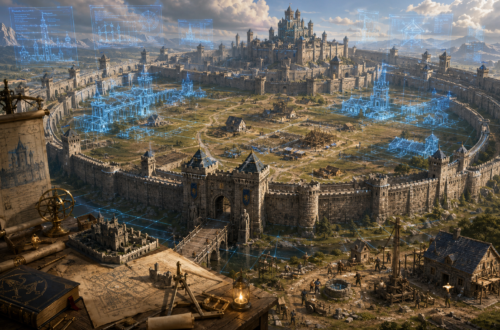
    A vast medieval fantasy kingdom is enclosed within enormous concentric stone walls, towering gatehouses, fortified keeps, and defensive towers that dominate the landscape. Despite the immense fortifications, the protected interior remains largely undeveloped, with only a few cottages, a small farmhouse, scattered construction sites, unfinished roads, and a partially built marketplace spread across open fields. Glowing blue magical architectural projections overlay the empty city, revealing ambitious plans for future districts, guild halls, towers, canals, and public buildings that have yet to be constructed. In the foreground, drafting tables, blueprints, surveying instruments, and engineering tools reinforce the theme of excessive planning, while a small group of builders focuses on practical structures such as a well and simple homes. The painterly Dungeons & Dragons-inspired scene symbolizes the software engineering concept of premature overengineering by contrasting overwhelming defensive infrastructure with a kingdom that has barely begun to grow.

    The Curse of Premature Fortification

    July 3, 2026
    A sprawling medieval fantasy kingdom stretches across a lush valley, with a fortified castle serving as the central hub of an expansive network of roads, bridges, and satellite settlements that symbolize a scalable software architecture. A massive dragon circles above the kingdom, representing the challenges of system growth, while an architect studies detailed plans from a stone overlook in the foreground. Glowing pathways connect infrastructure throughout the realm, illustrating concepts such as load balancing, distributed systems, caching, and scalable services. The scene emphasizes thoughtful planning, resilient infrastructure, and measured expansion through richly detailed architecture and environmental storytelling, using a classic Dungeons & Dragons-inspired aesthetic to visualize modern software engineering principles.

    The Dragon Named Scale: Building Systems That Grow

    July 13, 2026
  • The Architect's Grimoire (13)
  • The CSS Codex (13)
  • The Enchanted Workshop (13)
  • The Full-Stack Campaign (8)
  • The Guildmaster’s Handbook (13)
  • The Kingdom in the Clouds (8)

AI-Assisted Development Artificial Intelligence Backend Development Career Development Clean Code Cloud-Native Architecture Code Quality CSS Architecture CSS Best Practices CSS Fundamentals CSS Layout Design Systems Developer Growth Developer Productivity Distributed Systems Dungeons and Dragons Engineering Culture Engineering Judgment Engineering Leadership Fantasy Theme Front-End Development Frontend Development Full Stack Development Human-AI Collaboration Maintainable Code Mentorship Professional Development Professional Growth Refactoring Responsive Design Software Architecture Software Craftsmanship Software Design Software Development Software Engineering StackNScroll System Design Technical Debt Technical Leadership The Architect's Grimoire The CSS Codex The Enchanted Workshop The Full-Stack Campaign The Guildmaster's Handbook Web Development

Stack N' Scroll - 2026 ©