Stack n' Scroll

Code, Campaigns, and Lessons from the Digital Realm

November 2026
S M T W T F S
1234567
891011121314
15161718192021
22232425262728
2930  
« Sep    

Meta

  • Register
  • Log in
  • Entries feed
  • Comments feed
  • WordPress.org
Frank Jamison Avatar
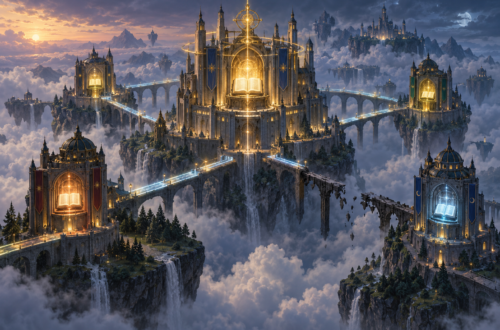
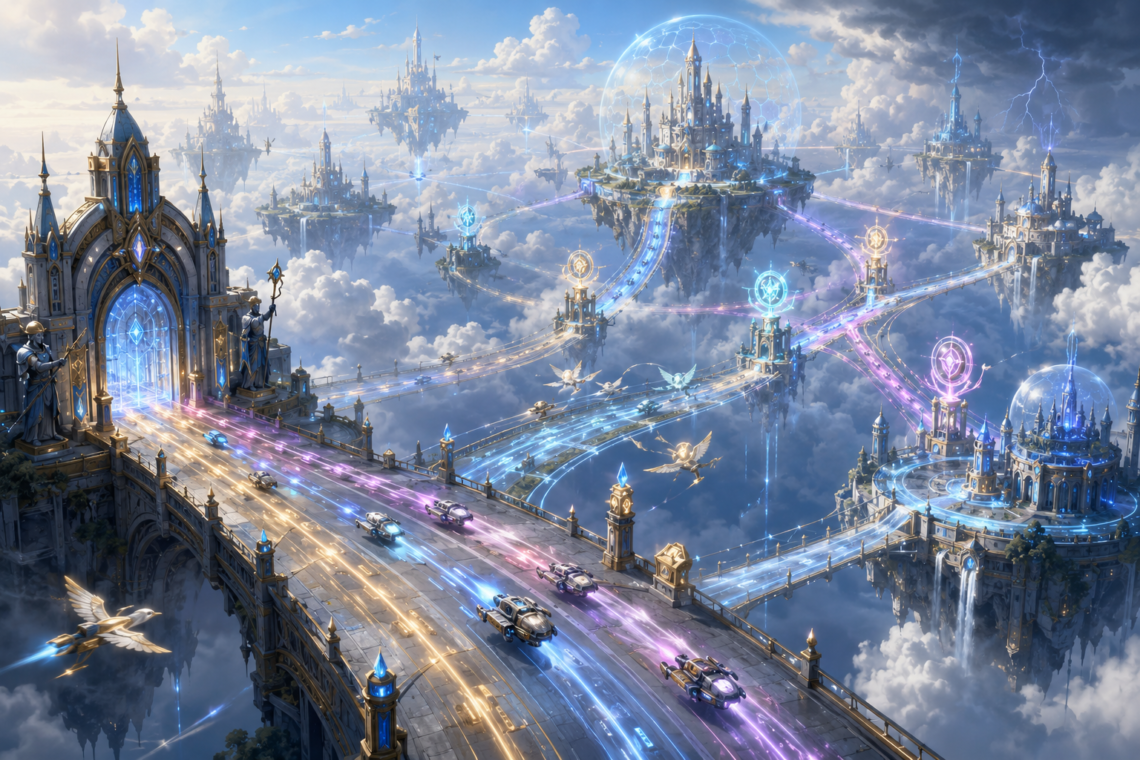
  • A vast cloud kingdom of floating cities and towers connected by glowing aerial roads, gateways, and branching energy paths, symbolizing service communication, APIs, service discovery, load balancing, and reliable cloud-native networking.
    The Kingdom in the Clouds

    Roads Through the Sky: Connecting Cloud-Native Services

    September 4, 2026 /

    A distributed kingdom survives only when its distant cities know how to speak. A single castle can rely on hallways. The kitchen knows where the pantry is, guards can walk directly to the armory, and a steward who needs an answer can cross the courtyard and ask for it. Once the kingdom spreads across distant cities, those assumptions disappear. The treasury may live in one region, the guild registry in another, and the market serving the public somewhere else entirely. Each city can function perfectly on its own and still leave the kingdom paralyzed if the roads between them are unreliable or poorly governed. Cloud-native systems inherit the same problem.…

    Read More
    Frank Jamison

    You May Also Like

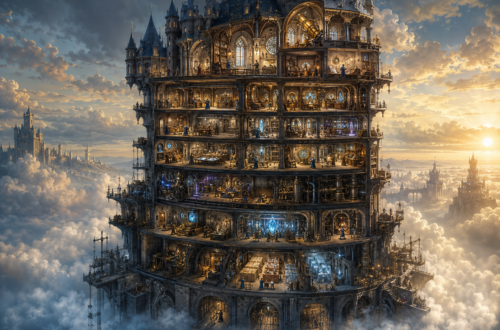
    Cutaway view of a vast wizard’s tower rising above the clouds, revealing layered workshops, storage chambers, managed systems, and small engineer-scholars operating within a provider-maintained infrastructure.

    Renting the Wizard’s Tower: Understanding Cloud Infrastructure

    August 31, 2026
    Wide fantasy illustration of a central glowing archive fortress connected to several smaller replicated archive towers by illuminated bridges, with one broken bridge representing network partition and inconsistent data across a distributed system.

    When Two Kings Claim the Throne: Consistency in Distributed Systems

    September 16, 2026
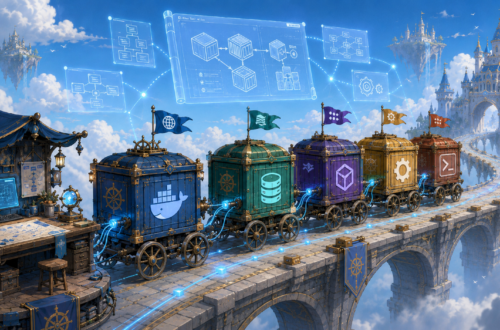
    Docker Compose, Containerization, Multi-Container Applications, Container Networking, Service Dependencies, Application Configuration, Local Development Environments, Docker, Containers, Distributed Systems, Application Architecture, Service Architecture, Development Environments, DevOps, The Kingdom in the Clouds

    The Caravan of Services: Composing Containerized Applications

    August 26, 2026
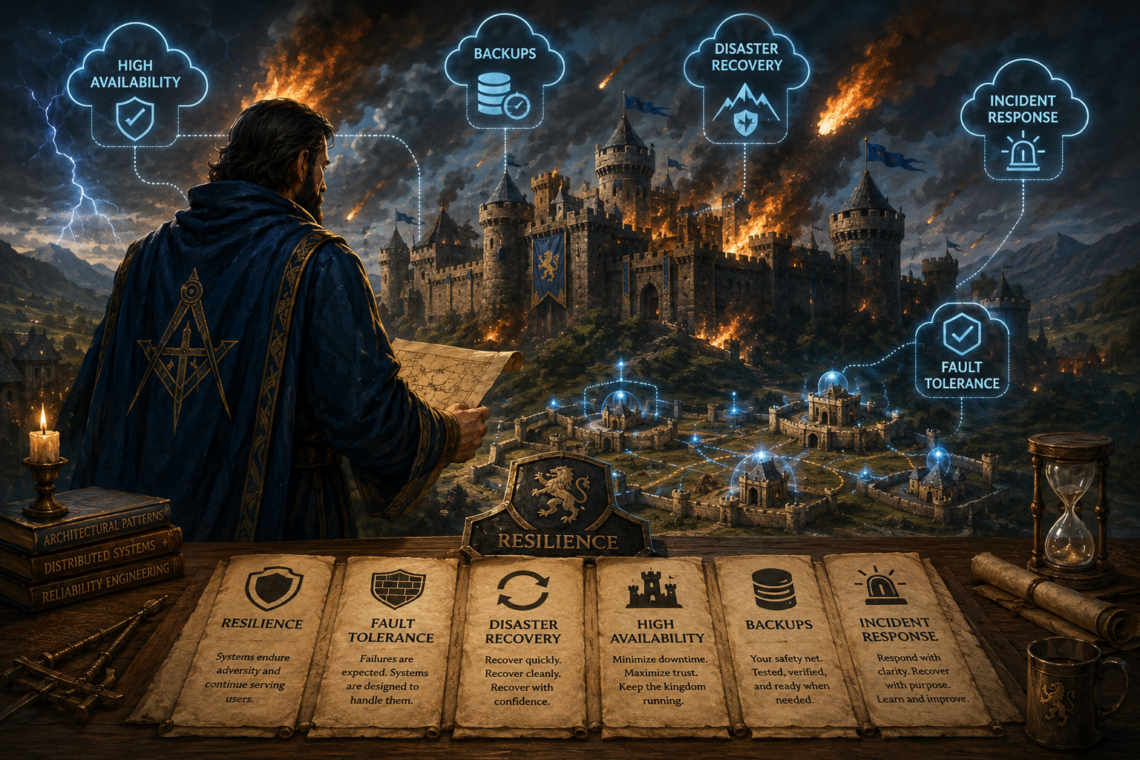
  • A fantasy-inspired digital illustration depicts a royal architect standing over maps and plans as a massive stone castle burns under a night sky filled with flaming projectiles. Although sections of the fortress are engulfed in flames, smaller fortified districts below remain connected by glowing blue pathways, symbolizing resilient system architecture and fault isolation. Floating holographic icons represent High Availability, Backups, Disaster Recovery, Fault Tolerance, and Incident Response, visually linking medieval defenses with modern software engineering concepts. Scrolls and architectural plans in the foreground reinforce themes of preparation, recovery, and thoughtful design, while the dramatic contrast between destruction and continuity emphasizes that resilient systems are designed to withstand failure rather than prevent it entirely.
    The Architect's Grimoire

    When the Kingdom Burns: Designing for Failure Before Disaster Strikes

    July 17, 2026 /

    Hope is a poor evacuation plan. There is a quiet confidence that settles over every engineering team after enough successful deployments. Systems remain stable for months. Monitoring dashboards glow green. Customers continue using the software without incident, and the last major outage slowly fades into memory. Over time, it becomes easy to mistake reliability for a permanent characteristic of the software instead of recognizing it as the product of thousands of careful engineering decisions. That confidence is understandable, but it is also one of the greatest risks a software organization can face. Software rarely fails because developers expect it to fail. More often, it fails because teams gradually stop imagining…
    Read More
    Frank Jamison

    You May Also Like

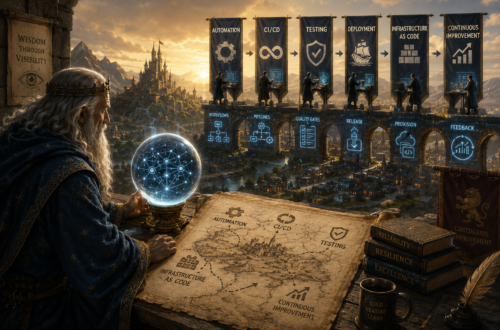
    A wise wizard studies a glowing crystal orb overlooking a vast fantasy kingdom where medieval architecture merges with modern software engineering. Across a towering stone aqueduct, six banners illustrate a continuous delivery pipeline labeled Automation, CI/CD, Testing, Deployment, Infrastructure as Code, and Continuous Improvement, with engineers working at illuminated stations beneath each stage. A detailed map on the wizard's table mirrors the same workflow using symbols and pathways, while holographic diagrams and glowing blue interfaces blend seamlessly into the medieval setting. The composition symbolizes mature software engineering practices transforming disciplined processes into an automated, self-improving kingdom, with warm golden light contrasting against cool blue technological elements. The article title does not appear in the image.

    Seeing Through the Crystal Ball: Observability Beyond Monitoring

    July 20, 2026
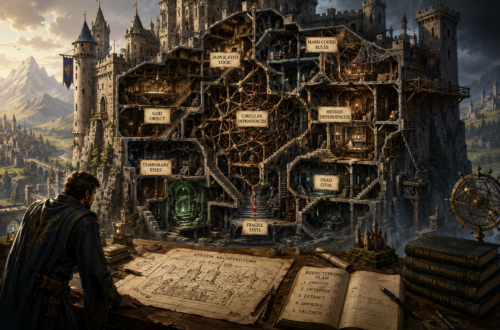
    A detailed fantasy castle is shown in cross-section, revealing a maze of interconnected rooms, stairways, hidden passages, and structural layers that symbolize the complexity of a long-lived software system. At the center, tangled corridors and web-like connections represent circular dependencies and hidden coupling, while workshop-like chambers illustrate concepts such as duplicated logic, hard-coded rules, temporary fixes, fragile tests, dead code, and hidden dependencies. In the foreground, an architect studies blueprints and a refactoring plan spread across a drafting table, surrounded by engineering tools, manuscripts, and architectural diagrams. The surrounding kingdom is orderly and well maintained, contrasting with the increasingly convoluted interior of the castle. The painterly, Dungeons & Dragons-inspired editorial illustration uses fantasy architecture to represent technical debt, legacy systems, refactoring, and the challenge of maintaining software that has grown through years of incremental change.

    Hidden Traps in the Dungeon: Escaping Technical Debt

    July 15, 2026
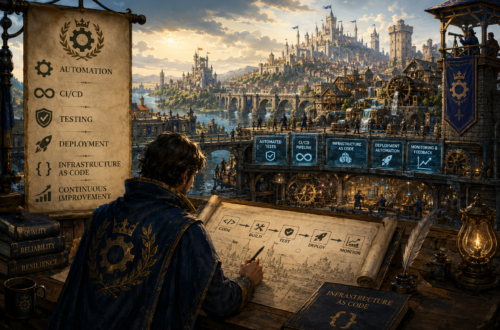
    A fantasy-inspired illustration depicts a master engineer overlooking a thriving medieval kingdom powered by invisible systems rather than heroic effort. In the foreground, a cloaked architect studies a blueprint illustrating a software delivery pipeline from code to build, test, deployment, and monitoring. Below, workshops, waterwheels, bridges, and aqueducts symbolize automated infrastructure supporting the bustling city above. Watchtowers overlook the realm while illuminated engineering panels represent automated testing, CI/CD pipelines, infrastructure as code, deployment automation, and monitoring. The scene conveys how automation, continuous improvement, and dependable engineering systems quietly enable a prosperous kingdom without drawing attention to themselves.

    The Automated Kingdom: When Excellence Becomes Routine

    July 22, 2026
  • The Architect's Grimoire (13)
  • The CSS Codex (13)
  • The Enchanted Workshop (13)
  • The Full-Stack Campaign (8)
  • The Guildmaster’s Handbook (13)
  • The Kingdom in the Clouds (9)

AI-Assisted Development Artificial Intelligence Backend Development Career Development Clean Code Cloud-Native Architecture Code Quality CSS Architecture CSS Best Practices Design Systems Developer Growth Developer Productivity Distributed Systems Dungeons and Dragons Engineering Culture Engineering Judgment Engineering Leadership Fantasy Theme Front-End Development Frontend Development Full Stack Development Human-AI Collaboration Maintainable Code Maintainable CSS Mentorship Professional Development Professional Growth Refactoring Responsive Design Software Architecture Software Craftsmanship Software Design Software Development Software Engineering StackNScroll System Design Technical Debt Technical Leadership The Architect's Grimoire The CSS Codex The Enchanted Workshop The Full-Stack Campaign The Guildmaster's Handbook The Kingdom in the Clouds Web Development

Stack N' Scroll - 2026 ©