Stack n' Scroll

Code, Campaigns, and Lessons from the Digital Realm

August 2026
S M T W T F S
 1
2345678
9101112131415
16171819202122
23242526272829
3031  
« Jul    

Meta

  • Register
  • Log in
  • Entries feed
  • Comments feed
  • WordPress.org
Frank Jamison Avatar
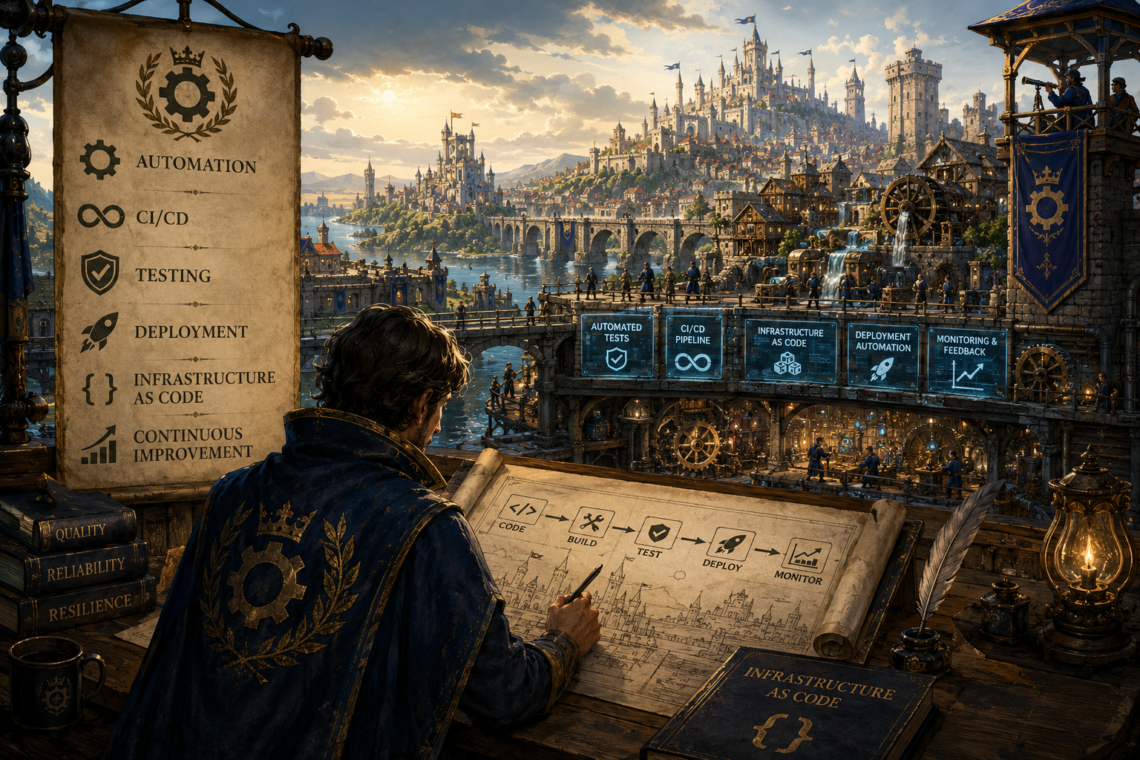
  • A fantasy-inspired illustration depicts a master engineer overlooking a thriving medieval kingdom powered by invisible systems rather than heroic effort. In the foreground, a cloaked architect studies a blueprint illustrating a software delivery pipeline from code to build, test, deployment, and monitoring. Below, workshops, waterwheels, bridges, and aqueducts symbolize automated infrastructure supporting the bustling city above. Watchtowers overlook the realm while illuminated engineering panels represent automated testing, CI/CD pipelines, infrastructure as code, deployment automation, and monitoring. The scene conveys how automation, continuous improvement, and dependable engineering systems quietly enable a prosperous kingdom without drawing attention to themselves.
    The Architect's Grimoire

    The Automated Kingdom: When Excellence Becomes Routine

    July 22, 2026 /

    The greatest kingdoms flourish because excellence becomes routine. The most reliable software systems are often the least impressive. Their deployments happen without ceremony. Their monitoring catches problems before customers notice them. Their infrastructure quietly provisions itself, and their operational routines become so dependable that engineers gradually stop thinking about them. The greatest compliment those systems receive is that nobody considers them remarkable anymore. Like the finest kingdoms, their success has become ordinary because excellence has become routine. Travelers rarely praise the aqueducts that deliver clean water every day or the roads that quietly connect every village to the capital. They admire the thriving markets, magnificent libraries, and prosperous cities made…

    Read More
    Frank Jamison

    You May Also Like

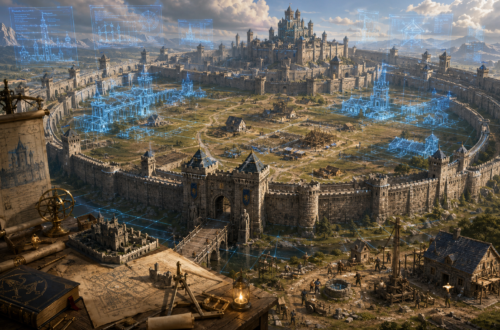
    A sprawling medieval fantasy kingdom stretches across a lush valley, with a fortified castle serving as the central hub of an expansive network of roads, bridges, and satellite settlements that symbolize a scalable software architecture. A massive dragon circles above the kingdom, representing the challenges of system growth, while an architect studies detailed plans from a stone overlook in the foreground. Glowing pathways connect infrastructure throughout the realm, illustrating concepts such as load balancing, distributed systems, caching, and scalable services. The scene emphasizes thoughtful planning, resilient infrastructure, and measured expansion through richly detailed architecture and environmental storytelling, using a classic Dungeons & Dragons-inspired aesthetic to visualize modern software engineering principles.

    The Dragon Named Scale: Building Systems That Grow

    July 13, 2026
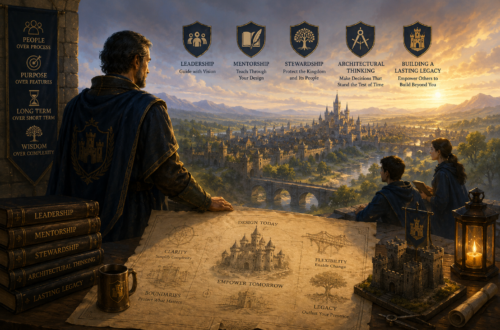
    A cinematic fantasy illustration of a master architect standing on a castle balcony at sunrise, overlooking a vast medieval kingdom while mentoring two apprentices. An architectural blueprint of the kingdom is spread across a stone table alongside drafting tools, a castle model, and books labeled Leadership, Mentorship, Stewardship, Architectural Thinking, and Lasting Legacy. Banners and heraldic emblems reinforce themes of leadership, architectural vision, and building systems that endure. The warm golden light, expansive cityscape, and symbolic imagery convey the lasting influence of thoughtful software architecture, mentorship, and engineering stewardship across generations.

    Becoming the Royal Architect: Designing Systems That Outlive You

    July 24, 2026
    A fantasy-inspired digital illustration depicts a royal architect standing over maps and plans as a massive stone castle burns under a night sky filled with flaming projectiles. Although sections of the fortress are engulfed in flames, smaller fortified districts below remain connected by glowing blue pathways, symbolizing resilient system architecture and fault isolation. Floating holographic icons represent High Availability, Backups, Disaster Recovery, Fault Tolerance, and Incident Response, visually linking medieval defenses with modern software engineering concepts. Scrolls and architectural plans in the foreground reinforce themes of preparation, recovery, and thoughtful design, while the dramatic contrast between destruction and continuity emphasizes that resilient systems are designed to withstand failure rather than prevent it entirely.

    When the Kingdom Burns: Designing for Failure Before Disaster Strikes

    July 17, 2026
  • A wise wizard studies a glowing crystal orb overlooking a vast fantasy kingdom where medieval architecture merges with modern software engineering. Across a towering stone aqueduct, six banners illustrate a continuous delivery pipeline labeled Automation, CI/CD, Testing, Deployment, Infrastructure as Code, and Continuous Improvement, with engineers working at illuminated stations beneath each stage. A detailed map on the wizard's table mirrors the same workflow using symbols and pathways, while holographic diagrams and glowing blue interfaces blend seamlessly into the medieval setting. The composition symbolizes mature software engineering practices transforming disciplined processes into an automated, self-improving kingdom, with warm golden light contrasting against cool blue technological elements. The article title does not appear in the image.
    The Architect's Grimoire

    Seeing Through the Crystal Ball: Observability Beyond Monitoring

    July 20, 2026 /

    A wise ruler never governs a kingdom they cannot see. Software architecture reaches an interesting stage after the obvious problems have been solved. The application survives deployments without drama, customers depend upon it every day, and the engineering team gradually shifts its attention from building features to operating a growing platform. Confidence naturally follows that maturity because the system appears stable, the infrastructure scales predictably, and production incidents become increasingly uncommon. Then, almost without warning, engineers begin encountering problems that refuse to fit neatly into familiar patterns. A handful of users report intermittent failures that nobody can reproduce. Response times drift upward despite healthy infrastructure metrics. A background process occasionally…

    Read More
    Frank Jamison

    You May Also Like

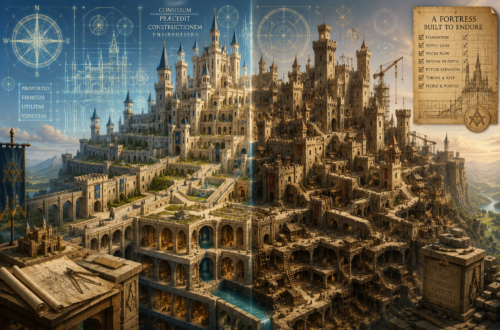
    A vast medieval fantasy castle dominates the landscape, split into two contrasting halves to illustrate the importance of architectural planning. The left side features a beautifully organized fortress with symmetrical towers, interconnected courtyards, bridges, aqueducts, and orderly roads, overlaid with glowing magical blueprints, surveying grids, compass roses, and geometric construction diagrams. The right side remains impressive but is visibly less organized, with awkward tower placement, inefficient stairways, conflicting roads, and haphazard expansions that suggest growth without an overall plan. Artistic cutaway sections reveal deep stone foundations, underground chambers, drainage tunnels, and structural supports extending into bedrock. Tiny builders and stonemasons emphasize the immense scale of the castle, while warm morning light highlights the contrast between intentional design and organic growth, visually representing the role of software architecture in creating maintainable, long-lasting systems.

    Why Castles Need Architects

    June 29, 2026
    A hooded royal architect studies a detailed medieval blueprint inside a heavily fortified castle treasury, where secure vaults, locked chests, and guarded passageways symbolize data protection, ownership, persistence, secrets management, and data integrity. Through a large stone archway, a majestic castle overlooks a peaceful river valley, reinforcing the theme that strong software architecture protects an organization's most valuable assets through thoughtful design rather than visible defenses alone.

    The Royal Treasury: Protecting the Kingdom’s Data

    July 10, 2026
    A sprawling medieval fantasy kingdom stretches across a lush valley, with a fortified castle serving as the central hub of an expansive network of roads, bridges, and satellite settlements that symbolize a scalable software architecture. A massive dragon circles above the kingdom, representing the challenges of system growth, while an architect studies detailed plans from a stone overlook in the foreground. Glowing pathways connect infrastructure throughout the realm, illustrating concepts such as load balancing, distributed systems, caching, and scalable services. The scene emphasizes thoughtful planning, resilient infrastructure, and measured expansion through richly detailed architecture and environmental storytelling, using a classic Dungeons & Dragons-inspired aesthetic to visualize modern software engineering principles.

    The Dragon Named Scale: Building Systems That Grow

    July 13, 2026
  • A colossal ancient stone monument shaped like a towering skill tree rises from the center of a vast mountain valley. Hundreds of glowing blue and gold energy nodes connect through branching pathways, terraces, stairways, and bridges that climb toward a brilliant radiant pinnacle at the summit. The lower levels glow softly while the upper tiers shine with increasingly powerful light, symbolizing growth, mastery, and the compounding value of long-term investment. Surrounding the monument, rivers, roads, distant settlements, and cultivated lands spread across the landscape, suggesting centuries of development fueled by the monument's energy. The scene conveys patience, progression, wisdom, and accumulated experience through an epic fantasy aesthetic.
    The CSS Codex

    Patience Is a Scaling Stat

    March 27, 2026 /

    The greatest guild halls were not built in a single turn of the hourglass. Editor’s Note: Before joining The CSS Codex: Mastering the Rules of the Realm, Patience Is a Scaling Stat first appeared on RandomThoughtsInTraffic.com. This revised and expanded edition explores the relationship between patience, craftsmanship, and long-term CSS maintainability through the lens of sustainable engineering practices. New material examines how small implementation decisions compound over time, how experienced developers approach architectural choices differently than newer practitioners, and why understanding systems often matters more than solving individual problems quickly. While the original article focused primarily on professional growth and mindset, this edition connects those lessons directly to CSS architecture,…
    Read More
    Frank Jamison

    You May Also Like

    An enormous ancient spellbook rests on a carved stone pedestal in a vast arcane archive as hundreds of stylesheet-like parchment pages erupt from its open pages and merge into a colossal serpentine creature made entirely of CSS rules, annotations, diagrams, revisions, and glowing magical symbols. The parchment monster coils through towering shelves filled with labeled codices while streams of luminous blue and violet magical energy connect scattered documents into a sprawling network of dependencies. Individual pages display selectors, properties, comments, crossed-out declarations, and specificity notes, emphasizing accumulated technical debt and architectural complexity. The scene is illuminated by glowing runes, magical ink, and dramatic volumetric light, creating the impression of a once-useful body of knowledge that has grown beyond its original purpose and become an intelligent living manifestation of an unmaintainable stylesheet.

    When the Stylesheet Becomes the Monster

    April 3, 2026
    An ancient illuminated codex floats above a stone pedestal inside a dark fantasy library while chaotic purple and blue magical energy erupts around it. Torn parchment scraps swirl through the magical storm bearing frustrated messages such as Why Did It Move?, But I Set the Color!, It Was Fine Yesterday!, I Do Not Understand!, and Why No Work?. Glowing question marks and floating debris drift through the air, reinforcing the sense of confusion and unpredictability. The massive codex radiates warm golden light that contrasts with the surrounding chaos, suggesting hidden knowledge and order beneath the apparent magical disorder. Towering bookshelves, candles, scrolls, and arcane artifacts fill the background, creating a fantasy atmosphere that symbolizes discovering the rules behind seemingly unpredictable behavior.

    When CSS Feels Like Wild Magic

    March 13, 2026
    An illuminated magical codex rests open atop an ornate stone throne in the center of a vast fantasy library. Streams of blue and gold arcane energy flow from surrounding scrolls, drafting tables, and enchanted tablets toward the glowing book. Above the throne, layered translucent diagrams resembling architectural blueprints, interconnected systems, and cascading structures overlap in the air, with one central design shining brightest. The grand hall is filled with bookshelves, maps, measuring instruments, and research materials beneath vaulted stone arches lit by warm torchlight and magical illumination. The scene evokes order, authority, craftsmanship, and the mastery of complex systems.

    The Laws of the Cascade

    March 9, 2026
  • The Architect's Grimoire (13)
  • The CSS Codex (13)
  • The Enchanted Workshop (9)
  • The Full-Stack Campaign (7)
  • The Guildmaster’s Handbook (13)

AI-Assisted Development Artificial Intelligence Backend Development Career Development Clean Code Code Quality CSS CSS Architecture CSS Best Practices CSS Fundamentals CSS Layout Design Systems Developer Education Developer Growth Developer Productivity Dungeons and Dragons Engineering Culture Engineering Judgment Engineering Leadership Fantasy Theme Front-End Development Frontend Development Full Stack Development Maintainable Code Maintainable CSS Mentorship Professional Development Professional Growth Refactoring Responsive Design Software Architecture Software Craftsmanship Software Design Software Development Software Engineering StackNScroll System Design Technical Debt Technical Leadership The Architect's Grimoire The CSS Codex The Enchanted Workshop The Full-Stack Campaign The Guildmaster's Handbook Web Development

Stack N' Scroll - 2026 ©