Stack n' Scroll

Code, Campaigns, and Lessons from the Digital Realm

October 2026
S M T W T F S
 123
45678910
11121314151617
18192021222324
25262728293031
« Sep    

Meta

  • Register
  • Log in
  • Entries feed
  • Comments feed
  • WordPress.org
Frank Jamison Avatar
  • A fantasy-tech illustration shows a medieval engineer preparing a containerized application for travel. A Docker-marked shipping container and wagons labeled Image, Config, Data, and Secrets travel toward a distant castle, while a packing checklist identifies runtime, dependencies, configuration, entrypoint, ports, data, and secrets. Banners and maps emphasize containers, Docker, images, environment consistency, reproducibility, and application portability.
    The Kingdom in the Clouds

    Packing the Castle: Understanding Containers

    August 24, 2026 /

    A well-packed workshop should work the same no matter where the road carries it. There is a particular kind of software failure that becomes almost funny after you have encountered it enough times. An application works perfectly on one developer’s machine, refuses to cooperate on another, behaves differently in testing, and then develops an entirely new personality after deployment. The code is the same, the database is supposedly the same, and everyone involved is reasonably certain that the necessary dependencies were installed. Yet somewhere between one machine and another, the application crossed an invisible border and discovered that the laws of physics had changed. For years, software teams fought these…

    Read More
    Frank Jamison

    You May Also Like

    Fantasy cloud-city architecture showing a partially materialized castle forming from glowing blue magical blueprints, with smaller summoned towers, message scrolls moving through conduits, and a permanent archive connected nearby to represent serverless execution, event-driven architecture, scaling, stateless computing, cold starts, and managed storage.

    The Castle That Appears on Command: Serverless Architecture

    September 2, 2026
    Cutaway view of a vast wizard’s tower rising above the clouds, revealing layered workshops, storage chambers, managed systems, and small engineer-scholars operating within a provider-maintained infrastructure.

    Renting the Wizard’s Tower: Understanding Cloud Infrastructure

    August 31, 2026
    Docker Compose, Containerization, Multi-Container Applications, Container Networking, Service Dependencies, Application Configuration, Local Development Environments, Docker, Containers, Distributed Systems, Application Architecture, Service Architecture, Development Environments, DevOps, The Kingdom in the Clouds

    The Caravan of Services: Composing Containerized Applications

    August 26, 2026
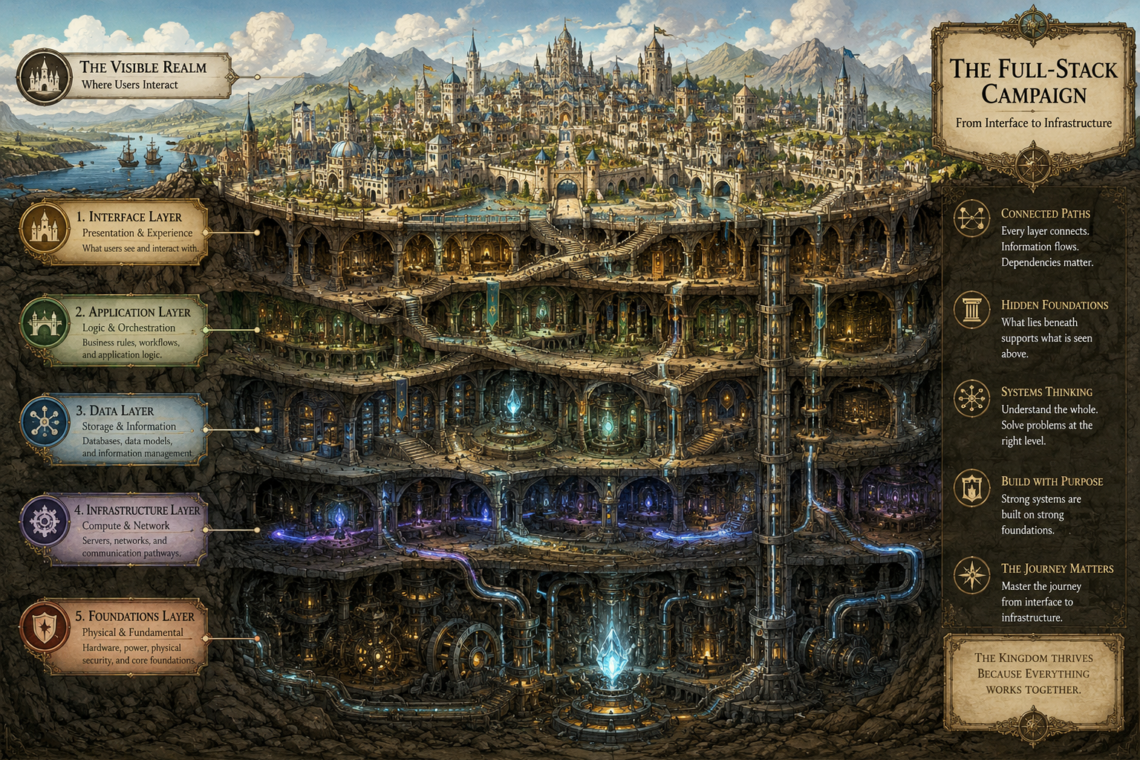
  • Detailed fantasy cross-section illustration titled The Full-Stack Campaign: From Interface to Infrastructure. A sprawling medieval fantasy kingdom filled with castles, towers, bridges, marketplaces, and guild halls sits on the surface beneath a bright sky. The ground beneath the city is cut away to reveal multiple interconnected underground layers extending deep into the earth. Massive stone roads, elevators, tunnels, aqueducts, glowing magical conduits, and engineering works connect hidden chambers, archives, vaults, transit networks, and subterranean fortresses. The deepest levels contain enormous dwarven-style machinery, crystal power systems, and foundational infrastructure supporting the realm above. Informational panels label each layer of the kingdom, visually illustrating how visible systems depend upon increasingly complex hidden foundations. The image conveys themes of architecture, interconnected systems, dependencies, and the journey from user-facing experiences to the infrastructure that supports them.
    The Full-Stack Campaign

    From Interface to Infrastructure

    April 4, 2026 /

    Before adventurers can explore the world, they must understand the rules that shape it. Editor’s Note Before appearing as the opening chapter of The Full-Stack Campaign: From Interface to Infrastructure, this article first appeared on RandomThoughtsInTraffic.com as an exploration of why developers often struggle when their knowledge remains confined to a single layer of the technology stack. This revised and expanded edition examines how information travels through modern web applications, explores the relationships between browsers, APIs, servers, databases, and infrastructure, and establishes the systems-oriented mindset that guides the remainder of the series. New material includes expanded architectural examples, a deeper discussion of specialization within software development, and a practical examination…


    Read More
    Frank Jamison

    You May Also Like

    Stamp Evaluation – Scott #985 (Used, Hinged, No Original Gum – Single Stamp) 3¢ Carmine Rose – Grand Army of the Republic, 1949 (Commemorative Issue – Rotary Press Printing, Perf 11 x 10½, Unwatermarked) Design Overview: Scott #985 commemorates the final national encampment of the Grand Army of the Republic. The design features an elderly Civil War veteran in the foreground, a younger soldier behind him, and the GAR emblem at left above the denomination. “United States Postage” anchors the lower tablet, while the commemorative inscription spans the top. Printed in carmine rose, the engraving retains strong color, clear portrait detail, and good contrast. Grading Breakdown: The centering grade is Fine/Very Fine 78. Visually, with the unaided eye, the perforation holes are easily seen to be clear of the design, but one or two margins are narrow. The bottom margin is the most narrow and establishes the centering limit. The left margin is the least narrow, while the right margin is more narrow than the top. All margins remain clearly outside the design and satisfy the Fine/Very Fine standard. The stamp presents pleasing overall balance, with the lower margin as the primary visual limitation. Soundness Evaluation: The faults present are two shorter perforations approximately half normal length and four fuzzy or ragged perforations. These faults constitute Minor Fault soundness. Minor Fault soundness combined with Fine/Very Fine centering yields a preliminary grade of Very Good 58. The group of shortened and ragged perforations is the controlling condition issue, while the stamp otherwise retains a clean appearance. Perforations and Margins: The perforations are generally complete, but several teeth show the shortened, fuzzy, or ragged condition noted in the fault list. These irregularities slightly soften the otherwise clean outline of the stamp. The bottom margin is closest to the design, the left margin is widest, and the right margin is narrower than the top. The frame remains visibly clear of the perforation holes on all four sides. Cancellation Evaluation: No visible cancellation appears on the face of the stamp. The portraits, GAR emblem, denomination, top inscription, and lower tablet are fully visible without postal markings crossing the design. For a used stamp, this creates a clean front presentation, though the absence of a visible cancel is treated conservatively and does not automatically produce a grade increase. Collector’s Note: Scott #985 is a historically appealing commemorative for collectors of Civil War memory, veterans’ organizations, patriotic themes, and late 1940s United States issues. The paired veteran-and-soldier design gives the stamp strong symbolic impact. Eye Appeal Adjustment: After centering and soundness are determined, eye appeal is considered. The stamp retains fresh carmine rose color, a sharp engraved impression, and an unobstructed design. The perforation faults have already been accounted for in soundness, and there is no heavy cancellation to penalize. No additional adjustment is warranted, so the preliminary grade remains 58. Final Numerical Grade Calculation: The centering grade is Fine/Very Fine 78. Minor Fault soundness reduces the grade by 20 points, producing a preliminary grade of Very Good 58. No cancellation deduction or other eye appeal adjustment is applied. The final numerical grade is 58. Summary: This used Scott #985 shows Fine/Very Fine 78 centering, with the bottom margin most narrow, the left margin widest, and the right margin narrower than the top. Minor Fault soundness lowers the preliminary grade to Very Good 58. Clean color and an unobstructed face support the result without changing it. Final Grade: Very Good 58.

    The First Map: How the Browser Shapes the World

    April 6, 2026
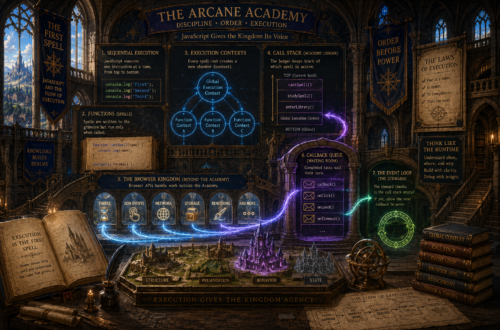
    A richly detailed Dungeons & Dragons-inspired fantasy illustration of the Arcane Academy, where the principles of JavaScript execution are represented as an organized system of magical scholarship and engineering. The vast medieval academy features towering stone arches, illuminated instructional panels, glowing diagrams, spellbooks, and magical energy flowing through the hall to illustrate sequential execution, functions, execution contexts, the Global Execution Context, the call stack, browser APIs, callback queues, and the event loop. At the center, streams of arcane energy connect the academy's systems, symbolizing how JavaScript gives a web application the ability to respond to user actions through disciplined, predictable execution. A detailed model of a fantasy kingdom at the bottom of the scene progresses from structure and presentation to behavior and state, reinforcing the journey of The Full-Stack Campaign and the idea that execution gives the kingdom agency.

    The First Spell: JavaScript and the Flow of Execution

    April 13, 2026
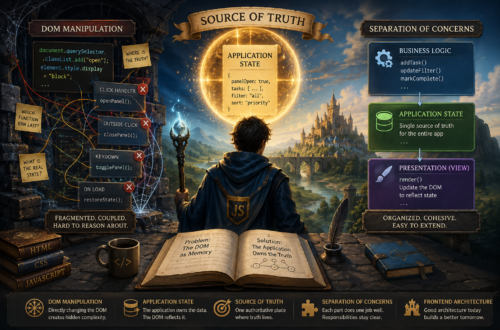
    A fantasy-inspired editorial illustration shows a developer wizard standing before a glowing magical orb labeled Source of Truth, symbolizing application state as the central authority in a web application. On the left, a dark stone chamber labeled DOM Manipulation is filled with tangled event listeners, sticky notes, and crisscrossing connections that represent tightly coupled code and hidden complexity. On the right, a bright architectural diagram labeled Separation of Concerns organizes business logic, application state, and presentation into distinct layers connected by a clear flow. An open spellbook in the foreground contrasts the problem of treating the DOM as memory with the solution of allowing the application to own its state. Books labeled HTML, CSS, and JavaScript, along with castles, mountains, and magical effects, reinforce the Dungeons & Dragons theme while illustrating the transition from direct DOM manipulation to maintainable frontend architecture.

    The Cost of Power: From DOM Manipulation to Better Design

    April 17, 2026
  • The Architect's Grimoire (13)
  • The CSS Codex (13)
  • The Enchanted Workshop (13)
  • The Full-Stack Campaign (8)
  • The Guildmaster’s Handbook (13)
  • The Kingdom in the Clouds (9)

AI-Assisted Development Artificial Intelligence Backend Development Career Development Clean Code Cloud-Native Architecture Code Quality CSS Architecture CSS Best Practices Design Systems Developer Growth Developer Productivity Distributed Systems Dungeons and Dragons Engineering Culture Engineering Judgment Engineering Leadership Fantasy Theme Front-End Development Frontend Development Full Stack Development Human-AI Collaboration Maintainable Code Maintainable CSS Mentorship Professional Development Professional Growth Refactoring Responsive Design Software Architecture Software Craftsmanship Software Design Software Development Software Engineering StackNScroll System Design Technical Debt Technical Leadership The Architect's Grimoire The CSS Codex The Enchanted Workshop The Full-Stack Campaign The Guildmaster's Handbook The Kingdom in the Clouds Web Development

Stack N' Scroll - 2026 ©