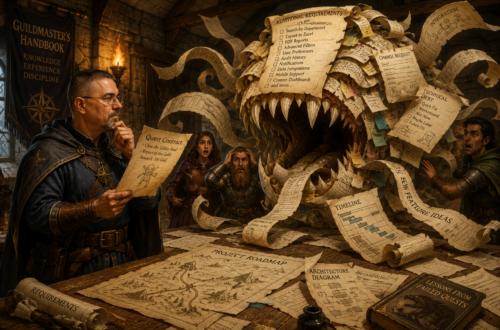
• Frank Jamison, depicted as a seasoned adventurer-engineer, studies a large map at a guild hall worktable covered with architectural diagrams, engineering blueprints, books, scrolls, and magical instruments. Behind him looms a towering shadowy creature formed from smoke and mist, symbolizing impostor syndrome. Warm torchlight illuminates the stone chamber, highlighting symbols of past achievements, knowledge, and experience. The scene blends medieval fantasy and software engineering themes to represent overcoming self-doubt through wisdom, perseverance, and hard-earned expertise.
    The Guildmaster’s Handbook

    When Impostor Syndrome Rolls a Critical Hit

    Even seasoned adventurers sometimes mistake uncertainty for failure. The Trial Hidden Behind the Character Sheet During this week’s theme, The Trials of the Realm, it would be easy to focus exclusively on technical challenges. We could discuss production outages, difficult debugging sessions, complex architectures, or impossible deadlines. Those are certainly trials every engineer encounters. Yet one of the most persistent challenges I have faced throughout my career never appeared in a ticketing system, generated an error message, or triggered an alert. It appeared quietly in my own thinking and attempted to convince me that I did not belong where I had already earned the right to stand. Impostor syndrome is…

  • Frank Jamison, portrayed as a seasoned guildmaster adventurer, stands at the center of a grand medieval guild hall strategy table covered with maps, contracts, architectural blueprints, engineering schematics, and glowing magical diagrams. Surrounded by representatives of merchants, nobility, scholars, quartermasters, and city officials, he calmly mediates a discussion while gesturing toward an illuminated map displaying interconnected pathways across the kingdom. Warm torchlight and cool magical light fill the bustling stone hall, emphasizing leadership, collaboration, communication, and problem-solving in a richly detailed fantasy setting inspired by Dungeons & Dragons.
    The Guildmaster’s Handbook

    Working With Stakeholders Without Losing Sanity

    The kingdom rarely speaks in technical terms. Wisdom begins with learning how to translate chaos. The Most Important Room Most Engineers Underestimate When many people first enter the world of software development, they imagine that success will be determined primarily by technical skill. They expect to spend their days solving complex problems, learning new technologies, designing elegant systems, and building useful applications. Those activities certainly form an important part of the profession, but they are not the whole story. Over time, most engineers discover that some of the most challenging and valuable work they perform happens away from the keyboard. I learned this lesson slowly. Early in my career, I…

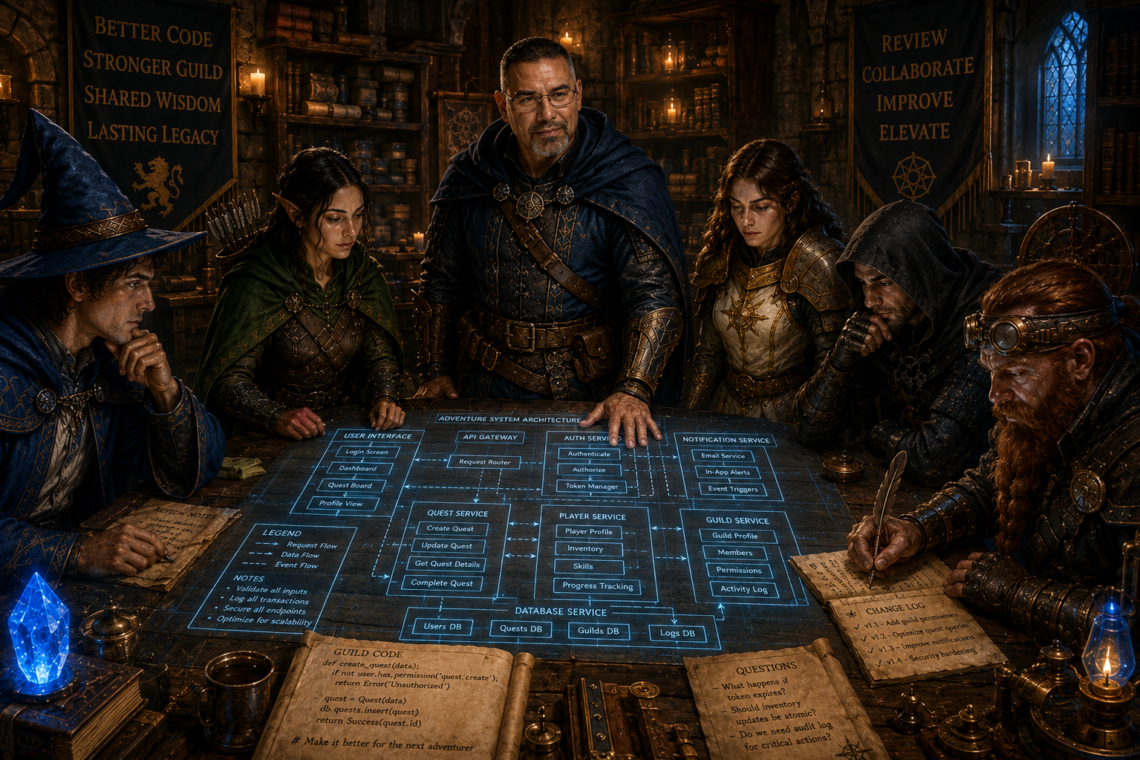
  • Frank Jamison, portrayed as a seasoned guildmaster and adventurer, stands at the head of a large strategy table inside a warmly lit medieval guild hall. Around him, a diverse party of adventurers including a wizard, ranger, cleric, rogue, and artificer collaboratively review a glowing magical blueprint filled with software architecture diagrams, annotated notes, and arcane symbols. Shelves of books and scrolls line the stone walls, while lanterns and blue magical runes illuminate the room. The scene symbolizes constructive code reviews, teamwork, mentorship, and professional growth within a fantasy-inspired guild setting.
    The Guildmaster’s Handbook

    Code Reviews Without Emotional Damage

    Criticism is not the enemy. Pride without growth is far more dangerous. The Review Table in the Guild Hall One of the most important lessons I have learned during my years in software development has very little to do with writing code. It is not about mastering a framework, learning a language, designing architecture, or deploying applications to the cloud. Instead, it concerns learning how to participate in code reviews without allowing pride, insecurity, frustration, or ego to interfere with growth. Many developers spend years improving their technical skills while investing far less effort in the collaborative skills that make engineering teams successful. Yet some of the strongest engineers I…

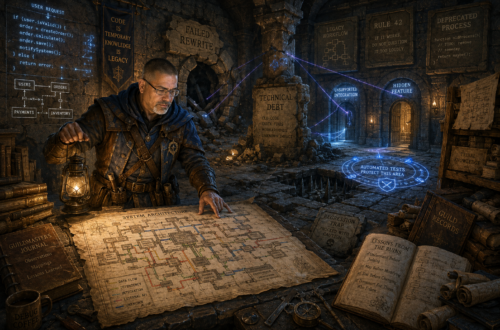
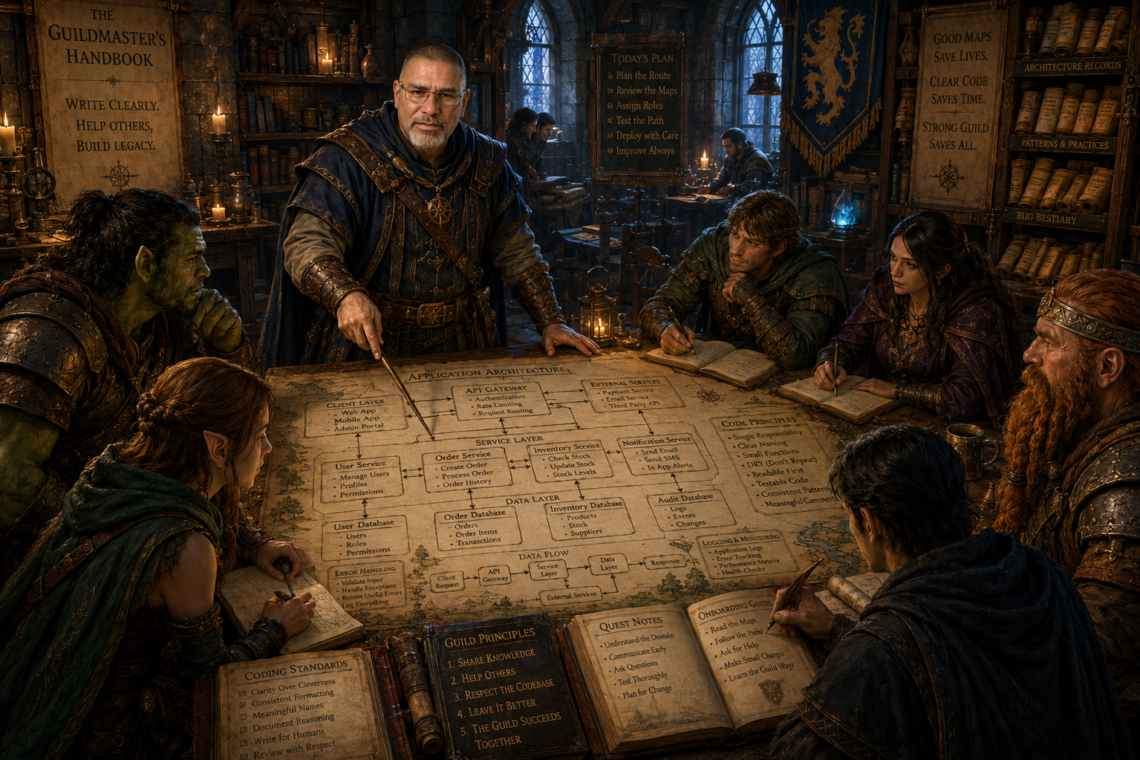
  • Frank Jamison, portrayed as a seasoned guildmaster and veteran adventurer, stands at the center of a bustling fantasy guild hall, guiding a diverse group of adventurers around a massive strategy table. The table is covered with detailed architectural diagrams, software-inspired maps, flowcharts, and handwritten guild principles rendered as medieval cartography. Shelves of scrolls, books, and guild records line the walls, while lanterns and warm candlelight illuminate the collaborative scene. Adventurers of multiple races and classes study notes, discuss plans, and learn from Frank's guidance. The image symbolizes code readability, mentorship, onboarding, documentation, and teamwork through visual metaphors of maps, pathways, and shared knowledge within a thriving adventurer's guild.
    The Guildmaster’s Handbook

    Writing Code Others Can Read

    The guild hall is crowded with adventurers. Write clearly, or your allies become your next obstacle. Life Inside the Guild Hall One of the first misconceptions many developers carry into the profession is the belief that software development is primarily a solitary activity. Popular culture often reinforces this image. We imagine a lone programmer sitting in a dimly lit room, crafting brilliant solutions through sheer technical skill and determination. While moments of solitary work certainly exist, the reality is far different. Most software is built, maintained, reviewed, and expanded by teams. Success depends as much on communication as it does on technical ability. This week’s theme is Surviving the Guild…

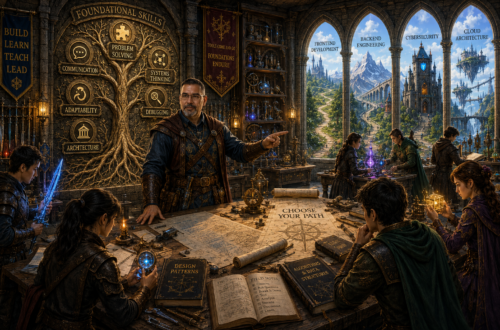
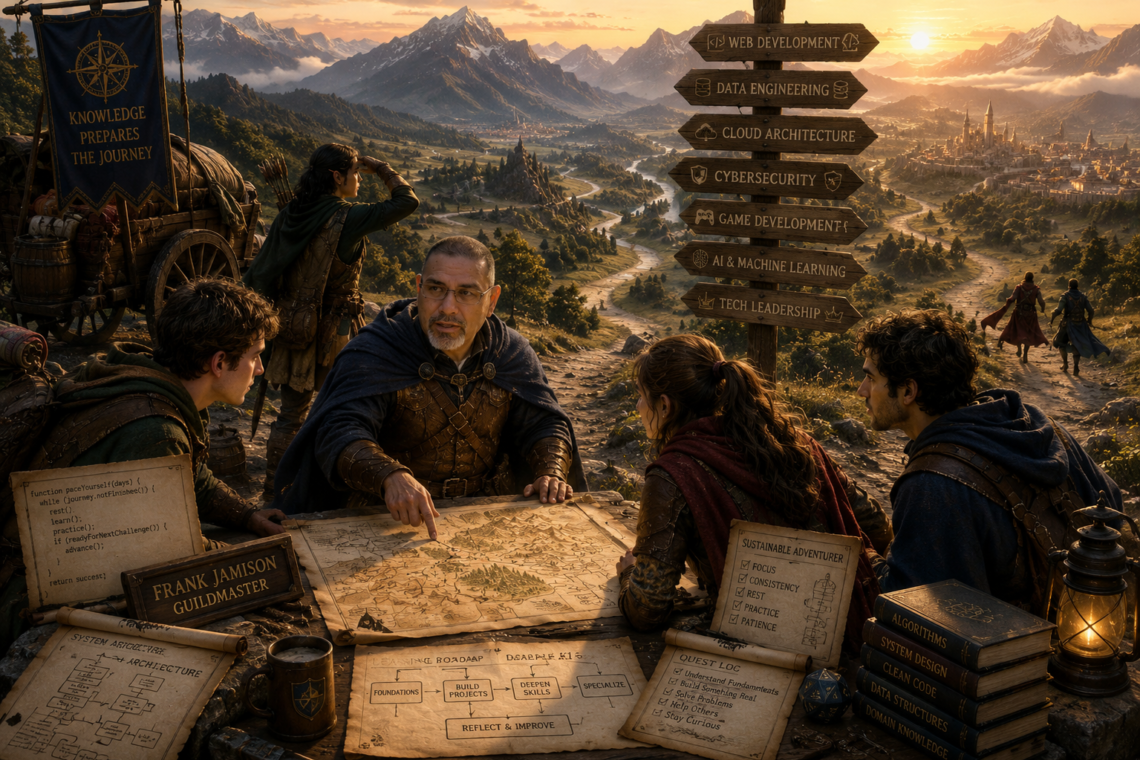
  • Frank Jamison, depicted as a seasoned guildmaster and mentor, leads a group of younger adventurers at sunrise while gathered around a large map beside a mountain crossroads. Wearing practical fantasy adventuring attire, he points toward multiple roads stretching through forests, valleys, mountains, and distant cities, symbolizing different technology career paths. Around the group are travel wagons, lanterns, books, engineering diagrams, code-filled scrolls, learning roadmaps, and quest logs that represent sustainable skill development. A towering signpost lists various specialties, including web development, cloud architecture, cybersecurity, and machine learning. The scene emphasizes mentorship, planning, endurance, and choosing a path wisely, with warm golden light illuminating the vast landscape and reinforcing the article's theme of learning without burning out.
    The Guildmaster’s Handbook

    Learning Without Burning Out

    No warrior survives every battle at full speed. Pace yourself, or exhaustion becomes the enemy. In our last gathering at the guild hall, I spoke about choosing a path. Every developer eventually faces a decision about where to invest time, energy, and attention. Some are drawn toward frontend development. Others find themselves fascinated by backend systems, cybersecurity, cloud infrastructure, data science, or countless other specialties. Choosing a path provides direction, but direction alone is not enough. An adventurer who charges down the correct road at an unsustainable pace may still fail to reach the destination. One of the most important lessons I have learned throughout my career is that success…

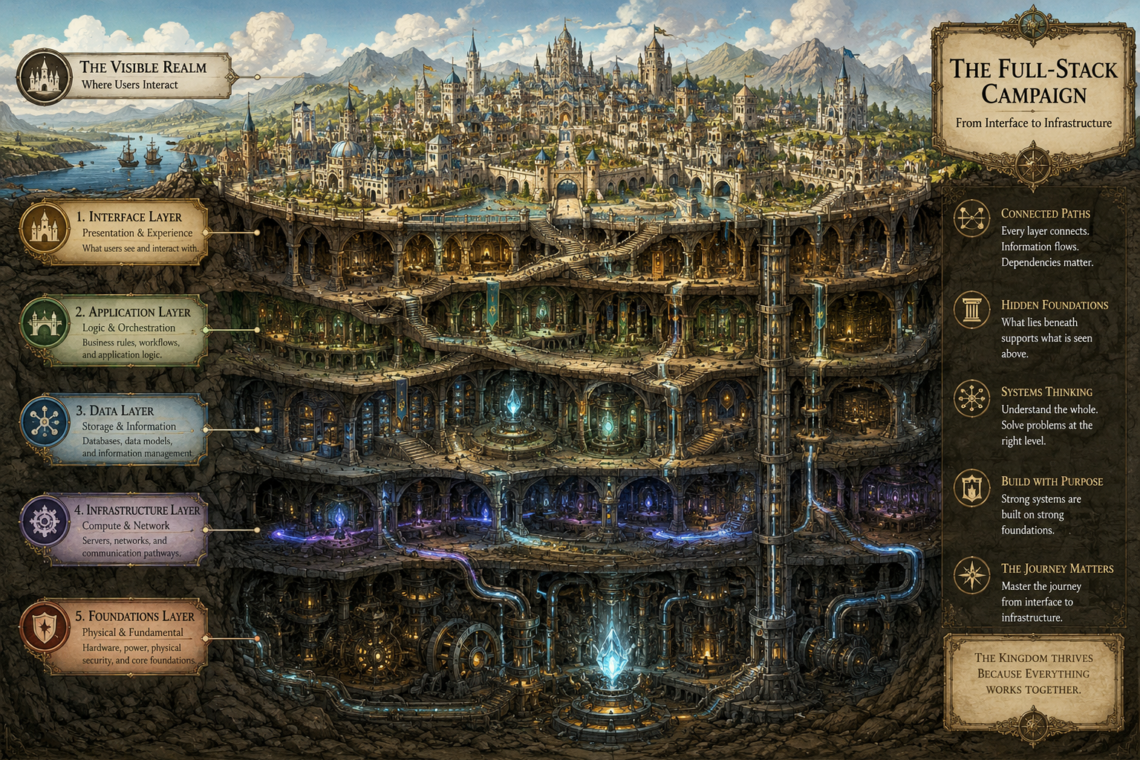
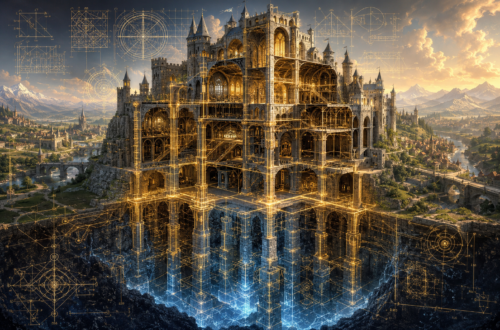
  • Detailed fantasy cross-section illustration titled The Full-Stack Campaign: From Interface to Infrastructure. A sprawling medieval fantasy kingdom filled with castles, towers, bridges, marketplaces, and guild halls sits on the surface beneath a bright sky. The ground beneath the city is cut away to reveal multiple interconnected underground layers extending deep into the earth. Massive stone roads, elevators, tunnels, aqueducts, glowing magical conduits, and engineering works connect hidden chambers, archives, vaults, transit networks, and subterranean fortresses. The deepest levels contain enormous dwarven-style machinery, crystal power systems, and foundational infrastructure supporting the realm above. Informational panels label each layer of the kingdom, visually illustrating how visible systems depend upon increasingly complex hidden foundations. The image conveys themes of architecture, interconnected systems, dependencies, and the journey from user-facing experiences to the infrastructure that supports them.
    The Full-Stack Campaign

    From Interface to Infrastructure

    Before adventurers can explore the world, they must understand the rules that shape it. Editor’s Note Before appearing as the opening chapter of The Full-Stack Campaign: From Interface to Infrastructure, this article first appeared on RandomThoughtsInTraffic.com as an exploration of why developers often struggle when their knowledge remains confined to a single layer of the technology stack. This revised and expanded edition examines how information travels through modern web applications, explores the relationships between browsers, APIs, servers, databases, and infrastructure, and establishes the systems-oriented mindset that guides the remainder of the series. New material includes expanded architectural examples, a deeper discussion of specialization within software development, and a practical examination…

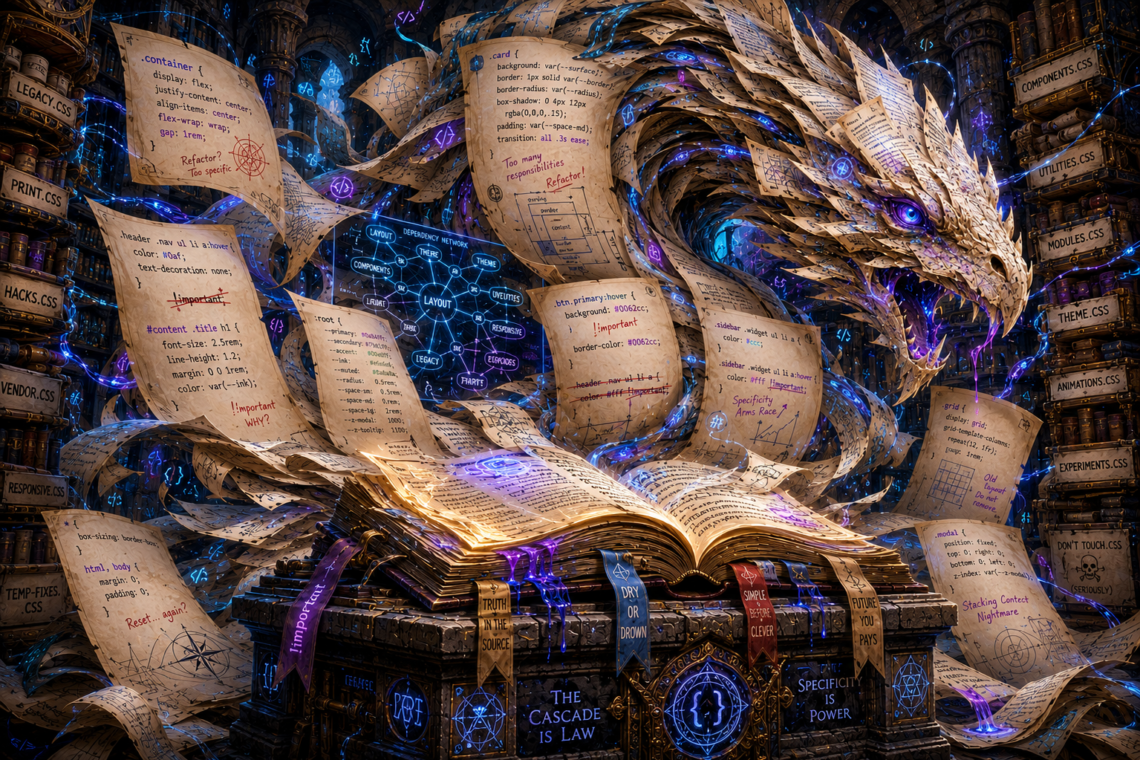
  • An enormous ancient spellbook rests on a carved stone pedestal in a vast arcane archive as hundreds of stylesheet-like parchment pages erupt from its open pages and merge into a colossal serpentine creature made entirely of CSS rules, annotations, diagrams, revisions, and glowing magical symbols. The parchment monster coils through towering shelves filled with labeled codices while streams of luminous blue and violet magical energy connect scattered documents into a sprawling network of dependencies. Individual pages display selectors, properties, comments, crossed-out declarations, and specificity notes, emphasizing accumulated technical debt and architectural complexity. The scene is illuminated by glowing runes, magical ink, and dramatic volumetric light, creating the impression of a once-useful body of knowledge that has grown beyond its original purpose and become an intelligent living manifestation of an unmaintainable stylesheet.
    The CSS Codex

    When the Stylesheet Becomes the Monster

    Ignore a growing beast long enough and eventually it guards the dungeon. Editor’s Note: This article originally appeared on RandomThoughtsInTraffic.com and has been revised and expanded for StackNScroll as the closing chapter of The CSS Codex. The original edition explored how CSS codebases gradually become more difficult to maintain as shortcuts, overrides, and exceptions accumulate over time. This updated version expands that discussion with deeper examination of architectural drift, technical debt, component design, specificity management, long-term maintenance practices, and the warning signs that experienced engineers learn to recognize before problems become crises. It also serves as a capstone for the broader lessons explored throughout The CSS Codex, bringing together concepts…

  • A colossal ancient stone monument shaped like a towering skill tree rises from the center of a vast mountain valley. Hundreds of glowing blue and gold energy nodes connect through branching pathways, terraces, stairways, and bridges that climb toward a brilliant radiant pinnacle at the summit. The lower levels glow softly while the upper tiers shine with increasingly powerful light, symbolizing growth, mastery, and the compounding value of long-term investment. Surrounding the monument, rivers, roads, distant settlements, and cultivated lands spread across the landscape, suggesting centuries of development fueled by the monument's energy. The scene conveys patience, progression, wisdom, and accumulated experience through an epic fantasy aesthetic.
    The CSS Codex

    Patience Is a Scaling Stat

    The greatest guild halls were not built in a single turn of the hourglass. Editor’s Note: Before joining The CSS Codex: Mastering the Rules of the Realm, Patience Is a Scaling Stat first appeared on RandomThoughtsInTraffic.com. This revised and expanded edition explores the relationship between patience, craftsmanship, and long-term CSS maintainability through the lens of sustainable engineering practices. New material examines how small implementation decisions compound over time, how experienced developers approach architectural choices differently than newer practitioners, and why understanding systems often matters more than solving individual problems quickly. While the original article focused primarily on professional growth and mindset, this edition connects those lessons directly to CSS architecture,…